Health
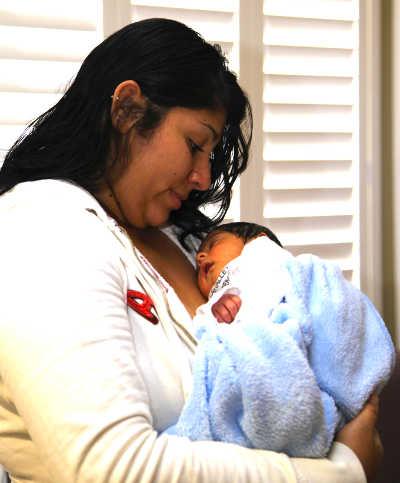
UKIAH, Calif. – The number 100 is significant in so many ways. On the Celsius scale, 100 degrees is the boiling temperature of water. 100 years is a century, considered a milestone today as during ancient times.
For Ukiah Valley Medical Center’s Family Birth Center staff, 100 has a different yet equally significant meaning.
Alex Anthony Galindo’s arrival at 6:45 p.m. on Wednesday, Oct. 31, marked a milestone at Ukiah Valley Medical Center’s Family Birth Center.
Little Alex is the 100th baby born in October, the most births in a single month since the Birth Center began delivering babies in April 1998.
Delivered by Karen Crabtree, M.D., local obstetrician and gynecologist at Mendocino Community Health Clinic, Alex Anthony weighed in at 6 pounds, 13 ounces and measured 18.5 inches long.
Proud mom Monica Marin of Ukiah, said she had a very good experience and she’s glad she chose UVMC. “The staff has been so helpful. And that means a lot to me being a first-time mom.”
The Family Birth Center has been averaging 70 deliveries per month leading up to this milestone.
“It is such a great accomplishment and truly a testament to the great staff we have here. And we’re hoping it gets even better as we are working hard to improve our facilities and equipment,” said Donna Bauer, director of perinatal services.
The department has also gone through recent renovations which make the rooms inviting and comfortable, for mom, baby and support persons. New bassinets and sofa beds make for a truly comforting experience.
“We want to make sure all moms and their families are able to bond and feel like they are in the comforts of their own homes,” said Bauer.
The department has also been hosting tours of the newly remodeled birthing suites to expectant families, boasting a private room large enough for the whole family with an on suite bathroom and Internet access.
Bauer also wanted expectant mothers to know, “We also provide birthing classes and breastfeeding consultation so that new families get support before and after the birth of their child.”
The Family Birth Center also has a special care nursery (Level II Neonatal ICU) which provides care for babies with special needs, a physician provider 24/7, a midwifery service, nurse educator and childbirth classes.
For a more intimate look at the Family Birth Center, expectant mothers can schedule a tour by calling 707-463-7550, or watch a virtual tour online at www.uvmc.org/birthcenter .
- Details
- Written by: Editor
A new study by researchers in Boston Children’s Hospital’s Division of Emergency Medicine indicates that a nationwide standard on booster seat laws for children 4 feet 9 inches and shorter, or up to 8 years old, would save lives.
The findings were published online Nov. 5 in the journal Pediatrics.
Boston Children’s researchers reviewed data from Fatality Analytic Reporting System, analyzing child deaths in motor vehicle accidents, looking specifically at whether the crash and resulting deaths or injuries took place in a state with or without a booster seat law. If the state did have a booster law, the team noted its age and height requirements.
The results varied from state to state, as many state’s booster seat laws have different age and height requirements, but overall findings were clear: states with booster seat laws had significantly fewer instances of death or injury from motor vehicle accidents, especially among children in the 6- to 7-year age group. Key findings include:
Out of 9,848 cases reviewed over a 10-year period, states with booster seat laws for children 4 to 6 had a roughly 20 percent lower rate of death and incapacitating injuries from motor vehicle crashes than states without booster seat laws.
States with booster seat laws that extended to 6- and 7-year-olds had a 35 percent decreased rate of death or incapacitating injury.
The AAP recommends that children be placed in belt-positioning booster seats after they grow too large for a car seat – around 4 years old – and until the child attains a height of about 4 feet 9 inches, usually around 8 to 12 years old.
Without boosters, many children shorter than 4 feet 9 inches run the risk of having the seat belt rest on their throat and abdomen, instead of their chest and lap. In the event of a crash, belts in that position may cause serious, even fatal, injuries to the intestines and spine.
Despite the effectiveness of booster seats in preventing this type of injury among children, usage remains low. According to reports, booster seats are used by only about half of children 4 to 5 years old and 35 percent of those 6 to 7 years old.
“Based on our findings, booster seat use for children under the age of 8 or 4 feet 9 inches really should go beyond causal suggestion,” said Rebekah Mannix, MD, MPH, of Boston Children’s Division of Emergency Medicine, lead author on the paper. “It’s clear that these laws save lives and we recommended all states adopt them.”
“At the end of the day we all want children to be safe,” added Lois Lee, MD, MPH, co-author on the study. “Data show booster seat laws help protect children, and we hope it can convince lawmakers to adopt laws that require kids to be in the proper child passenger restraint (car seat and booster seat) until the recommended age and height.”
- Details
- Written by: Editor
Recent combat veterans who are diagnosed with post traumatic stress disorder have significantly smaller volume in an area of the brain critical for regulating fear and anxiety responses, according to research led by scientists at Duke University and the Durham VA Medical Center.
The finding, published Nov. 5, in the journal Archives of General Psychiatry, for the first time provides clear evidence that smaller amygdala volume is associated with PTSD, regardless of the severity of trauma.
But it’s not clear whether the physiological difference was caused by a traumatic event, or whether PTSD develops more readily in people who naturally have smaller amygdalas.
“Researchers found 20 years ago that there were changes in volume of the hippocampus associated with PTSD, but the amygdala is more relevant to the disorder,” said Rajendra A. Morey, M.D., M.S., assistant professor at Duke and lead author of the study. Morey said studies in animals have established the amygdala’s role in regulating fear, anxiety and stress responses, but its effect on human behavior is less well known.
“It’s associated with how fear is processed, especially abnormal fear processing.” Morey said. “So it makes sense to look at the structure of the amygdala.”
The researchers enrolled 200 combat veterans who served in Iraq and Afghanistan after Sept. 11, 2001; half had PTSD and the other half had been exposed to trauma, but had not developed PTSD. Amygdala and hippocampus volumes were computed from MRI scans of all the participants.
The researchers found significant evidence that PTSD among study participants was associated with smaller volume in both the left and right amygdala, and confirmed previous studies linking the disorder to a smaller left hippocampus.
The differences in brain volumes between the two groups were not due to the extent of depression, substance abuse, trauma load or PTSD severity – factors the researchers took into account in their statistical model.
The finding provides new insight into a condition that strikes nearly 14 percent of combat veterans serving in Iraq and Afghanistan, according to the Department of Veterans Affairs.
PTSD also is estimated to afflict 6.8 percent of adults in the general population who have suffered abuse, crimes and other traumas over their lifetimes.
“The next step is to try to figure out whether a smaller amygdala is the consequence of a trauma, or a vulnerability that makes people get PTSD,” Morey said.
He said the study demonstrated that amygdala volume does not appear to be affected by the severity, frequency or duration of trauma, indicating that such exposures do not cause the amygdala to shrink.
As a result, it appears more likely that people with measurably smaller amygdala to begin with are susceptible to PTSD, but more studies are needed to make that determination.
Morey said he and colleagues are exploring that question, and are intrigued by evidence from their study that suggests people may have a propensity for developing PTSD based on inherently smaller amygdala volume.
“This is one piece in a bigger puzzle to understanding why some people develop PTSD and others do not,” Morey said. “We are getting closer to that answer.”
In addition to Morey, study authors include: Kevin S. LaBar; Shannon K. Beall; Vanessa M. Brown; Courtney C. Haswell; Jessica D. Nasser; H. Ryan Wagner.
All are associated with Duke and the VA’s Mental Illness Research Education and Clinical Center at the Durham VA Medical Center. Gregory McCarthy and Andrea L. Gold are from Yale University.
Funding for the study was from the U.S. Department of Veterans Affairs and the National Institutes of Health.
- Details
- Written by: Editor
Cardiac bypass surgery superior to non-surgical procedure for adults with diabetes and heart disease
Adults with diabetes and multi-vessel coronary heart disease who underwent cardiac bypass surgery had better overall heart-related outcomes than those who underwent an artery-opening procedure to improve blood flow to the heart muscle, according to the results from an international study.
The research was supported by the National Heart, Lung, and Blood Institute (NHLBI), part of the National Institutes of Health.
The study compared the effectiveness of coronary artery bypass graft (CABG) surgery with a non-surgical procedure known as percutaneous coronary intervention (PCI) that included insertion of drug-eluting stents.
After five years, the CABG group had fewer adverse events and better survival rates than the PCI group.
Principal investigator Valentin Fuster, M.D., Ph.D., of Mount Sinai School of Medicine in New York City, will present the study findings on Sunday, Nov. 4, at 7:58 p.m. ET at the American Heart Association’s annual meeting in Los Angeles.
The findings will appear concurrently online in The New England Journal of Medicine. A companion paper on cost effectiveness will appear online in Circulation.
“These study results confirm that bypass surgery is a better overall treatment option for individuals with diabetes and multi-vessel coronary disease and may assist physicians’ efforts to prevent cardiovascular events such as heart attacks and deaths in this high-risk group,” explained Gary H. Gibbons, M.D., director of the NHLBI.
In coronary heart disease, plaque builds up inside coronary arteries. This often leads to blocked or reduced blood flow to the heart muscle and can result in chest pain, heart attack, heart failure, and/or erratic heartbeats (arrhythmia).
In 2010, nearly 380,000 Americans died from coronary heart disease. Approximately 25 percent to 30 percent of patients needing CABG or PCI have diabetes and multi-vessel coronary heart disease.
In the United States, more than one million procedures (CABG and PCI) are performed each year to restore circulation to patients with blocked arteries.
In CABG, surgeons try to improve blood flow to the heart muscle by using a healthy artery or vein from another part of the body to bypass a blocked coronary artery.
PCI is a less invasive procedure in which blocked arteries are opened from the inside with a balloon. A stent, or small mesh tube, is then usually inserted to prop the opened arteries so that blood continues to flow into the heart muscle.
The type of stent used in the study, called drug-eluting, is coated with medicine that is slowly and continuously released to prevent an opened artery from becoming blocked again.
The study, called Future Revascularization Evaluation in Patients with Diabetes Mellitus: Optimal Management of Multivessel Disease (FREEDOM), involved 140 international centers and a total of 1,900 adults enrolled from 2005 to 2010.
The participants had diabetes and coronary heart disease that involved narrowing of multiple blood vessels, but not the left main coronary artery, which usually requires immediate treatment with CABG.
At each clinical site, a team of specialists in neurology, heart disease, diabetes, and general medicine screened potential participants to ensure that they were eligible for both CABG and PCI.
Those who were selected for the trial were randomly assigned to receive one of the interventions. As recommended by international guidelines for patients who receive drug-eluting stents, the PCI group also received anti-clotting therapies.
A drug called abciximab was administered intravenously during the procedure, and clopidogrel was given orally for at least 12 months after the procedure, accompanied by aspirin for those who could tolerate it. Study participants were followed for at least two years.
During the trial, participants received standard medical care for all major cardiovascular risk factors such as high LDL cholesterol, high blood pressure, and high blood sugar. Participants also were counseled about lifestyle choices such as smoking cessation, diet, and regular exercise.
After five years, the CABG group had a lower combined rate of strokes, heart attacks, and deaths (18.7 percent) than the PCI group (26.6 percent).
Strokes, which are a well-known risk of bypass surgery, occurred slightly more often in the CABG group (5.2 percent) than in the PCI group (2.4 percent).
However, more people died from any cause in the PCI group (16.3 percent) than in the CABG group (10.9 percent). The survival advantage of CABG over PCI was consistent regardless of race, gender, number of blocked vessels, or disease severity.
“The advantages of CABG over PCI were striking in this trial and could change treatment recommendations for thousands of individuals with diabetes and heart disease,” said Fuster.
FREEDOM was supported by NIH grants HL071988 and HL092989. Cordis, Johnson & Johnson, and Boston Scientific provided stents. Eli Lilly provided an unrestricted research grant for abciximab, and Sanofi-Aventis and Bristol Myers Squibb donated clopidogrel.
FREEDOM involved hundreds of investigators from more than 16 countries, with a clinical coordinating center at Mount Sinai School of Medicine and a data coordinating center at New England Research Institutes in Watertown, Mass.
- Details
- Written by: Editor