Health
SACRAMENTO – California Department of Public Health (CDPH) Director Dr. Ron Chapman this week warned people not to eat certain DFI brand cantaloupes because they may be contaminated with Salmonella.
The Salmonella contamination was identified during routine surveillance tests conducted by the U.S. Department of Agriculture, and to date, no illnesses have been associated with these cantaloupes.
DFI Marketing Inc. of Huron, Calif., initiated a voluntary recall of 28,000 cartons of bulk cantaloupes after being informed of the Salmonella contamination.
The recalled cantaloupes were sold between Aug. 27, 2012, and Sept. 10, 2012, at retail locations in Alabama, Arizona, California, Colorado, Florida, Georgia, Idaho, Illinois, Indiana, Kansas, Kentucky, Maine, Michigan, Minnesota, Missouri, Nevada, New York, Oklahoma, Tennessee, Texas, Virginia, and Mexico.
The cantaloupes were packed in cases of 6, 9, 12, 15, and 18 melons under the DFI brand with, “826 California Westside” stamped on the carton. Individual cantaloupes are affixed with a small sticker that states “DFI, Huron, CA.”
Description: DFICantaloupes CrateWhile it is unlikely that many of these recalled cantaloupes are still being sold, CDPH is concerned that consumers may still have some of the recalled cantaloupes in their homes.
Consumers in possession of these recalled cantaloupes should discard them or return them to the store of purchase for a refund.
Anyone handling the recalled cantaloupes should promptly wash their hands with soap and warm water to ensure they do not become exposed to any Salmonella bacteria that may be present.
The cantaloupes being recalled by DFI Marketing are not related to prior recalls of cantaloupes by Chamberlain Farms in Indiana or Burch Equipment in North Carolina.
Symptoms of Salmonella infection include fever, abdominal cramps, and diarrhea which may be bloody. Most infected people recover within a week.
Some may develop complications that require hospitalization. Infants, the elderly, and people with weakened immune systems are at highest risk for more severe illness.
CDPH recommends consumers experiencing any ill effects after consuming these products should consult their health care provider.
Consumers that observe the product being offered for sale are encouraged to report the activity to the CDPH toll-free complaint line at 800-495-3232.
- Details
- Written by: Editor
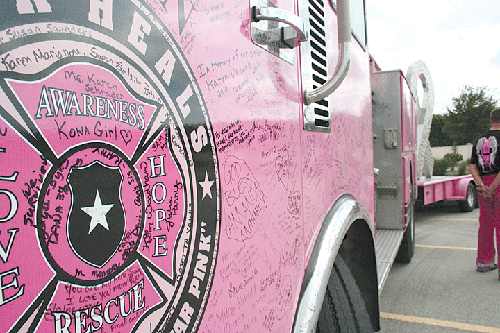
UKIAH, Calif. – Four pink fire trucks filled with firefighters dressed in pink and towing a giant ribbon will be making their way to Alex Thomas Plaza on Wednesday, Sept. 19, to bring help and hope to those in our community dealing with cancer.
Unlike other organizations the funds that are raised by the Pink Heals Fire Trucks stay in the communities they visit, which is one of the reasons that Diane Pulliam, event organizer had a passion to bring them to Ukiah.
“I happened to be on Facebook and saw someone post something about the Pink Heals fire trucks. I did some research and thought this would be an awesome way to build community involvement and help support our Cancer Resource Center of Mendocino County at the same time. I’ve been working on this for almost a year now, and am tickled pink, to say it’s actually happening,” shared Pulliam.
When asked what her reasons were for supporting the Cancer Resource Center Pulliam said, “In December of 2008 I was diagnosed with inflammatory Ductal Carcinoma, stage 3. The Cancer Resource Center, my local doctors, and Ukiah Valley Medical Center all helped me get the care and support I needed. I really want to give back to the Cancer Resource Center since they helped me when I was diagnosed. Residents in our community need to understand how lucky we are to have a local resource like the Cancer Resource Center.”
Pulliam added, “Once the Pink Heals reach Alex Thomas Plaza there will be a parade of emergency service vehicles, including the Pink fire trucks, kids’ games, bounce house, food, Pink Glam Contest and free informational booths about resources our community has for those dealing with cancer.”
In addition to the main event the Pink Heals fire trucks will also be making a scheduled stop at Ukiah Valley Medical Center.
“I’m excited,” said Russell Hardy, M.D., oncologist at the Ukiah Valley Rural Health Center, “It really inspires patients to let them know someone cares about them and can have a positive influence on their outcomes.”
That’s a sentiment also shared by UVMC CEO, Gwen Matthews. “This is really going to be fun and encouraging to our guests, and we are grateful that the Pink Heals have chosen to make Ukiah Valley Medical Center a destination on their journey through Ukiah.”
Pink Heals is an organization that was started by Dave Graybill, a former pro athlete, retired firefighter, philanthropist and founder of the international Pink Heals movement.
Ukiah will be part of a 73-city Pink Heals tour which began on July 28 and will conclude on Oct. 15 in Phoenix.
The Pink Heals fire trucks will be on the UVMC campus from 9:30 a.m. to 11:30 a.m. Festivities at Alex Thomas Plaza will begin at noon and end at 6:30 p.m.
For more information contact Diane Pulliam at 707-485-0994.
- Details
- Written by: Editor
UKIAH, Calif. – Ukiah Valley Medical Center recently received a $100,000 bequest from an anonymous donor.
According to Allyne Brown, director of philanthropy, “With our plans to expand moving ahead, this is perfect timing,” referring to the donation and UVMCs plans to expand the emergency department and intensive care unit within the next year.
“The donor, who wants to remain anonymous, is providing these funds to help fund a medication room, a physician dictation room and two garden areas that will be located around the hospital campus,” continued Brown.
Even though the donor prefers to remain anonymous, the reason for the gift is because of a whole hearted belief that UVMC is improving and looking at helping to sustain the future of health care in Mendocino County.
“Creating a bequest is easier than you might think,” Brown said. “It is a gift that usually takes place after the passing of the individual donor and can be used for a specific purpose or be left in memory of the donor.”
If you would like to learn more about UVMC’s emergency department and intensive care unit expansion plans, Allyne Brown can be reached at 707-463-7623.
- Details
- Written by: Editor
A new ‘traffic light’ test devised by Dr Nick Sheron and colleagues at University of Southampton and Southampton General Hospital could be used in primary care to diagnose liver fibrosis and cirrhosis in high risk populations more easily than at present.
Liver disease develops silently without symptoms, and many people have no idea they have liver failure until it is too late – one-third of people admitted to hospital with end-stage liver disease die within the first few months.
A simple test available in primary care could diagnose disease much earlier, enabling those at risk to change their behavior and save lives.
The Southampton Traffic Light (STL) test, details of which are published in the September 2012 issue of the British Journal of General Practice (BJGP), combines several different tests and clinical markers which are given a score that indicates the patient’s likelihood of developing liver fibrosis and liver cirrhosis.
The result comes in three colors: red means that the patient has liver scarring (fibrosis) and may even have cirrhosis, green means that there is no cirrhosis and the patient is highly unlikely to die from liver disease over the next five years.
Amber means there is at least a 50-50 chance of scarring with a significant possibility of death within five years, and patients are advised to stop drinking to avoid further disease and death.
The test was given to over 1,000 patients, and their progress was carefully followed and monitored afterwards, in some cases over several years, to assess the accuracy of the test in predicting whether they developed liver fibrosis or cirrhosis.
The test proved to be accurate in severe liver disease, and while not a substitute for clinical judgment or other liver function tests, can provide Gps with an objective means to accurately assess the potential severity of liver fibrosis in high-risk patients – for example, heavy drinkers, those with type II diabetes, or obese people.
Dr Nick Sheron, lead author and Head of Clinical Hepatology at the University of Southampton, and consultant hepatologist at Southampton General Hospital, said: “We are reliant on general practitioners detecting liver disease in the community so they can intervene to prevent serious liver problems developing, but so far we haven’t been able to give them the tools they need to do this. We hope that this type of test for liver scarring may start to change this because the earlier we can detect liver disease, the more liver deaths we should be able to prevent.”
Study co-author and GP Dr Michael Moore said: “In primary care, minor abnormalities of existing liver tests are quite common but we struggle to know how best to investigate these further and who warrants specialist intervention. The traffic light test has the advantage of highlighting those at highest risk who should be investigated further and those in whom the risk is much lower where a watchful approach is more appropriate. This is not a universal screening test but if targeted at those in whom there is a suspicion of liver disease should result in a more rational approach to further investigation.”
Professor Sir Ian Gilmore, chair of the Alcohol Health Alliance added: “One of the challenges of liver disease, which is rising dramatically in this country, is the silent nature of the condition until it is often too late to reverse the damage. However, minor changes in standard liver blood tests are so common that it is difficult for Gps to know when to refer for specialist advice. This large study from Dr Sheron and colleagues in Southampton may prove really useful for guiding the right patients towards specialist care in a timely way.”
- Details
- Written by: Editor