Health
- Details
- Written by: Editor
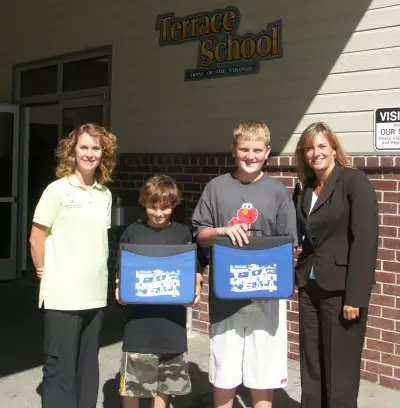
Sutter Lakeside Hospital CEO and author, Kelly Mather; Carrie McClure, school site coordinator; and Tammi Silva, “Healthy Kids Are Contagious” program director, made their rounds to Lake County schools beginning with Terrace School in Lakeport where Stacey Holland, teacher and originator of the binder program, was enjoying the first day of school with her students.
Principal Mike Beery at Mt. Vista Middle School greeted Mrs. Mather, McClure and Silva with smiles and appreciation.
The initial leg of the trip was concluded at Cobb Elementary School where Principal Tracy Skeen expressed her appreciation to Sutter Lakeside Hospital and Center for Health for their continued dedication to the health of students not only at her school but across the county.
Other members of the Healthy Kids Are Contagious school site team, including Kayla Hickey, school site assistant; Anna Knudson, K-4 program coordinator; and Christine Petty, fifth grade fitness testing coordinator, delivered binders to sixth graders at Lucerne Elementary, Coyote Valley Elementary, Eastlake School, Pomo Elementary, Minnie Cannon Elementary, Upper Lake Middle School, Burns Valley Elementary, Lower Lake Elementary and Lake County International Charter School.
The binders are donated as part of the Sutter’s Healthy Kids Are Contagious program, which provides education to students about not only nutrition, and exercise but also addresses mental emotional issues from the Wellness University Five Keys to Wellness curriculum so that they will be motivated to make healthier choices for a lifetime.
The Five Keys identifies and promotes five aspects of healthful living, including self-love, breathing, positive choices, balance and trust.
“To improve health and lower health care costs in our county, we are reaching children as they create the habits that will guide their lives,” said Mather.
The Healthy Kids Are Contagious program offers school presentations that cover a variety of subjects ranging from avoiding the flu; spine health; the benefits of exercise on the heart; yellow, red, green-light food choices; and the importance of self-respect.
For each of the programs a costumed mascot, such as “Healthy Mr. Heart,” makes an appearance and helps build enthusiasm.
During “Create Your Health” sessions, sixth graders learn the Five Keys to Wellness. After introducing these concepts in the classroom, Lake County teachers report their students have passed up sweets and treats because, as one student put it, “I care about myself so I won’t eat things that aren’t good for me.”
“What is exciting about the programs is that children help their peers to make more healthy choices, positively reinforcing each other and consequently build a culture of wellness in their classrooms and their schools,” said Mather. “Then they take home these messages and spread wellness to other children and ultimately, to the community.”
Sutter Lakeside Hospital & Center for Health’s mission is to improve the health of the community by supporting the inherent ability of each community member to create a healthier life.
A leader in the transformation of health care whose focus is beginning to move from illness care to embracing wellness concepts, Sutter Lakeside Hospital and Center for Health provides both high quality illness care and access to wellness care that emphasizes personal responsibility for healthy living while providing the resources needed for community members to create health.
For more information, contact Tammi Silva, director, Center for Health at 707-262-5122 or by email at
{mos_sb_discuss:2}
- Details
- Written by: Editor
Construction workers call to one another and move large items of furniture as Nurse Director Julie Tucker crosses the threshold pushing a dolly piled high with boxes of medical equipment.
Where open spaces and holes in the wall and floor once were, desks and sinks and tubes and operating chairs have appeared over the last few days. The environment is active, noisy and generally enthused.
On Saturday, Oct. 6, the Pediatric Dental Initiative (PDI) will host a grand opening celebration of its new Redwood Empire Surgery Center in Windsor. It has been a long road for PDI’s staff, board and volunteers, and the enthusiasm of seeing PDI’s dream come true is palpable. As the picture comes together more each day, one gets an idea of what the center, once completed and operational, will look like and how many lives it will improve.
The Redwood Empire Surgery Center will serve families in a five-county region. In Lake County, the surgery center will support the longstanding oral health program coordinated through the Healthy Start staff and Marta Fuller’s Dental Disease Prevention Program, with partial funding from First 5 Lake.
This program strives to improve the oral health of children in our community through a combination of education and restorative care provided by local dental clinics. The surgery center will augment this program by providing sedated dentistry particularly to young children (ages 0-5) and people of all ages with developmental delays suffering from severe tooth decay.
In very young children, this condition is known as Early Childhood Caries (ECC) or “baby bottle tooth decay” and currently affects about 28 percent of children in California. The pain caused by ECC is not only physical but also emotional and psychological, due to the stigma that comes with having “bad” teeth. This stigma and suffering can have a profound effect on a person’s learning, development and self-esteem.
The Redwood Empire Surgery Center will be fully licensed to treat those children in need of oral surgery with general anesthesia. During the startup phase Dr. Mark Hagele, DDS and his skilled team will treat seven patients per day, two days per week. The center’s goal is to provide families with child-friendly quality care and prevention education. The surgery center will accept patients on Medi-Cal and Healthy Families insurances, and in time will also contract with other insurance providers. First 5 Lake awarded PDI a small grant to assist in the purchase of the surgery center’s medical equipment.
PDI invites members of the community to come and celebrate with them on Oct. 6 from 1 to 4 p.m. by enjoying some great snacks, music and fun!
PDI will supply educational games and activities for children and families: Snappy the Crocodile, trivia and active games, a coloring booth and face painting, radio DJs and the Windsor Bloco drum and dance troupe will provide entertainment.
PDI’s official ribbon-cutting ceremony will incorporate a few words from PDI’s CEO Viveka Rydell and a traditional blessing by Aztec dancers Xiucoatl.
Support PDI on this special day, provide your kids with information on oral health and cavity prevention or just have a fun day out with the whole family!
PDI is located at 1360 19th Hole Drive, Suite 205, Windsor. For more information call 707-837-8833 or visit www.pedidental.org.
{mos_sb_discuss:2}
- Details
- Written by: Editor
The result, say researchers and care providers, is a system that wastes money while restricting the choices of older adults and people with disabilities.
At issue during a joint hearing of the Aging and Long-Term Care Committee and the Health Committee was the “discharge plans” that hospitals provide to patients before releasing them.
“Hospitalization is a turning point for seniors,” said Assemblywoman Patty Berg, D-Eureka, who chairs the Aging and Long-Term Care Committee. “Better discharge planning can mean the difference between a patient getting better, getting to stay home, or getting hospitalized again.”
Research has shown that as hospital stays have shortened and health care costs have risen, patients are increasingly likely to leave the hospital with inadequate care plans, or with little understanding of what those plans entail. Patients and caregivers – especially non-English speakers – have difficulty finding information about health conditions and home care, where or how to get help, eligibility for services, and other social support.
Oftentimes, hospital discharge planners have large caseloads and not enough information to help patients decide on an alternative to a nursing home. Moreover, Medi-Cal and Medicare rules make it less complicated to opt for an institutional setting, while erecting a confusing maze for those seeking to return to their homes.
The Centers for Disease Control and Prevention say that California hospitals now discharge someone over the age of 65 more than one million times each year. According to the American Journal of Nursing, about 40 percent of patients in hospitals are over the age of 65.
Discharge planning will become an even larger issue as the baby boomers enter retirement. According to Health Research for Action at University of California Berkeley, one in five Californians will be 65 or older in California by mid-century. The American Journal of Nursing states that hospital admissions of older adults are expected to increase by 78 percent in the next 20 years.
As co-author of the three-part Master Plan on Aging, Berg has focused on policies that give seniors more flexibility in choosing to stay in their homes, rather than nursing homes. She has been an advocate of more home-based services.
{mos_sb_discuss:2}
- Details
- Written by: Editor
The Bush veto blocks reauthorization of the State Children's Health Insurance Program (SCHIP). SCHIP is a joint state-federal program which subsidizes health coverage for 6.6 million people (mostly children) from families that earn too much to qualify for Medicaid but not enough to afford their own private coverage.
California receives more SCHIP funding than any other state. As a result of Bush’s veto, California stands to lose upwards of $739 million over the next five years, leaving nearly 775,000 of the state’s children without coverage.
North Coast Senator Patricia Wiggins (D–Santa Rosa) issued the following statement in response to the President’s action:
“This says a lot about the president’s badly misplaced sense of priorities that he would veto a bill to ensure health care coverage for millions of American children who are currently without coverage,” Wiggins said. “His subsequent proposal for an additional $5 billion in funding (the legislation Bush vetoed called for spending $35 billion over five years) falls far short of what is needed to bring millions of uninsured children into the nation’s health care system, and it is my sincere hope that the Senate and Congress vote to override his veto as quickly as possible.”
{mos_sb_discuss:2}