Health
- Details
- Written by: Elizabeth Larson
The position is open to anyone who wants to help and is available to volunteer at least once a week during flexible hours.
ICU volunteers help answer phones, open doors and check in patient visitors.
“We love our volunteers,” said Pauline Orr, RN, director of ICU, Med/Surg and Outpatient Care. “We are a busy four bed ICU and admit high volumes of patients each month. ICU volunteers are an integral part of the team by supporting our dedicated staff.”
“I am very proud of what the ICU nurses are capable of doing, and know that extra volunteer support will make a big difference for the efficiency and wellbeing of the nursing staff,” said Dr. Kosolcharoen, medical director, ICU.
“The caliber of Sutter Lakeside volunteers, and their contributions, will help build a team that will continue to make Sutter proud for many years to come,” said Orr.
Please consider this exciting opportunity to support critically ill patients and their caretakers, or consider volunteering for one of the many other opportunities within the Auxiliary.
Sutter Lakeside Auxiliary volunteers manage and staff the hospital gift shop at the hospital. The gift shop funds support hospital programs, services and equipment.
The most recent purchase includes a 3D/4D ultrasound machine and a special scale for disabled patients in the clinics.
The Auxiliary has also contributed to the hospital’s 3D mammography machine, anesthesia machines for surgery, an ultrasound for cardiology and patient lounge area furniture.
Other Auxiliary opportunities include greeting patients at the information desk (Tuesday mornings), or volunteering in the Emergency Department or Family Birth Center.
In the month of March alone, the Auxiliary’s 20 volunteers contributed more than 540 hours.
Volunteers must be over the age of 18 and be willing to commit to at least one year of service.
To apply, or for more information, please contact Morgen Jarus at 707-262-5121 or
- Details
- Written by: Elizabeth Larson
“It’s hard to argue with a proposal that gets people into the most integrated community settings possible while saving the state millions of dollars,” Sen. Dodd said. “This bill will return long-term nursing home residents back to their communities, allowing them to age in place. At the same time, because it is so much more efficient to care for someone at home, the bill saves money.”
Senate Bill 214 would establish the Community Living with Choice, Independence and Dignity Act of 2019. It allows the existing California Community Transitions program, to continue if federal funding expires in September 2020.
The program started in 2007 has successfully transitioned 3,629 from institutional settings, for an average annual savings of $60,000 per person.
The bill would direct the state Department of Health Care Services to continue the program with federal matching funds, if available. It would also authorize the use of state money and require the department to seek partnerships with local jurisdictions to secure complementary funding.
The bill is co-sponsored by Disability Rights California and East Bay Innovations.
“We’re appreciative of Sen. Dodd’s leadership in authoring this bill so we can continue to provide these important services,” East Bay Innovations’ executive director Tom Heinz said. “California Community Transitions opens up the world again for people who have been trapped in institutionalized settings so they can return to a life of dignity and choice.”
Sen. Dodd represents California’s Third Senate District, which includes all or portions of Solano, Napa, Sonoma, Yolo, Sacramento, and Contra Costa counties. Visit his Web site at www.sen.ca.gov/dodd .
- Details
- Written by: Elizabeth Larson
WASHINGTON, DC – On Tuesday Rep. Mike Thompson (CA-05) discussed the heavy burden of surprise medical bills on patients in a House Ways and Means Subcommittee on Health hearing.
“We have all heard the stories – the $23,000 MRI, the $48,000 treatment for a bad rash,” said Thompson. “And we all know the heavy burden surprise medical bills can have on patients. In fact, one study found that 20 percent of hospital visits that began in the emergency room resulted in a surprise bill. Patients should be taken out of this process and we must also ensure solutions don’t limit access to health care or raise costs and premiums. We must ensure these surprise bills don’t continue to hit our constituents and that they can continue to access quality, medical care.”
Watch his discussion in the video of the Tuesday hearing above.
- Details
- Written by: Elizabeth Larson
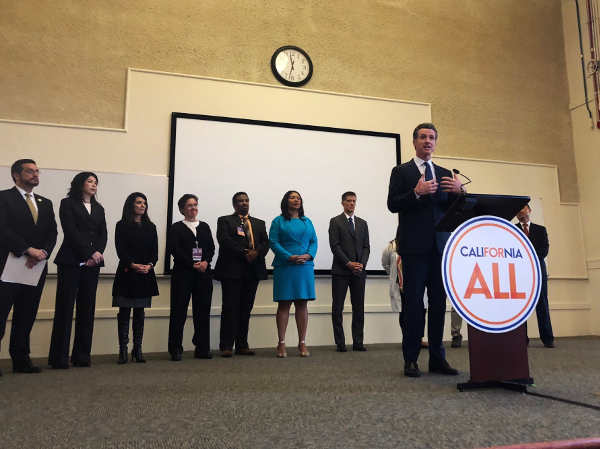
SAN FRANCISCO – Gov. Gavin Newsom on Thursday joined San Francisco Mayor London Breed and officials from Santa Clara and Alameda counties to announce that the three Bay Area counties, among the largest public purchasers of prescription drugs in California, will partner with the state to use our combined market power to take on drug companies and lower the cost of prescription drugs.
Last month, Los Angeles County – the state’s largest local purchaser of drugs – joined in the state’s efforts.
Just moments after being sworn in, Gov. Newsom launched a series of first-in-the-nation actions to make health care more affordable for all Californians and to move the state closer toward the goal of health care for all.
Those proposals included an executive order to create the nation’s biggest single-purchaser system for drugs and to, ultimately, allow all Californians and private employers to sit together at the bargaining table across from big drug companies when negotiating prescription drug prices.
“Californians are coming together to use their market power and their moral power to demand fairer prices for prescription drugs,” said Governor Newsom. “Now we are able to go to the table with massive capacity to leverage the negotiation, drive down costs, put more money in your pocketbooks and make a difference in peoples’ lives.”
The announcement was part of the governor’s “California for All” Health Care Tour. A week after he released his revised budget that advances these priorities, Gov. Newsom is taking his proposals on the road as part of the statewide tour launched Tuesday in Sacramento.
The governor will travel across the state this week hosting events that highlight how the health care initiatives in his budget proposal would help families meet their health care challenges.
Each event will focus on one of the proposals in Gov. Newsom’s health care package and the tour will host events in San Francisco, San Diego, Los Angeles and Sacramento.
“In San Francisco and across the nation, high-cost prescription medications often force people to choose between seeking life-saving treatment and putting food on the table for their families,” said San Francisco Mayor Breed. “By opting in to Gov. Newsom’s prescription drug single-purchaser system, San Francisco and other counties across California will bring down the costs of these medications and increase access to health care for our residents.”
“Alameda County is pleased to stand with Gov. Newsom to leverage the collective bargaining power of the State and its counties to lower the cost of prescription drugs for all Californians,” said Alameda County Health Care Services Agency Director Colleen Chawla.
“Public health systems play an especially important and unique role in delivering care, services and treatment to the patients we serve, especially the uninsured and the underinsured. We are a safety-net health care system that is proud to offer top-notch care to all who need it. But to do that, we need to explore all opportunities to reduce costs whenever possible so that our limited resources can be better spent to help the homeless, the mentally ill and other vulnerable members of our community,” said Santa Clara County Executive Dr. Jeffrey V. Smith, M.D., J.D.
Gov. Newsom’s health care proposals are a central pillar of his broader “California for All” agenda. The governor believes that the California Dream should be accessible to everyone – not just a privileged few, and the crushing crisis of affordability and rising cost of living are limiting families’ ability to get ahead.
Recent data shows that health care and prescription drugs are chief among those concerns for California families. Those buying on the individual market will see an average 9 percent rise in health care costs this year, according to Covered California.
American families have seen their prescription drug costs nearly double since the year 2000, according to the Kaiser Family Foundation and prescription drug pricing is one of the largest drivers of rising health care costs.
In January, a Reuters report found 30 drug manufacturers that did business with the State of California planned to raise their prices in January.
Gov. Newsom’s health care proposals take those cost and access concerns head-on. They include:
– California becoming the first state in history to expand Medi-Cal coverage to all eligible undocumented young adults age 19 through 25.
– Expanding financial help for families and individuals to buy health insurance in private market and becoming the first state in America to give monthly discounts to middle-income families buying insurance.
– Taking on prescription drug prices by creating one of the nation’s biggest single-purchaser systems for prescription drugs that allows government, individuals and potentially private employers to sit together at the bargaining table to negotiate drug prices.
– Working with Congress to create a robust federal waiver to allow the state to move toward single payer and creating a commission to do the planning necessary for a transition under a Democratic president.
– While the White House attacks reproductive health care, Gov. Newsom proposes making a historic $100 million investment in reproductive and sexual health care.
The Washington Post editorial board wrote Gov. Newsom’s proposals “would make his state a leader in resisting Republican efforts to unravel the Affordable Care Act,” noting that “Mr. Newsom’s plan is a promising reform that other states – and, if Congress and the president ever come to their senses, the federal government – should consider.” C
loser to home, the East Bay Times and San Jose Mercury News editorial board called the governor’s health care proposals “a solid step toward lowering costs, improving health outcomes and moving the state closer to universal coverage.”