Health
- Details
- Written by: Elizabeth Larson
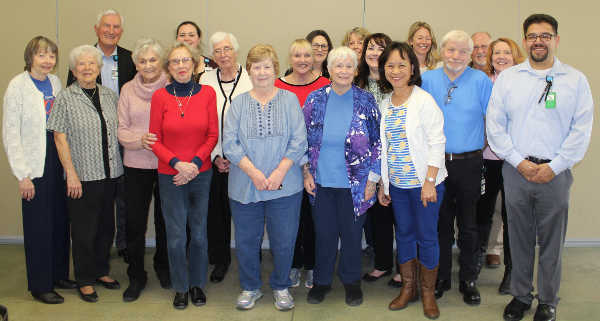
CLEARLAKE, Calif. – Adventist Health Clear Lake’s physicians, nurses and other staff work alongside a dedicated team of men and women who serve patients and visitors as volunteers promoting healing and wellness.
Adventist Health Clear Lake recognized its volunteer team during National Volunteer Appreciation Week, April 8 to 12.
Cumulatively, Adventist Health Clear Lake’s volunteers have served a combined 63,144 hours, the equivalent of more than 31 full-time employees working for one year.
The volunteers serve throughout the hospital and outpatient centers and are most visible at the check-in desk, where they greet patients and help them find their destination within the hospital or clinic.
“The feeling you get in a patient room taking them from a level of anxiety to feeling much better. When you hear a thank you from a patient or when you hear from a doctor ‘Good job, Vale,’ it makes you feel like an asset. It’s all about putting a smile on someone’s face,” said Vale Hanzel, Emergency Department volunteer.“
Hanzel exemplifies the heartfelt impact a volunteer can create for our patients and visitors when they arrive at our hospital and clinics, according to Katie Sust, director of patient experience. “That is why we are so grateful to have such compassionate and service-minded individuals as part of our team.”
Sust and the team at Adventist Health Clear Lake planned a full week of activities to celebrate the dedicated service of the volunteer team, beginning with the annual Volunteer Appreciation Luncheon on April 9 at the Lake County Campus of Woodland Community College, where each volunteer was honored for their hours of service in 2018 and received a special gift.
Festivities continued with Coffee and Goodies on April 10, in the Mountain View Café and concluded with dinner at the hospital’s Mountain View Café on April 11.
Ron Boyce is one of the newest members of the volunteer team. ”When folks hug your neck, or when you talk to someone that is down and use your words to turn their day around. That is where the reward comes in. I thank God He gives me the ability to look at the positive.”
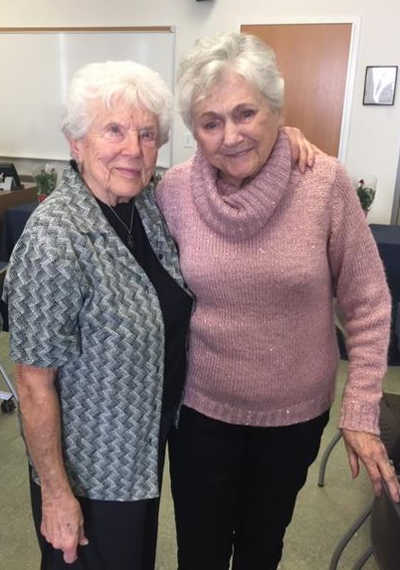
Shirley Knobels and Lois Meisenbach are best friends and long-time volunteers at the hospital.
“Shirley and I entertain! It’s like a dinner show,” Meisenbach said.
Knobels agreed. “You try to smile because you just don’t know why they are here. It’s very rewarding to be there for people.”
Knobels is retiring from volunteer service at the hospital after nearly 30 years, to move closer to family, and takes a little piece of our heart with her.
National Volunteer Week, April 8 to 12, celebrated the work of volunteers nationwide. Established in 1974 by Presidential Proclamation, National Volunteer Week recognizes volunteers and urges a culture of service.
If you are interested in volunteering at St. Helena Hospital Clear Lake, contact Katie Sust, director of patient experience, at
- Details
- Written by: California Department of Public Health
This is the first confirmed infant death from the disease since 2018.
CDPH and the Centers for Disease Control and Prevention, or CDC, recommend that expectant mothers receive the whooping cough booster shot (also called Tdap, or tetanus, diphtheria and acellular pertussis vaccine) at the earliest opportunity between 27 and 36 weeks of every pregnancy, even if previously immunized.
Getting immunized during pregnancy boosts the mother, who then passes some of her protective antibodies on to the fetus. This helps protect newborns until they are old enough to begin receiving their own whooping cough immunizations at 6 to 8 weeks of age.
“To give babies the best protection, I urge all pregnant women to get vaccinated against whooping cough as early as possible during the third trimester of every pregnancy,” said Dr. Karen Smith, CDPH director and state public health officer. “The best way to prevent whooping cough is by getting vaccinated.”
The symptoms of whooping cough vary by age. For children, whooping cough typically starts with a runny nose and cough for one to two weeks. The cough then worsens and often results in rapid coughing spells that end with a whooping sound.
Young infants may not have typical whooping cough symptoms and may have no apparent cough. Parents may describe episodes in which breathing briefly stops and the infant’s face turns red or purple. For adults, whooping cough may be a cough illness that lasts for several weeks.
Most health plans cover Tdap immunizations, and many pharmacies offer it. Medi-Cal members may be able to get their Tdap shots at the pharmacy where they usually pick up their prescriptions. Call your health plan to learn more. If you do not have health insurance, call your local health department to find a low- or no-cost location.
More information about pertussis is available on CDPH’s Web site.
- Details
- Written by: Elizabeth Larson
With the goal of enhancing patient safety in hospitals, Senate Bill 227 would require the California Department of Public Health, or CDPH, to conduct unannounced visits to hospitals to inspect for compliance with nurse staffing requirements.
The measure empowers CDPH to enforce the nurse staffing ratios by fining hospitals that repeatedly create unsafe conditions for patient care.
In 1999, Gov. Gray Davis signed into law Assembly Bill 394, the nation’s first law mandating nurse-to-patient ratios in California.
In 2004, regulations implementing AB 394 went into effect, which set the minimum ratio of nurses to patient by unit, including one-to-one in operating rooms and one-to-five in general medical-surgical units.
Enforced by CDPH, these ratios are outlined in Title 22 of the California Code of Regulations. Though these ratios are mandated by law, some hospitals repeatedly violate staffing requirements. From 2008 to 2017, there were 634 out-of-ratio deficiencies reported to CDPH.
“When hospitals do not follow nurse-to-patient staffing ratios, patients can be seriously injured or even die,” Sen. Leyva said. “SB 227 will help to ensure that hospitals meet the letter of the law and prioritize patient safety at all times. When hospitals repeatedly ignore nurse staffing ratios, CDPH should have the ability to fine those facilities so that they do not continue to jeopardize the safety of patients.”
Now advancing to the Senate Appropriations Committee for consideration, SB 227 is jointly sponsored by SEIU California, SEIU Local 121RN and United Nurses Associations of California / Union of Health Care Professionals (UNAC / UHCP).
It is also supported by the American Federation of State, County, and Municipal Employees, California Labor Federation, California Nurses Association/ National Nurses United, California Professional Firefighters, California School Employees Association, California School Nurses Organization, California Teamsters Public Affairs Council, Congress of California Seniors, Consumer Attorneys of California, Engineers and Scientists of California Local 20, International Longshore and Warehouse Union, Local 13 and San Francisco AIDS Foundation.
- Details
- Written by: Elizabeth Larson
This bipartisan legislation is a combination of bills intended to promote and expand transparency in drug pricing, including requirements that manufacturers justify large, rapid price increases.
“For far too long, people in our district and across our nation have faced spiking costs for prescription drugs. The system is so opaque that patients don’t even know where their money is going,” Thompson said. “Today I voted to advance bipartisan legislation to help fix this issue and give patients the transparency they deserve. We have seen that when hospital prices are more transparent, those entities are held more accountable for their costs and this legislation will do the same with drug prices. I will continue fighting to lower the costs of prescription drugs and ensure health care is more affordable and more accessible for everyone.”
The STAR Act combines language from three pieces of drug pricing legislation, including:
– Requiring drug manufacturers to make public and justify large spikes in the prices of their products, and justify costly initial prices of newly-launched drugs;
– Requiring manufacturers to disclose the aggregate value and quantity of free samples provided to physicians;
– Requiring pharmacy benefit managers to publicly and more broadly report the rebates and other discounts they provide to health plans or providers;
– Requiring all drug manufacturers to submit average sales price data for physician-administered drugs under Part B of Medicare; and
– Requiring the HHS Secretary to do a report analyzing drug use, costs, spending, and patient health outcomes.
Thompson represents California’s Fifth Congressional District, which includes all or part of Contra Costa, Lake, Napa, Solano and Sonoma counties. He is a senior member of the House Committee on Ways and Means where he chairs the Subcommittee on Tax Policy. Rep. Thompson is Chairman of the House Gun Violence Prevention Task Force. He is also co-chair of the bipartisan, bicameral Congressional Wine Caucus and a member of the fiscally-conservative Blue Dog Coalition.