Health
- Details
- Written by: Editor
Routine surveillance samples collected by DPR inspectors found various pesticides, including dimethoate, omethoate, monocrotophos and methidathion, at levels that pose a health risk to humans.
Both monocrotophos and methidathion have been banned for food use in the United States for several years.
“Anyone feeling ill after consuming cactus products should consult their health care provider,” said CDPH Director and State Health Officer Dr. Karen Smith. “The symptoms of acute poisoning may include sweating, headache, weakness, nausea, vomiting, hypersalivation, abdominal cramps, and diarrhea. Consumption of monocrotophos can lead to neurotoxicity and permanent nerve damage.”
DPR sampled contaminated cactus pads that were offered for sale to consumers and wholesale customers between January 23-29 at the following locations:
– Rancho San Miguel Markets, Madera;
– La Monarca Market, Lower Lake;
– FreshPoint Central California, Turlock;
– Arteaga’s Food Center, Sacramento;
– Stater Bros. Distribution Center, San Bernardino;
– S&L Wholesale Produce, San Francisco.
DPR immediately removed the cactus pads it could locate from store shelves and distribution centers. The items were quarantined or destroyed so that they do not pose a threat to consumers.
However, DPR believes it is possible that some of the cactus pads may have been sold to other stores in California, Nevada and Oregon.
The tainted produce was packaged with the brand names “Mexpogroup Fresh Produce,” “Aramburo,” or “Los Tres Huastecos”.
“Many Californians eat cactus as part of their diet, but the pesticide levels we have found at some specific locations are concerning,” said Brian Leahy, DPR director. “We are not aware of any illnesses that have been reported to date, but we suggest that anyone who bought this product from these locations recently, return it to the place of purchase or dispose of it in the garbage.”
Washing or peeling the cactus is not effective and people should not try to salvage any of this contaminated produce.
CDPH and CDPR have alerted the U.S. Food and Drug Administration about the issue.
Consumers who observe the product being offered for sale are encouraged to report the activity to the CDPH toll free complaint line at 800-495-3232.
- Details
- Written by: Editor
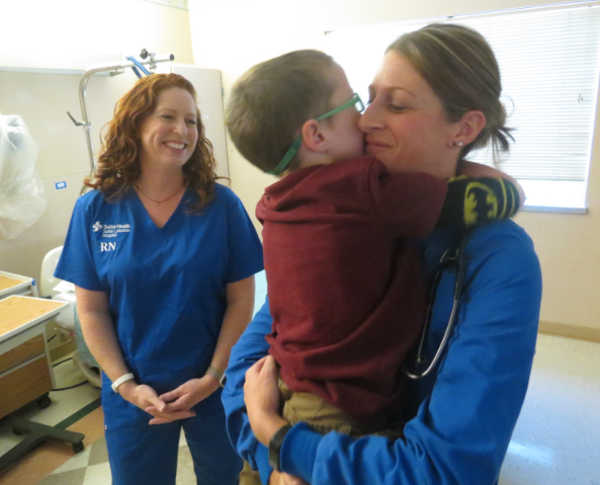
LAKEPORT, Calif. – When Kaiden Shuck was born four weeks early on July 30, 2007, doctors told his mother not to expect him to survive.
Edith Shuck, Kaiden’s mother, went to the hospital while pregnant for a stress test on July 29, a month before her due date. To her surprise, the doctor told her that she wouldn’t be leaving, but would deliver shortly.
“His heart rate kept dropping. I had a C-section that night, and he was having complications with his breathing,” said Edith.
The day after his birth, Kaiden was flown to the neonatal intensive care unit (NICU) at UCSF, where he would spend the next four months.
“I had to wait until they let me go to get to him,” said Edith. “Waiting was the worst. I kept asking, ‘Is he going to be okay?’ They really didn’t think he would survive.”
Kaiden was born legally blind. At four months old, he began suffering from near constant seizures. He was unable to walk until the age of eight. Between the ages of seven and ten he couldn’t gain weight, and he’s currently undergoing testing for Crohn’s disease. The root of Kaiden’s failure to thrive remains a mystery, however his mother expects him to continue to overcome the improbable.
“He’s fought everything they said he wouldn’t do,” said Edith. “I feel very lucky to have him as mine.”
Edith has overcome her own share of obstacles as well.
“I change his feeding tubes myself. At first I told them ‘I can’t take that tube out and see that hole in his stomach. I can’t do it.’ Then we had a spare at home and I thought, ‘You know what? I can do this and I’m going to.’ I’ve been doing it ever since.”
Access to care when needed most
Edith and Kaiden have weekly appointments at Sutter Lakeside Hospital to change his PICC line, a tube that aids in fulfilling Kaiden’s needs by supplying nutrition directly into his veins.
Before his PICC line, he hadn’t gained weight in years; since May, he’s gained 10 pounds. Edith doesn’t mind the hour and a half round trip for the fifteen minute procedure. Her son’s access to outpatient care at Sutter Lakeside Hospital saves her a weekly six hour trip to San Francisco.
“The nurses have been so amazing,” said Edith. “The two nurses we have all the time became like other moms. They see him coming and they’re ready to go. They’re just as good as we’ve ever had in San Francisco or Davis. It’s comfortable knowing we’re here and they’ll take care of him.”
Edith considers Sabrina Bailey, RN, and Ali Conser, RN, Kaiden’s dream team. Sabrina and Ali, who met in nursing school, work together to change Kaiden’s PICC line and dressing as quickly as possible.
“That little boy – he is just so sweet,” said Ali. “He doesn’t say a lot but he always wants to give hugs and kisses. You can tell he has a warmth about him; it makes you comfortable.”
Outpatient care offers a variety of services from wound care to blood infusions. Pediatric patients aren’t common, but the staff is equipped to care for children as well.
“His smile when he walks in really does light up the room,” said Ali.
Though PICC line changes are uncomfortable, Kaiden doesn’t hold a grudge.
“He’s never mad when it’s done. He still wants to give you a hug and kiss,” said Ali.
Hope for the future
While Edith sometimes struggles with the loneliness of being a single mother to a special needs child, she gains strength from her son.
“He has such a beautiful soul; he just loves. I’ll go through anything just to have him with me, no matter what it is. My mother has been a huge support as well.”
As for Kaiden’s future, Edith trusts that her son will continue to persevere.
“A lot of the time we don’t have answers. We’re back and forth all the time to the city – not knowing what’s next is the hardest part. I wish we knew but at the same time, he’s amazing. I feel very lucky to have him as mine.”
Sutter Lakeside Hospital’s 10 bed adult and pediatric outpatient care unit is open 24/7. Services include infusions, wound care, blood transfusions, cardiac stress tests, PICC line insertions and more. For more information about Sutter Lakeside Hospital, visit www.sutterlakeside.org.
- Details
- Written by: Editor
Sutter Lakeside Hospital was one of nine hospitals at the not-for-profit health care network named to the state’s 2017 Hospital C-section Honor Roll.
The agency announced the honor roll recognition on behalf of Smart Care California, a coalition of public and private health care purchasers that collectively cover 16 million people statewide – or 40 percent of all Californians.
Sutter Lakeside joined the following Sutter Health hospitals named to the 2017 Hospital C-section Honor Roll for the second consecutive year:
– Alta Bates Summit Medical Center, Berkeley.
– Eden Medical Center, Castro Valley.
– Sutter Davis Hospital.
– Sutter Maternity & Surgery Center of Santa Cruz.
– Sutter Medical Center, Sacramento.
– Sutter Roseville Medical Center.
– Sutter Santa Rosa Regional Hospital.
– Sutter Solano Medical Center
“This recognition is a testament to the dedication of our Family Birth Center staff,” said Sutter Lakeside Hospital Chief Administrative Officer Dan Peterson. “Accomplishments such as these showcase their expert care and commitment to our patients.”
“Over the last decade, Sutter Health has developed and implemented many programs to improve the care and safety of mothers and babies through pregnancy, labor and delivery,” said Sutter Health Chief Medical Officer Stephen Lockhart, M.D., Ph.D. “We’ve worked hard to enhance quality and safety at our hospitals to ensure we have among the lowest C-section rates in California – so it’s especially gratifying to receive recognition for leadership in this area.”
Nearly one of three American babies enters the world through a surgical birth. Cesarean delivery is the most commonly performed surgical procedure in the United States. When complications arise during pregnancy, C-sections can save the lives of mothers and infants, but some women undergo the surgery for no medical reason, exposing both mother and baby to potentially avoidable complications.
Even for low-risk, first-birth pregnancies, there is a huge variation in hospital C-section rates. Rates in California hospitals range from less than 15 percent to more than 60 percent.
To respond to the rise in unnecessary C-sections, the U.S. Department of Health and Human Services adopted the Healthy People 2020 target of reducing nationwide C-section rates for low-risk, first-births to 23.9 percent.
The Smart Care California honor roll acknowledge hospitals that have achieved – and in many cases gone beyond – that goal. The Sutter Health system NTSV C-section Rate for a rolling 12 months ending November 30, 2017 was 21.3 percent, well below the 23.9 national goal.
“The decline in California’s rate for low-risk, first birth C-sections will lead to healthier babies and mothers,” said CHHS Secretary Diana Dooley. “Thanks to the hospitals and their staff for their hard work in achieving this measurable progress.”
Sutter Health has actively worked on lowering its C-section rates since 1999, when the Northern California health system launched the First Pregnancy and Delivery program whose results were published in the American Journal of Obstetrics and Gynecology in 2006.
- Details
- Written by: Editor
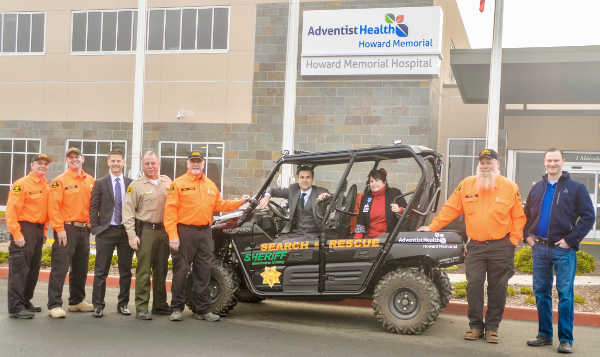
WILLITS, Calif. – Adventist Health Howard Memorial – formerly Frank R. Howard Memorial Hospital – recognizes the important role that Mendocino County’s first responders play in keeping the community safe and healthy.
The recent wildfires underscored even more the benefits that well trained and equipped first responders can make when disasters occur.
That’s why when the Mendocino County Sheriff’s Search and Rescue team, or SAR, asked for the hospital’s help, the decision was easy.
The hospital donated $14,500 to Search and Rescue towards the purchase of a new Utility Terrain Vehicle, or UTV, an item that has been on their wish list for quite some time.
Search and Rescue is a nonprofit organization and receives no annual funding from the sheriff’s office. The 50 members of SAR are all volunteers who donate their time and energy to help the community. Many members spend a good deal of their own money for their personal equipment and costs to travel to and from trainings.
SAR’s budget for training and supplies is about $15,000 per year and is met through fundraising efforts and community donations. It had previously used a UTV on a “loan program” sponsored by Kawasaki and administered by Ukiah Motosports.
The program has since been discontinued by Kawasaki. So the hospital donation was definitely a welcome gesture.
“During the recent fires, we worked very closely with the Search and Rescue team, and saw first-hand the great work that they do,” Adventist Health Howard Memorial President Jason Wells explained. “Besides helping the Mendocino County Sheriff’s Office with doing welfare checks and locating missing persons, they also provided a sense of security; both for the hospital and for the community. Knowing that we had great partners ready to help was invaluable during those times.”
As a part of the Mendo-Lake Complex Fire operations, SAR volunteers assisted in accounting for missing persons, helping people evacuate from their homes, and also caring for and rescuing animals who were displaced, injured, or other otherwise could not be taken by their families when they evacuated.
In addition to helping during disasters, is called upon, on average twice a month to help locate missing persons or help the Sheriff’s office with evidence search for certain cases. The new UTV has already been used on several missions including to help locate a missing person in the woods off Hwy 20 and James Creek recently.
“Mendocino County has some very rugged terrain, and typically it is in that type of terrain in which people become lost. This UTV will allow us to quickly deploy SAR resources to search areas which would otherwise not be easily accessible,” explained Jared Chaney, SAR commander.
“The Sheriff’s Office and SAR is grateful to have community partners, such as Adventist Health Howard Memorial, that donate generously to provide a much-needed piece of equipment for search and rescue operations,” Sheriff Tom Allman shares. “It’s these types of relationships, between the private sector and the public, that allow our SAR Team to provide the professional services to the community that they do.”
Dave Kobetz with MotoSports of Ukiah helped to provide the UTV at a highly discounted cost and coordinated with aftermarket vendors to donate thousands of dollars in add-ons, including a winch, windshield and a hard-shell roof. Motosports also donated the labor needed to prepare the UTV for action.
“We like partnering with organizations that help us accomplish our mission,” said Judson Howe, Adventist Health Howard Memorial CFO. “This donation benefits not just the residents of Willits but also all of Mendocino County. To be able to help an organization that puts their lives on the line, all on their own time, makes this so worthwhile.”
To join SAR or to learn more, visit their website at https://www.mendocinosar.org.