Health
- Details
- Written by: Editor
SACRAMENTO – State Treasurer John Chiang will provide $20 million in one-time emergency grants to support community clinics that provide vital health services to California’s most vulnerable residents.
The Community Clinic Lifeline Grant Program will help small or rural nonprofit clinics, including Planned Parenthood clinics, keep their doors open and provide critical services as lawmakers work to address the potential losses in health care funds due to threatened federal actions such as repealing the Affordable Health Care and eliminating funding for essential women’s health and preventative services.
“These community clinics that nobly serve the poorest patients in our state could be forced to shutter their doors if President Trump and Congressional Republicans are successful at replacing Obamacare with their Wealthcare and denying access to basic health services to women and children.” Chiang said. “Here in California, we do not turn our backs to those in need. We will provide a helping hand to make sure men, women, children and undocumented immigrants continue to have access to the basic health care services they require.”
Washington is poised to slash budgets for a range of programs, such as family planning and preventative services, maternal and child health programs and Medicaid.
President Trump’s budget proposal would prevent Planned Parenthood clinics from participating in any federally funded health program.
"The program will provide reproductive health care providers like Planned Parenthood a line of defense against the persistent attacks waged by Congress and the President,” said Kathy Kneer, CEO, Planned Parenthood Affiliates of California.
The funding for this new grant program comes from principal and interest payments that have accrued the last 15 to 20 years in the Treasurer’s Help II Loan Program.
The Help II Loan Program provides low- interest rate loans to California’s nonprofit small or rural health clinics for facilities and equipment.
The grants will support core operations to allow clinics to continue providing care to their patients as they develop long-term plans to deal with the loss of federal funding.
Any licensed nonprofit small or rural primary care clinic in a medically underserved area that is at risk of cutting services or closing because of adverse federal actions will be eligible for a one-time grant up to $250,000.
“We applaud the Treasurer, and the Legislature, for recognizing the value provided by community health centers and ensuring that they’ll be able to keep their doors open by providing emergency funding,” said Carmela Castellano-Garcia, President and CEO of CaliforniaHealth+ Advocates. “We must continue to protect California’s most vulnerable populations – particularly in underserved areas – and the Lifeline Grant Program is a necessary investment.”
Community clinics provide basic services to one out of seven Californians, regardless of their ability to pay.
“Tearing apart this important safety net would have enormous consequences, leaving our most vulnerable residents, including women, children and undocumented immigrants, with no access to primary and preventative care and no option for treatment other than costly emergency visits,” Chiang said.
The treasurer partnered with Senate Budget and Fiscal Review Committee Chair Holly J. Mitchell, D-Los Angeles, Sen. Richard Pan, D-Sacramento, and Assemblymember Joaquin Arambula, D-Fresno, on getting legislation approved to enact the grant program.
- Details
- Written by: Editor
LAKE COUNTY, Calif. – Hospice Services of Lake County has been providing end-of-life care for Lake County residents with a life expectancy of less than six months for 38 years.
This past week, the organization received confirmation from Partnership HealthPlan that its application to become the Intensive Home-Based Palliative Care provider for Lake County has been approved.
Partnership HealthPlan administers Medi-Cal benefits for more than 560,000 people in 14 Northern California counties, including Lake.
In September 2016, Hospice Services added a new program, Lake County Transitions.
The Transitions Program was created to provide home-based care for patients in transition after or while still receiving curative treatments, but before they are ready for hospice care.
This new contract will allow Hospice Services to get reimbursed for the care that they’re already providing to those in the community in conjunction with their primary health care teams.
The program is designed for patients with more complex needs, within the last years of their lives, who are not yet candidates for hospice.
Some of the many services that they provide are symptom management, medication management, psychological counseling, support for family members, addressing unmet needs in the realm of appropriate living arrangements, discussions of advance directives and physician order of life sustaining treatment form completion, as well as other issues relating to the patient’s declining health status.
Hospice Services appreciates the support of many healthcare providers in our development of this program, specifically Sutter Lakeside Hospital, Adventist Clear Lake and Mark Turrill, MD for their letters of support for our application, as well as Lake County representatives on the Partnership Board of Commissioners: Karen Tait, MD, Lake County Public Health Director, and Robert Gardner, MD, Lucerne Community Clinic.
Hospice Services is grateful to align with Partnership HealthPlan in the development of this contract, as well as The California Health Care Foundation, which continues to provide financial and technical support to increase access to quality health care in our homes, here in Lake County.
- Details
- Written by: Elizabeth Larson
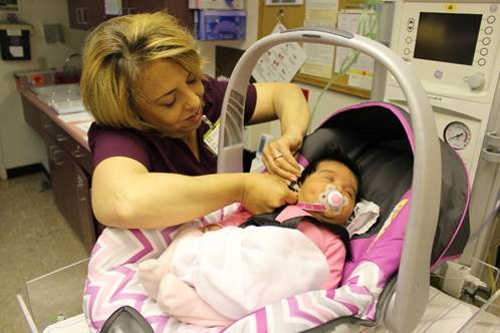
CLEARLAKE, Calif. – St. Helena Hospital Clear Lake has brought its newborn hearing screening program in-house, allowing the hospital to offer flexible scheduling for families.
Previously, the program was being managed by an outside agency and parents only had one day per month to bring their newborn in for his or her next screening.
“After considering the busy lives of our patients and their families, we determined it was in the best interest of our community to offer a hearing screening program truly tailored to their needs,” said Melissa Keller, RN, manager of the Women’s Care Unit, which offers family birth services. “We want to create a seamless experience for our patients during delivery and after discharge so it is easy for them to help their newborns grow and thrive.”
St. Helena Hospital Clear Lake is certified to participate in the Newborn Hearing Screening Program by the California Department of Health Care Services.
The Newborn Hearing Screening Program was developed by the California Department of Health Care Services and Children’s Medical Services to identify hearing loss in infants and guide families to the appropriate services needed to develop communication skills.
By starting its own hearing screening program, the Women’s Care Unit is able to tailor post-discharge screenings and education to the parents’ needs and schedule.
Families who deliver at St. Helena Hospital Clear Lake have the opportunity to have their baby’s hearing screened multiple times.
The first hearing newborns experience is at the hospital within the first 24 hours after delivery.
The Women’s Care Unit nursing staff provides parents with education on the hearing screening and many benefits to the newborn. Results of the hearing screening are communicated to the newborn’s pediatrician and the Newborn Hearing Screening Program, and followup screenings are scheduled to ensure that infants’ hearing is developing properly.
If an infant does not pass the screening, they will be referred for additional testing.
“The future of our community depends on the health of the children we serve,” says Josie Lutz, RN, who coordinates the hearing screen program. “Offering these important screenings makes a difference at the root level in the community where I live, which is something I’m passionate about.”
Learn more about the infant screening program and Women’s Care Unit by calling 707-995-5875.
- Details
- Written by: Editor
LAKEPORT, Calif. – Joint pain can have many causes, including injury, arthritis and inflammation.
However, the results are the same: daily activities can become uncomfortable or unmanageable.
Sutter Lakeside Hospital will host a free public seminar on living with joint pain on Tuesday, June 20, from 6 to 7 p.m. in the hospital conference room.
Dr. Amber Chatwin, board-certified orthopedic surgeon, will give a presentation on common causes, discuss joint pain treatment options, and answer questions from the audience.
Interested participants can register online at www.sutterlakeside.org/events .
Treatments for joint pain can range from physical therapy or medication to the use of a walking aid such as a cane.
Generally, physicians avoid joint replacement surgery as long as possible. But when knee or hip pain starts to limit a patient’s ability to lead a normal life, total joint replacement may be an option.
More than seven million Americans have had total knee or total hip replacement surgery, according to the National Center for Biotechnology Information.
Trends show that joint replacement surgery is becoming more common, with a younger demographic seeking surgery.
Sutter Lakeside Hospital partners with Surgical Affiliate Management Group Inc., or SAMGI, to provide top surgical care, including orthopedic surgery, to Lake County patients.
SAMGI, founded in 1996, specializes in providing 24/7 general surgery coverage, often in collaboration with rural hospitals.
For more information about the seminar, or to reserve your seat, please visit www.sutterlakeside.org/events .
Morgen E. Wells is community relations and fund development coordinator for Sutter Lakeside Hospital.