Health
- Details
- Written by: Editor
SACRAMENTO – California Department of Public Health (CDPH) Director and State Public Health Officer Dr. Karen Smith announced Wednesday that it is no longer necessary for CDPH to monitor travelers returning from Ebola-affected countries in West Africa for symptoms of Ebola virus disease, or EVD.
The end of CDPH’s Ebola Monitoring Program comes as the World Health Organization (WHO) declares Guinea free of EVD.
CDPH stopped monitoring travelers from Liberia on Sept. 3, 2015, and those from Sierra Leon on Nov. 7, 2015, following guidance from the Centers for Disease Control and Prevention (CDC) and after WHO declared those countries free of EVD.
“As the Ebola outbreak comes to an end, the continued focus on traveler health is extremely important,” Dr. Smith said. “Health care providers need to rapidly identify travel-related risks in people who may have infectious diseases to prevent the spread of diseases and provide the best care possible. We live in a world where the introduction of a new and highly infectious disease to California could be just a plane ride away.”
Smith added, “California’s response to the Ebola outbreak in West Africa has proven that the Department and its public health partners are prepared to respond to potential outbreaks of other infectious diseases that may be imported from other countries.”
Since CDPH and local health departments (LHDs) began monitoring travelers returning from the Liberia, Sierra Leone and Guinea on Oct. 12, 2014, nearly 1,300 travelers have been monitored.
With the three West African nations free of EVD, daily monitoring of returning travelers will no longer be required due to the low possibility of transmission of the disease into the United States.
The West Africa Ebola outbreak started December 2013 and infected 28,640 people, of which 11,315 died. It has been the largest Ebola outbreak in history.
The monitoring of returning travelers from Ebola-affected nations in West Africa has protected California from Ebola virus transmission.
Besides monitoring travelers, CDPH collaborated with local health departments, emergency medical services, and the health care community to ensure that EMS personnel, physicians, and hospitals in California were ready to safely transport and care for potential EVD patients.
No cases of EVD were identified in California during this outbreak.
“Monitoring travelers from the affected countries was a monumental task that proved very successful,” Dr. Smith said. “The CDPH Ebola Returning Traveler Epidemiology Team, along with the staff at local health departments throughout California, has worked hard to monitor all returning travelers on a daily basis for up to 21 days. The collaboration between CDPH and the local health departments is what made the traveler monitoring system work so well.”
In addition, CDPH and LHD staff have worked closely with health care facility staff and emergency medical services personnel to create a network that is prepared to safely transport and care for persons with EVD or other diseases that have the potential to spread in health care facilities, Dr. Smith said.
- Details
- Written by: Editor
SACRAMENTO – The California Health and Human Services Agency (CHHS) and the California Department of Public Health (CDPH) on Tuesday announced 23 community-based health innovations that advance the Let’s Get Healthy California effort to make California the nation’s healthiest state by 2022.
These innovations will be recognized and discussed as part of an Innovation Conference in Sacramento on Jan. 26, 2016.
“We invited communities across the state to submit innovative ideas and projects that further the Triple Aim of better health, better care, and lower cost in California,” said CHHS Secretary Diana Dooley. “This is a great opportunity to recognize and learn from the work going on at a local level to meet the goals of our Let’s Get Healthy California initiative.”
“The Let’s Get Healthy California Innovation Challenge was designed to promote improvement in population health and care through new pathways,” said CDPH Director Dr. Karen Smith. “It encouraged the state and locals to collaborate, share ideas, and learn from one another to support new and creative ways to make California the healthiest state in the nation.”
CHHS and CDPH received nearly 100 submissions from community and health advocates, health care providers, community based organizations, civic and data enthusiasts, and many other individuals as part of this past summer’s Innovation Challenge.
January’s conference will showcase and also measure California’s progress to meet the six goal areas of the Let’s Get Healthy California report.
In 2012, Gov. Jerry Brown issued Executive Order B-19-12 to create the Let’s Get Healthy California Task Force with the goal of making California the healthiest state in the nation by 2022. The Let’s Get Healthy California initiative focuses on furthering the Triple Aim – better health, better care and lower costs – and promoting health equity.
It consists of two strategic directions – Health Across the Lifespan and Pathways to Health – and six major goal areas, Healthy Beginnings, Living Well, End of Life, Redesigning the Health System, Creating Healthy Communities, and Lowering the Cost of Care. For more information on the Innovation Challenge and conference, visit the Let’s Get Healthy California Web page.
The 23 selected health innovations are listed below. For more information on each of the innovations, please visit CHHS’ Let’s Get Healthy California Web page.
Goal 1: Healthy Beginnings
· “Bright Beginnings,” Ventura County Public Health, Ventura County
· “Building Broccoli Smiles through Food Literacy,” Food Literacy Center, Sacramento, Sacramento County
· “Collaborative Partnerships and Environments for Early Childhood Health,” Healthy & Active Before 5, Contra Costa County
· “Healthy Babies are Worth the Wait Community Program,” March of Dimes, Barstow, Victorville, Apple Valley, Hesperia, and Adelanto, San Bernardino County
Goal 2: Living Well
· “AARP Livability Index,” AARP
· “Ending Hunger in Orange County,” Waste Not OC, Anaheim and Orange, Orange County
· “Growing Healthy Habits – A Community Garden Model,” Yolo County Health and Human Services Agency, Woodland, Yolo County
· “Skid Row Healthy Food Micro-Enterprise Project,” Los Angeles Community Action Network, Los Angeles, Los Angeles County
· “Street Vendors: Bringing Healthy Food to Central Valley Residents,” Cultiva La Salud – Public Health Institute, Southeast Fresno, Fresno County
Goal 3: End of Life
· “How to Make Advance Care Planning Easier,” University of California, San Francisco, San Francisco County
· “Medical-Legal Partnership for Seniors,” University of California San Francisco/University of California Hastings Consortium on Law, Science & Health Policy, San Francisco, San Francisco County
· “UCLA Health/Coalition for Compassionate Care of California Advance Care Planning Initiative (ACPI)”, University of California, Los Angeles, (UCLA) Health and Coalition for Compassionate Care of California, Los Angeles County
Goal 4: Redesigning the Health System
· “Clinic in the Park: Connect, Screen, Educate,” Clinic in the Park: Connect, Screen, Educate, a fiscally sponsored project of OneOC, Anaheim, Costa Mesa, Irvine, Santa Ana and Tustin, Orange County
· “The MobileMAMA Text Program: Integrating Medical Care and Social Services for Pregnant Women in the Safety Net,” Harbor-UCLA Medical Center, Los Angeles County Department of Health Services and the Robert Wood Johnson Foundation Clinical Scholars Program
· “Santa Rosa Community Health Centers Care Coordination Program,” Santa Rosa Community Health Centers (SRCHC), Santa Rosa, Sonoma County
Goal 5: Creating Healthy Communities
· “A Culture of Health: Creation of the Healthy RC Steering Committee,” city of Rancho Cucamonga, Healthy RC, Rancho Cucamonga, San Bernardino County
· “Active Design Guidelines and Icon,” Sacramento, Sacramento County
· “Live the Challenge,” Building Healthy Communities South Kern, Arvin, Lamont, Weedpatch and Greenfield, Kern County
· “Walk With Friends,” Health Education Council, South Sacramento Valley Hi neighborhood, Sacramento County
Goal 6: Lowering the Cost of Care
· “Care Transitions,” Partnership HealthPlan of California, Northern California
· “Improving Healthcare Quality & Safety While Reducing Costs Through Clinical Pharmacy Service Integration,” University of Southern California School of Pharmacy and AltaMed Health Services, Los Angeles County and Orange County
· “Increasing Tdap Vaccination Among Pregnant Medi-Cal Women In Los Angeles County,” Los Angeles County Comprehensive Perinatal Services Program, San Fernando Valley, Los Angeles County
· “RxSafe Marin: Marin County Prescription Drug Misuse and Abuse Initiative,” Marin County Department of Health and Human Services, Marin County
- Details
- Written by: Editor
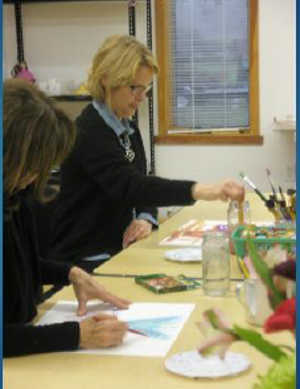
UKIAH, Calif. – Ukiah Valley Medical Center (UVMC) is now offering complimentary group art therapy sessions as part of the hospital’s Cancer Treatment and Infusion Center’s Focus on Healing program.
The sessions are facilitated by Sue Sweet, marriage and family therapist and registered art therapist, and made possible by a substantial grant provided by the T.R. Eriksen Foundation, a private foundation established as a charitable trust in 2000 whose primary purpose is to provide financial support to those who work in the field of human services.
In accordance with the hospital’s philosophy of patient-centered care that focuses on the whole person – mind, emotions and body, and in response to feedback from patients who requested more support after treatment, this alternative therapy continues to advance UVMC’s commitment to the Focus on Healing Program which offers art, music, movement and other healing modalities, in addition to advanced medical treatment for patients with cancer.
Sweet is a cancer survivor who continues to use art therapy as a tool in her own healing journey. She previously introduced art therapy combined with other evidence-based practices to the Cancer Resource Centers of Mendocino County and in 2014 she introduced it to UVMC.
Group art therapy provides an avenue to explore one’s unique but often universal experiences with coping with cancer and other serious illnesses. Art therapy is effective in reducing stress, assisting in exploration and expression of thoughts and feelings, developing creativity and strategies for increasing feelings of well-being.
“The beauty of group work is we are more alike than we are different, and when people come together and express universal truths, it heals everyone who is part of the process. Because of that it can be more profound than individual therapy,” said Sweet.
Individuals who are newly diagnosed, currently in treatment and in post treatment and those who have other serious illnesses that might benefit from this therapy are welcome to participate in classes. The maximum capacity of each class is 10 individuals per session.
Participants must be preregistered for the first session that runs from Friday, Jan. 22, through Friday, March 11, from 10 a.m. to 12 p.m.
Classes will take place at the Art Therapy Institute of the Redwoods, a space provided by Linda Chapman, ATR-BC. There is a nominal $8 sliding scale fee for art materials. No artistic skill necessary.
For further information or registration contact Sue Sweet, MFT-ATR at 707-671-5122 or
- Details
- Written by: Editor
SACRAMENTO – California Department of Public Health (CDPH) Director and State Public Health Officer Dr. Karen Smith is reminding anyone who hasn’t yet received a flu vaccine to do so in time for the holidays.
“The holiday season is a time to enjoy getting together with friends and family,” Dr. Smith said. “Unfortunately, it’s also often when many people catch the flu. Getting the flu vaccine is the best way to protect yourself against influenza and to protect those around you as well. Don’t let the flu ruin your holidays.”
In the United States, flu activity is usually highest between December and February and can continue into May. As long as flu viruses are circulating, it’s not too late to get vaccinated.
Flu vaccine is available now. Once administered, it takes the vaccine up to two weeks to fully protect you against the flu. An influenza vaccine is especially important for pregnant women and other people at higher risk for severe influenza.
Each year, flu causes millions of illnesses, hundreds of thousands of hospitalizations and thousands or sometimes tens of thousands of deaths in the United States. To reduce this threat, CDPH recommends the annual flu vaccine for everyone 6 months of age and older, including pregnant women.
Two of this season’s vaccine components, the influenza A (H3N2) and influenza B (Yamagata lineage) strains, have been updated to match the viruses Californians are facing this flu season.
Flu can cause severe disease across all ages. According to the recently published California influenza surveillance report, there were 78 influenza-associated deaths reported in persons under 65 years of age in California during the 2014-15 influenza season.
Two Californians younger than 65 years of age have already lost their lives due to the flu or its complications in this current influenza season.
Common symptoms of the flu include fever, cough, sore throat, chills, fatigue or body aches. Children may also have nausea, vomiting or diarrhea.
CDPH also encourages people to protect their health by eating a nutritious diet, getting enough sleep and not smoking. People who feel they may have influenza should contact their physician.
To stop the spread of flu and other respiratory illnesses, Californians should also:
– Stay home when you are sick.
– Cover your coughs and sneezes with a tissue and throw away the used tissue.
– Wash your hands often and thoroughly with soap and warm water or an alcohol-based hand sanitizer.
– Avoid touching your eyes, nose and mouth.
Dr. Smith encourages Californians to contact their health care provider, physician’s office, clinic or pharmacy about obtaining the flu vaccine. Some local health departments may also offer low- or no-cost flu immunizations.
For more information about the flu visit the CDPH influenza Web page, http://www.cdph.ca.gov/HealthInfo/discond/Pages/Influenza%28Flu%29.aspx .
To find a flu vaccine location near you, visit www.flu.gov .