Health
- Details
- Written by: Editor
SACRAMENTO – With the spring holidays approaching in the next weeks, many Californians are heading to the Philippines or other countries where measles outbreaks are occurring or measles circulates in the population.
The California Department of Public Health (CDPH) strongly encourages all Californians to make sure they are protected against measles and other dangerous diseases before they go abroad.
“Measles is extremely contagious and can be very serious. The best way to protect yourself and your family against measles is with the Measles Mumps and Rubella (MMR) vaccination, which is 97 percent effective after two doses,” said Dr. Gil Chavez, deputy director of the CDPH Center for Infectious Disease Prevention and state epidemiologist. “Vaccination is especially important for those who plan to travel internationally, which places them at high risk of getting the disease and spreading it to others after they come home.”
The current outbreak beginning in December 2014 is likely to have started from a traveler who got measles overseas.
Most cases of measles in the United States in 2014 were associated with travel to and from the Philippines, where measles has been widespread.
Other cases were associated with travel elsewhere in Asia, Europe or Africa. Measles has also been spread at international airports.
Immunization with MMR vaccine protects against measles while abroad and back at home. Unvaccinated Californians who are traveling outside of North or South America should receive the MMR vaccine before they go.
Infants who are traveling abroad can be vaccinated with an early dose as young as six months of age (though they should also have the two standard doses of the MMR at 12-15 months and at 4-6 years of age).
Check with your health care provider to see whether you and your family are fully protected against measles, influenza and other diseases that are common in other countries.
Travelers can find helpful information about the vaccinations needed on the Centers for Disease Control and Prevention (CDC) Web site, http://wwwnc.cdc.gov/travel/destinations/list .
Travelers should also watch for the symptoms of measles after returning home. Measles begins with a fever that lasts for a couple of days, followed by a cough, runny nose, red, watery eyes, and rash.
The rash typically appears first on the face, along the hairline, and behind the ears and then affects the rest of the body.
If you think you or a family member may have measles, promptly contact your health care provider by telephone before entering a medical facility, where the disease could spread to others.
More information about measles is available on the CDPH Web site, www.cdph.ca.gov .
- Details
- Written by: Editor
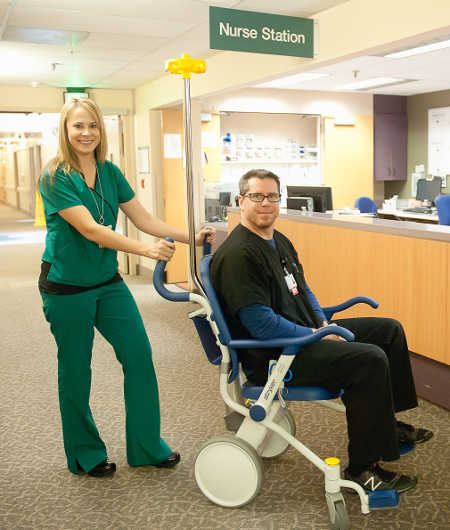
LAKEPORT, Calif. – Thanks to volunteer generosity, more Sutter Lakeside Hospital patients will enjoy riding in “the Lexus of wheelchairs,” said Medical Surgical Department Manager Anne Garner.
The auxiliary volunteers, who run the hospital gift shop and coordinate other fundraising efforts, donated $6,000 so the Medical Surgical Department could purchase two Stryker wheelchairs.
The chairs, which can easily hold a patient up to 400 pounds, provide a whole new level of comfort for patients and the hospital staff transporting them.
“The chairs are extremely comfortable for patients and so easy to maneuver that it reduces risk of injury to the patient and takes the strain off our staff,” Garner said. “They feature attached IV poles; oxygen tank holders; a paperwork tray; very few detachable parts; and a high-quality, durable, sanitary and rustproof plastic construction.”
Garner said her staff was happy to say goodbye to the older steel wheelchairs because they were getting rusty and missing parts, such as footrests, that made them uncomfortable.
From the moment staff members saw a new Stryker wheelchair roll by from the Emergency Department, they were in love.
“We wanted one so badly that I immediately put a presentation together and borrowed one of the Emergency Department’s chairs to demonstrate its features to the Auxiliary,” Garner said. “My team and I were hoping for one new wheelchair, so you can imagine how thrilled we were when the Auxiliary bought us two.”
“We could immediately see how beneficial and wonderful these new wheelchairs would be for the Medical Surgical Department,” said Auxiliary President Sharon Brasher. “We’re always looking for ways to support the hospital and help patients have a more comfortable experience.”
Garner appreciates the auxiliary support in what she said feels like an “upgrade from driving a 1966 Volkswagen to a brand-new Lexus.”
She and her staff show their appreciation by buying treats and gifts in the shop at every opportunity.
“The ladies and gentlemen of the auxiliary are the unsung heroes of this hospital,” Garner said. “They run a gift shop that’s no bigger than a walk-in closet but is fully stocked with the best merchandise you can imagine. Their amazing talents and generosity are so appreciated.”
To learn more about Sutter Lakeside, visit www.sutterlakeside.org/ .
- Details
- Written by: Editor
LAKEPORT, Calif. – Even with a history of cervical cancer and heart problems, 92-year-old Enes Cereni of South San Francisco says she enjoys time with her husband of 63 years and their children, grandchildren and great-grandchildren thanks to Sutter Health’s Advanced Illness Management program, which covers 16 counties across Northern California.
Beginning this week, patients in the Sutter Lakeside Hospital service area with late-stage chronic illness can access the same resources and support available to Mrs. Cerini through AIM’s next major expansion in Northern California.
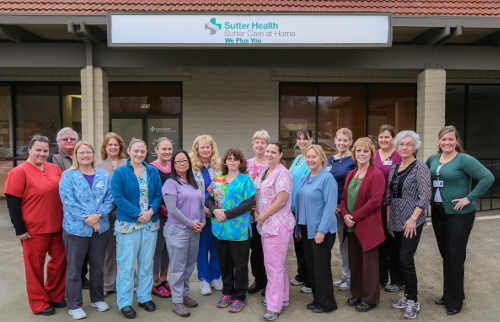
The expansion extends access to patients within the Sutter Lakeside Branch of Sutter Care at Home.
The AIM program provides nurse-led care management, palliative care and advance care planning for patients with late-stage chronic illness.
AIM employs a nurse-led interdisciplinary team to bridge the gaps between the hospital, the community physician’s office and home.
With a pilot program in Sutter Health’s Sacramento Sierra Region showing positive outcomes, the Center for Medicare & Medicaid Innovation awarded Sutter Health a three-year, $13 million Health Care Innovation Award to support the expansion of AIM throughout Northern California.
The AIM program focuses on the patient’s personal goals, and ensures the plan of care is aligned with these preferences.
The AIM program improves the patient’s ability to self manage their care at home, thus reducing the need for repeated emergency department visits and hospitalizations.
Most recently, the AIM Data shows:
• 56-percent reduction in hospital stays;
• 19-percent reduction in emergency room visits;
• 59-percent reduction of time spent in the ICU;
• 97-percent patient satisfaction.
“Before AIM, I had a choice of calling 911 and that’s it, and I’d end up in the hospital,” said 81-year-old AIM patient Edward Fogarty. “I don’t want to go to the ER. What AIM gives me is that I can call someone besides 911, and they give me advice and counsel, which really helps.”
For more information about AIM, visit http://www.sutterhealth.org/quality/focus/advanced-illness-management.html .
- Details
- Written by: Editor
NORTHERN CALIFORNIA – Coinciding with the debut of a documentary featuring Congressman John Garamendi called “Fading Away: Alzheimer’s,” all community members are invited to participate in Congressman John Garamendi’s Facebook Alzheimer’s Q&A on Wednesday, Feb. 11, at 7 p.m.
It will be the first Facebook Q&A ever hosted by Garamendi.
On Wednesday at 7 p.m., Sacramento’s PBS affiliate, KVIE, will air “Fading Away,” a documentary produced by Karen Christian that features the Garamendi family’s experience with Alzheimer’s, other families’ experiences, and the latest scientific breakthroughs happening at UC Davis and across the country.
Simultaneously during this airing, Congressman Garamendi will conduct a live Q&A on Facebook at https://www.facebook.com/repgaramendi .
Optional RSVPs can be made at http://on.fb.me/1AQmSXl .
Encores of the documentary will air at 4 p.m. Friday, Feb. 14, and at 6 p.m. Sunday, Feb. 16. No live Q&A will be conducted for the encore airings.
In addition, Congressman Garamendi will be hosting a telephone town hall tonight from 7:30 to 8:30 p.m.
He will be joined by Karen Christian, producer of the Alzheimer’s documentary “Fading Away,” and Ruth Gay, director of Public Policy and Advocacy at the Alzheimer’s Association of Northern California and Northern Nevada.
Topics of discussion will include personal stories and issues in the new federal budget that impact the Third Congressional District.
Questions from constituents will also be answered.
Forty thousand Third District constituents will receive invitations to this telephone town hall.