Health
- Details
- Written by: Editor
An analysis released by Trust for America's Health (TFAH) finds that fewer than 90 percent of children ages 19-to-35 months old have received the recommended vaccination against measles, mumps and rubella (MMR) in 17 states.
New Hampshire has the highest MMR vaccination rate for preschoolers at 96.3 percent, and Colorado, Ohio and West Virginia have the lowest at 86 percent, based on data from the latest completed National Immunization Survey from 2013.
No state in the Northeast was below 90 percent, while eight states in the South, five in the West and four in the Midwest had rates below 90 percent. Nationally 91.1 percent of preschoolers are vaccinated.
"Sadly, there is a persistent preschooler vaccination gap in the United States. We're seeing now how leaving children unnecessarily vulnerable to threats like the measles can have a tragic result," said Jeffrey Levi, PhD, executive director of TFAH. "We need to redouble our national commitment to improving vaccination rates."
Healthy People 2020 set 90 percent as the baseline national goal for preschooler MMR vaccinations. Reaching the national rate of 91.1 percent has helped reduce measles rates by 99 percent. Achieving even higher vaccination rates would help protect even more individuals and increase "herd immunity" protection for the wider community.
The U.S. Centers for Disease Control and Prevention (CDC) and the Advisory Committee on Immunization Practices (ACIP) recommend that every child receive a first dose of the MMR vaccine after reaching the age of 12 months old. A second MMR dose is recommended for 4-to-6 year olds.
"It is so important that communities maintain high levels of MMR vaccination-because measles is so infectious-and especially when outbreaks are occurring around them," said Litjen (L.J) Tan, MS, PhD, chief strategy officer of the Immunization Action Coalition. "To have pockets where community immunity is below 90 percent is worrisome as they will be the ones most vulnerable to a case of measles exploding into an outbreak."
Rates of preschooler vaccinations are typically lower than for school-age children, since they are not yet in the school system, which require vaccinations for children to attend.
Among kindergarteners, 94.7 percent have been vaccinated for measles, with a high of 99.7 percent in Mississippi and a low of 81.7 percent in Colorado.
States differ significantly in policies allowing parents to "opt-out" of the attendance requirements. Within states, even states with high MMR vaccination rates, there can be communities with groups of individuals who are unvaccinated, making these communities vulnerable to measles and other preventable diseases.
In January 2015, CDC issued a Health Advisory about an ongoing multi-state measles outbreak, which has been linked to more than 102 cases in 14 states so far. Most individuals who get the measles are not vaccinated – including infants.
In 2000, measles was declared virtually eliminated in the United States, when cases dropped to around 60. Measles rates remained below 100 from 2002 to 2007, with many of those cases linked to overseas travel. In 2014, there was a surge in measles, with at least 23 outbreaks and more than 600 cases.
Measles is a highly contagious, viral illness that can lead to health complications, including pneumonia, encephalitis and eventually death. Prior to routine vaccination, measles infected approximately three to four million Americans, killed 400 to 500 individuals and led to 48,000 hospitalizations each year.
Vaccines undergo rigorous review and testing for effectiveness and safety by the Food and Drug Administration (FDA) before they are released to market and safety is also tracked through several monitoring systems once they are in use.
Numerous reviews, including by all of the existing studies by the Institute of Medicine (IOM), have concluded that the MMR vaccine is safe and has no causal link to developmental disorders.
Overall, there is a long-standing preschooler vaccination gap in the United States. More than 2 million preschoolers do not receive all recommended vaccinations on time: 27.4 percent do not receive the full childhood series; 27.4 percent do not receive the rotavirus vaccine; 18 percent do not receive the pneumococcal vaccine; 16.9 percent do not receive the diphtheria, tetanus and whooping cough vaccine; 9.2 percent do not receive all three doses of the hepatitis B vaccine; 8.8 percent do not receive the chickenpox vaccine; and 7.3 percent do not receive the polio vaccine.
In addition, many infants (by 13 months) do not receive all recommended vaccines: 43.2 percent do not receive the chickenpox vaccine; 12.6 percent do not receive the pneumococcal vaccine; 10.7 percent do not receive the meningitis, pneumonia and epiglottis Hib vaccine; 10.6 do not receive the diphtheria, tetanus and whooping cough vaccine; 15.4 percent do not receive all three doses of the hepatitis B vaccine; and 6.3 percent do not receive the polio vaccine.
Some key recommendations for improving vaccination rates include:
– Increasing public education campaigns about the safety and effectiveness of vaccines;
– Minimizing vaccine exemptions – states should enact and enable universal childhood vaccinations except where immunization is medically-contraindicated. Non-medical vaccine exemptions, including personal belief exemptions, enable higher rates of exemptions in those states that allow them;
– Increasing provider education and vaccine standard of practice to help ensure providers are responsibly promoting the importance of vaccination to their patients and actively tracking whether patients have received all recommended vaccinations and providing them when they have not;
– Bolstering immunization registries and tracking to help ensure children's and adults' immunizations are up-to-date, and providers can identify when an individual is missing a recommended vaccination. Immunizations registries should be integrated with electronic health records (EHRs) and be interoperable across providers, so, for instance, if a child goes to the doctor with a stomach virus or visits a specialist, they can easily flag if a child has not received a vaccine and can provide it then. There should also be increased education for providers to support and expand vaccinations as standard practice and to discuss and track vaccination histories with their patients;
– Expanding alternate delivery sites – the National Vaccine Advisory Committee (NVAC) has recommended including expansion of vaccination services offered by pharmacists and other community immunization providers, vaccination at the workplace and increased vaccination by providers who care for pregnant women; and
– Supporting expanded research and use of alternatives to syringe administration of vaccination – experiences with alternative delivery methods, such as using the nasal mist intranasal administration of live-attenuated influenza vaccine (LAIV), have been well-received by the public and have contributed to increased uptake in pediatric and adult vaccinations.
- Details
- Written by: Editor
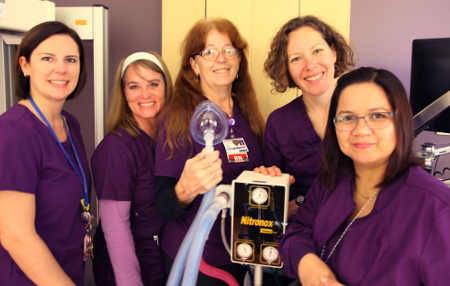
UKIAH, Calif. Childbirth is no laughing matter, or is it!? Ukiah Valley Medical Center (UVMC) joins a growing number of health care facilities to offer nitrous oxide, often referred to as laughing gas, to women in labor at the Family Birth Center.
Nitrous oxide is a mixture of nitrogen and oxygen gases. It is a noninvasive analgesic that reduces anxiety and pain, can be used late in labor and is self-administered, thus giving the laboring mom the ability to control her pain when she needs it.
Nitrous oxide takes effect in seconds, doesn’t inhibit labor contractions, and has little side effects for mother or baby.
Mendocino Community Health Clinic Obstetrician and Gynecologist Karen Crabtree, M.D., medical director of Care for Her, championed the use of nitrous oxide.
As she explained, “Nitrous oxide has a long history of success in other countries with very successful outcomes. Since FDA approval, we’ve been preparing for the launch which has included manufacturing of special equipment and training of nurses and staff. UVMC is one of the few hospitals in Northern California to offer nitrous oxide. As a small hospital, it is very cutting edge to have this option available.”
“Adding nitrous oxide gives women another choice in an area where there are few options,” said Casey Ford, director of Perinatal Services at UVMC. “Many women want to avoid the interventions that prevent them from getting out of bed to use the Jacuzzi, shower, or just walk around. With laughing gas it is never too early or too late to take the edge off of the pain, and it can be initiated in minutes.”
Nitrous oxide has been in use at UVMC since the beginning of December. Approximately 20 women have used it.
“I offered it to my patient, a first time mom, and she loved it,” said Agnes Calumpang, a registered nurse at the Family Birth Center. “She started it at 3 centimeters and used it to 7 centimeters. She was very happy with the results and liked the fact that she was in control.”
Birth centers around the country are beginning to show more interest in nitrous oxide as an option for women in labor.
However, UVMC is the only facility North of San Francisco, and South of Portland, OR to offer nitrous oxide as a pain management option for mothers to be.
Given all of its benefits, nitrous oxide truly provides expectant mothers with an opportunity to laugh while in labor.
The Family Birth Center offers a state-of-the art facility, with large private birthing suites and a Special Care Nursery. The center also offers educational and support classes for expectant moms and caregivers.
The Family Birth Center is located at Ukiah Valley Medical Center, 275 Hospital Drive in Ukiah.
For more information about classes, please call 707-463-7550 or visit us online at www.uvmc.org/birthcenter .
- Details
- Written by: Editor
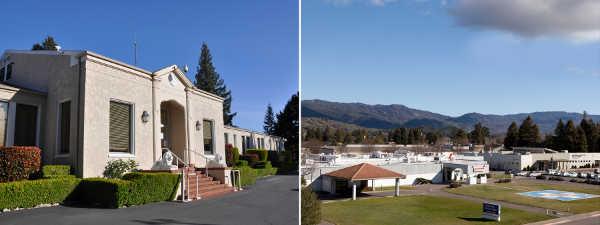
MENDOCINO COUNTY, Calif. – Adventist Health (AH) is making a significant investment in Mendocino County to improve the information technology infrastructure of Frank R. Howard Memorial Hospital (HMH), Ukiah Valley Medical Center (UVMC) and their associated clinics to serve patients seamlessly across the region.
In February, AH will roll out an upgrade to the software that is used in the registration process.
According to Becky Ryan, lead project manager for the upgrade in Mendocino County, “Currently our clinics and hospitals have been running on two different legacy software systems. That is one of the reasons when you register for a service in the clinic, and then at the hospital you have to reregister as if you were a new patient. This upgrade will make significant improvements to how information is transferred between the clinics and hospitals. Our patient’s medical records will now be integrated into one system to provide seamless care for our patients in the clinics and at the hospital. The integration will improve the timeliness and thoroughness of patient care, including reduction of medication errors and unnecessary testing.”
This is the fourth upgrade that AH has undertaken as a system. Three other regions have already upgraded and improved their processes and flow of information.
Once all the upgrades are complete it will help improve processes across its19 hospitals and numerous clinics throughout California, Hawaii, Oregon and Washington.
This means that medical records will be more easily accessible and transferable across the system – essentially making it easier for patients who utilize the services of an AH-affiliated hospital or clinic while outside of Mendocino county or the state.
President and CEO of UVMC Gwen Matthews believes that this upgrade will make a tremendous improvement in the overall information technology systems of the medical center.
“This will greatly improve the flow of electronic information across UVMC as a whole,” said Matthews. “Our clinics and ambulatory hospital services, lab and medical imaging, emergency services will be able to access the same medical record and information on each patient. This will help provide a consistent continuum of care for each patient no matter where they are seen in the system.”
Likewise, Howard Memorial Hospital President and CEO Rick Bockmann echoed Matthews’ sentiments.
“Patient safety and quality patient care have always been a top priority at HMH,” he said. “An upgraded system better enables us to continue to provide high quality care to our patients. With this change, patients will only register once even if their care requires multiple services within our care delivery network. As we approach the opening of our new HMH Hospital, I am confident this new system will improve the patient experience above our already high standards.”
The new system will take effect starting Feb. 4. The staff at both hospitals and all affiliated clinics have made every effort to ensure that there is minimal impact to patients during this transition. There might be slightly longer than normal waiting times as the staff gets acquainted with the new software.
These clinics include Heart Institute in Ukiah; Fort Bragg Rural Health Center; Mendocino Family Care; Redwood Medical Clinic in Willits; Ukiah Valley Medical Specialties - Gastroenterology; Ukiah Valley Medical Specialties – Orthopedics, and Ukiah Valley Rural Health Center network of clinics. Patients with scheduled appointments from Feb. 4 through Feb. 28 are advised to bring their ID/Driver’s License and proof of insurance for re-registration in the new system.
- Details
- Written by: Editor
LAKEPORT, Calif. – Sutter Lakeside received a disease-specific industry certification recognizing it as a primary stroke center on Friday, Jan. 16.
This means the hospital offers high-quality, immediate treatment on par with leading stroke centers in San Francisco.
“This is critical since we serve a remote population,” said Nicole Lamm, Sutter Lakeside Emergency Department nurse manager and stroke coordinator. “A stroke occurs when blood is unable to get to a part of your brain, and from its onset 32,000 brain cells die every second. There’s no time to drive to San Francisco to see a neurosurgeon.”
Sutter Lakeside works closely with the California Pacific Medical Center (CPMC) in San Francisco on stroke cases.
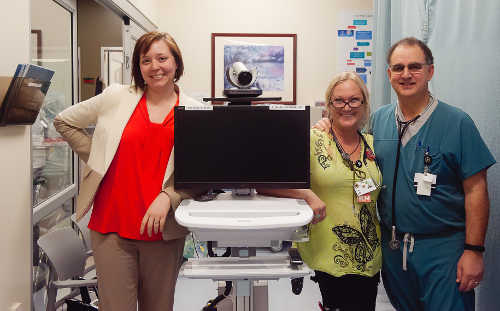
Using telemedicine, a CPMC neurosurgeon can perform a bedside assessment just as he or she would in person, while patients benefit from faster, more personalized local care.
The primary stroke center designation is especially meaningful in Lake County, which has a high incidence of stroke in part due to its large retired and low-income populations.
According to Lamm, the biggest problem with stroke treatment is that people don’t get to the hospital fast enough.
Men wait an average of five hours to seek medical help, and on average women wait much longer – sometimes more than 24 hours.
To be most effective, treatment should be administered within three hours.
“We tell people to think FAST about the key signs of stroke: “F is for facial drooping (on one side); A is for arm or leg weakness; S is for speech changes; and T reminds us that time is of the essence,” Lamm says. “If you see any of these symptoms, call 911 immediately. This isn’t just about transportation; it gives us time to pull up the patient’s medical history to prepare the most effective, expedient course of treatment.”
Stroke victims often don’t realize they’re having a stroke, which is why they wait so long to seek help. It’s important to share the signs of stroke with caretakers and family members, including children.
“We also want people to know that many strokes are preventable,” Lamm said. “Key risk factors include obesity, smoking, high cholesterol and high blood pressure. Maintaining a healthy lifestyle is our first and best defense.”
The primary stroke center certification comes from The Joint Commission, which accredits and certifies more than 20,500 health care organizations and programs throughout the United States.
The hospital has been working toward this goal for approximately two years. It received the certification after passing an onsite review by a Joint Commission field reviewer who assessed clinical procedures and outcomes, performance measures, leadership commitment and patient-education efforts.
“The certification demonstrates our commitment to meeting the most stringent performance standards for our patients,” said Sutter Lakeside Chief Administrative Officer Siri Nelson. “It all boils down to consistent care and better outcomes.”
To learn more about Sutter Lakeside, visit www.sutterlakeside.org/ .