Health
- Details
- Written by: Robert Sanders
A surprise discovery that overturns decades of thinking about how the body fixes proteins that come unraveled greatly expands opportunities for therapies to prevent diseases such as Alzheimer's and Parkinson's, which have been linked to the accumulation of improperly folded proteins in the brain.
“This finding provides a whole other outlook on protein-folding diseases; a new way to go after them,” said Andrew Dillin, the Thomas and Stacey Siebel Distinguished Chair of Stem Cell Research in the Department of Molecular and Cell Biology and Howard Hughes Medical Institute investigator at the University of California, Berkeley.
Dillin, UC Berkeley postdoctoral fellows Nathan A. Baird and Peter M. Douglas and their colleagues at the University of Michigan, The Scripps Research Institute and Genentech Inc., will publish their results in the Oct. 17 issue of the journal Science.
Cells put a lot of effort into preventing proteins – which are like a string of beads arranged in a precise three-dimensional shape – from unraveling, since a protein's activity as an enzyme or structural component depends on being properly shaped and folded.
There are at least 350 separate molecular chaperones constantly patrolling the cell to refold misfolded proteins. Heat is one of the major threats toproteins, as can be demonstrated when frying an egg – the clear white albumen turns opaque as the proteins unfold and then tangle like spaghetti.
For 35 years, researchers have worked under the assumption that when cells undergo heat shock, as with a fever, they produce a protein that triggers a cascade of events that field even more chaperones to refold unraveling proteins that could kill the cell.
The protein, HSF-1 (heat shock factor-1), does this by binding to promoters upstream of the 350-plus chaperone genes, upping the genes' activity and launching the army of chaperones, which originally were called “heat shock proteins.”
Injecting animals with HSF-1 has been shown not only to increase their tolerance of heat stress, but to increase lifespan.
Because an accumulation of misfolded proteins has been implicated in aging and in neurodegenerative diseases such as Alzheimer's, Parkinson's and Huntington's diseases, scientists have sought ways to artificially boost HSF-1 in order to reduce the protein plaques and tangles that eventually kill brain cells.
To date, such boosters have extended lifespan in lab animals, including mice, but greatly increased the incidence of cancer.
Dillin's team found in experiments on the nematode worm C. elegans that HSF-1 does a whole lot more than trigger release of chaperones.
An equal if not more important function is to stabilize the cell's cytoskeleton, which is the highway that transports essential supplies – healing chaperones included – around the cell.
“We are suggesting that, rather than making more of HSF-1 to prevent diseases like Huntington's, we should be looking for ways to make the actin cytoskeleton better,” Dillin said. Such tactics might avoid the carcinogenic side effects of upping HSF-1.
Dillin is codirector of the Paul F. Glenn Center for Aging Research, a new collaboration between UC Berkeley and UC San Francisco supported by the Glenn Foundation for Medical Research. Center investigators will study the many ways that proteins malfunction within cells, ideally paving the way for novel treatments for neurodegenerative diseases.
A cell at war
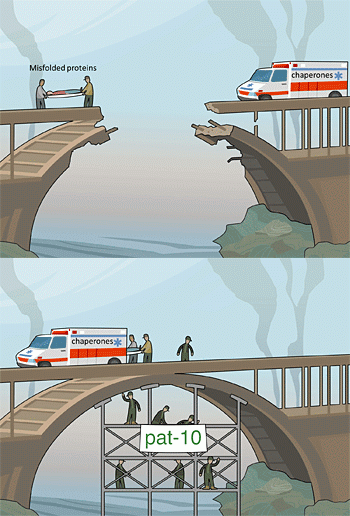
Dillin compares a cell experiencing heat shock to a country under attack. In a war, an aggressor first cuts off all communications, such as roads, train and bridges, which prevents the doctors from treating the wounded.
Similarly, heat shock disrupts the cytoskeletal highway, preventing the chaperone “doctors” from reaching the patients, the misfolded proteins.
“We think HSF-1 not only makes more chaperones, more doctors, but also insures that the roadways stay intact to keep everything functional and make sure the chaperones can get to the sick and wounded warriors,” he said.
The researchers found specifically that HSF-1 up-regulates another gene, pat-10, that produces a protein that stabilizes actin, the building blocks of the cytoskeleton.
By boosting pat-10 activity, they were able to cure worms that had been altered to express the Huntington's disease gene, and also extend the lifespan of normal worms.
Dillin suspects that HSF-1's main function is, in fact, to protect the actin cytoskeleton. He and his team mutated HSF-1 so that it no longer boosted chaperones, demonstrating, he said, that “you can survive heat shock with the normal level of heat shock proteins, as long as you make your cytoskeleton work better.”
He noted that the team's results – that boosting chaperones is not essential to surviving heat stress – were so contradictory to current thinking that “I made my post-docs' lives hell for three years” insisting on more experiments to rule out errors. Yet, when Dillin presented the results recently to members of the protein-folding community, he said the first reaction of many was, “That makes perfect sense.”
Dillin's colleagues include Milos S. Simic and Suzanne C. Wolff of UC Berkeley, Ana R. Grant of the University of Michigan in Ann Arbor, James J. Moresco and John R. Yates III of Scripps in La Jolla, Calif., and Gerard Manning of Genentech, South San Francisco, Calif. The work is funded by the Howard Hughes Medical Institute as well as by the National Institute of General Medical Sciences (8 P41 GM103533-17) and National Institute on Aging (R01AG027463-04) of the National Institutes of Health.
Robert Sanders works for the UC Berkeley News Center.
- Details
- Written by: Editor
SACRAMENTO – Dr. Ron Chapman, California Department of Public Health (CDPH) director and state health officer, today warned consumers about the risks associated with wearing decorative contact lenses without proper consultation with an eye care professional.
Decorative contact lenses are non-corrective lenses that do not correct vision and are intended to temporarily change the appearance of the eye.
Use of these lenses can carry serious risks, including permanent eye injury that may lead to blindness.
Advertised as color, cosmetic, fashion and theatrical contact lenses, they are especially popular around Halloween.
These decorative contact lenses are typically sold at beauty supply stores and other novelty stores.
All decorative contact lenses currently approved or cleared under the federal Food, Drug and Cosmetic Act are classified as prescription medical devices and, therefore may be sold only to or on the prescription of a licensed practitioner.
Wearing any kind of contact lens, including decorative lenses, can cause serious injury if not used correctly.
The risks include infection, blindness, ulcers, decreased vision, cuts or scratches to the surface of the eye, itchiness or redness. If these conditions are left untreated, the injuries can progress rapidly.
In most severe cases, blindness and eye loss can occur.
Consumers who have experienced any injury or illness with decorative contact lenses should contact their health care provider or contact CDPH at 1-800-495-3232.
- Details
- Written by: Editor
LAKEPORT, Calif. – October is National Physical Therapy Month, and Sutter Lakeside Hospital is recognizing the important role that physical therapy plays in the patient healing process.
Physical therapy helps to restore movement and function following an injury or surgery, relieve pain, and prevent illness and injury.
A recent body of research suggests that physical therapy treatment can be an equally effective, safer, more economical alternative to surgery and prescription drugs for numerous conditions, ranging from chronic back pain to an ankle sprain.
At Sutter Lakeside Hospital, physical therapists work collaboratively with their clients, tailoring each treatment plan to the patient.
This holistic approach includes patient education, identifying the cause of the problem, and long-term preventative strategies.
The tools that a physical therapist may employ during the rehabilitation process include exercise, massage, ultrasound, spinal manipulation, biofeedback, lasers, and a variety of hot/cold modalities.
Sutter Lakeside Hospital’s Rehabilitation Services offers physical, occupational and speech therapy on an outpatient basis.
“Our patients have access to a large fitness gym, free group fitness classes, and a very unique outdoor Mobility Park,” said Director of Rehabilitation Services Joe Prisco. “We’re proud of the services that we offer to Lake County. As a physical therapist myself, I truly appreciate being a part of the patient healing process here at Sutter Lakeside.”
Tiffany Ortega, assistant administrator at Sutter Lakeside Hospital, added, “We are a small hospital, so we are very pleased by all the amenities that we can offer to our patients. However, it is truly our top-notch physical therapists that set us apart. They are instrumental in ensuring that our patients return back to health.”
To learn more about Sutter Lakeside, visit www.sutterlakeside.org/ .
- Details
- Written by: Editor
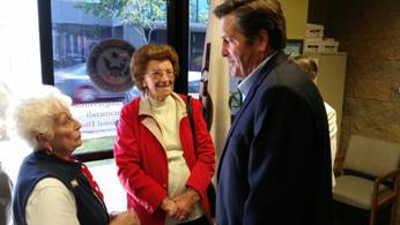
NORTHERN CALIFORNIA – On Wednesday, Congressman John Garamendi (D-CA-03), former Insurance Commissioner and health care advisor to President Clinton, highlighted the Department of Health and Human Services (HHS) announcement that there will be no increase in the Medicare Part B premium or deductible in 2015.
Garamendi said this is a welcome departure from the early 2000s when these premiums took a rapidly growing amount of money out of the pockets of seniors.
“There is good news for America’s seniors, many of whom live on a fixed income. For the second year in a row, there will be no increase in the Medicare Part B premium – with the premium remaining at $104.90 for 2013, 2014, and 2015,” said Congressman Garamendi. “Similarly, for the second year in a row, there will also be no increase in the Medicare Part B deductible in 2015 – with the deductible remaining at $147.
“Since the Affordable Care Act was enacted, seniors have experienced significant savings, including free preventative services, prescription drug discounts, and almost no growth in the Part B premium,” Garamendi added. “By contrast, in earlier years, seniors faced the burden of skyrocketing Medicare Part B premiums. Between 2000 and 2008, the Medicare Part B premium shot up 112 percent (jumping from $45.50 to $96.40). By comparison, the Medicare Trustees project that the premium will grow by only 10 percent from 2008 to 2016 (rising from $96.40 to $106.50) – or less than one-tenth of that rate.”
Part B premium growth has declined because of the dramatic slowdown in the growth of health care costs since the enactment of the Affordable Care Act (ACA).
Over the past four years, Medicare spending per capita has averaged only 0.8 percent a year – compared to an average growth rate of 6.3 percent a year from 2000 to 2008.
This announcement from HHS adds to the growing list of ways in which seniors with Medicare have experienced major savings, better benefits, and a more solvent program since the ACA was signed into law:
– Because of the ACA, more than 8.3 million seniors with Medicare have saved more than $12 billion on their prescription drugs, an average savings of $1,443 per senior.
– Because of the ACA, seniors now have free Medicare coverage of key preventative services, such as mammograms and colonoscopies. 37 million seniors received free preventative services through Medicare in 2013 alone.
– Since the enactment of the ACA, the solvency of the Medicare Trust Fund has been extended by 13 years. Prior to the ACA, the Medicare Trustees projected that the Trust Fund would be exhausted by 2017. In their latest report, the Medicare Trustees projected that the fund will remain solvent until 2030.
The health care reform law is supported by prominent senior citizens’ organizations, including AARP and the National Committee to Preserve Social Security & Medicare, because it protects and improves Medicare for older Americans.
Congressman Garamendi added, “I vividly remember the dark days before Medicare, watching impoverished seniors in the county ward who were simply warehoused and left to die. While today almost all seniors have health insurance coverage, before Medicare only about half had coverage. We can’t go back to those days. For that reason, I am committed to preserving and strengthening Medicare for our nation’s seniors.”