Health
- Details
- Written by: Editor
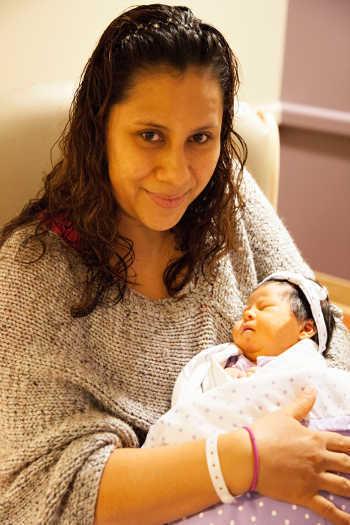
UKIAH, Calif. – On May 22, a beautiful baby girl, Yaretzi – Aztec for “will be loved forever” – Ramos, was born to Fabiola Ramos at the Family Birth Center.
This is a typical event on any given day at Ukiah Valley Medical Center. But for the Ramos family the day became anything but typical.
Upon further assessment of Yaretzi by pediatrician Paul H. Macdonald, M.D., it was determined that Yaretzi would need a pediatric echocardiogram.
“Newborns can be extremely vulnerable and I wanted to take necessary precautions to make sure her heart was functioning properly,” Macdonald said.
Initially this came as a shock to the Ramos family.
“Typically for this test we would have to transport the baby by helicopter or ambulance to the Bay Area leaving the family filled with anxiety as the mother recovers and the family prepares to make the trek down to San Francisco or Oakland to be with their baby. Just knowing the extra burden this puts on families helped UVMC’s administrative team make the decision to invest in the necessary training and equipment to make pediatric echocardiograms available at UVMC,” said Dr. Macdonald.
“The investment in the well-being and piece-of-mind of mothers and young families is worth the cost,” said UVMC Chief Executive Officer Gwen Matthews. “As the largest medical center in Mendocino and Lake counties, we want to make sure we are able to provide the services our community needs close to home.”
“Each of our adult echocardiography technicians recently went through training at the University of California Davis Medical Center,” said UVMC Echocardiography Supervisor Linda Tea.
“This training was comprised of observation studies of live pediatric echocardiograms being performed in a Neonatal Intensive Care Unit and outpatient radiology lab,” said Tea. “Our techs also went through extensive simulations demonstrating their competency on a state-of-the-art training mannequin before attempting the test on an actual pediatric patient. The pediatric echocardiogram can be performed on newborn infants to 18 year olds.”
As for her daughter being the first patient to have a pediatric echocardiogram done at UVMC, Fabiola Ramos said, “I am so glad we were able to do the test here [at UVMC]. I couldn’t imagine having to worry about Yaretzi being transported without me to [the Bay Area] and then having to worry about getting down there myself.”
Fortunately, the echocardiogram ruled out the need for any transport.
“I am so thankful for the care I received at UVMC and especially the nurses; Monica, Daisy, Maria and Dr. Macdonald – they are all angels who helped my little angel. I will forever be grateful to UVMC,” Ramos added.
In addition to pediatric echocardiograms, UVMC offers state-of-the-art diagnostic services including one of the most powerful MRI’s in Northern California, PET/CT scanner, CT scanner, nuclear medicine, digital x-ray, ultrasound, digital mammography, DXA scan, and other advanced diagnostic tests and procedures at two different locations: Mendocino Radiology and UVMC.
For more information on diagnostic imaging tests and procedures available at UVMC please call 707-463-7342.
- Details
- Written by: Gary Quackenbush
LAKEPORT, Calif. – Sutter Lakeside Hospital has improved its ability to provide non-stop, around-the-clock intensive care unit (ICU) patient coverage in recent years by utilizing an electronic telemedicine network called eICU.
“Large city hospitals, and major university medical centers with 20-30 intensive care beds have physicians and specialists on-site to staff ICU shifts 24/7,” said Dr. Bunchong Kosolcharoen, known as Dr. Tony, the director of Sutter Lakeside Hospital’s Intensive Care Unit, states.
“At rural hospitals like Sutter Lakeside, our resources are limited,” he added. “In order to provide the highest level of care, equivalent to university-level hospitals, we have instituted electronic remote monitoring at night. This ensures that quality patient care can be provided continuously by a whole team of doctors.”
From 4 p.m. to 7 a.m., doctors from around the North Bay area, including Santa Rosa Memorial Hospital, Marin General Hospital and Sutter affiliate California Pacific Medical Center, provide acute care of Lakeside ICU patients by observing them electronically.
These doctors can view patients at Sutter Lakeside visually, see patient charts, and look at electronic records, x-rays and test results remotely; physicians can even track Sutter Lakeside’s patients’ vital signs through an electronic stethoscope.
Kosolcharoen added, “The eICU is comprised of a big group of physicians from a variety of hospitals, including those outside the Sutter system, so we have the advantage of being able to draw from a very deep pool of knowledge and experience.”
Using high resolution cameras and telemedicine links, the eICU enables up-to-the-minute monitoring so that doctors miles away can write orders and ensure that patient care occurs in real time.
For example, should a patient’s heart stop at night, an alarm is triggered and the telemedicine team alerts nurses on duty at Sutter Lakeside to take immediate action.
“The eICU is a collaborative process where primary and staff physicians at Lakeside confer closely with CPMC doctors and ensure that established care plans are carried over before signing out. I like to think of this as a second-eyes process where the San Francisco staff serves as a backup for those of us at Lakeside every night,” explained Dr. James Pretorius, a hospitalist at Sutter Lakeside who works in the eICU.
“Another new feature allows doctors to have a two-way visual discussion with patients using a TV monitor rolled into the patient’s room on a robotic cart,” Pretorius said. “The Lakeside Emergency Room staff and the stroke team at CPMC are using this device today for personal, one-on-one visits with patients to observe their status. These and other high-tech systems enable us to provide an extremely high level of care.”
The Sutter eICU network monitoring system has become a model for the North Bay region. At Sutter Lakeside Hospital, it is one more way that the hospital can provide excellent care for patients and keep them close-to-home.
“We want to provide the best care possible for the whole patient. I ask myself if I would I want to be admitted to Lakeside’s eICU and my answer is definitely ‘yes.’ While technology alone cannot replace doctors, it does make information flow quickly so physicians at both locations can make timely, accurate decisions faster and more efficiently,” said Kosolcharoen.
To learn more about Sutter Lakeside, visit www.sutterlakeside.org/ .
- Details
- Written by: Editor
SACRAMENTO – The Assembly passed legislation last week aimed at addressing ongoing problems with resident and employee safety at California developmental centers and state hospitals.
The bill was passed to the Senate on a unanimous, bipartisan vote.
AB 602, by Assemblymember Mariko Yamada (D-Davis), would require employees at state hospitals and developmental centers to report serious assault and abuse incidents directly to outside law enforcement agencies within two hours. Currently, those reports are made internally within 48 hours.
“The current internal process to report and investigate these violations is inadequate,” Assemblymember Yamada said. “These matters should be investigated by local law enforcement agencies to ensure that state hospital and developmental center residents have access to the same protections as any other citizen.”
To facilitate investigations at the state’s developmental centers and state hospitals, which provide care for some of the state’s most vulnerable residents, AB 602 will also require local law enforcement to participate in specialized training.
In 2012, after the investigative media organization California Watch found that the Office of Protective Services, the state's internal security body housed at state hospitals and developmental centers, had left a large number of abuse and sexual assault incidents uninvestigated, legislative leaders proposed several bills to increase transparency and expedite reports of abuse.
Yamada's district includes the Sonoma Developmental Center and the Napa State Hospital where many of the most serious incidents have occurred.
She also chairs the Assembly Select Committee on State Hospital and Developmental Center Safety, which will convene an oversight hearing in late June to coincide with the release of a state audit of the Office of Protective Services.
Yamada also is seeking to participate in Task Force on the Future of State Developmental Centers convened by the California Health and Human Services Agency Secretary Diana S. Dooley.
- Details
- Written by: Editor
LAKE COUNTY, Calif. – Partnership HealthPlan of California (PHC), the non-profit Medi-Cal health plan in Sonoma, Solano, Napa, Marin, Mendocino and Yolo counties, continues its work on the expansion of its managed care program into eight additional northern California counties late this summer: Del Norte, Humboldt, Lake, Lassen, Modoc, Shasta, Siskiyou and Trinity counties.
Medi-Cal, nationally known as Medicaid, is a state and federal program that provides health care to over seven million low-income residents in California.
PHC and its community partners want to ensure that this transition is a smooth one for its members and medical providers.
While there will be no change in benefits as a result of this switch to managed care, it’s important to note that Medi-Cal recipients must choose a primary care provider for their health care under the new system.
The move to managed care for Medi-Cal recipients in the northern counties has been in the works for several years.
Beginning Sept. 1, 296,000 Medi-Cal beneficiaries in 14 counties will have a medical home through PHC, coordination of care, and supplemental benefits not covered by the State’s traditional Medi-Cal program.
The goal of PHC has been to expand upon the existing number of medical providers willing to see Medi-Cal patients and to support the delivery of more care locally, so that when possible, residents do not need to leave their communities to seek care.
The roughly 103,000 Medi-Cal beneficiaries in the eight northern California counties will have access to a Member Services Call Center to learn more about their benefits, select a physician, and have their complaints addressed.
A small number of Medi-Cal recipients will remain in the State’s traditional Medi-Cal program and can continue to see medical providers who accept Medi-Cal for payment.
However, those Medi-Cal members who are enrolled in PHC will have access to substance abuse benefits and several benefits such as audiology services and podiatry services for diabetics; services that were cut in 2009 by the State of California due to the ongoing economic issues that impact the State’s budget.
Members from each county covered by Partnership HealthPlan of California are represented on the PHC Governing Board.
The board includes representatives from the member and provider communities, all appointed by each county’s Board of Supervisors.
Members also are represented on a number of advisory committees, which bring together PHC members and medical providers from various counties and programs to discuss ways PHC can improve.
“We have tremendous support from our provider community and government partners in making sure that the transition to managed care is fluid. PHC has a process in place to ensure that medical care does not get interrupted during this time,” said Jack Horn, chief executive officer of Partnership HealthPlan of California.
PHC meets on a regular basis with primary care and specialty physicians, community stakeholders, hospitals, local government representatives and safety net providers to gather input, collaborate and plan for the transition.
“High quality continuity of care is our biggest priority,” Horn said. “With this expansion, these rural Medi-Cal recipients will have access to a primary care physician, better access to specialty care, and access to health plan staff dedicated to providing quality assistance and care to all of our members. We are pleased to be working with our partners in the north. They have been very innovative in providing care for patients and we are learning a lot from each other. The relationship is very collaborative.”
Partnership HealthPlan of California began operating in 1994. Additional information about PHC can be found at www.partnershiphp.org .