How to resolve AdBlock issue?
Refresh this page
How to resolve AdBlock issue?
Refresh this page
Lake County News,California
  • Home
    • Registration Form
  • News
    • Education
    • Veterans
    • Community
      • Obituaries
      • Letters
      • Commentary
    • Police Logs
    • Business
    • Recreation
    • Health
    • Religion
    • Legals
    • Arts & Life
    • Regional
  • Calendar
  • Contact us
    • FAQs
    • Phones, E-Mail
    • Subscribe
  • Advertise Here
  • Login
How to resolve AdBlock issue?
Refresh this page

News

Long-running Goat Mountain repeater project completed

Details
Written by: LAUREN BERLINN
Published: 12 October 2025
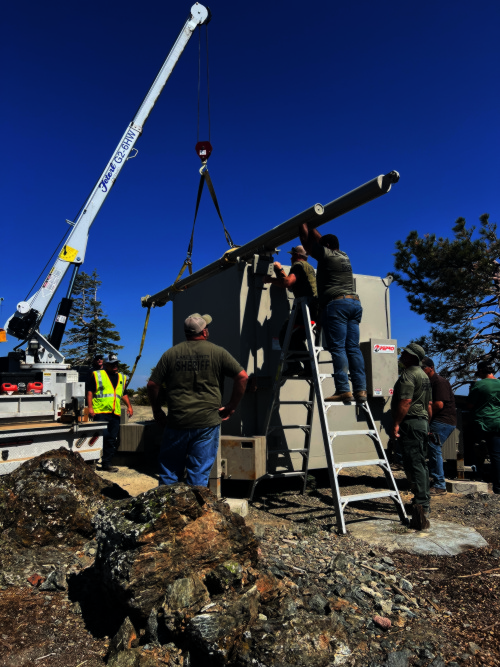
The completion of the Goat Mountain repeater project was the culmination of 15 years of effort. Photo courtesy of the Lake County Sheriff’s Office.

LAKE COUNTY, Calif. — After more than 15 years of planning, testing and multi-agency collaboration, the Goat Mountain Project has reached a major milestone. 

On Oct. 1, the communications repeater at Goat Mountain was successfully brought online and is now fully operational.

The Goat Mountain Project is a joint initiative of the Lake County Sheriff’s Office, Lake County Fire Protection District, and Pacific Gas and Electric Co., with aerial support provided by PJ Helicopters. 

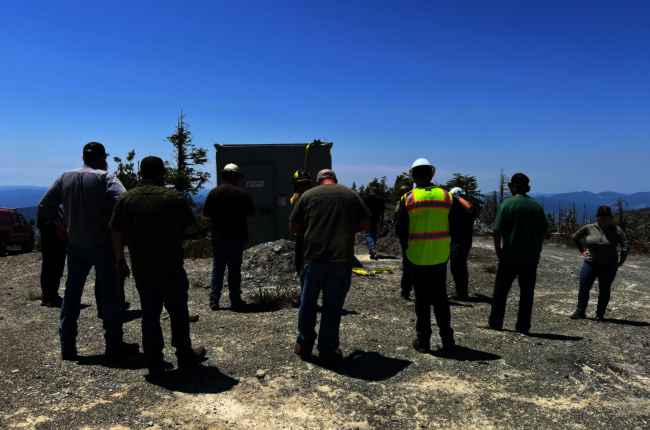
The crew working on the Goat Mountain Project. Photo courtesy of the Lake County Sheriff’s Office.


The project was designed to eliminate critical radio dead zones that have limited law enforcement and fire response for years.

The newly activated repeater significantly improves coverage across Bear Valley, Indian Valley, Bartlett, and areas north of Bartlett, Walker Ridge, and the Lake Pillsbury area.

It also strengthens communication along Highway 20 east of Highway 20 and Highway 53, including Spring Valley.

Bringing this project online required persistence and dedication. Members of the Sheriff's Office and partner agencies made more than five trips to the rugged Goat Mountain site to deliver, install, and activate the equipment, despite ongoing challenges posed by wildfire seasons and severe winter storms.

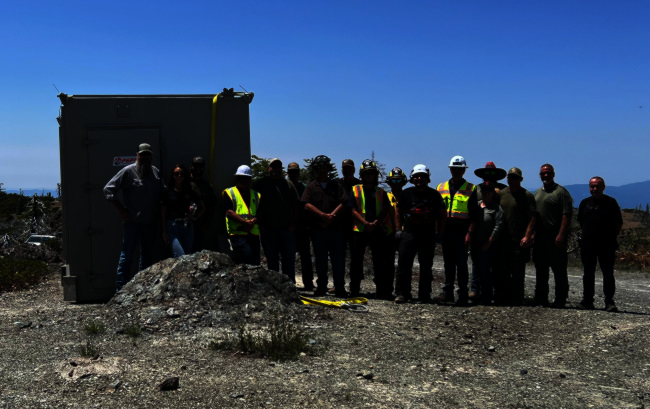
The Goat Mountain Project crew. Photo courtesy of the Lake County Sheriff’s Office.


The project began more than a decade ago with field testing of potential repeater sites across San Hedrin, Walker Ridge, Lake Pillsbury and ultimately Goat Mountain. 

Goat Mountain was identified as the only viable location to provide the broad coverage needed. After years of environmental review and funding coordination, the project has now been fully completed with the installation of the vault, repeater, and communications equipment.

Future projects will continue to expand and strengthen this system to ensure Lake County’s first responders remain connected when it matters most.

Lauren Berlinn is public information and community engagement officer for the Lake County Sheriff’s Office.


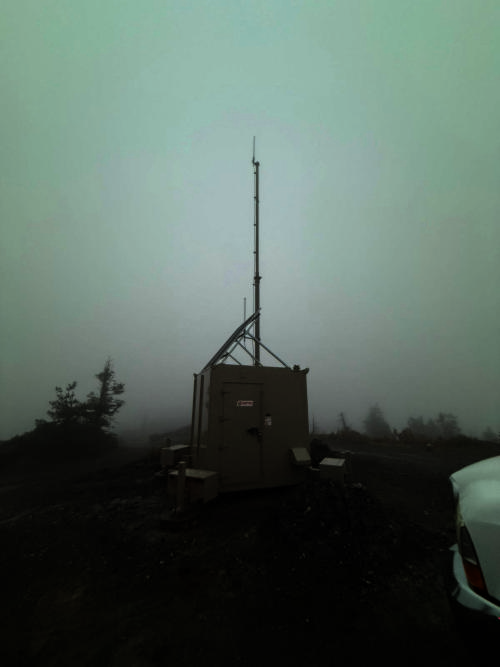
The Goat Mountain repeater. Photo courtesy of the Lake County Sheriff’s Office.

Lower Lake wildland fire close to full containment

Details
Written by: Elizabeth Larson
Published: 12 October 2025

LAKE COUNTY, Calif. — A fire that began in Lower Lake on Saturday afternoon is nearing full containment.

Cal Fire said the Rock fire began at 3:42 p.m. near Butte Rock Ranch Road and Morgan Valley Road.

By Saturday night, Cal Fire said the fire was 39 acres and 90% contained.

Four engines and 15 firefighters were assigned to the incident as of Saturday night.

Radio traffic indicated that units were continuing to monitor the incident, with a crew to return on Sunday morning. 

The cause remains under investigation, Cal Fire said.

Email Elizabeth Larson at This email address is being protected from spambots. You need JavaScript enabled to view it.. Follow her on Twitter, @ERLarson, and on Bluesky, @erlarson.bsky.social. Find Lake County News on the following platforms: Facebook, @LakeCoNews; X, @LakeCoNews; Threads, @lakeconews, and on Bluesky, @lakeconews.bsky.social. 

Friendships aren’t just about keeping score – new psychology research looks at why we help our friends when they need it

Details
Written by: Jessica D. Ayers, Boise State University and Athena Aktipis, Arizona State University
Published: 12 October 2025

Friendship isn’t about a running tally of who’s doing more. miodrag ignjatovic/E+ via Getty Images

Despite how natural friendship can feel, people rarely stop to analyze it. How do you know when someone will make a good friend? When is it time to move on from a friendship? Oftentimes, people rely on gut intuitions to answer these kinds of questions.

In psychology research, there’s no universally accepted definition of a friend. Traditionally, when psychologists have analyzed friendship, it’s often been through the lens of exchange. How much did that friend do for me? How much did I do for them? The idea is that friendships are transactional, where friends stick around only as long as they are getting at least as much as they are giving in the friendship.

But this focus doesn’t capture what feels like the essence of friendship for many people. We and our colleagues think another model for relationships – what we call risk-pooling – better matches what many people experience. In this kind of friendship, no one is keeping track of who did what for whom.

Our research over the past decade suggests that this kind of friendship was essential for our ancient ancestors to survive the challenges they encountered. And we feel it’s essential for surviving the challenges of life today, whether navigating personal struggles or dealing with natural disasters.

three men drink wine at cafe table with bill on it
Social exchange theory focuses on whether friends are investing and getting the same amount from the relationship. tim scott/Moment via Getty Images

A focus on what friends give you

The traditional social exchange theory of friendship views relationships as transactions where people keep a tally of costs and benefits. Building on this framework, researchers have suggested that you approach each friendship with a running list of pluses and minuses to decide whether to maintain the bond. You keep friendships that provide more benefits than costs, and you end those that don’t.

The theory holds that this balancing act comes into play when making decisions about what kinds of friendships to pursue and how to treat your friends. It’s even made its way into pop psychology self-help spaces.

We contend that the biggest issue with social exchange theory is that it misses the nuances of real-life relationships. Frankly, the theory’s wrong: People often don’t use this cost-to-benefit ratio in their friendships.

Less accounting, more supporting

Anybody who has seen a friend through tough times – or been the one who was supported – can tell you that keeping track of what a friend does for you isn’t what friendships are about. Friendships are more about companionship, enjoyment and bonding. Sometimes, friendship is about helping just because your friend is in need and you care about their well-being.

Social exchange theory would suggest that you’d be better off dropping someone who is going through cancer treatment or a death in the family because they’re not providing as many benefits to you as they could. But real-life experiences with these situations suggest the opposite: These are the times when many people are most likely to support their friends.

Our research is consistent with this intuition about the shortcomings of social exchange theory. When we surveyed people about what they want in a friend, they didn’t place a high value on having a friend who is conscientious about paying back any debts – something highly valued from a social exchange perspective.

People considered other traits – such as loyalty, reliability, respectfulness and being there in times of need – to be much more important. These qualities that relate to emotional commitment were seen as necessities, while paying back was seen as a luxury that mattered only once the emotional commitment was met.

Having friends who will help you when you’re struggling, work with you in the friendship and provide emotional support all ranked higher in importance than having a friend who pays you back. While they might not always be able to provide tangible benefits, friends can show they care in many other ways.

Of course, friendship isn’t always positive. Some friends can take advantage by asking too much or neglecting responsibilities they could handle themselves. In those cases, it can be useful to step back and weigh the costs and benefits.

Friendship is more than the sum of its parts

But how do friendships actually help people survive? That is one question that we investigated as part of The Human Generosity Project, a cross-disciplinary research collaboration.

The risk-pooling rather than exchange pattern of friendship is something that we found across societies, from “kere kere” in Fiji to “tomor marang” among the Ik in Uganda. People help their friends in times of need without expecting to be paid back.

Two Maasai herders in traditional clothing with herd of cattle against dusty landscape
Maasai people cultivate lifelong relationships called osotua partnerships. calm_eyes/iStock via Getty Images Plus

The Maasai, an Indigenous group in Kenya and Tanzania who rely on cattle herds to make their living, cultivate friends who help them when they are in need, with no expectation about paying each other back. People ask for help from these special friends, called osotua partners, only when they are in genuine need, and they give if they are asked and able.

These partnerships are not about everyday favors – rather, they are about surviving unpredictable, life-altering risks. Osotua relationships are built over a lifetime, passed down across generations and often marked with sacred rituals.

When we modeled how these osotua relationships function over time, we found they help people survive when their environments are volatile and when they ask those most likely to be able to help. These relationships lead to higher rates of survival for both partners compared to those built on keeping track of debts.

These friends act as social insurance systems for each other, helping each other when needs arise because of unpredictable and uncontrollable events.

And we see this in the United States, just as we do in smaller-scale, more remote societies. In one study, we focused on ranchers in southern Arizona and New Mexico embedded in a network of what they call “neighboring.” They don’t expect to be paid back when they help their neighbors with unpredictable challenges such as an accident, injury or illness. We also found this same pattern in an online study of U.S.-based participants.

In contrast, people such as the ranchers we studied are more likely to expect to be paid back for help when needs arise because of more predictable challenges such as branding cattle or paying bills.

Catastrophic insurance, not tit for tat

What all this research suggests is that friendship is less about the exchange of favors and more about being there for each other when unforeseeable disaster strikes. Friendship seems more like an insurance plan designed to kick in when you need it most rather than a system of balanced exchange.

What lets these partnerships endure is not only generosity, but also restraint and responsibility: Maasai expect their osotua partners to take care of themselves when they can and to ask only when help is truly needed. That balance of care, respect and self-management offers a useful model.

In a world of growing uncertainty, cultivating risk-pooling friendships and striving to be a good partner yourself may help you build resilience. Our ancestors survived with the help of this kind of relationship; our future may depend on them too.The Conversation

Jessica D. Ayers, Assistant Professor of Psychological Science, Boise State University and Athena Aktipis, Associate Professor of Psychology, Arizona State University

This article is republished from The Conversation under a Creative Commons license. Read the original article.
Space News: Astronaut candidates get to work at Johnson Space Center

Details
Written by: Linda E. Grimm
Published: 12 October 2025
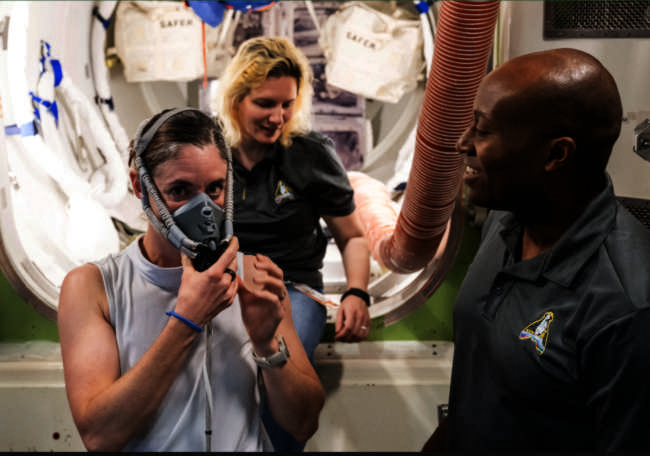
NASA astronauts Andre Douglas, Christina Birch and Deniz Burnham during life support systems training in a mockup of an International Space Station airlock at Johnson Space Center. Photo: NASA/James Blair.


NASA announced its newest class of astronaut candidates on Sept. 22 at the agency’s Johnson Space Center in Houston. 

After the welcome ceremony, the 10 highly qualified individuals rolled up their sleeves and prepared for the next step in their journey to the stars: nearly two years of training to become flight-eligible for missions to low Earth orbit, the Moon, and ultimately, Mars.

The training astronaut candidates complete is comprehensive and rigorous. They learn about NASA’s history and vision, and how astronauts advance the agency’s mission.

They take classes on space health — gaining an understanding of radiation exposure, microgravity’s effects on the human body, space food and nutrition, and how to use the exercise equipment aboard the International Space Station. They also study first aid and practice providing medical care for crewmates. 

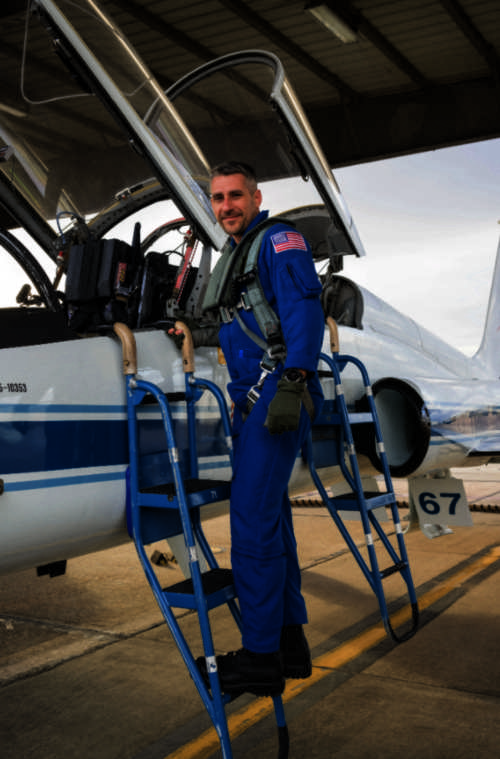
Each candidate will receive flight training, learning to pilot or improving their current piloting skills through the T-38 supersonic jet and other aviation platforms.

With NASA’s plans for the future of exploration, this class of astronauts may have opportunities to fly to low Earth orbit, or even beyond. 

Some may contribute to research and technology investigations taking place aboard the space station — which is about to celebrate 25 years of continuous human presence in space. Others may venture to the Moon to prepare for future Mars missions.   

To be ready for any destination, this class will complete both space station training and advanced preparation for deep space. These exercises allow astronaut candidates to work through problems and build relationships with their classmates while preparing them for space flights.

NASA astronaut Luke Delaney prepares for a training flight in a T-38 jet. Photo: NASA/Robert Markowitz.


“Training was such an intense period that we got to know each other really well,” said NASA astronaut Anil Menon, who joined the agency as part of the 2021 class — astronaut group 23. “Now when we come together, there are these moments — like we might be handing off a capcom shift, or we might be flying a jet together — and in those moments, I feel like I know them so well that we know how to navigate all sorts of challenges together and just be our best selves as a team.”

Astronaut candidate training also teaches foundational skills that can be applied to any destination in space. 

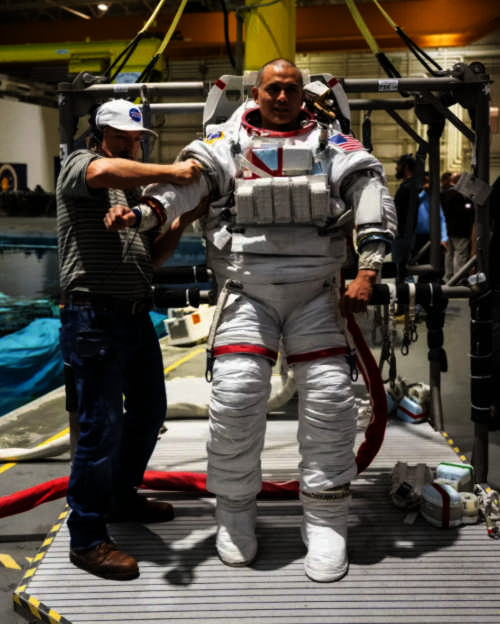
The group will complete several dives in the Neutral Buoyancy Laboratory, simulating spacewalks in different environments and learning how to do maintenance tasks in microgravity with a full-scale underwater mockup of the International Space Station as their worksite. 

They will also train inside other mockups of space vehicles, learning emergency procedures, maintenance, and repair of spacecraft, along with how to contribute to future developmental programs.

Robotics training will prepare them to use the station’s Canadarm2 robotic arm. They will trek through the wilderness as part of their land and water survival training, and they will study geology in the classroom and in the field. 

The group will practice tasks in a variety of simulations, leveraging Johnson’s world-class facilities, virtual reality, and immersive technologies. Additionally, the class will work shifts in the Mission Control Center in Houston to experience a day in the life of the people who keep watch over the astronauts and vehicles.

Astronaut candidates who successfully complete the training program celebrate their achievement in a graduation ceremony, after which they are officially flight-eligible members of NASA’s astronaut corps. They will also receive office and ground support roles at Johnson while they await future flight assignments.

“I’ve been exposed to a lot of different parts of what we do at Johnson Space Center, working both with the current increment of supporting operations aboard the International Space Station, as well as supporting some development of the Orion spacecraft and Artemis II preparations,” said NASA astronaut Chris Birch, another member of astronaut group 23.

Many members of NASA’s active astronaut corps emphasize that the learning does not stop when astronaut candidate training ends. 

“You have the foundational training and you continue to build off of that,” said Deniz Burnham, adding that the hardest days can be the most educational. “You get to learn, you get to improve, and then you’re still getting the opportunity. It’s such a positively unique experience and environment, and you can’t help but be grateful.”

As NASA astronaut Frank Rubio, class mentor, told the group, “You’ll become part of a legacy of those who trained before you, continuing the adventure they started, and looking ahead to future human exploration.”

Linda E. Grimm works for the Johnson Space Center Office of Communications.

NASA astronaut Anil Menon suits up before completing a training dive in the Neutral Buoyancy Laboratory at Johnson Space Center. Photo: NASA/Josh Valcarcel.

  1. Lake County students continue to show growth on state assessments
  2. McGuire to host community conversation on hunger Oct. 16
  3. Flu season has arrived – and so have updated flu vaccines
  • 195
  • 196
  • 197
  • 198
  • 199
  • 200
  • 201
  • 202
  • 203
  • 204
How to resolve AdBlock issue?
Refresh this page