How to resolve AdBlock issue?
Refresh this page
How to resolve AdBlock issue?
Refresh this page
Lake County News,California
  • Home
    • Registration Form
  • News
    • Education
    • Veterans
    • Community
      • Obituaries
      • Letters
      • Commentary
    • Police Logs
    • Business
    • Recreation
    • Health
    • Religion
    • Legals
    • Arts & Life
    • Regional
  • Calendar
  • Contact us
    • FAQs
    • Phones, E-Mail
    • Subscribe
  • Advertise Here
  • Login
How to resolve AdBlock issue?
Refresh this page

News

Trump scraps the nation’s most comprehensive food insecurity report − making it harder to know how many Americans struggle to get enough food

Details
Written by: Tracy Roof, University of Richmond
Published: 03 October 2025

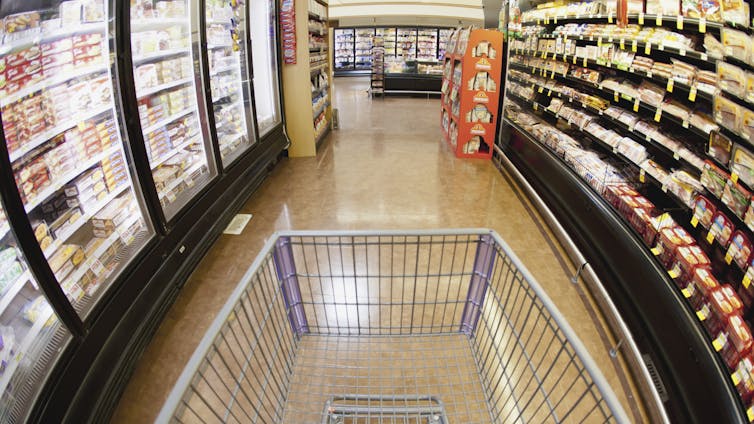
Nearly 1 in 7 Americans had trouble consistently getting enough to eat in 2023. Patrick Strattner/fStop via Getty Images

The Trump administration announced on Sept. 20, 2025, that it plans to stop releasing food insecurity data. The federal government has tracked and analyzed this data for the past three decades, but it plans to stop after publishing statistics pertaining to 2024 data. The Conversation U.S. asked Tracy Roof, a political scientist who has researched the history of government nutrition programs, to explain the significance of the U.S. Household Food Security Survey and what might happen if the government discontinues it.

What’s food insecurity?

The U.S. Department of Agriculture defines food security as “access by all people at all times to enough food for an active, healthy life.”

People who are food insecure are unsure they can get enough food or unable to get enough food to meet these basic needs because they can’t afford it.

How does the government measure it?

The USDA has collected data on food insecurity since the mid-1990s. It includes the share of the population that is food insecure and a subset of this group considered to have very low food security.

People who are food insecure may not significantly reduce how much they eat, but they are likely to eat less balanced meals or lower-quality food. People with very low food security report eating less altogether, such as by skipping meals or eating smaller meals.

These statistics are based on answers to questions the USDA adds to the Current Population Survey, which the Census Bureau administers every December. There are 10 questions in the survey. Households with children are asked four more.

The questions inquire about access to food, such as whether someone has worried in the past year that their food would run out before they had enough money to buy more, or how frequently they have skipped meals, could not afford balanced meals, or felt hunger.

The U.S. food insecurity rate stood at 13.5% in 2023, the most recent year for which data is currently available. The final annual food security report, expected in October, will be issued for 2024 – based on data collected during the Biden administration’s last year.

Why did the government start measuring it?

Calls for creating the food stamp program in the 1960s led to an intense debate in Washington about the extent of malnutrition in the U.S. Until then, the government did not consistently collect reliable or national statistics on the prevalence of malnutrition.

Those concerns reached critical mass when the Citizens’ Board of Inquiry into Hunger and Malnutrition, launched by a group of anti-hunger activists, issued a report in 1968, Hunger USA. It estimated that 10 million Americans were malnourished.

That report highlighted widespread incidence of anemia and protein deficiency in children. That same year, a CBS documentary, “Hunger in America,” shocked Americans with disturbing images of malnourished children. The attention to hunger resulted in a significant expansion of the food stamp program, but it did not lead to better government data collection.

The expansion of government food assistance all but eliminated the problem of malnutrition. In 1977, the Field Foundation sent teams of doctors into poverty stricken areas to assess the nutritional status of residents. Although there were still many people facing economic hardship, the doctors found there was little evidence of the nutritional deficiencies they had seen a decade earlier.

Policymakers struggled to reach a consensus on the definition of hunger. But the debate gradually shifted from how to measure malnutrition to how to estimate how many Americans lacked sufficient access to food.

Calls for what would later be known as food insecurity data grew after the Reagan administration scaled back the food stamps program in the early 1980s. Despite the unemployment rate soaring to nearly 11% in 1982 and a steep increase in the poverty rate, the number of people on food stamps had remained relatively flat.

Although the Reagan administration denied that there was a serious hunger problem, news reports were filled with stories of families struggling to afford food.

Many were families of unemployed breadwinners who had never needed the government’s help before. During this period, the number of food banks grew substantially, and they reported soaring demand for free food.

Because there was still no government data available to resolve the dispute, the Reagan administration responded to political pressure by creating a task force on hunger in 1983. It called for improved measures of the nutritional status of Americans.

The task force also pointed to the difference between “hunger as medically defined” and “hunger as commonly defined.” That is, someone can experience hunger – not getting enough to eat – without displaying the physical signs of malnutrition. In other words, it would make more sense to measure access to food as opposed to the effects of malnutrition.

In 1990 Congress passed the National Nutrition Monitoring and Related Research Act, which President George H.W. Bush signed into law. It required the secretaries of Agriculture and Health and Human Services to develop a 10-year plan to assess the dietary and nutritional status of Americans. This plan, in turn, recommended developing a standardized measurement of food insecurity.

The Food Security Survey, developed in consultation with a team of experts, was first administered in 1995. Rather than focusing on nutritional status, it was designed to pick up on behaviors that suggested people were not getting enough to eat.

Did tracking food insecurity help policymakers?

Tracking food insecurity allowed the USDA, Congress, researchers and anti-hunger groups to know how nutritional assistance programs were performing and what types of households continued to experience need. Researchers also used the data to look at the causes and consequences of food insecurity.

Food banks relied on the data to understand who was most likely to need their help.

The data also allowed policymakers to see the big jump in need during the Great Recession starting in 2008. It also showed a slight decline in food insecurity with the rise in government assistance early in the COVID-19 pandemic, followed by another big jump with steeply rising food prices in 2022.

The big budget bill Congress passed in July will cut spending on the Supplemental Nutrition Assistance Program by an estimated US$186 million through 2034, an almost 20% reduction.

Supporters of SNAP, the new name for the food stamp program adopted in 2008, worry the loss of the annual reports will hide the full impact of these cuts.

Why is the administration doing this?

In the brief press release the USDA issued on Sept. 20 announcing the termination of the annual food insecurity reports, the USDA indicated that the Trump administration considers the food security survey to be “redundant, costly, politicized, and extraneous,” and does “nothing more than fear monger.”

While I disagree with that characterization, it is true that anti-hunger advocates have pointed to increases in food insecurity to call for more government help.

Is comparable data available from other sources?

Although the USDA noted there are “more timely and accurate data sets” available, it was not clear which datasets it was referring to. Democrats have called on the Trump administration to identify the data.

Feeding America, the largest national network of food banks, releases an annual food insecurity report called the Map the Meal Gap. But like other nonprofits and academic researchers that track these trends, it relies on the government’s food insecurity data.

There is other government data on food purchases and nutritional status, and a host of other surveys that use USDA questions. However, there is no other survey that comprehensively measures the number of Americans who struggle to get enough to eat.

As in the 1980s, policymakers and the public may have to turn to food banks’ reports of increased demand to get a sense of whether the need for help is rising or falling. But those reports can’t replace the USDA’s Food Security Survey.The Conversation

Tracy Roof, Associate Professor of Political Science, University of Richmond

This article is republished from The Conversation under a Creative Commons license. Read the original article.

Clearlake Animal Control: ‘Jade’ and the dogs

Details
Written by: Elizabeth Larson
Published: 03 October 2025
"Jade." Photo courtesy of Clearlake Animal Control.

CLEARLAKE, Calif. — Clearlake Animal Control has a wide selection of canines waiting for new homes.

The shelter has 47 adoptable dogs listed on its website.

This week’s dogs include “Jade,” a 2-year-old female lab mix.

Shelter staff said she loves toys and splashing around in water. “This affectionate girl adores snuggles and will happily curl up beside you after a day of adventure. She's a pro on the leash, making her walks a joy. Jade is good with some dogs, so she's open to meeting new furry friends!”

The shelter is located at 6820 Old Highway 53. It’s open from 9 a.m. to 6 p.m. Tuesday through Saturday. 

For more information, call the shelter at 707-762-6227, email This email address is being protected from spambots. You need JavaScript enabled to view it., visit Clearlake Animal Control on Facebook or on the city’s website.

This week’s adoptable dogs are featured below.

Email Elizabeth Larson at This email address is being protected from spambots. You need JavaScript enabled to view it.. Follow her on Twitter, @ERLarson, and on Bluesky, @erlarson.bsky.social. Find Lake County News on the following platforms: Facebook, @LakeCoNews; X, @LakeCoNews; Threads, @lakeconews, and on Bluesky, @lakeconews.bsky.social. 

Clearlake City Council plans special meeting to consider resolution for Sonoma Clean Power proposal

Details
Written by: Elizabeth Larson
Published: 02 October 2025

LAKE COUNTY, Calif. — The Clearlake City Council is planning a special meeting to consider a resolution in support of a plan for public power generation. 

The special meeting will take place at 6:30 p.m. Thursday, Oct. 2, in the council chambers at Clearlake City Hall, 14050 Olympic Drive, following the regular meeting at 6 p.m.

The meeting will be broadcast live on the city's YouTube channel or the Lake County PEGTV YouTube Channel. 

Community members also can participate via Zoom. The webinar passcode is 330437. 

The single item of business for the special meeting is the introduction and first reading of an ordinance authorizing the implementation of a community choice aggregation program by participating with the Sonoma Clean Power Authority, or SCPA.

If approved, the council will set a second reading for its next meeting.

During its regular meeting ahead of the special meeting on Tuesday, the council will discuss and consider joining SCPA.

The council met with the Lakeport City Council and the Board of Supervisors in a special meeting on Tuesday evening to discuss the SCPA proposal.

City Attorney Scott Drexel’s report to the council explains that community choice aggregation, authorized by Assembly Bill 117 in 2002, “allows cities and counties to aggregate the electricity load of residents and businesses to procure power from alternative suppliers while maintaining the existing utility's role in delivering that power.”

Drexel said that SCPA has operated a community choice aggregation program since 2014. 

SCPA now serves customers in Sonoma and Mendocino counties.

Email Elizabeth Larson at This email address is being protected from spambots. You need JavaScript enabled to view it.. Follow her on Twitter, @ERLarson, and on Bluesky, @erlarson.bsky.social. Find Lake County News on the following platforms: Facebook, @LakeCoNews; X, @LakeCoNews; Threads, @lakeconews, and on Bluesky, @lakeconews.bsky.social. 

California prepares for extreme weather swings as new water year begins

Details
Written by: Lake County News reports
Published: 02 October 2025

While California’s climate has always swung between dry and wet conditions, the past five years have proven what climate science has predicted: California must be prepared for extreme weather events of all kinds, even simultaneous drought and flood conditions.

As the new water year gets underway, Lake Oroville, the State Water Project’s largest reservoir, is currently 109 percent of average for this date, however there is uncertainty about conditions this winter. 

The latest outlook from the National Oceanic and Atmospheric Administration’s Climate Predication Center shows a 71 percent chance of La Niña conditions this fall, decreasing to a 54 percent chance in December through February.

La Niña events have historically resulted in more dry than wet years, but research also suggests that even as the climate grows hotter and drier overall, the precipitation that California does receive will arrive in stronger storms, increasing the risk from flooding.

“There is no such thing as a normal water year in California,” said DWR Director Karla Nemeth. “Just in the past two winters, deceptively average rain and snowfall totals statewide masked the extremely dry conditions in Southern California that contributed to devastating fires as well as flood events across the state from powerful atmospheric river events. California must be ready to respond to emergencies from droughts to floods to fires.”

Last winter, extremely dry fall conditions in Southern California fueled the destructive Eaton and Palisades fires just weeks before the typical peak of atmospheric river storm activity in California. 

DWR, alongside the Governor’s Office of Emergency Services, Cal Fire, Caltrans, the California Geological Survey and the California Conservation Corps worked around the clock to protect downstream communities and watersheds as part of the state’s largest watershed protection mission to keep hazardous material from contaminating local water supplies and waterways.   

Extreme flooding will remain a critical concern moving into this water year as a warmer atmosphere drives more moisture through more powerful storms. 

DWR’s flood operations staff will be holding meetings with emergency response personnel across the state in the coming weeks to make sure the state and communities are prepared to respond. 

DWR has over 4.3 million sandbags and 191 flood fight materials containers pre-positioned for quick deployment across the state if needed.

“The past decade has clearly demonstrated the need to prepare for extremes,” said State Climatologist Dr. Michael Anderson. “A dramatic flood year in 2023 was followed by two years with large spatial disparities. While our water supplies are in a good position heading into the new water year, we will be watching closely for dry and wet extreme conditions that can pose hazards statewide.”

California is also starting this water year with more groundwater data than ever before, helping groundwater sustainability agencies and communities monitor conditions in their region to promote long-term sustainability and protect drinking water supplies against the impacts of climate change. 

Over the course of 2024, the state received average precipitation, helping sustain natural and managed recharge efforts after the exceptionally wet 2023. These last three years — 2023, 2024 and 2025 — have seen continued increases in groundwater storage.

California’s water year runs from Oct. 1 to Sept. 30 and is the official 12-month timeframe used by water managers to compile and compare hydrologic records.

For more information on California’s current hydrological conditions, visit https://cww.water.ca.gov. 

  1. State controller publishes 2024 higher education payroll data
  2. Supervisors seek applicants for Spring Valley CSA No. 2 Advisory Board
  3. Government shutdown begins; no word yet on extent of local impacts
  • 205
  • 206
  • 207
  • 208
  • 209
  • 210
  • 211
  • 212
  • 213
  • 214
How to resolve AdBlock issue?
Refresh this page