How to resolve AdBlock issue?
Refresh this page
How to resolve AdBlock issue?
Refresh this page
Lake County News,California
  • Home
    • Registration Form
  • News
    • Community
      • Obituaries
      • Letters
      • Commentary
    • Education
    • Veterans
    • Police Logs
    • Business
    • Recreation
    • Health
    • Religion
    • Legals
    • Arts & Life
    • Regional
  • Calendar
  • Contact us
    • FAQs
    • Phones, E-Mail
    • Subscribe
  • Advertise Here
  • Login

Why 2026 could see the end of the Farm Bill era of American agriculture policy

Federal funding is a key support for programs that provide free food to needy families. Joseph Prezioso/AFP via Getty Images

With Congress back in session, legislators will take up a set of issues they haven’t comprehensively addressed since 2018 – the year the last farm bill passed.

Farm bills are massive pieces of legislation that address a diverse constellation of topics, including agricultural commodities, conservation, trade, nutrition, rural development, energy, forestry and more. Because of their complexity, farm bills are difficult to negotiate in any political environment. And as the topics have expanded since the first iteration in 1933, Congress has generally agreed to take the whole thing up once every five years or so.

However, the most recent farm bill’s provisions expired in 2023. They have been renewed one year at a time ever since, but without the comprehensive overhaul that used to accompany farm bills.

As former federal employees handling agriculture policy who now study that topic, it’s unclear to us whether a comprehensive, five-year farm bill can be passed in 2026, or ever again.

The July 2025 enactment of the so-called “One Big Beautiful Bill Act,” the Trump administration’s budget priorities in the tax and spending bill, revised funding levels for many programs that were historically handled in the farm bill. For instance, that law included a 20% cut in funding to the Supplemental Nutrition Assistance Program, known as SNAP, which helps low-income families buy food. And it doubled support for the largest farm subsidy programs.

Those changes and current divisions in Congress mean the nation’s food and agriculture policy may remain stuck in limbo for yet another year.

A man in a field reaches toward a plant.
An Indiana soybean farmer examines his crop. AP Photo/Michael Conroy

Cuts to SNAP used for farm subsidies

For decades, political conventional wisdom has held that sweeping federal farm bills are able to pass only because farmers seeking subsidies and anti-hunger advocates wanting increased SNAP dollars recognize the mutual advantage in working together. That’s how to build a broad, bipartisan consensus strong enough to garner the 60 votes in the U.S. Senate to avoid a filibuster and actually pass a bill.

But the One Big Beautiful Bill Act tax and spending law did not create a compromise between those competing interests. It slashed SNAP spending by US$186 billion over the next decade. At the same time, it boosted price support for farmers who grow key crops like corn, soybeans and wheat by $60 billion, in addition to a $10 billion economic relief package passed at the end of 2024 to address high costs of seeds, fertilizer and other farming supplies.

Supporters of anti-hunger programs are furious that these funds for farmers are being paid for by cutting SNAP benefits to families.

In addition, about one-third of the SNAP cuts came by shifting the program’s cost to state budgets. States have always carried some of the costs to administer SNAP, but they have never before been required to fund billions of dollars in benefits. Many states will be unable to cover these increased costs and will be forced to either reduce benefits or opt out of SNAP altogether, dramatically cutting the help available to hungry Americans.

Groups that support SNAP are unlikely to help pass any bill relating to food or farm policy that does not substantially reverse the cuts to SNAP.

A crowd of people moves through an area with many boxes.
Californians collect free food at a community gathering. Justin Sullivan/Getty Images

And farmers who receive money under the two largest farm subsidy programs are not even required to grow the specific crops those programs are meant to support. Rather, they must simply own farmland that was designated in 1996 as having grown that crop in the early 1980s.

Farmers have repeatedly said they would prefer federal farm policies that support markets and create conditions for stable, fair commodity prices. And evidence shows that spending more money on farm subsidies does little to actually improve underlying economic conditions affecting the costs of farming or the prices of what is grown.

And yet, in early December 2025, the Department of Agriculture released an additional $12 billion to help offset losses farmers experienced when Trump’s tariffs reduced agricultural exports. In mid-December, the National Farmers Union said that money still wasn’t enough to cover losses from consistently low commodity prices and high seed and fertilizer costs.

A regular five-year farm bill may be out of reach

The success of any bill depends on political will in Congress and outside pressure coming together to deliver the required number of votes.

Some leaders in Congress remain optimistic about the prospects of a farm bill passing in 2026, but major legislation is rare with midterm elections looming, so meaningful progress appears unlikely. It seems to us more likely that the ongoing stalemate will continue indefinitely.

In September 2025, Politico reported that instead of a complete five-year farm bill, the House and Senate committees on agriculture might take up a series of smaller bills to extend existing programs whose authorizations are expiring. Doing so would be an effective declaration that a permanent five-year farm bill is on indefinite hold.

Prospects for sustainable farm policy

By using financial incentives cleverly, Congress has shifted farming practices over time in ways that lawmakers determined were in the public’s interest.

The 2022 Inflation Reduction Act, for instance, allocated $20 billion over four years to encourage farmers to reduce or offset carbon emissions, which the Agriculture Department calls “climate-smart agriculture.” Those funds, along with a separate Department of Agriculture initiative with similar aims, were well received by American farmers. Farmers applied for far more money than was actually available.

A large green machine moves through rows of crops.
A Georgia farmer harvests corn from a field. AP Photo/Mike Stewart

The One Big Beautiful Bill Act tax and spending law cut those funds and repurposed them for traditional Agriculture Department programs for farmers who want to implement conservation practices on their land.

But unexpectedly, the Trump administration’s “Make America Healthy Again,” or MAHA, agenda contains some ideas that climate-smart advocates have previously advanced. These include scathing indictments of the effects of conventional agriculture on Americans’ health, including concerns over pesticide use and the so-far-undefined category of “ultra-processed foods.”

The MAHA agenda could be an opportunity for organic farmers to secure a boost in federal funding. In December, the Agriculture Department committed $700 million toward “regenerative” practices, but that’s a trifling amount compared with the billions commodity farmers received in 2025.

And the administration’s allies who support conventional agriculture have already expressed concerns that MAHA efforts might reduce the nation’s agricultural productivity. The administration may end up caught between the MAHA movement and Big Ag.

Overall, in this new political environment, we believe advocates for changes in agriculture and food aid will likely need to rethink how to advance their agendas without the promise of a farm bill coming anytime soon.The Conversation

Christopher Neubert, Deputy Director, Swette Center for Sustainable Food Systems, Arizona State University and Kathleen Merrigan, Executive Director, Swette Center for Sustainable Food Systems, Arizona State University

This article is republished from The Conversation under a Creative Commons license. Read the original article.
Details
Written by: Christopher Neubert, Arizona State University and Kathleen Merrigan, Arizona State University
Published: 12 January 2026

Renovated Lakeport Library reopens for the new year

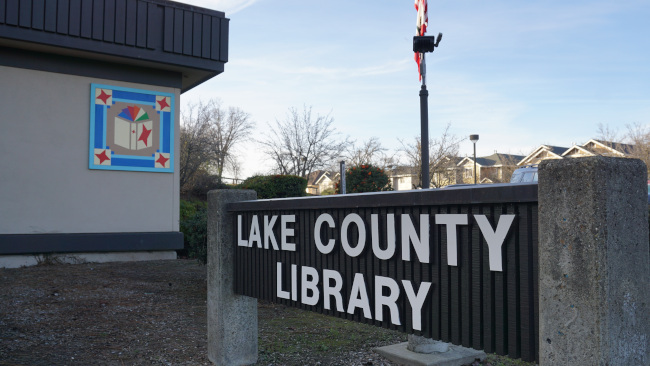
The Lake County Library’s Lakeport branch has reopened after a monthlong closure for renovations including a new sprinkler system. Photo by Elizabeth Larson/Lake County News.


LAKEPORT, Calif. – After a monthlong closure for renovations, the Lake County Library’s Lakeport branch has reopened for the new year.

The Lakeport Library, located at 1425 N. High St., was under construction for the month of December. During the closure, patrons were served by curbside pickup, the bookmobile and digital access.

The library building was constructed in 1986. At that time, the county library moved from the Carnegie Library in downtown Lakeport, where it had been since 1918.

In 2017, the library had roof improvements, new carpet installed, a new circulation desk added and reorganization. There was also a bathroom renovation in 2024.

For 2025, the library renovations involved installing a modern fire suppression, or sprinkler, system to increase the building’s safety.

This required removing the existing drop ceiling, installing the pipework and hardware, and then reinstalling the ceiling. The work also includes necessary plumbing upgrades to support the system. 

While the work isn’t fully completed yet, the most hands-on work is done, which is why the library is open to patrons, said County Librarian Christopher Veach.

On Saturday, community members were busy enjoying the facility once again, whether picking up books or getting together for group meetings.

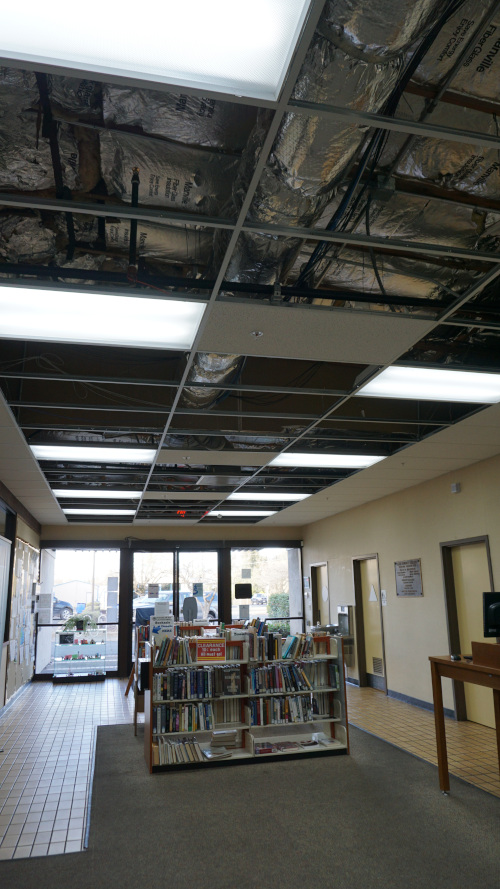
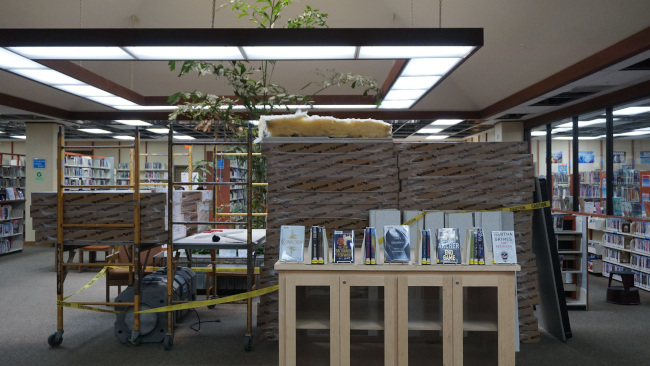
There are still openings in the ceiling to complete the sprinkler work and construction materials are stacked in the center of the building, however, staff and patrons are able to safely move around the work.

Building materials are staged in the library’s foyer as work to complete the renovations continues. Photo by Elizabeth Larson/Lake County News.


Much of the funding for the project came from a state grant.

On March 15, 2022, the Board of Supervisors approved an application to the California State Library to secure grant funding for the project, as Lake County News has reported.

The grant was approved and provided through the California State Library’s Building Forward Infrastructure Grant program. 

The total program budget is $1,649,502. Of that money, $1,099,667 was awarded from the California State Library and a $549,835 match came from the Lake County General Fund. 

Veach said the project aims to make libraries safer for everyone in times of disasters, adding to Lake County’s resilience.

The infrastructure will be protected and secure more than ever before, Veach said.

By doing this, “We ensure the library remains a reliable community resource, strengthening our ability to fulfill our mission to promote reading, literacy, and lifelong learning for everyone in Lake County,” Veach added.

Jordan O’Halloran writes feature stories for Lake County News.

Ceiling tiles have been temporarily removed to allow for the ongoing installation of a new sprinkler system at the Lake County Library’s Lakeport branch. Photo by Elizabeth Larson/Lake County News.

Details
Written by: Jordan O'Halloran
Published: 11 January 2026

Ellenson dominates Clear Lake to claim 2026 WON BASS Winter Open Title

Garrett Ellenson of Nine Mile Falls, Washington, won the WON BASS Winter Open at Clear Lake. Photo by Craig Nelson.

LAKEPORT, Calif. – In a display of remarkable consistency, Garrett Ellenson of Nine Mile Falls, Washington, outlasted a field of elite anglers to secure the Pro Champion title at the inaugural 2026 WON BASS Winter Open at Clear Lake.

While several competitors made late-stage charges, Ellenson’s ability to find "mega bags" day after day proved to be the winning formula. 

He finished the three-day event with a massive total weight of 98.37 pounds, falling just shy of the elusive 100-pound “Century Belt.”

Joe Uribre Jr. from Sunrise, Arizona, and AJ Valencia from Clearlake, California. Photo by Craig Nelson.


The final day of competition saw a significant shift in conditions. Warmer temperatures compared to the start of the week triggered a massive feeding window, resulting in a total of nine bags exceeding the 30-pound mark.

The leaderboard was a revolving door of leaders as anglers took turns in the “hot seat.”

However, Ellenson shut the door on the competition when he stepped to the scales with a 32.53-pound bag, sealing his victory and taking home a Ranger/Mercury prize package valued at $55,000.

Mason McAbee from Bakersfield, California, and Randy Marshall from Folsom, California. Photo by Craig Nelson.


While Ellenson took the top prize, several other pros made waves during the final weigh-in.

Mason McAbee claimed "Heavy Stringer" honors for the final day with a staggering 37.73-pound limit.

Joe Uribe Jr. took home "Big Bass" honors on the final day with a "beast" weighing in at 9.71 pounds. 

John Pearl from Upper Lake, California, and Ronnie Orbaker from Madera, California. Photo by Craig Nelson.


Local favorites Nathan Phillips and John Pearl rallied with 30-plus pound bags on the final day to secure spots in the top five.

Though the Century Belt remained unclaimed this week, the pro circuit won't have to wait long for another shot at history. 

The quest for the belt continues when the WON BASS Cal Open returns to Clear Lake from April 16 to 18.

Craig Nelson is a former professional golfer who fell in love with tournament bass fishing 20 years ago. He found Lake County after fishing an FLW Stren Series event and never left. He’s the back-to-back winner of the Konocti Classic and runner up in the inaugural WON Bass Clear Lake Open.

Nathan Phillips from Cobb Mountain, California. Photo by Craig Nelson.


Details
Written by: Craig Nelson
Published: 11 January 2026

Hopland Grade crash results in major injuries

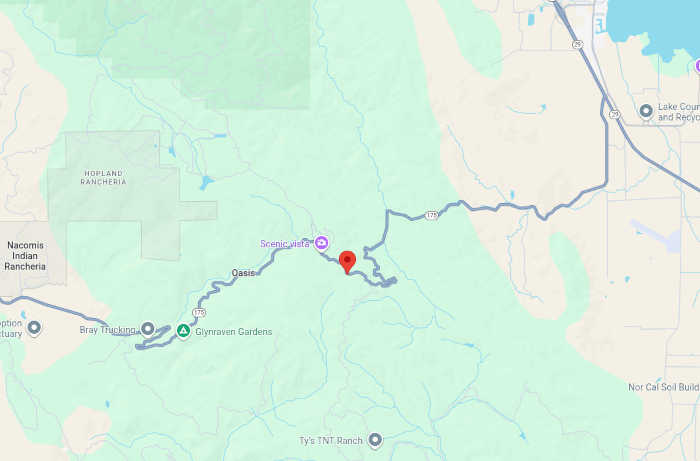
The site of the crash as identified by the California Highway Patrol. Google map image.


LAKE COUNTY, Calif. — A Saturday night solo-vehicle crash on the Hopland Grade sent one person to a trauma center.

The crash was first reported shortly after 7 p.m. on westbound Highway 175 just inside the Lake County line, according to the California Highway Patrol.

First responders arriving on scene, just after 7:30 p.m. reported over the radio that a vehicle was 200 feet down an embankment. 

Radio reports said there was just one patient. The CHP said that individual was reported to be out of the vehicle and up on the roadway.

Lakeport Fire transported the crash victim to Sutter Lakeside Hospital, where REACH arrived at around 8:30 p.m. to pick the patient up and fly them to a trauma center. 

The CHP said the crash victim suffered major injuries. 

Additional information about the crash and its cause was not immediately available. 

Email Elizabeth Larson at This email address is being protected from spambots. You need JavaScript enabled to view it.. Follow her on Twitter, @ERLarson, and on Bluesky, @erlarson.bsky.social. Find Lake County News on the following platforms: Facebook, @LakeCoNews; X, @LakeCoNews; Threads, @lakeconews, and on Bluesky, @lakeconews.bsky.social. 

Details
Written by: Elizabeth Larson
Published: 11 January 2026
  • 22
  • 23
  • 24
  • 25
  • 26
  • 27
  • 28
  • 29
  • 30
  • 31

Public Safety

  • Lakeport Police Department celebrates long-awaited new headquarters

  • Lakeport Police Department investigates flag vandalism cases

  • Lakeport Police Department thanks Kathy Fowler Chevrolet for donation

Community

  • Hidden Valley Lake Garden Club installs new officers

  • 'America's Top Teens' searching for talent

  • 'The Goodness of Sea Vegetables' featured topic of March 5 co-op talk

Community & Business

  • Annual 'Adelante Jovenes' event introduces students, parents to college opportunities

  • Gas prices are dropping just in time for the holiday travel season

  • Lake County Association of Realtors installs new board and presents awards

  • Local businesses support travel show

  • Preschool families harvest pumpkins

  • Preschool students earn their wings

How to resolve AdBlock issue?
Refresh this page