 How to resolve AdBlock issue?
Gov. Newsom proclaims Black History Month

SACRAMENTO – Gov. Gavin Newsom on Thursday issued a proclamation declaring February 2026 as Black History Month.
The text of the proclamation and a copy can be found below:
PROCLAMATION
This year, as we celebrate the 100th anniversary of Black History Month we pay homage to the rich history and contributions of Black Americans who have shaped our state and nation in countless ways through centuries of struggle and triumph. First proposed by scholar Carter G. Woodson in 1926, Black History Month lifts up the Black experience in a fuller telling of America’s story, and selects a theme to highlight facets of history that merit particular attention.
This year’s theme, “A Century of Black History Commemorations,” explores the impact and meaning of Black history on the status of Black peoples in the modern world. Through every conceivable avenue – from the arts to public and civic service to the sciences – Black Americans have changed the world, broken barriers, and pushed progress forward.
For more than 175 years, Black Californians have led the way for change and forged a path for those who came after them. Writers like Octavia Butler and Maya Angelou penned classics that transformed the literary world. Organizers like Huey Newton and Angela Davis demonstrated that change was possible. Belva Davis, who recently passed, was the first Black woman TV reporter on the West Coast who provided a new perspective in the news.
The preservation and recognition of Black history has long been a focus in California. The state has been home to a number of Black newspapers and publishing houses, and, notably, the California African American Museum is the first African American museum of art, history, and culture fully supported by a state.
Maya Angelou said, “I have a great respect for the past. We can only know where we’re going if we know where we’ve been.” During Black History Month, let us reflect on our shared history, and draw inspiration from the progress made as we continue together on the path toward equality, liberty, and opportunity for all.
NOW THEREFORE I, GAVIN NEWSOM, Governor of the State of California, do hereby proclaim February 2026 as “Black History Month.”
IN WITNESS WHEREOF I have hereunto set my hand and caused the Great Seal of the State of California to be affixed this 1st day of February 2026.
GAVIN NEWSOM
Governor of California
ATTEST:
SHIRLEY N. WEBER, Ph.D.
Secretary of State
- Details
- Written by: Lake County News Reports
Highway 20 upgrades among California Transportation Commission-approved projects

The California Transportation Commission, or CTC, this past week allocated nearly $1 billion to expand transit capabilities, add new highway safety features and boost the state’s continued climate action goals.
The $988.7 million approved includes $184 million from the federal Infrastructure Investment and Jobs Act of 2021, or IIJA, and $336 million in support from Senate Bill 1 (SB 1), the Road Repair and Accountability Act of 2017.
The investments made by these two funding sources have created an estimated 684,000 jobs. It has helped Californians, businesses and visitors who rely on the state’s transportation network for employment and educational opportunities, access to goods and services and connection to recreational attractions.
Among the projects, approximately $1.7 million has been approved toward stormwater upgrades and roadway repairs on Route 20 from east of New Long Valley Road to east of Walker Ridge Road near Clearlake Oaks in Lake County.
“Creating a brighter future in the Golden State is about addressing big challenges with meaningful investments like those made today,” said California Transportation Secretary Toks Omishakin. “This level of support funds wide-ranging transportation upgrades that provide the backbone of California’s vibrant economy by improving goods movement, expanding transit and rail systems and making our system more bikeable and walkable. These benefits will be experienced by every region, including disadvantaged communities throughout the state.”
“The long-term investments allocated today will power our ongoing effort to provide the safest, most accessible transportation system possible for all users, while continuing to serve as responsible stewards of California’s environment,” said Caltrans Director Dina El-Tawansy. “From new sidewalks and bicycle lanes to bridge repairs and highway reconditioning, we are improving our transportation system for the benefit of all Californians and creating thousands of jobs in the process.”
“Today’s investments will improve the safety, mobility, and economic prosperity of all Californians, especially those in rural communities,” said California Transportation Commission Chair Darnell Grisby said following the Tuesday meeting. “These infrastructure improvements will better connect working families to jobs, schools, essential services, and recreational activities while simultaneously reducing out-of-pocket transportation costs. Thank you to all our partner agencies for their help in delivering these projects across California.”
The list of funded projects includes $96 million to improve travel times and enhance traffic safety between Ventura County and Goleta with high-occupancy vehicle lanes, pedestrian and bike paths and transit enhancements.
Approximately $73 million will go to improve semi-truck operations and safety on Interstate 10 in San Bernardino County, and $63 million will be used in Riverside County for a new bridge, bike lanes and wildlife crossing as part of an upgrade to the Ramona Expressway.
The commission also agreed to fund several notable transit-related projects including $60 million to help rehabilitate Union Station in the city of Los Angeles; $17 million for 20 electric buses for the city of Glendale; and $21 million for eight new light rail vehicles for Sacramento Regional Transit.
In addition, the commission allocated $18.8 million for the Wallis Annenberg Wildlife Crossing in partnership with the California Natural Resources Agency. This crossing will provide a safe wildlife passage over U.S. 101, reducing wildlife-vehicle collisions and support long-term species viability through improved movement. This will be the first of its kind in California and a globally significant model for wildlife connectivity in an urban corridor.
In addition to the Lake County road work, projects approved in District 1 include:
Approximately $12.5 million in SB1 funding toward bridge repairs on Route 36, Route 211 and U.S. 101 in Humboldt County.
Approximately $1.4 million toward roadway repairs and realignment along with slope stabilization on Route 36 east of Bridgeville in Humboldt County.
Approximately $1.3 million in SB1 funding toward roadway, drainage and guardrail improvements on U.S. 101 near Garberville in Humboldt County.
Approximately $1.3 million in SB1 funding toward roadway and guardrail upgrades from Rockport to DeHaven on Route 1 in Mendocino County.
Approximately $1.1 million in SB1 funding toward roadway and drainage improvements on Route 271 near Leggett in Mendocino County.
California will receive nearly $54 billion in federal infrastructure funding with IIJA. This includes investments to upgrade the state’s roads, bridges, rail, public transit, airports, electric vehicle charging network, ports and waterways. IIJA funding alone has already created an estimated 269,00 jobs.
SB 1, which has provided $5 billion annually for transportation projects since 2017, provides funding annually split between the state and local agencies. Road projects progress through construction phases more quickly based on the availability of funds, including projects that are partially funded by SB 1. It has created approximately 417,000 jobs.
For more information about transportation and other infrastructure projects funded with state and federal investments, visit build.ca.gov.
- Details
- Written by: Lake County News Reports
Kelseyville Pear Festival donates to Kelseyville Unified athletics
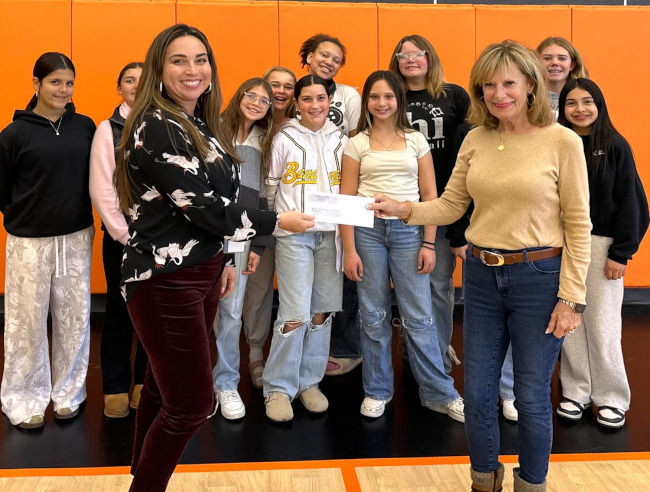
KELSEYVILLE, Calif. — The Kelseyville Unified School District reported that it has gratefully accepted the Kelseyville Pear Festival’s generous donation to fund all listed needs for student athletes at Mountain Vista Middle School and Kelseyville High School.
“This extraordinary show of community support will have a lasting impact on more than 235 students who participate in school sports programs each year,” said Mountain Vista Middle School, or MVMS, Athletic Director Allison Panella.
The donation will allow MVMS to purchase new uniforms, essential safety equipment, and other supplies for several sports teams, including track and field, basketball, soccer, softball and golf.
It will also allow Kelseyville High School to purchase uniforms and equipment for track and field, cross country and softball.
At MVMS, many sports teams had been using uniforms that were five to ten years old, along with equipment that had worn down through seasons of heavy use.
Replacing these items ensures students can compete safely, confidently, and with pride in representing their school, according to MVMS Principal Rick Kale.
MVMS wasted no time in putting the donation to good use. According to Panella, the school purchased new uniforms for Girls A and B Basketball teams, allowing athletes to begin their seasons feeling confident, prepared, and proud to represent their school.
“Wearing updated team uniforms strengthens a sense of unity and professionalism that positively affects morale and team cohesion,” she said.
Members of the co-ed golf team will receive matching polos, marking the first time the program has had an official team uniform.
This milestone will help build a stronger team identity and create a shared sense of belonging for students who previously competed without consistent team gear.
These improvements have brought renewed excitement and pride to athletes, coaches and families alike.
“Getting new uniforms and equipment makes us feel proud to represent our school,” said MVMS student athlete Francisco Calvillo said. “It doesn’t matter if we play basketball, run track, or are out on the golf course, we feel like one school team. It shows that people in our community care about us and want us to do our best.”
Thanks to the Pear Festival’s generosity, MVMS basketball teams will benefit from new game uniforms, practice gear, and team bags that promote unity and organization throughout the season.
Soccer players will receive updated uniforms and gear that strengthen team identity and school spirit.
Softball athletes will have access to improved protective equipment, helmets, and essential gear that directly supports player safety.
Track and field athletes will benefit from updated practice equipment, improved storage for shared gear, and supplies that enhance daily training.
In addition, every athletic team at MVMS will be equipped with updated first-aid kits, helping to ensure coaches have the tools they need to respond quickly and appropriately to student injuries during practices and competitions.
“Athletics teaches teamwork, resilience, and confidence,” said Kale. “Now our students have the uniforms and equipment they need to participate safely and proudly. We are deeply grateful for this investment in our kids and their future.”
The new uniforms and equipment at the middle school and high school will serve students for multiple seasons.
Panella noted that having updated uniforms, using safe and reliable gear, and feeling supported by their community helps to build confidence, belonging, and pride in the students that extends far beyond the playing field.
Panella said the Kelseyville Pear Festival’s contribution represents a significant investment in local youth.
“Their support strengthens school programs, promotes student well-being, and reinforces the connection between schools and the greater Kelseyville community,” Panella said. “Mt. Vista Middle School and Kelseyville High School extend their heartfelt gratitude to the Kelseyville Pear Festival for supporting local students and making it possible for young athletes to learn, grow, and succeed through sports. The positive effects of this generosity will be seen on the courts, fields, and tracks, as well as in the daily lives of our students for years to come.”
- Details
- Written by: Lake County News Reports
Tiny earthquakes reveal hidden faults under Northern California
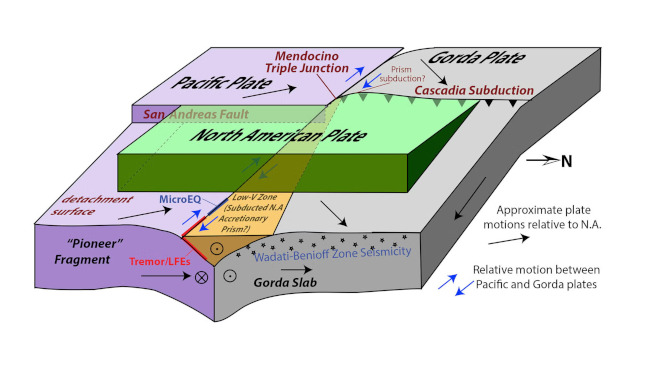
By tracking swarms of very small earthquakes, seismologists are getting a new picture of the complex region where the San Andreas fault meets the Cascadia subduction zone, an area that could give rise to devastating major earthquakes.
The work, by researchers at the U.S. Geological Survey, the University of California, Davis, and the University of Colorado Boulder, is published Jan. 15 in Science.
“If we don’t understand the underlying tectonic processes, it’s hard to predict the seismic hazard,” said co-author Amanda Thomas, professor of earth and planetary sciences at UC Davis.
Three of the great tectonic plates that make up the Earth’s crust meet at the Mendocino Triple Junction, off the Humboldt County coast. South of the junction, the Pacific plate is moving roughly northwest against the North American plate, forming the San Andreas fault. To the north, the Gorda (or Juan de Fuca) plate is moving northeast to dive under the North American plate and disappear into the Earth’s mantle, a process called subduction.
But whatever is going on at the Mendocino Triple Junction is clearly a lot more complex than three lines on a map. For example, a large (magnitude 7.2) earthquake in 1992 occurred at a much shallower depth than expected.
First author David Shelly of the USGS Geologic Hazards Center in Golden, Colo., compared it to studying an iceberg.
“You can see a bit at the surface, but you have to figure out what is the configuration underneath,” Shelly said.
Shelly, Thomas, Kathryn Materna at CU Boulder and Robert Skoumal at USGS’s Earthquake Science Center at Moffett Field, Calif., used a network of seismometers in the Pacific Northwest to measure very small, “low-frequency” earthquakes occurring where the plates rub against or over each other. These earthquakes are thousands of times less intense than any shaking we could feel at the surface.
They confirmed their model by looking at how the plates respond to tidal forces. The gravitational forces of the Sun and Moon pull on tectonic plates just as they do on the waters of the ocean. When tidal forces align with the direction in which a plate wants to move, you should see more small earthquakes, Thomas said.
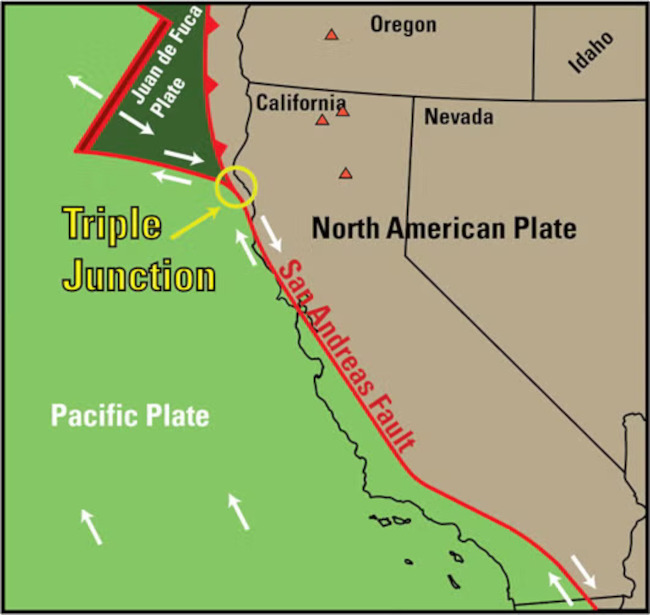
Five moving pieces
The new model includes five moving pieces, not just three plates — and two of them are out of sight from the Earth’s surface.
At the southern end of the Cascadia subduction zone, a chunk has broken off the North American plate and is being pulled down with the Gorda plate as it sinks under North America, the team found.
South of the triple junction, the Pacific plate is dragging a blob of rock called the Pioneer fragment underneath the North American plate as it moves northwards. The fault boundary between the Pioneer fragment and the North American plate is essentially horizontal and not visible from the surface at all.
The Pioneer fragment was originally part of the Farallon plate, an ancient tectonic plate that once ran along the coast of California but is now mostly gone.
The new model explains the shallowness of the 1992 earthquake, because the subducting surface is shallower than previously thought, Materna said.
“It had been assumed that faults follow the leading edge of the subducting slab, but this example deviates from that,” Materna said. “The plate boundary seems not to be where we thought it was.”
The work was supported by a grant from the National Science Foundation.
Andy Fell writes for the University of California, Davis.
- Details
- Written by: Andy Fell