 How to resolve AdBlock issue?
Man found with multiple stab wounds; sheriff’s office offers no details on case
KELSEYVILLE, Calif. – The Lake County Sheriff’s Office is not making public any information about an assault case last weekend in which a man was found in Kelseyville with multiple stab wounds.
The victim, described as a male subject in his mid-40s, was found at Store 24 in Kelseyville early on the morning of Sunday, Jan. 6, according to Shane Tinker, a firefighter with Kelseyville Fire Protection District.
Tinker was on the scene and spoke to Lake County News with the permission of district Chief Mike Stone, who also confirmed the weekend incident occurred.
Tinker could not release certain details about the case, including the man’s name, due to federal medical privacy laws.
Firefighters were dispatched at approximately 2:03 a.m. Sunday and directed to stage at the downtown fire department in response to a stabbing victim at the convenience store, located on Main Street, according to Tinker.
Once a deputy cleared the scene firefighters arrived at the store to find the man sitting on the ground against the outside door of the gas station’s bathroom, Tinker said.
Tinker said the man told him that he had been attacked on Reeves Lane outside of Lakeport.
The victim, who Tinker described as being in distress, told firefighters he had no idea who jumped him or what weapon they used to assault him.
Firefighters wanted to fly the man out of county due to his injuries, but an air ambulance wasn’t available due to weather. A Kelseyville Fire ambulance transported the man to Sutter Lakeside Hospital in Lakeport, Tinker said.
At Sutter Lakeside an emergency room doctor counted about a dozen stab wounds on the left side of the man’s chest, left arm and the left side of his back, according to Tinker.
The Lake County Sheriff’s Office has released no report on the case over the past several days, and did not respond to a request from Lake County News regarding the case or possible investigation.
Email Elizabeth Larson at
- Details
- Written by: Elizabeth Larson
Lake County News sues sheriff for discrimination, retaliation over news coverage
LAKE COUNTY, Calif. – Lake County News announced that it is suing Lake County's sheriff for discrimination.
In a lawsuit filed in Lake County Superior Court, John Jensen and Elizabeth Larson – doing business as Lake County News – allege that Lake County Sheriff Frank Rivero is retaliating against them and their media outlet because Rivero is angry about LCN’s coverage of issues critical of Rivero.
That reporting includes a series of articles in which the journalists uncovered that Rivero was under investigation by Lake County District Attorney Don Anderson for allegedly lying about a 2008 shooting in which Rivero was involved while working as a deputy.
“The Lake County Sheriff's Office has a media distribution list that identifies the email addresses for all media outlets that have asked to receive copies of press releases issued by the sheriff's office. LCN was removed from this list after publishing articles critical of Sheriff Rivero. That means our competitors receive press releases with important public safety information, but LCN does not. And that means that LCN cannot inform its readers of this important information,” Larson said.
LCN's lawsuit also alleges that the sheriff’s office discriminates against LCN by failing to comply with the California Public Records Act (CPRA).
“The CPRA allows journalists and private citizens to gain access to information and documents held by governmental agencies,” said Paul Nicholas Boylan, a Davis-based attorney specializing in open government issues who is representing Jensen and Larson.
“Investigative journalists in California rely on CPRA to look into how government operates and to determine whether or not public officials and employees are behaving in a lawful manner. That's what happened in the city of Bell case from a few years ago. A local journalist used the CPRA to prove widespread corruption. That would not have been possible without the CPRA,” Boylan said.
“This isn't just about us, just about one small Internet media outlet that covers news in a small county in Northern California,” Larson said. “This is about something bigger. It is about the freedom of the press and the right of people to be free from government retaliation.”
She added, “It isn't right for elected officials to punish media outlets and the people associated with those media outlets when they report on issues and publish statements that the elected officials don't like. There are rules to prevent that from happening, and my husband and I have decided to take the steps necessary to make sure it doesn't happen to us and doesn't happen to anybody else.”
Jensen and Larson are considering additional legal actions. “Elizabeth and I have been advised that we have potential actions for damages against the sheriff and those working with him to violate our constitutional rights,” Jensen said.
“We're waiting to see how all of this works out before we decide what to do next,” Larson
concluded.
Boylan said that negotiations are beginning and that he is hopeful that this dispute can be resolved quickly.
“The law is very clear: public officials cannot pick and choose which media outlets they communicate with based on the content of what is being reported,” Boylan said.
“There is no question in my mind that my clients are going to prevail if Sheriff Rivero refuses to treat them fairly and equally and continues to violate the public's right to access governmental information and records,” Boylan added. “The only rational decision, the only option the sheriff has, is to return my clients to the sheriff office’s media distribution list and to provide my clients with access to the public documents and information they have requested.”
- Details
- Written by: Lake County News reports
State seeks end to court orders capping the state’s prison population and requiring oversight of prison mental health care
California's governor said Tuesday that the state government has taken legal action to end a federal court order that caps the state’s prison population and another that requires “intrusive supervision” of prison mental health care.
“After decades of judicial intervention in our correctional system and the expenditure of billions of taxpayer dollars, the time has come to restore California’s rightful control of its prison system,” said Gov. Jerry Brown.
The state also complied with the court’s order to identify options to achieve additional reductions in the number of inmates held in state prison.
This filing, made under protest, asserts that further reductions “threaten public safety and interfere with California’s independent right to determine its own criminal justice laws.”
“California’s prison health care system is now a model for the nation,” said CDCR Secretary Jeff Beard. “Independent expert reviews have found that California’s prison medical and mental health care systems meet constitutional standards. It would be both unnecessary and unsafe for the courts to order further inmate reductions.”
In 1991, California prison inmates filed a class action lawsuit, Coleman v. Brown, alleging that California’s prison mental health care system was unconstitutional.
Subsequently, prior administrations entered into various consent decrees that set in motion vast judicial oversight of our prison system.
In the intervening years, California has rebuilt its prison mental health care system into one of the best in the nation, investing billions in additional treatment capacity and hiring hundreds of mental health care professionals.
The state seeks to end this judicial oversight because the mental health care provided to prisoners now exceeds constitutional requirements.
In 2007, the Coleman case along with Plata v. Brown, a case concerning medical care, was assigned to a three-judge court.
That court found that overcrowding was the primary cause of the failure to deliver constitutional medical and mental health care in California prisons, and in 2009 ordered the state to reduce crowding to 137.5 percent of “design capacity.” The U.S Supreme Court affirmed that order in 2011.
Since 2006, the inmate population in the state’s 33 prisons has been reduced by over 43,000 and crowding is down from more than 200 percent to just below 150 percent. More than half of the population decline has happened since October 1, 2011, as a result of Public Safety Realignment.
Lowering the prison population beyond this point – as ordered by the court – would require rewriting or disregarding the California Constitution and numerous state laws that limit the early release of prisoners.
The result would be shorter sentences for inmates incarcerated for serious and violent offenses, increased burdens on counties, and expanded use of contract facilities at considerable cost to the taxpayers.
Gov. Brown also announced that he has signed a proclamation ending the prison overcrowding emergency that has been in place since 2006. This will allow the state to phase out the use of private out-of-state prison beds for California inmates starting in July of 2013. At this time, there are approximately 8,900 California inmates in out-of-state prisons.
“The extreme circumstances of overcrowding in California’s prisons no longer exist,” said Secretary Beard. “With improved health care systems and additional state capacity, it is no longer necessary to send prisoners and California taxpayer dollars to other states.”
To read the court filings, go to the State Reports section of CDCR’s Three-judge Court Web page, http://www.cdcr.ca.gov/News/3_judge_panel_decision.html .
A PROCLAMATION BY THE GOVERNOR OF THE STATE OF CALIFORNIA
WHEREAS, on October 4, 2006, Governor Schwarzenegger issued a Proclamation declaring a state of emergency in California’s prison system due to severe inmate overcrowding. In the Proclamation, Governor Schwarzenegger found that the prison overcrowding crisis posed a “substantial risk to the health and safety of the men and women who work inside these prisons and the inmates housed in them.”
WHEREAS, at the time of the Proclamation, the California Department of Corrections and Rehabilitation’s inmate population was at an all-time high of more than 170,000 inmates, with approximately 161,000 inmates in CDCR’s 33 prisons and another 9,000 inmates in its camps and contract prisons.
WHEREAS, at the time of the Proclamation, prison overcrowding had forced CDCR to house more than 15,000 inmates in gymnasiums, dayrooms, and other common areas not designed as living units, frequently in double or triple bunks. The large numbers of inmates housed together in tight quarters created line-of-sight problems for correctional officers by blocking their views and posing substantially increased risks of violence.
WHEREAS, at the time of the Proclamation, CDCR projected that its total inmate population in its prisons, camps, and contract prisons would grow to over 193,000 in 2011.
WHEREAS, in the Proclamation, Governor Schwarzenegger directed the CDCR Secretary to involuntarily transfer inmates to correctional facilities out of state as the Secretary deemed necessary to mitigate the emergency caused by prison overcrowding. Governor Schwarzenegger suspended applicable state laws to allow these involuntary inmate transfers to occur.
WHEREAS, in furtherance of this directive, CDCR entered into contracts with privately operated prisons in other states to house CDCR inmates. CDCR currently maintains about 8,900 inmates in out-of-state prisons under these contracts.
WHEREAS, since the date of the Proclamation, the State has undertaken several significant measures that have greatly relieved prison crowding and continue to do so. Among these measures, the 2011 Public Safety Realignment Act, which I signed into law in April 2011, has had the biggest and most immediate impact on reducing prison crowding.
WHEREAS, on October 1, 2011, the Public Safety Realignment Program went into effect. Under Realignment, lower-level felons now serve their sentences in county jails rather than state prisons. In addition, once offenders have served their sentences and are released from incarceration, if they violate the terms of their release, they serve any additional period of incarceration in county jail rather than state prison. Realignment has markedly reduced prison crowding without releasing any state inmates early. Since its implementation, the state prison population has dropped by approximately 24,925 inmates.
WHEREAS, currently, the number of inmates housed in CDCR’s 33 prisons has been reduced by over 43,000 inmates from when the October 2006 Proclamation was issued to a current level of about 119,213.
WHEREAS, as a result of the dramatic decrease in the prison population under Realignment, last year CDCR was able to stop housing inmates in prison common areas that were not designed as living units. No longer are any inmates housed in gymnasiums, dayrooms, or other common areas.
WHEREAS, as a result of the greatly decreased prison population, CDCR’s electrical system and sewer/wastewater systems are no longer being overloaded.
WHEREAS, in May 2007, the Legislature passed the Public Safety and Offender Rehabilitation Services Act, Assembly Bill 900, which provided funding for numerous state prison construction projects.
WHEREAS, since the date of the Proclamation, California has constructed and is constructing new health care facilities for inmates, including: new health care facilities at San Quentin and Avenal State Prisons, new Intermediate Care Facilities at Salinas Valley State Prison, California Institution for Women and California Medical Facility, new small management yards in Administrative Segregation Units throughout the State, a new 20-bed Psychiatric Services Unit at the California Institution for Women, a new 50-bed Mental Health Crisis Facility at California Men’s Colony at San Luis Obispo, and new treatment and office spaces at California State Prison at Sacramento, California State Prison at Los Angeles County, California Men’s Colony at San Luis Obispo, California Medical Facility at Vacaville, California State Prison at Corcoran, and Salinas Valley State Prison at Salinas.
WHEREAS, construction began in 2010 on a new 1.2 million square-foot intermediate medical and mental health care prison facility in Stockton. This new facility, which will house 1,722 inmates, is scheduled to be opened in July 2013.
WHEREAS, in 2012, the Legislature approved my administration’s comprehensive plan (commonly called the “Blueprint”) to further improve California’s prison system following Realignment, while making it less costly and more efficient. Under the Blueprint, CDCR will no longer need to involuntarily transfer inmates to contract prisons in other states beyond July of this year. Moreover, under the Blueprint, CDCR’s use of out-of-state contract beds will be incrementally reduced over the next few years and eliminated entirely by July 2016.
WHEREAS, prison crowding no longer poses safety risks to prison staff or inmates, nor does it inhibit the delivery of timely and effective health care services to inmates.
WHEREAS, due to the measures the State has taken to alleviate prison crowding, it is now clear that the circumstances that gave rise to the emergency no longer exist. The 2006 emergency proclamation does, however, need to remain in place until later this year to allow the final inmate transfers to out-of-state prisons to be completed. This will allow the out-of-state program to be incrementally decreased as called for in the Blueprint, and will ensure that the State’s prison population density remains at appropriate levels.
NOW, THEREFORE, I, EDMUND G. BROWN JR., Governor of the State of California, in accordance with the authority vested in me by the Constitution and the statutes of the State of California, hereby proclaim that the October 4, 2006 Prison Overcrowding Emergency Proclamation is terminated, effective July 31, 2013; and
I FURTHER DIRECT that as soon as possible, this proclamation be filed in the Office of the Secretary of State and that widespread publicity and notice be given to this proclamation.
IN WITNESS WHEREOF, I have hereunto set my hand and caused the Great Seal of the State of California to be affixed this 8th day of January 2013.
EDMUND G. BROWN JR.
Governor of California
ATTEST:
DEBRA BOWEN
Secretary of State
- Details
- Written by: Lake County News reports
Lunas takes oath of office as newest Lake County Superior Court judge
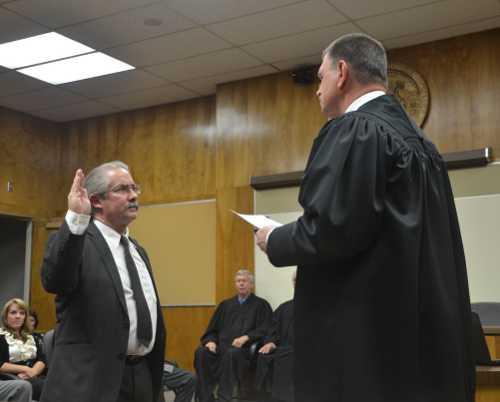
LAKEPORT, Calif. – The Lake County Superior Court bench welcomed its newest member on Monday.
Judge Michael Lunas took his oath of office and then took his place on the bench during an afternoon ceremony in the Department 1 courtroom at the Lake County Courthouse in Lakeport.
Lunas was elected in November to succeed retiring Judge David Herrick.
It was Herrick who would administer to Lunas his oath of office during the ceremony, which ran just under 45 minutes before a packed courtroom gallery.
Presiding Judge Stephen Hedstrom led the ceremony, flanked by Herrick, Judge Richard Martin, Judge Andrew Blum and Superior Court Commissioner Vincent Lechowick, and joined by retired judges Arthur Mann and Richard Freeborn.
“We’ve got quite a bit of judicial experience here,” Hedstrom said before introducing all of the judges.
Hedstrom welcomed Lunas and his family, and told him, “Judge Herrick is a tough act to follow.”
However, Hedstrom went on to tell Lunas that he had the necessary intellect, character and disposition to succeed as a judge, noting that Lunas would be an “outstanding addition” to the superior court bench.
Then, Hedstrom turned the tables a bit on the new judge. “Do you realize what you’ve done?” he asked of the prospect of taking on such a huge responsibility in the community.
“The people are entrusting you with their property, their children, their lifestyles and their very freedoms,” Hedstrom said, adding that Lunas would find being a judge the most challenging job he will ever have.
He told Lunas, once a successful powerlifter, that his ability to bench press would serve him well.
“Some days it will feel like you’re carrying the weight of the world as you agonize over the decisions you will soon be making on a daily basis,” said Hedstrom. “It is no small responsibility, issuing orders and judgments that directly impact a person’s life.”
Hedstrom added that he would be working harder than he ever has before. “Your brain will be fried,” as he applied the complicated laws of sentencing guidelines to very real cases.
“You’re going to scare him off,” Blum interjected.
“I’m not through,” Hedstrom said, to a round of laughter from the gallery.
Hedstrom guaranteed Lunas that he and his wife’s hearts would skip a beat when the phone rang at 2 a.m. for him to sign a restraining order.
Despite the awesomeness of the responsibility Lunas was undertaking, Hedstrom told him he wouldn’t have to shoulder it alone, and that he would have the support of his fellow judges.
“We are always here for each other,” said Hedstrom, who also acknowledged an “incredibly overworked and underpaid” court staff that gives the judges excellent support on a daily basis. “They cover our backs,” he said of court staff.
“If I scared you earlier I am only half sorry,” said Hedstrom.
He said there is no greater satisfaction than the work of a judge. “It is the hardest job you will ever love. Welcome to the bench.”
Blum presented Lunas with a framed copy of a saying from Justice Learned Hand, which is traditionally passed on to the newest judge on the local bench. It had been written in calligraphy by the late Gail Golden, wife of Judge John Golden, who began the tradition by giving it to Judge Robert Crone.
Hand, a 19th century judge, wrote of both the joys and challenges of being a judge. “Trust me, there are many of each,” Blum said.
The passage notes that, “A judge’s life, like every other, has in it much of drudgery, senseless bickerings, stupid obstinacies, captious pettyfogging, all disguising and obstructing the only sane purpose which can justify the whole endeavor. These take an inordinate part of his time; they harass and befog the unhappy wretch, and at times almost drive him from that bench where like any other workman he must do his work.”
However, there is something else which makes the work of a judge “a delectable calling,” Hand wrote.
“For when the case is all in, and the turmoil stops, and after he is left alone, things begin to take form. From his pen or in his head, slowly or swiftly as his capacities admit, out of the murk the pattern emerges, his pattern, the expression of what he has seen and what he has therefore made, the impress of his self upon the not-self, upon the hitherto formless material of which he was once but a part and over which he has now become the master. That is a pleasure which nobody who has felt it will be likely to underrate.”
Blum, who had received the framed saying following his July 2010 oath ceremony, said he was glad to pass it to Lunas for two reasons – first, it would mean he was no longer the rookie, and second, he has found the saying helpful and believed Lunas would, too.
He told Lunas there would be days when he was dragging and asking why he’s doing the job. “This will help explain why you’re doing this job.”
Freeborn told Lunas to always remember that service to humanity is the best work. He advised Lunas to learn to work quickly but not to rush, to take time for himself and his family, and to remember that for a judge to completely separate himself from the community is not wise.
Mann told Lunas that, in many ways, he was envious of him, beginning his career as a judge. He called it the most rewarding career he could ever imagine.
“You’ll find new challenges every day,” Mann said. “The rewards far outweigh the detriments.”
Each of the sitting judges wished Lunas good luck and congratulations.
Martin said he had been impressed with Lunas during his appearances in court, noting he was prepared and informed.
“What I’m more impressed with is attitude,” said Martin, explaining that since the election Lunas has been showing up to judge’s meetings to learn about his job, and that he was cooperative, eager and ready to go to work ahead of being sworn in.
“I think you will enjoy the job,” said Martin.
Blum said Lunas joins “a small but very busy court” that, based on its statistics, should have six rather than the four judges it has.
Lunas will handle a wide variety of cases, which is how local judges work, said Blum, adding that Lunas will get thrown into the deep end.
“Well, Mike, it’s time,” said Herrick. “Seems like yesterday, but 18 years ago I sat where you are.”
Herrick said Lunas probably was filled with anticipation, was awestruck and wondering how to live up to the work of the others on the bench. He said he knew Lunas had worked hard for what he had gotten.
“This job is the most rewarding thing that you can possibly do,” said Herrick.
While Lunas had a distinguished legal career, “What you can do from this bench is far superior to that,” said Herrick.
“So, if you’re ready, enough speeches,” said Herrick, calling Lunas forward and administering his oath of office.
Herrick afterward congratulated Lunas, who received a standing ovation.
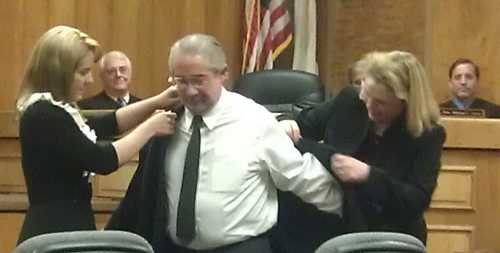
As part of the local court’s tradition, Lunas’ wife, Diana, came forward to help him put on his judicial robe. She was joined by their daughter Haleigh, with the two women carefully fitting him with his new work attire before each gave him a hug and a kiss. His other children then came forward to congratulate him.
Lunas then took the bench as his fellow judges looked on.
“I am just really humbled and overwhelmed by this occasion,” said Lunas, who admitted that he hadn’t been so nervous before entering a courtroom in 30 years.
“We are and have been blessed with really great judges in Lake County,” said Lunas. “I’ve learned so much from all of you gentlemen.”
Lunas praised Herrick, noting it seemed like just yesterday since Herrick had taken the bench. “I don’t know where the last 18 years have gone.”
Lunas said that if he can do the job of judge half as well as Herrick, he will be satisfied.
He said he was looking forward to joining the team of judges.
“The only promise I am going to make is I will do my utmost,” and work every day to be the best judge he can be, said Lunas.
Lunas remarked on the challenge of running for office in 2012, which was compounded by a fire that damaged his law office in downtown Lakeport in September.
The outpouring of community support after the fire was amazing, Lunas said. “This community is really something.”
He said he and his family were very proud to be part of the community, and he thanked his family for their patience.
To Diana, his wife of 25 years, Lunas offered the biggest thanks for her countless contributions.
“I love you more than anything. Thank you for all you've done for me,” he said. “I wouldn't be here without you. I wouldn't be who I am without you.”
With that, Lunas welcomed everyone to join him in a reception downtown.
Email Elizabeth Larson at
- Details
- Written by: Elizabeth Larson