How to resolve AdBlock issue?
Refresh this page
How to resolve AdBlock issue?
Refresh this page
Lake County News,California
  • Home
    • Registration Form
  • News
    • Community
      • Obituaries
      • Letters
      • Commentary
    • Education
    • Veterans
    • Police Logs
    • Business
    • Recreation
    • Health
    • Religion
    • Legals
    • Arts & Life
    • Regional
  • Calendar
  • Contact us
    • FAQs
    • Phones, E-Mail
    • Subscribe
  • Advertise Here
  • Login

Clearlake sewer spill impacted area significantly expands as key questions remain unanswered

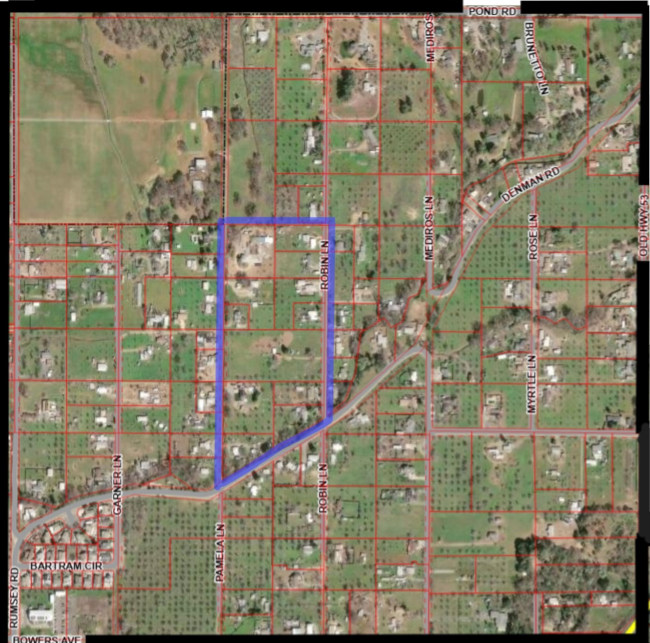
The county of Lake provided this new map of the area impacted by the spill, which began on the morning of Sunday, Jan. 11, 2026. The purple outline represents the initial spill area of about 40 acres. The total size of the overall area is estimated at 357 acres. 

LAKE COUNTY, Calif. — The county of Lake on Friday reported a significantly expanded area affected by the Robin Lane sewage spill and announced a work plan for the weekend. 

Meanwhile, key questions about contamination, mitigation and assistance remain unanswered.

A new map included in the county’s Friday multi-departmental update shows the affected area stretching east of Smith Lane, west of Old Highway 53, south of Pond Road and north of Bowers Avenue — enclosing roughly 357 acres, according to calculations using Google Maps. 

That expanded area is over eight times larger than the area previously marked based on this calculation conducted by Lake County News. 

The report that came at 6 p.m. on Friday, right before a three-day holiday starts, included a new map of impacted areas, and three separate contributions from the Environmental Health, Special Districts and the Public Health Officer. 

The impact area map was revised “due to [water] test results received,” said the Environmental Health section of the update.

However, the update did not disclose any well or water testing data or provide any interpretation of the results that would indicate the level or extent of contamination, nor did it provide any kind of timeline or data in terms of mitigation and recovery work. 

Guidance advising affected residents to temporarily relocate remains in effect for all areas included in the newly drawn map, according to Public Health Officer Dr. Robert Bernstein in the update. 

The Robin Lane sewer spill began on Sunday morning with the rupture of a 16-inch force main operated by the Lake County Sanitation District.

Lake County Special Districts was notified at around 7:30 a.m. Sunday, and the flow was finally stopped at 9:55 p.m. Monday, according to Lori Baca, the agency’s customer service supervisor. 

The spill was initially reported to have impacted 58 properties in the area south of Pond Road and north of Rumsey Road, east of Pamela Lane and west of Robin Lane in and around the city of Clearlake.

With the significant expansion of the impact area, the county did not provide an updated number of properties affected. 

Lake County News followed up on Friday evening. 

“Unfortunately, I don’t have an immediate answer,” said Chief Deputy County Administrative Officer Matthew Rothstein, who is also a county spokesperson, in an email. “But will ensure that is discussed and an update is provided tomorrow.”

A text message was also sent to Clearlake City Manager Alan Flora with the same question on the number of affected properties.

“It would be more but I don’t have a number,” he replied. 

Cleanup work continues while well testing pauses during long weekend

Lake County Special Districts reported that ongoing cleanup work has occurred at “most area properties, with lime treatment applied and decontamination of properties and driveways affected by sewage.”

Meanwhile, seven properties have reported experiencing “periodic ponding,” according to the Special Districts section on the Friday update. “Those properties have been pumped throughout the day.”

Work will continue on Saturday to disinfect driveways — in the affected area that have not been treated to date — with Decon30, a disinfectant cleaner used in water damage restoration and general cleaning, the statement said.

The Special Districts section said “Residents unable to access their properties due to health and safety concerns have been placed in hotels.” It did not indicate how many residents — out of all living in the impacted area who are under a public health advice to relocate — were placed in a hotel and how long the stay would last. 

Environmental Health reported that their teams conducted water testing on Thursday, “blanketing the entire area affected by the spill.” 

“A small number of parcels have not yet been sampled due to lack of owner approval to access the property,” the Friday report said, adding that no testing will be conducted over the long weekend through Monday as the lab will not be able to process samples during the period. 

The update said wells are currently undergoing the “shock stage,” meaning they are being sanitized with chlorine. Wells can only be retested 24 to 48 hours after the shock process is completed. But it did not mention the number or percentage of wells that have been tested and “shocked.”

Key questions left unanswered 

The county provided “door-to-door notices on status regarding affected wells,” according to the update. But it did not publicly provide any data indicating overall progress or preliminary results from the testing conducted so far.

Questions that remain unanswered involve how many wells have been tested so far, the severity of any contamination detected, how many households have temporarily relocated, what assistance the county’s local emergency proclamations made residents eligible for and when impacted households can expect that help to become available.

These were among the questions that Lake County News posed to county officials on Thursday and Friday, with the most recent one sent out at 4:17 p.m. Friday. 

None of them was addressed by the update released later in the evening, and no additional replies were received. 

The next town hall is expected to be held on Wednesday, Jan. 21, at 6 p.m. at Clearlake City Hall. 

Editor’s note: The county released an update in which the date of the town hall was corrected from Jan. 22 to Jan. 21.

Email staff reporter Lingzi Chen at This email address is being protected from spambots. You need JavaScript enabled to view it.. 

Details
Written by: Lingzi Chen
Published: 17 January 2026

CDPH urges vaccination and timely treatment as influenza cases rise

The California Department of Public Health, or CDPH, is alerting health care providers and the public that influenza activity and hospital admissions are increasing across the state. A newly emerged influenza A strain, H3N2 subclade K, is circulating globally and has been detected in California.

“Current seasonal flu vaccines remain effective at reducing severe illness and hospitalization, including the currently circulating viruses,” said Dr. Erica Pan, CDPH director and state Public Health officer. “It is important for families to know that flu vaccines, tests, and treatments remain widely available for all Californians and that it is not too late to get a flu vaccine. As a pediatrician, parent, and daughter, I have made sure that my own family is protected with this season’s flu vaccine."

CDPH has also confirmed the second pediatric flu-associated fatality in California this season. Young children and older adults remain at highest risk for severe flu complications, and there are several ways for families to take action to protect their health.

Take action

• Vaccinate now: Everyone 6 months and older who has not yet received the 2025–26 influenza vaccine should get vaccinated as soon as possible. Vaccination is the best defense against severe influenza and hospitalization. To schedule your vaccine appointment, contact your health care provider, local pharmacy, or visit myturn.ca.gov.
• Test promptly: Individuals with flu symptoms at risk for serious disease should check with their doctor to see if they should be tested in case they may benefit from treatment. At-home combined influenza/COVID-19 tests can be used when available.
• Start antivirals immediately: High-risk and hospitalized patients with suspected flu should receive antiviral treatment without delay, even before test results are confirmed. Recommended treatments include oseltamivir or single-dose baloxavir, which reduce the risk of serious illness and hospitalization.

Coverage and availability

Despite changes in federal recommendations, CDPH’s recommended vaccines will continue to be covered by health care insurers regulated by the state of California and can be received at your local pharmacy, from your health care provider, or through other authorized vaccine providers at no cost. 

To schedule your vaccine appointment, contact your health care provider, local pharmacy, or visit myturn.ca.gov. 

Details
Written by: LAKE COUNTY NEWS REPORTS
Published: 17 January 2026

Clearlake Animal Control: ‘Winkie’ and the dogs

“Winkie.” Photo courtesy of Clearlake Animal Control.


CLEARLAKE, Calif. — Clearlake Animal Control has many great dogs waiting for their new families.

The shelter has 56 adoptable dogs and puppies listed on its website.

This week’s dogs include “Winkie,” a 1-year-old male Doberman Pinscher mix with a short black coat.

The shelter is located at 6820 Old Highway 53. It’s open from 9 a.m. to 6 p.m. Tuesday through Saturday. 

For more information, call the shelter at 707-762-6227, email This email address is being protected from spambots. You need JavaScript enabled to view it. or visit Clearlake’s adoptable dogs here.

This week’s adoptable dogs are featured below.

Email Elizabeth Larson at This email address is being protected from spambots. You need JavaScript enabled to view it.. Follow her on Twitter, @ERLarson, and on Bluesky, @erlarson.bsky.social. Find Lake County News on the following platforms: Facebook, @LakeCoNews; X, @LakeCoNews; Threads, @lakeconews, and on Bluesky, @lakeconews.bsky.social. 


Details
Written by: Elizabeth Larson
Published: 17 January 2026

Deep reading can boost your critical thinking and help you resist misinformation – here’s how to build the skill

Just slowing down gives you time to question and reflect. Morsa Images/DigitalVision via Getty Images

The average American checks their phone over 140 times a day, clocking an average of 4.5 hours of daily use, with 57% of people admitting they’re “addicted” to their phone. Tech companies, influencers and other content creators compete for all that attention, which has incentivized the rise of misinformation.

Considering this challenging information landscape, strong critical reading skills are as relevant and necessary as they’ve ever been.

Unfortunately, literacy continues to be a serious concern. Reading comprehension scores have continued to decline. The majority of Gen Z parents are not reading aloud to their young children because they view it as a chore. Many college students cannot make it through an entire book.

With their endless scrolling and easy reposting and sharing of content, social media platforms are designed to encourage passive engagement that people use to relieve boredom and escape stress.

As a cognitive scientist and a literacy expert, we research the ways people process information through reading. Based on our work, we believe that deep reading can be an effective way to counter misinformation as well as reduce stress and loneliness. It can be tough to go deeper than a speedy skim, but there are strategies you can use to strengthen important reading skills.

woman sits on end of bed holding head in hand while looking at phone
Counterintuitively, social media can make you feel more bored and lonely. Dmitrii Marchenko/Moment via Getty Images

Deep reading versus doomscrolling

People use smartphones and social media for a variety of reasons, such as to relieve boredom, seek attention, make connections and share news. The infinite amount of information available at your fingertips can lead to information overload, interfering with how you pay attention and make decisions. Research from cognitive science helps to explain how scrolling trains your brain to think passively.

To keep people engaged, social media algorithms feed people content similar to what they’ve already engaged with, reinforcing users’ beliefs with similar posts. Repeated exposure to information increases its believability, especially if different sources repeat the information, an effect known as illusory truth.

Deep reading, on the other hand, refers to the intentional process of engaging with information in critical, analytical and empathetic ways. It involves making inferences, drawing connections, engaging with different perspectives and questioning possible interpretations.

Deep reading does require effort. It can trigger negative feelings like irritation or confusion, and it can very often feel unpleasant. The important question, then: Why would anyone choose the hard work of deep reading when they can just scroll and skim?

Motivating mental effort

Mindless scrolling may come with unintended consequences. Smartphone and social media use is associated with increased boredom and loneliness. And doomscrolling is related to higher levels of existential anxiety and misanthropy.

In contrast, attention and effort, despite being exhausting, can deepen your sense of purpose and strengthen social connection. People also feel motivated to complete tasks that help them pursue personal goals, especially when these tasks are recognized by others. For these reasons, sharing books may be one tool to promote deep reading.

One example is a teacher who guides students through longer texts, like novels, paired with active discussions about the books to reinforce comprehension and interpretation. While the debate over the ongoing practice of assigning excerpts over full books in schools continues, evidence does suggest that sustained reading in social settings can promote lifelong enjoyment in reading.

With social connection in mind, social media can actually be used as a positive tool. BookTok is a popular online community of people who use TikTok to discuss and recommend books. Fans post in-depth analyses of “K-Pop Demon Hunters” and other movies or shows, demonstrating that close analysis still has a place in the endless scroll of social media.

three people laughing together at a table, with books open in front of them
Talking about what you’ve read can add a social dimension to what can be a solitary activity. Alfonso Soler/iStock via Getty Images Plus

Slowing yourself down to read deeply

There are steps you can take to meaningfully engage with the constant stream of information you encounter. Of course, this process can be taxing, and people only have so much effort and attention to expend. It’s important to both recognize your limited cognitive resources and be intentional about how you direct those resources.

Simply being aware of how digital reading practices shape your brain can encourage new attitudes and habits toward how you consume information. Just pausing can reduce susceptibility to misinformation. Taking a few extra seconds to consciously judge information can counteract illusory truth, indicating that intentionally slowing down even just a bit can be beneficial.

Reading deeply means being able to intentionally choose when to read at different speeds, slowing down as needed to wrestle with difficult passages, savor striking prose, critically evaluate information, and reflect on the meaning of a text. It involves entering into a dialogue with the text rather than gleaning information.

Awareness does not mean that you never doomscroll at the end of a long day. But it does mean becoming conscious of the need to also stick with a single text more frequently and to engage with different perspectives.

You can start small, perhaps with poems, short stories or essays, before moving up to longer texts. Partner with a friend or family member and set a goal to read a full-length novel or nonfiction book. Accomplish that goal in small chunks, such as reading one chapter a day and discussing what you read with your reading buddy. Practicing deep reading, such as reading novels, can open you up to new perspectives and ideas that you can explore in conversation with others, in person or even on TikTok.The Conversation

JT Torres, Director of the Harte Center for Teaching and Learning, Washington and Lee University and Jeff Saerys-Foy, Associate Professor of Psychology, Quinnipiac University

This article is republished from The Conversation under a Creative Commons license. Read the original article.

Details
Written by: JT Torres, Washington and Lee University and Jeff Saerys-Foy, Quinnipiac University
Published: 17 January 2026
  • 16
  • 17
  • 18
  • 19
  • 20
  • 21
  • 22
  • 23
  • 24
  • 25

Public Safety

  • Lakeport Police Department celebrates long-awaited new headquarters

  • Lakeport Police Department investigates flag vandalism cases

  • Lakeport Police Department thanks Kathy Fowler Chevrolet for donation

Community

  • Hidden Valley Lake Garden Club installs new officers

  • 'America's Top Teens' searching for talent

  • 'The Goodness of Sea Vegetables' featured topic of March 5 co-op talk

Community & Business

  • Annual 'Adelante Jovenes' event introduces students, parents to college opportunities

  • Gas prices are dropping just in time for the holiday travel season

  • Lake County Association of Realtors installs new board and presents awards

  • Local businesses support travel show

  • Preschool families harvest pumpkins

  • Preschool students earn their wings

How to resolve AdBlock issue?
Refresh this page