How to resolve AdBlock issue?
Refresh this page
How to resolve AdBlock issue?
Refresh this page
Lake County News,California
  • Home
    • Registration Form
  • News
    • Community
      • Obituaries
      • Letters
      • Commentary
    • Education
    • Veterans
    • Police Logs
    • Business
    • Recreation
    • Health
    • Religion
    • Legals
    • Arts & Life
    • Regional
  • Calendar
  • Contact us
    • FAQs
    • Phones, E-Mail
    • Subscribe
  • Advertise Here
  • Login

Worsening allergies aren’t your imagination − windy days create the perfect pollen storm


Windy days can mean more pollen and more sneezing. mladenbalinovac/E+ via Getty Images

Evolution has fostered many reproductive strategies across the spectrum of life. From dandelions to giraffes, nature finds a way.

One of those ways creates quite a bit of suffering for humans: pollen, the infamous male gametophyte of the plant kingdom.

In the Southeastern U.S., where I live, you know it’s spring when your car has turned yellow and pollen blankets your patio furniture and anything else left outside. Suddenly there are long lines at every car wash in town.
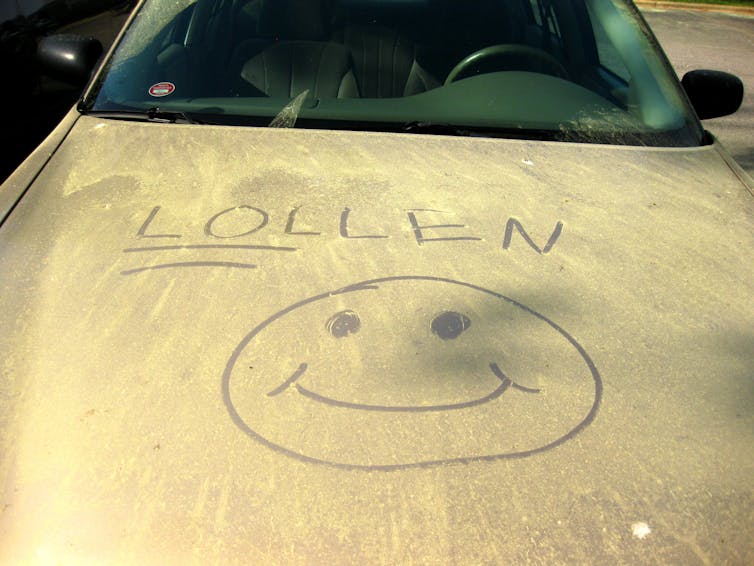
A car covered in yellow. Someone drew a smiley face with the words 'LOLLEN,' with LOL underlined.
On heavy pollen days, cars can end up covered in yellow grains. Scott Akerman/Flickr, CC BY

Even people who aren’t allergic to pollen – clearly an advantage for a pollination ecologist like me – can experience sneezing and watery eyes during the release of tree pollen each spring. Enough particulate matter in the air will irritate just about anyone, even if your immune system does not launch an all-out attack.

So, why is there so much pollen? And why does it seem to be getting worse?

2 ways trees spread their pollen

Trees don’t have an easy time in the reproductive game. As a tree, you have two options to disperse your pollen.

Option 1: Employ an agent, such as a butterfly or bee, that can carry your pollen to another plant of the same species.

The downside of this option is that you must invest in a showy flower display and a sweet scent to advertise yourself, and sugary nectar to pay your agent for its services.

A bee noses into a white flower.
A bee enjoys pollen from a cherry blossom. Pollen is a primary source of protein for bees. Ivan Radic/Flickr, CC BY

Option 2, the budget option, is much less precise: Get a free ride on the wind.

Wind was the original pollinator, evolving long before animal-mediated pollination. Wind doesn’t require a showy flower nor a nectar reward. What it does require for pollination to succeed is ample amounts of lightweight, small-diameter pollen.

Why wind-blown pollen makes allergies worse

Wind is not an efficient pollinator, however. The probability of one pollen grain landing in the right location – the stigma or ovule of another plant of the same species – is infinitesimally small.

Therefore, wind-pollinated trees must compensate for this inefficiency by producing copious amounts of pollen, and it must be light enough to be carried.

For allergy sufferers, that can mean air filled with microscopic pollen grains that can get into your eyes, throat and lungs, sneak in through window screens and convince your immune system that you’ve inhaled a dangerous intruder.

Tiny flowers on a live oak tree.
When wind blows the tiny pollen grains of live oaks, allergy sufferers feel it. Charles Willgren/Flickr, CC BY

Plants relying on animal-mediated pollination, by contrast, can produce heavier and stickier pollen to adhere to the body of an insect. So don’t blame the bees for your allergies – it’s really the wind.

Climate change has a role here, too

Plants initiate pollen release based on a few factors, including temperature and light cues. Many of our temperate tree species respond to cues that signal the beginning of spring, including warmer temperatures.

Studies have found that pollen seasons have intensified in the past three decades as the climate has warmed. One study that examined 60 location across North America found pollen seasons expanded by an average of 20 days from 1990 to 2018 and pollen concentrations increased by 21%.

That’s not all. Increasing carbon dioxide levels may also be driving increases in the quantity of tree pollen produced.

Why the Southeast gets socked

What could make this pollen boost even worse?

For the Southeastern U.S. in particular, strong windstorms are becoming more common and more intense − and not just hurricanes.

Anyone who has lived in the Southeast for the past couple of decades has likely noticed this. The region has more tornado warnings, more severe thunderstorms, more power outages. This is especially true in the mid-South, from Mississippi to Alabama.

A map showing windiest events in the Southeast are over Alabama and Mississippi.
Severity of wind and storm events mapped from NOAA data, 2012-2019, shows high activity over Mississippi and Alabama. Red areas have the most severe events. Christine Cairns Fortuin

Since wind is the vector of airborne pollen, windier conditions can also make allergies worse. Pollen remains airborne for longer on windy days, and it travels farther.

To make matters worse, increasing storm activity may be doing more than just transporting pollen. Storms can also break apart pollen grains, creating smaller particles that can penetrate deeper into the lungs.

Many allergy sufferers may notice worsening allergies during storms.

The peak of spring wind and storm season tends to correspond to the timing of the release of tree pollen that blankets our world in yellow. The effects of climate change, including longer pollen seasons and more pollen released, and corresponding shifts in windy days and storm severity are helping to create the perfect pollen storm.The Conversation

Christine Cairns Fortuin, Assistant Professor of Forestry, Mississippi State University

This article is republished from The Conversation under a Creative Commons license. Read the original article.


Details
Written by: Christine Cairns Fortuin, Mississippi State University
Published: 08 May 2025

Public comment period for proposed fire hazard map expanding ‘very high’ zones in Lake County closes next week

LAKE COUNTY, Calif. — Public comment on a proposed fire hazard severity zone map that significantly expands Lake County acreage in the highest severity zone is set to close next week. So far, officials say the response has been minimal.

On Feb. 10, Cal Fire released its new fire hazard severity zone map for “Local Responsibility Areas,” or the LRA, adding a total of 14,000 acres of Lake County land to the “very high” fire hazard severity zone, marking an 878% increase in acreage designated the highest severity category.

County and city officials feared that with such expansion, the new map could have major implications for the county, particularly in relation to fire insurance. They also have questioned the fact that the ratings on the map cannot be altered to a lower grade, regardless of local mitigation efforts.

The new map is in a 90-day public comment period that began Feb. 12 and ends Tuesday, May 13.

Local governments are required to adopt the map by ordinance at the end of a 120-day period; their deadline is July 1.

Nearly three months after the map’s release, both the cities of Lakeport and Clearlake report receiving no public input.

“At this time the City of Lakeport has not received any comments regarding the LRA Fire Hazard Severity Maps,” Lakeport City Manger Kevin Ingram said in an email to Lake County News this week.

“We haven't received any comments I am aware of,” Clearlake City Manager Alan Flora said. “We had been worried the response would be very muted.”

With the adoption deadline approaching, all three local governments are considering setting public hearings.

County Community Development Director Mireya Turner said the Board of Supervisors is tentatively scheduled to hold a first reading of the draft ordinance adopting the map on May 20.

Flora said Clearlake will present the map and ordinance at next week’s City Council meeting.

Ingram said Lakeport is tentatively planning to bring the item to either its June 3 or June 17 meeting. Once a date is confirmed, he expects public interest to increase.

“However, Cal Fire does not really leave much room for substantive action on any received comments beyond upzoning a location,” he added, noting the limited effect public input may have.

Still, officials say the opportunity for comment remains important.

During a Clearlake City Council meeting in February, Flora urged residents to speak up — even though he didn’t expect many would.

“Unfortunately, the community probably is not going to respond or care about this as much as they should until they get a cancellation notice of their insurance,” he said at the time. “Which, if they do nothing, is going to happen.”

The public can still direct questions about the maps to the Office of the State Fire Marshal at This email address is being protected from spambots. You need JavaScript enabled to view it. or by calling 916-633-7655.

Public comment can be submitted to the county and two city councils:

City of Clearlake: 14050 Olympic Drive, Clearlake. Email comments that apply within the city of Clearlake to: This email address is being protected from spambots. You need JavaScript enabled to view it. or call City Manager Alan Flora at 707-994-8201.
City of Lakeport: 225 Park St., Lakeport. Email comments that apply within the city of Lakeport to: This email address is being protected from spambots. You need JavaScript enabled to view it. or call City Manager Kevin Ingram at 707-263-5615, Extension 102.
County of Lake: 255 N Forbes St., Lakeport, Third Floor, Community Development Department. Email comments for County Jurisdiction areas to: This email address is being protected from spambots. You need JavaScript enabled to view it. or call Director Mireya Turner at 707-263-2382.

Significant increase in the highest-severity zone acreage

The release of the new LRA map marks its first update since 2011.

Compared to the 2011 version, this new map significantly expands the “very high” acreage in Lake County.

In Clearlake, the acreage rated as “very high” increases from 1,583 to 4,054 acres. In Lakeport, it rises from zero to 603 acres.

Meanwhile, unincorporated areas under county jurisdiction see the most dramatic jump, from just 5 acres to 10,881 acres.

Overall, the total acreage classified as "very high" has grown by 13,950 acres — from 1,588 to 15,538 acres — a total increase of approximately 878%.

In addition, the 2011 map was only required to show the “very high” category. The new map, however, also displays local areas rated moderate and high.

This is not the first time that Lake County has dealt with concerns about the fire hazard severity zone map.

The Office of the State Fire Marshal is required by law to classify both the state and local responsibility areas into moderate, high and very high fire hazard severity zones.

In April 2024, the updated mapping for State Responsibility Areas went into effect, despite local opposition expressed during the public hearing at the Lake County Board of Supervisors meeting.

The updated State Responsibility Areas map classified 366,812 acres in Lake County as "very high" fire hazard zones, accounting for 92% of the total acreage under SRA.

Concerns on fire insurance and the mandatory adoption process

Local officials have raised concerns about both the consequences and the process of adopting the new LRA map.

While Cal Fire and the State Insurance Commission maintain that the map is intended for governance and administrative purposes, a new policy enacted in December allows insurance companies to incorporate catastrophic maps into rate-setting.

“We know that the insurance companies were using them,” said Lakeport Fire Chief Patrick Reitz in a preliminary discussion about the map at the Lakeport city council meeting on Feb. 18.

“But now it is absolutely permitted,” he said.

Cal Fire has also been instructed to accelerate its “Zone 0” policy implementation which requires all structures in “very high” fire hazard zones on the LRA map to maintain an “ember-resistant zone” within the immediate 5-feet of structures.

In the meantime, local officials are frustrated by the fact that the county and cities “must” adopt the map as required by state law.

It’s not by choice, said Flora, who also used the word “restrictive” to describe the lack of flexibility in the adoption process: “We can increase the severity zones, but we can’t decrease them.”

“It is frustrating to be able to do a lot of mitigation work that still does not impact these severity zones,” Flora added.

“If you have ‘moderate,’ you can make a claim — ‘actually, it’s not moderate, it should be high,’” said Supervisor Bruno Sabatier of the rule that he found peculiar. “I don’t know who would ever do it.”

“We can’t do anything about it,” Chief Reitz said. “They give us a public hearing process that's lip service only.”

Email staff reporter Lingzi Chen at This email address is being protected from spambots. You need JavaScript enabled to view it.. 
Details
Written by: LINGZI CHEN
Published: 07 May 2025

Middletown Unified School Board to consider agreement with teachers union

LAKE COUNTY, Calif. — A potential strike by the Middletown Teachers Association has been averted thanks to the union and the Middletown Unified School District reaching an agreement that the district school board will consider approving on Wednesday night.

The district will hold its regular board meeting at 6 p.m. Wednesday, May 7, in the Middletown Unified multi-use room, located at 20932 Big Canyon Road.

On April 16, the membership of the Middletown Teachers Association, or MTA, voted overwhelmingly to authorize a potential strike, the first time such a vote was taken since the association was formed more than 30 years ago, as Lake County News has reported.

At that time, Middletown Unified Superintendent Jeff Crane told Lake County News that a May 2 bargaining session between the district and union was planned, and that the district was optimistic progress would be made.

As it turned out, that session yielded a tentative agreement that both Crane and union representative Diego Santelices confirmed that the MTA’s membership voted to ratify on Tuesday.

Now, it’s up to the Middletown Unified School Board to make a final decision on the contract, which it’s expected to do on Wednesday evening.

The tentative agreement calls for a 1% salary increase for MTA members to be added to the salary schedule starting in 2025-26 — and retroactive to July 1, 2025 — if the district’s unaudited actuals for the 2024-25 school year reflect an increase in the end balance for unrestricted funds that equals more than $6.1 million.

The single year retro payment is expected to total $850 per full-time employee, according to the agenda packet.

Other provisions of the tentative agreement include that the district will arrange for mandated training to be completed during professional development time, early release days and in lieu of staffing meetings, with an effort to reduce training as much as possible; for peer support stipends to be increased to $2,500 annually; for adjustments to be made surrounding rules for bilingual stipends; and for the district to send an annual reminder at the start of the school year to all personnel responsible for individualized education programs, or IEPs, in order for them to prepare for their participation.

Email Elizabeth Larson at This email address is being protected from spambots. You need JavaScript enabled to view it.. Follow her on Twitter, @ERLarson, and on Bluesky, @erlarson.bsky.social. Find Lake County News on the following platforms: Facebook, @LakeCoNews; X, @LakeCoNews; Threads, @lakeconews, and on Bluesky, @lakeconews.bsky.social.
Details
Written by: Elizabeth Larson
Published: 07 May 2025

Fallen California Highway Patrol officers honored in Tuesday ceremony

A ceremony on Tuesday, May 6, 2025, honored the sacrifices of the 232 California Highway Patrol officers who have died in the line of duty since the agency’s inception nearly a century ago. Photo courtesy of the Governor’s Office.

On Tuesday, Gov. Gavin Newsom attended the California Highway Patrol Annual Memorial Ceremony, paying tribute to the 232 uniformed members who have lost their lives in the line of duty since the department’s inception in 1929.

“We remember the officers who faced uncertainty and risk with resolve, not because they expected recognition, but because they believed in doing what is right. May their service to this state never be forgotten,” said Newsom.

The memorial ceremony at the CHP Academy in West Sacramento included an honor guard procession, laying of the wreath, rifle salute, roll call of the fallen and knelling of the memorial bell.

In memorial, Governor Newsom ordered flags to be flown at half-staff over the State Capitol and Capitol Annex Swing Space.


Gov. Gavin Newsom speaks at a ceremony to honor the California Highway Patrol’s fallen officers on Tuesday, May 6, 2025. Photo courtesy of the Governor’s Office.
Details
Written by: LAKE COUNTY NEWS REPORTS
Published: 07 May 2025
  • 283
  • 284
  • 285
  • 286
  • 287
  • 288
  • 289
  • 290
  • 291
  • 292

Public Safety

  • Lakeport Police Department celebrates long-awaited new headquarters

  • Lakeport Police Department investigates flag vandalism cases

  • Lakeport Police Department thanks Kathy Fowler Chevrolet for donation

Community

  • Hidden Valley Lake Garden Club installs new officers

  • 'America's Top Teens' searching for talent

  • 'The Goodness of Sea Vegetables' featured topic of March 5 co-op talk

Community & Business

  • Annual 'Adelante Jovenes' event introduces students, parents to college opportunities

  • Gas prices are dropping just in time for the holiday travel season

  • Lake County Association of Realtors installs new board and presents awards

  • Local businesses support travel show

  • Preschool families harvest pumpkins

  • Preschool students earn their wings

How to resolve AdBlock issue?
Refresh this page