How to resolve AdBlock issue?
Refresh this page
Lake County News,California
  • Home
    • Registration Form
  • News
    • Education
    • Veterans
    • Community
      • Obituaries
      • Letters
      • Commentary
    • Police Logs
    • Business
    • Recreation
    • Health
    • Religion
    • Legals
    • Arts & Life
    • Regional
  • Calendar
  • Contact us
    • FAQs
    • Phones, E-Mail
    • Subscribe
  • Advertise Here
  • Login
How to resolve AdBlock issue?
Refresh this page

News

Governor deploys firefighter strike team to support Oregon wildfire response

Cal Fire engines being sent to support wildfire suppression in Oregon. Photo courtesy of the Governor’s Office.


As wildfire conditions intensify across the Pacific Northwest, Gov. Gavin Newsom has directed the deployment of a Cal Fire Type 3 engine strike team to assist firefighting efforts in southern Oregon. 

The deployment includes five fire engines and a strike team leader who will join suppression operations just north of the California-Oregon border.

“Just as Oregon supported our state during the Los Angeles firestorms, we’re glad to support our Northern neighbors with strike teams and fire engines to aid in their wildfire response efforts. I’m proud California can lend a helping hand to fellow Americans in their time of need,” said Gov. Newsom.

This mobilization comes in response to a significant lightning event that ignited numerous wildfires across the region. 

Southern Oregon has experienced more than 2,000 lightning strikes in recent days, compounded by high temperatures and gusty winds. 

The National Weather Service has issued red flag warnings through July 8 for much of southern and central Oregon, signaling elevated fire danger and the need for immediate firefighting reinforcements.

Upon arrival in Medford, Cal Fire resources will seamlessly integrate into Oregon’s Department of Forestry command structure to support suppression efforts on active fires. 

This response is part of a long-standing interstate mutual aid agreement that strengthens wildfire readiness across the western United States.

California remains prepared to send additional resources should conditions escalate.

“We stand with Oregon during this critical time, just as they’ve stood with us during some of California’s toughest fire seasons,” said Anale Burlew, chief deputy director of Cal Fire. “These mutual aid partnerships are built on trust, coordination, and a shared commitment to public safety.”

Earlier this week, Newsom announced the deployment of 27 highly skilled Urban Search and Rescue Team members to Texas to assist with ongoing response efforts related to severe flooding impacts.

The aftermath of floods, hurricanes and other disasters can be hardest on older rural Americans – here’s how families and neighbors can help

Edith Schaecher, center, and her daughter and granddaughter look at a photo album recovered from her tornado-damaged home in Greenfield, Iowa, in May 2024. AP Photo/Charlie Neibergall

Hurricanes, tornadoes and other extreme weather do not distinguish between urban and rural boundaries. But when a disaster strikes, there are big differences in how well people are able to respond and recover – and older adults in rural areas are especially vulnerable.

If a disaster causes injuries, getting health care can take longer in rural areas. Many rural hospitals have closed, leaving patients traveling longer distances for care.

At the same time, rural areas have higher percentages of older adults, a group that is more likely to have chronic health problems that make experiencing natural disasters especially dangerous. Medical treatments, such as dialysis, can be disrupted when power goes out or clinics are damaged, and injuries are more likely around property damaged by flooding or powerful winds.

As a sociologist who studies rural issues and directs the Institute of Behavioral Science at the University of Colorado Boulder, I believe that understanding the risks is essential for ensuring healthier lives for older adults. I see many different ways rural communities are helping reduce their vulnerability in disasters.

Disasters disrupt health care, especially in isolated rural regions

According to the U.S. Census Bureau, about 20% of the country’s rural population is age 65 and over, compared with only 16% of urban residents. That’s about 10 million older adults living in rural areas.

There are three primary reasons rural America has been aging faster than the rest of the country: Young people have been leaving for college and job opportunities, meaning fewer residents are starting new families. Many older rural residents are choosing to “age in place” where they have strong social ties. And some rural areas are gaining older adults who choose to retire there.

An aging population means rural areas tend to have a larger percentage of residents with chronic disease, such as dementia, heart disease, respiratory illness and diabetes.

According to research from the National Council on Aging, nearly 95% of adults age 60 and older have at least one chronic condition, while more than 78% have two or more. Rural areas also have higher rates of death from chronic diseases, particularly heart disease.

At the same time, health care access in rural areas is rapidly declining.

Nearly 200 rural hospitals have closed or stopped providing in-patient care since 2005. Over 700 more — one-third of the nation’s remaining rural hospitals — were considered to be at risk of closing even before the cuts to Medicaid that the president signed in July 2025.

Hospital closures have left rural residents traveling about 20 miles farther for common in-patient health care services than they did two decades ago, and even farther for specialist care.

Those miles might seem trivial, but in emergencies when roads are damaged or flooded, they can mean losing access to care and treatment.

After Hurricane Katrina struck New Orleans in 2005, 44% of patients on dialysis missed at least one treatment session, and almost 17% missed three or more.

When Hurricanes Matthew and Florence hit rural Robeson County, North Carolina, in 2016 and 2018, some patients who relied on insulin to manage their blood sugar levels went without insulin for weeks. The county had high rates of poverty and poor health already, and the healthy foods people needed to manage the disease were also hard to find after the storm.

Insulin is important for treating diabetes – a chronic disease estimated to affect nearly one-third of adults age 65 and older. But a sufficient supply can be harder to maintain when a disaster knocks out power, because insulin should be kept cool, and medical facilities and drugstores may be harder for patients to reach.

Rural residents also often live farther from community centers, schools or other facilities that can serve as cooling centers during heat waves or evacuation centers in times of crisis.

Alzheimer’s disease can make evacuation difficult

Cognitive decline also affects older adults’ ability to manage disasters.

Over 11% of Americans age 65 and older – more than 7 million people – have Alzheimer’s disease or related dementia, and the prevalence is higher in rural areas’ older populations compared with urban areas.

Caregivers for family members living with dementia may struggle to find time to prepare for disasters. And when disaster strikes, they face unique challenges. Disasters disrupt routines, which can cause agitation for people with Alzheimer’s, and patients may resist evacuation.

Living through a disaster can also worsen brain health over the long run. Older adults who lived through the 2011 Great East Japan earthquake and tsunami were found to have greater cognitive decline over the following decade, especially those who lost their homes or jobs, or whose health care routines were disrupted.

Social safety nets are essential

One thing that many rural communities have that helps is a strong social fabric. Those social connections can help reduce older adults’ vulnerability when disasters strike.

Following severe flooding in Colorado in 2013, social connections helped older adults navigate the maze of paperwork required for disaster aid, and some even provided personal loans.
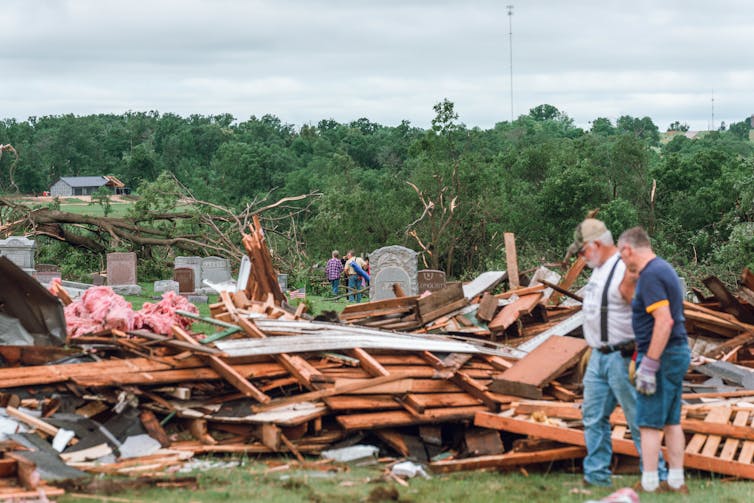
Two older men stand by debris form a storm-damaged church. Another group of people walks in the background.
Community support through churches, like this one whose building was hit by a tornado in rural Argyle, Wis., in 2024, and other groups can help older adults recover from disasters. Ross Harried/NurPhoto via Getty Images

Friends, family and neighbors in rural areas often check in on seniors, particularly those living alone. They can help them develop disaster response plans to ensure older residents have access to medications and medical treatment, and that they have an evacuation plan.

Rural communities and local groups can also help build up older adults’ mental and physical health before and after storms by developing educational, social and exercise programs. Better health and social connections can improve resilience, including older adults’ ability to respond to alerts and recover after disasters.

Ensuring that everyone in the community has that kind of support is important in rural areas and cities alike as storm and flood risks worsen, particularly for older adults.The Conversation

Lori Hunter, Professor of Sociology, Director of the Institute of Behavioral Science, University of Colorado Boulder

This article is republished from The Conversation under a Creative Commons license. Read the original article.

$1.2 million in Lake County school funds on hold amidst multibillion federal education freeze

LAKE COUNTY, Calif. — Right before the new fiscal year began for schools, the Trump Administration announced an abrupt freeze of over $6 billion in federal education funding nationwide — including an estimated $1 billion to California and $1.2 million to Lake County schools — despite congressional approval.

State and Lake County officials say the move — described as an “impoundment of federal funds” — will bring tremendous disruption to public school services. 

The U.S. Department of Education announced the freeze on June 30, one day before the July 1 start of the school year, when funds are typically released. 

It’s projected that $1.2 million has been withheld from county schools — about 16.5% of its over $7 million in total federal funds allocation, according to Lake County Superintendent of Schools Brock Falkenberg.

Falkenberg told Lake County News that he had not received any official communication prior to the fund freeze, and that it occurred, “Without notice and without reason and without engagement or warning.”

“It is troubling; It will have a tremendous impact,” he told Lake County News. “We’re still trying to evaluate what actually is going to mean locally, but it is millions of dollars.”

Locally, such a decision “jeopardizes essential educational services, especially those that support our most vulnerable students,” Falkenberg said in a July 2 press release. “Programs supporting adults working toward a high school diploma, after-school initiatives that keep children safe and enriched, services for English learners, and resources for students from migrant families are all at serious risk.”
 
The freeze came abruptly without an explanation, raising concerns about its legality and motivation.

In a July 1 press release, the California Department of Education estimates a $1 billion freeze being “illegally impounded” statewide.

State Superintendent Tony Thurmond said the decision appeared to be politically driven. 

“The President is completely disregarding the democratic process by impounding dollars already budgeted, rather than trying to make his case for cuts to elected representatives sent to Congress by the American people to make these decisions,” Superintendent Thurmond said in the press release. “In the notification we received, the Trump Administration provides no legal justification for withholding these dollars from our students. The Administration is punishing children for the sole reason that states refuse to cater to Trump’s political ideology.” 

“It is unprecedented in my career,” Falkenberg told Lake County News in a phone call. “There’s always been respect for the budgets that have been in place as the administration changes.”

Falkenberg said he has worked as an educator and administrator for three decades. For him the current funding freeze breaks with that long-standing norm of respecting approved budgets, regardless of political and administration changes.

Worst case scenario, Falkenberg said, if the frozen funds ended as cuts and never came through, he would expect “a cut in staffing and a cut in programs that are supporting our adult learners, our after school programs, our programs to support and enhance teacher preparation, our support for students who are English learners — that’s the programs that are supporting families or students of families of migrants.” 

‘Foundational to educational opportunities’

Falkenberg explained that education budgets were laid out in March, assuming these funds would be in place. “We have programs in place and have made purchases assuming these funds would be there. Only to the very last minute here that they may not come,” he said.

“These aren’t supplementary programs; they are foundational to educational opportunities,” Falkenberg said in his press release. “These funds were enacted by Congress and signed into law by the President. School districts across California, including here at home, responsibly integrated them into their budgets with the clear expectation of timely delivery.”

The answers to many questions remain unclear: Why did the abrupt freeze occur? Is it permanent or temporary? If it’s temporary, when will the fund be released?

“A lot of your questions are the same questions that we are trying to delve into right now,” Falkenberg said.

Lake County News made multiple calls over the past week to reach the U.S. Department of Education’s press office with these questions.

Each call was met with an automated message: “Our center is temporarily closed at this time.” After a voice message was recorded — with no options to review, re-record or mark it as urgent — the call ended abruptly: “Thank you for your message. Goodbye.”

News outlets are not alone in struggling to get answers from the federal agency. 

“Everyone’s in the same position; they're scrambling,” said State Superintendent Thurmond in a KCRA 3 interview. “They have no idea what this means and what the impacts are. We can't even get the information out of the US Department of Education about what's being funded and what's not.”

While local access to federal information remains limited, Falkenberg is worried about what this may signal for the future. 

“That's a good indicator even if we end up receiving these funds in a month or two, they won't be in the next budget,” Falkenberg told Lake County News. “If these are not a priority of the current administration, and there's a good possibility they won't be budgeted in the long run.”

He added, “I think the dust will start to settle — for lack of a better term — in the next week to two weeks, and at that point in time, we'll just be able to have much more robust conversations about next steps.”

Email Lingzi Chen at This email address is being protected from spambots. You need JavaScript enabled to view it.. 

Seventh annual Broadband Summit focuses on North State connectivity

NORTHERN CALIFORNIA — The North State Planning and Development Collective at California State University, Chico, along with the Northeastern and Upstate California Connect Broadband Consortia, will hold its seventh annual Virtual Broadband Summit next month.

The event will take place on Thursday, Aug. 28, from 9 to 11 a.m.

Registration is free and is now open through Eventbrite.com.

The event brings together regional and state leaders in broadband for a morning dedicated to the current broadband programs and initiatives underway in the California North State region.  

“Broadband is critical to the way we all live, do business and learn,” said Jason Schwenkler, executive director for the collective and manager of the Upstate and Northeastern California Connect Broadband Consortia. “This annual event allows us the opportunity to inform the region about current broadband policy, infrastructure developments and more affecting the North State region.

The agenda includes: 

• Welcome and update from Jason Schwenkler.
• Legislation and Policy Update by Sunne Wright-McPeak, President and CEO, California Emerging Technology Fund, or CETF. 
• Broadband for All Update by Scott Adams, deputy director of broadband and digital literacy, California Department of Technology and an update from Mark Monroe, deputy director of California's Middle-Mile Initiative, California Department of Technology.
• Update from Maria Ellis, deputy director of broadband, California Public Utilities Commission
 
To register, search “7th Annual Virtual Broadband Summit” on Eventbrite.com.

For additional information about the event agenda or registration, contact Sabrina Oregel, outreach coordinator, at This email address is being protected from spambots. You need JavaScript enabled to view it.. 

Middletown Area Town Hall to meet July 10

MIDDLETOWN, Calif. — The Middletown Area Town Hall, or MATH, will get updates on a new park project and other projects in the south county area.

MATH will meet at 7 p.m. Thursday, July 10, in the Middletown Community Meeting Room/Library at 21256 Washington St., Middletown. The meeting is open to the public.

Zoom will not be available. Viewers can participate via PEG TV at www.youtube.com/LakeCountyPegTV. 

On the agenda is a presentation by Public Services Director Lars Ewing regarding a new park in Middletown.

The group will consider voting to finalize MATH’s updated bylaws, which will then be sent to the Board of Supervisors for approval.

In other business, the group will get an update on a public meeting on Aug. 7 regarding Caltrans projects in the Middletown area and the Lake Lake Area Planning Council’s Zero Emission Vehicle Infrastructure Plan.

MATH — established by resolution of the Lake County Board of Supervisors on Dec. 12, 2006 — is a municipal advisory council serving the residents of Anderson Springs, Cobb, Coyote Valley (including Hidden Valley Lake), Long Valley and Middletown.

For more information email This email address is being protected from spambots. You need JavaScript enabled to view it.. 

Email Elizabeth Larson at This email address is being protected from spambots. You need JavaScript enabled to view it.. Follow her on Twitter, @ERLarson, and on Bluesky, @erlarson.bsky.social. Find Lake County News on the following platforms: Facebook, @LakeCoNews; X, @LakeCoNews; Threads, @lakeconews, and on Bluesky, @lakeconews.bsky.social. 

‘Big’ legislative package shifts more of SNAP’s costs to states, saving federal dollars but causing fewer Americans to get help paying for food

People shop for food in Brooklyn in 2023 at a store that makes sure that its customers know it accepts SNAP benefits, also known as food stamps and EBT. Spencer Platt/Getty Images

The legislative package that President Donald Trump signed into law on July 4, 2025, has several provisions that will shrink the safety net, including the Supplemental Nutrition Assistance Program, long known as food stamps. SNAP spending will decline by an estimated US$186 billion through 2034 as a result of several changes Congress made to the program that today helps roughly 42 million people buy groceries – an almost 20% reduction.

In my research on the history of food stamps, I’ve found that the program was meant to be widely available to most low-income people. The SNAP changes break that tradition in two ways.

The Congressional Budget Office estimates that about 3 million people are likely to be dropped from the program and lose their benefits. This decline will occur in part because more people will face time limits if they don’t meet work requirements. Even those who meet the requirements may lose benefits because of difficulty submitting the necessary documents.

And because states will soon have to take on more of the costs of the program, which totaled over $100 billion in 2024, they may eventually further restrict who gets help due to their own budgetary constraints.

Summing up SNAP’s origins

Inspired by the plight of unemployed coal miners whom John F. Kennedy met in Appalachia when he campaigned for the presidency in 1960, the early food stamps program was not limited to single parents with children, older people and people with disabilities, like many other safety net programs were at the time. It was supposed to help low-income people afford more and better food, regardless of their circumstances.

In response to national attention in the late 1960s to widespread hunger and malnutrition in other areas of the country, such as among tenant farmers in the rural South, a limited food stamps program was expanded. It reached every part of the country by 1974.

From the start, the states administered the program and covered some of its administrative costs and the federal government paid for the benefits in full. This arrangement encouraged states to enroll everyone who needed help without fearing the budgetary consequences.

Who could qualify and how much help they could get were set by uniform national standards, so that even the residents of the poorest states would be able to afford a budget-conscious but nutritionally adequate diet.

The federal government’s responsibility for the cost of benefits also allowed spending to automatically grow during economic downturns, when more people need assistance. These federal dollars helped families, retailers and local economies weather tough times.

The changes to the SNAP program included in the legislative package that Congress approved by narrow margins and Trump signed into law, however, will make it harder for the program to serve its original goals.

Restricting benefits

Since the early 1970s, most so-called able-bodied adults who were not caring for a child or an adult with disabilities had to meet a work requirement to get food stamps. Welfare reform legislation in 1996 made that requirement stricter for such adults between the ages of 18 and 50 by imposing a three-month time limit if they didn’t log 20 hours or more of employment or another approved activity, such as verified volunteering.

Budget legislation passed in 2023 expanded this rule to adults up to age 54. The 2025 law will further expand the time limit to adults up to age 64 and parents of children age 14 or over.

States can currently get permission from the federal government to waive work requirements in areas with insufficient jobs or unemployment above the national average. This flexibility to waive work requirements will now be significantly limited and available only where at least 1 in 10 workers are unemployed.

Concerned senators secured an exemption from the work requirements for most Native Americans and Native Alaskans, who are more likely to live in areas with limited job opportunities.

A 2023 budget deal exempted veterans, the homeless and young adults exiting the foster care system from work requirements because they can experience special challenges getting jobs. The 2025 law does not exempt them.

The new changes to SNAP policies will also deny benefits to many immigrants with authorization to be in the U.S., such as people granted political asylum or official refugee status. Immigrants without authorization to reside in the U.S. will continue to be ineligible for SNAP benefits.

Tracking ‘error rates’

Critics of food stamps have long argued that states lack incentives to carefully administer the program because the federal government is on the hook for the cost of benefits.

In the 1970s, as the number of Americans on the food stamp rolls soared, the U.S. Department of Agriculture, which oversees the program, developed a system for assessing if states were accurately determining whether applicants were eligible for benefits and how much they could get.

A state’s “payment error rate” estimates the share of benefits paid out that were more or less than an applicant was actually eligible for. The error rate was not then and is not today a measure of fraud. Typically, it just indicates the share of families who get a higher – or lower – amount of benefits than they are eligible for because of mistakes or confusion on the part of the applicant or the case worker who handles the application.

Congress tried to penalize states with error rates over 5% in the 1980s but ultimately suspended the effort under state pressure. After years of political wrangling, the USDA started to consistently enforce financial penalties on states with high error rates in the mid-1990s.

States responded by increasing their red tape. For example, they asked applicants to submit more documentation and made them go through more bureaucratic hoops, like having more frequent in-person interviews, to get – and continue receiving – SNAP benefits.

These demands hit low-wage workers hardest because their applications were more prone to mistakes. Low-income workers often don’t have consistent work hours and their pay can vary from week to week and month to month. The number of families getting benefits fell steeply.

The USDA tried to reverse this decline by offering states options to simplify the process for applying for and continuing to get SNAP benefits over the course of the presidencies of Bill Clinton, George W. Bush and Barack Obama. Enrollment grew steadily.

Penalizing high rates

Since 2008, states with error rates over 6% have had to develop a detailed plan to lower them.

Despite this requirement, the national average error rate jumped from 7.4% before the pandemic, to a record high of 11.7% in 2023. Rates rose as states struggled with a surge of people applying for benefits, a shortage of staff in state welfare agencies and procedural changes.

Republican leaders in Congress have responded to that increase by calling for more accountability.

Making states pay more

The big legislative package will increase states’ expenses in two ways.

It will reduce the federal government’s responsibility for half of the cost of administering the program to 25% beginning in the 2027 fiscal year.

And some states will have to pay a share of benefit costs for the first time in the program’s history, depending on their payment error rates. Beginning in the 2028 fiscal year, states with an error rate between 6-8% would be responsible for 5% of the cost of benefits. Those with an error rate between 8-10% would have to pay 10%, and states with an error rate over 10% would have to pay 15%. The federal government would continue to pay all benefits in states with error rates below 6%.

Republicans argue the changes will give states more “skin in the game” and ensure better administration of the program.

While the national payment error rate fell from 11.68% in the 2023 fiscal year to 10.93% a year later, 42 states still had rates in excess of 6% in 2024. Twenty states plus the District of Columbia had rates of 10% or higher.

At nearly 25%, Alaska has the highest payment error rate in the country. But Alaska won’t be in trouble right away. To ease passage in the Senate, where the vote of Sen. Lisa Murkowski, an Alaska Republican, was in doubt, a provision was added to the bill allowing several states with the highest error rates to avoid cost sharing for up to two years after it begins.

Democrats argue this may encourage states to actually increase their error rates in the short term.

The effect of the new law on the amount of help an eligible household gets is expected to be limited.

About 600,000 individuals and families will lose an average of $100 a month in benefits because of a change in the way utility costs are treated. The law also prevents future administrations from increasing benefits beyond the cost of living, as the Biden Administration did.

States cannot cut benefits below the national standards set in federal law.

But the shift of costs to financially strapped states will force them to make tough choices. They will either have to cut back spending on other programs, increase taxes, discourage people from getting SNAP benefits or drop the program altogether.

The changes will, in the end, make it even harder for Americans who can’t afford the bare necessities to get enough nutritious food to feed their families.The Conversation

Tracy Roof, Associate Professor of Political Science, University of Richmond

This article is republished from The Conversation under a Creative Commons license. Read the original article.

  • 196
  • 197
  • 198
  • 199
  • 200
  • 201
  • 202
  • 203
  • 204
  • 205

Community

  • Sheriff’s Activities League and Clearlake Bassmasters offer youth fishing clinic

  • City Nature Challenge takes place April 24 to 27

Public Safety

  • Lakeport Police logs: Wednesday, Feb. 11

  • Lakeport Police logs: Tuesday, Feb. 10

Education

  • Ramos measure requiring school officer training in use of anti-opioid drug moves forward

  • Lake County Chapter of CWA announces annual scholarships 

Health

  • California ranks 24th in America’s Health Rankings Annual Report from United Health Foundation

  • Healthy blood donors especially vital during active flu season

Business

  • Employment law summit takes place March 9

  • Two Lake County Mediacom employees earn company’s top service awards

Obituaries

  • Terry Knight

  • Ellen Thomas

Opinion & Letters

  • Who should pay for AI’s power? Not California ratepayers

  • Crandell: Supporting nephew for reelection in supervisorial race

Veterans

  • State honors fallen chief warrant officer killed in conflict in Iran

  • CalVet and CSU Long Beach team up to improve data collection related to veteran suicides

Recreation

  • April Audubon program will show how volunteers can help monitor local osprey nests

  • First guided nature walk of spring at Anderson Marsh State Historic Park April 11

  • Second Saturday guided nature walks continue at Anderson Marsh State Historic Park

  • Wet weather trail closure in effect on Upper Lake Ranger District

Religion

  • Kelseyville Presbyterian Church plans Easter service

  • Easter ‘Sonrise’ Service returns to Xabatin Community Park

Arts & Life

  • ‘CIA’ delves into the shadowy world of an espionage thriller

  • ‘War Machine’ shifts the battlefield into uncharted territory

Government & Politics

  • Lake County Democratic Central Committee endorses Falkenberg

  • Crandell launches reelection campaign plans March 15 event

Legals

  • April 23 hearing on Lake Coco Farms Major Use Permit

  • NOTICE OF 30-DAY PUBLIC COMMENT PERIOD & NOTICE OF PUBLIC HEARING

How to resolve AdBlock issue?
Refresh this page