
 How to resolve AdBlock issue?
 Tuesday night fire damages building at Ceago Vinegarden
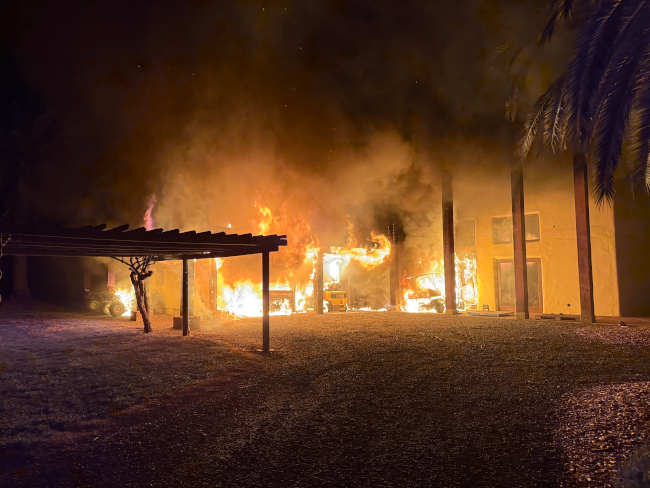
NICE, Calif. — A fire on Tuesday night damaged a building at a famed Northshore winery.
The fire at Ceago Vinegarden, located on Highway 20 between Nice and Lucerne, was dispatched just before 9 p.m. Tuesday.
Initial reports from the scene indicated one of the structures in the Ceago’s compound of buildings was fully involved when firefighters arrived on scene minutes after the initial dispatch.
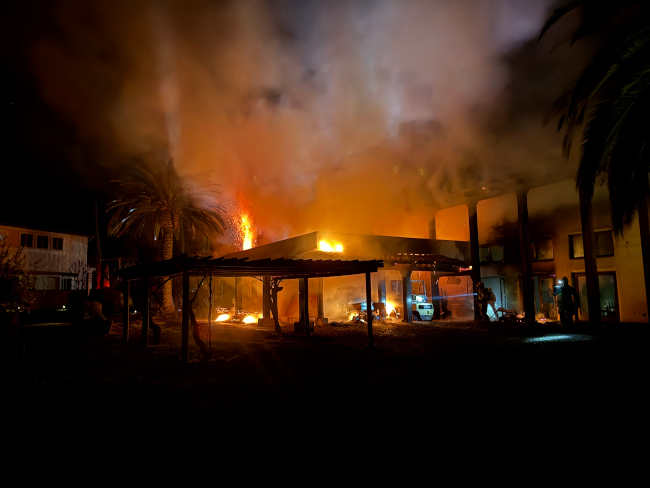
Firefighters from Northshore Fire, Lakeport Fire and Cal Fire responded to the scene. Lakeport Fire sent its ladder truck to assist with the firefighting effort and the Northshore Fire Support Team was dispatched due to the incident being extended.
Ceago’s owner, Jim Fetzer, told Lake County News that his son, Barney, heard a loud boom before discovering the fire in what Fetzer called the “shop” building. Barney Fetzer then ran to his father’s residence shouting, “Fire! Fire!”
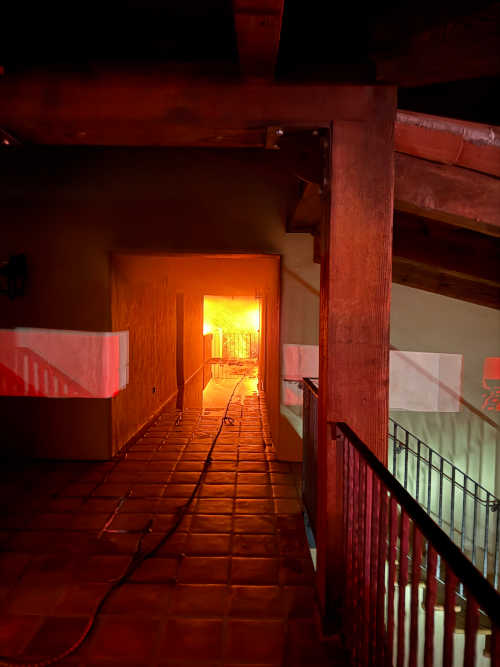
The shop building, Jim Fetzer said, is not lived in, but has been used for events. It’s located at the back of the main building and is where Fetzer has plans for a commercial kitchen and restaurant venue.
There was no one in the building. “Everybody’s safe,” Fetzer said.
“You never imagine” an incident like the fire, he said.
The fire, which was kept to the shop building, was reported to be knocked down shortly before 10 p.m., but overhaul continued until early Wednesday morning.
Fetzer has owned the 163-acre property since 2001. He developed a biodynamic winery and farm there which he closed to the public in 2014 when he retired.
Email Elizabeth Larson at
- Details
- Written by: Elizabeth Larson
Scotts Valley Pomo respond to lawsuit seeking to stop casino project
LAKE COUNTY, Calif. — A Lake County tribe seeking to build a new mega casino in Vallejo said Tuesday that a federal lawsuit filed by two other tribes seeking to stop the project is without merit.On Monday, the Yocha Dehe Wintun Nation and the Kletsel Dehe Band of Wintun Indians filed a lawsuit challenging the decision by the Department of the Interior to allow the Scotts Valley Band of Pomo Indians to build its casino in Vallejo.
Scotts Valley’s $700 million, 400,000-square-foot mega casino complex, along with 24 homes and an administrative building, will be located on a 128-acre site near I-80 and Highway 37, as Lake County News has reported.
The suit filed by the Yocha Dehe and Kletsel Dehe tribes alleges multiple “fundamental” violations of federal laws meant to protect tribes and their ancestral lands.
One of their key arguments is that Scotts Valley has no documented cultural connection to Vallejo, and that allowing the casino approval to stand sets an ominous precedent that undermines tribal sovereignty and weakens the foundation of federal-tribal land policy.
They also argue that the Department of Interior misled them, refused to consult with them, cut short the environmental review process and ignored evidence of the significant environmental consequences on local tribes and the surrounding community.
The outcome, the tribes said in a Monday statement, was that they had no choice but to sue, and that the case was about more than a casino but “about protecting the integrity of the land-into-trust process and ensuring decisions are made fairly, lawfully, and based on true historical ties,” said Charlie Wright, chairman of the Kletsel Dehe Wintun Nation.
On Tuesday, Scotts Valley issued a statement from Tribal Chairman Shawn Davis in response to the lawsuit’s filing.
“This anti-competitive lawsuit was completely expected, and it doesn’t change our approach and commitment to the project. We are moving forward in collaboration with the local community just as we have been,” Davis said.
“The specious arguments raised in the lawsuit mischaracterize both the facts and the law. To try to avoid fair competition, the plaintiff is throwing whatever they can at the wall with their court filing, but it won’t stick. We are confident that the Department of the Interior followed the law in its thorough review of our application and that our tribal land will remain in trust. We plan to join the United States in defending and upholding this decision,” the statement continued.
“The Scotts Valley Band of Pomo Indians is proud of the careful and lawful steps we’ve taken to restore a land base for our Tribe and to pursue opportunities to benefit our citizens and our neighbors for generations to come. We are 100-percent committed to advancing opportunity and prosperity for our tribal members and the surrounding community which will benefit from thousands of jobs and hundreds of millions of dollars in wages and benefits,” Davis said.
As a result of the Department of Interior’s approval of Scotts Valley’s fee to trust application in January, “The land is now the sovereign homeland of the Scotts Valley Tribe,” according to Davis’ statement.
The Bureau of Indian Affairs defines a “fee to trust” land acquisition as “the transfer of land title from an individual Indian or federally-recognized Tribe to the United States, in trust, for the benefit of that individual Indian or tribe.”
Davis said a federal court previously affirmed Scotts Valley’s “longstanding historical connection to Vallejo,” as did the findings of the Bureau of Indian Affairs and Department of Interior.
Studies conducted for the Bureau of Indian Affairs found the project would employ thousands of existing Vallejo and Solano County residents and generate a massive boost to the local economy, Davis said.
For more information on the opposition to the project visit www.protecttribalhomelands.com.
To learn more about the studies conducted and the proposed project from Scotts Valley’s perspective, visit: https://www.scottsvalleycasinoea.com/.
Email Elizabeth Larson at
- Details
- Written by: Elizabeth Larson
Yuba Community College District Board to discuss possible bond measure
NORTHERN CALIFORNIA — In a special meeting this week, the Yuba Community College District Board of Trustees will conduct a training and hold a preliminary discussion on a possible bond measure.The special board meeting and study session will be held at 2 p.m. Thursday, March 27, at the Yuba College campus, 2088 N. Beale Road, Building 300-Flavors, Marysville.
The meeting also will be available via Zoom at this link. The call-in number is 1 669 900 6833; the Zoom Meeting ID is 838 8526 0070.
The agenda and meeting documents are available here.
The main items on the agenda are a “10+1” training relating to the board’s work with the Academic Senate, the primary role of which is “to make recommendations and be the
official voice of faculty on academic and professional matters,” according to the board presentation.
Also on the agenda is a preliminary bond discussion.
The report for the bond matter explains that in the fall of 2023, then-District Board President Juan Delgado, charged a board ad hoc committee that consisted of three board trustees and district administrators to evaluate the feasibility of issuing a bond measure during the 2024 presidential election.
“After careful discussions, the Ad Hoc Committee concluded that the political and economic conditions within the counties within YCCD's service areas would not support issuing a bond measure,” the report said.
The report said the ad hoc committee recommended that the district revisit the matter after the presidential election, at which point it would “initiate the work on community outreach and development, focusing on familiarizing the communities with the progress of the existing bond projects, the positive differences the colleges are making in the communities and the support that the colleges urgently need to take the colleges to the new level of services.”
Board President Richard Teagarden has appointed a board ad hoc committee to discuss the need for a potential bond. Teagarden along with trustees Dennise Burbank and John Cassidy sit on that ad hoc committee, according to the meeting documents.
The ad hoc committee held its first preliminary discussion with Chancellor Shouan Pan and President Tawny Dotson, the district reported.
The special meeting on Thursday will include a discussion with the board about the future direction of the ad hoc committee's work, as well “the necessity and feasibility of a future bond” which the report for the meeting notes is “directly related to the core mission of supporting student success when the colleges are confronted with urgent facility challenges and fast-changing information technologies.”
Previous bond measures J, approved in 2006 for $190 million, and Q from 2017, which approved $33,565,000, led to significant facility improvements throughout the eight-county district. The district reported that all of the projects from those two bonds are expected to be completed by 2026.
However, the district’s last attempt at a general bond, Measure C in March of 2020, failed, 63 to 39 percent. That bond was for $228 million.
Email Elizabeth Larson at
- Details
- Written by: Elizabeth Larson
Public invited to Klaus Park concept design meeting March 26
CLEARLAKE OAKS, Calif. — Lake County Public Services staff will be on hand Wednesday evening to share with the public the progress on designing the county’s newest public park.The design concept meeting on the new John T. Klaus Park will take place from 4 to 6 p.m. Wednesday, March 26, in the Nylander Building, located next to the playground at Nylander Park and behind the Red & White grocery store in Clearlake Oaks.
Community members can drop in during the two-hour meeting to peruse the draft proposals for the 570-acre park, which will be located near the roundabout at Highway 20 and Highway 53 just east of Clearlake Oaks.
Aspects of the park announced so far include a trail system, cultural center, native garden, dog parks and frisbee golf.
County staff will be present to answer questions and obtain comments, which will be used to create a more finalized design.
The property was donated to the county, with the Board of Supervisors accepting the donation in November 2022. Several million dollars also accompanied the land donation in order to develop the park.
In August, the county began hosting public meetings on the project, beginning with a listening session that featured a consulting firm, Helix, which was helping to complete studies for the plan.
For more information call the Lake County Public Services Department at 707-262-1618 from 8 a.m. to 5 p.m. Monday through Friday or email
Email Elizabeth Larson at
- Details
- Written by: Elizabeth Larson
Windsor, Vallejo casino projects challenged by new lawsuits
NORTHERN CALIFORNIA — Two Lake County tribes are facing legal headwinds in response to the U.S. Department of Interior’s approval earlier this year of their out-of-county casino projects.The projects, proposed by the Koi Nation of Northern California and Scotts Valley Band of Pomo Indians of Lakeport, have faced significant opposition from other tribes and communities alike.
Now, both casino proposals — one in Windsor, the other in Vallejo — appear to be headed toward lengthy legal battles that could slow or halt them altogether as the result of lawsuits filed in federal court over the past month.
The suits fault the process to approve the casinos for failing to take into account community and tribal input, as well as glossing over environmental concerns.
The casino projects also were opposed by Gov. Gavin Newsom. In August, Matthew Lee, Gov. Gavin Newsom’s senior advisor for tribal negotiations and deputy legal affairs secretary, wrote to Bryan Newland, the assistant secretary for the Bureau of Indian Affairs, to urge the federal government not to approve them.
Lee’s letter raised concerns about the projects being focused “less on restoring the relevant tribes’ aboriginal homelands, and more on creating new gaming operations in desirable markets.”
Despite the governor’s opposition, at the start of January, the Department of Interior gave approval to the two projects in the waning days of the Biden administration, under Department of Interior Secretary Deb Haaland.
The agency greenlighted the projects in the face of heavy opposition both from the communities where the projects will be located and from other tribes who said the Koi and Scotts Valley were trying to get casinos well outside of their ancestral lands.
In February, four Sonoma County tribes filed lawsuits against the Department of Interior for the approval of the casino development in Windsor proposed by the Koi Nation, formerly based in Lower Lake.
The Koi Nation’s Shiloh Resort & Casino is slated to be built on 68 acres at 222 E. Shiloh Road in Windsor. It will include 2,500 gaming machines, a 400-room hotel, along with restaurants, a meeting center and spa.
On Feb. 14, Graton Rancheria filed its lawsuit, which on March 20 was consolidated with another suit it had filed for declaratory and injunctive relief against the Department of Interior in November.
Lytton Rancheria, Dry Creek Rancheria and Cloverdale Rancheria filed their joint suit against the government on Feb. 21.
Then, on Monday, the Yocha Dehe Wintun Nation and the Kletsel Dehe Band of Wintun Indians filed a lawsuit challenging the decision by the Department of the Interior to allow the Scotts Valley Pomo to build its casino in Vallejo.
Scotts Valley’s $700 million, 400,000-square-foot mega casino complex, along with 24 homes and an administrative building, will be located on a 128-acre site near I-80 and Highway 37.
Connections to ancestral land and process
The Graton lawsuit, like those that would follow, faults the government’s procedural approach, calling it flawed.
It also claims that the government “steamrolled” important statutory protections “in their regulatory sprint” to approve the Koi Nation’s project, “regardless of applicable legal requirements.”
In the suit filed by Lytton, Dry Creek and Cloverdale, the tribes assert that the action to approve the Koi casino project was driven by personal connections. They argue it also will have huge impacts nationwide.
“Defendants’ actions depart from decades of precedent and practice that carefully scrutinized the connections between Indian tribes and the land upon which they wished to build gaming facilities. The effects of Defendants’ actions will be enormous: they set a precedent for
green-lighting casinos in virtually any location throughout the United States, no matter how tenuous an Indian Tribe’s connection to the proposed casino site may be. And, upon information and belief, that was the point of the final agency decision to approve the Koi application,” the lawsuit complaint states.
The suit alleges that Bryan Newland, the assistant secretary for Indian Affairs at the time of the relevant approvals, is a former attorney for Koi who, during his tenure at the Bureau of Indian affairs, “significantly broadened” the agency’s “interpretation and implementation of statutes and regulations governing Indian gaming facilities in a manner that facilitated approval of Koi’s and other tribes’ applications.”
They emphasize that the Koi’s territory is 50 miles away from the casino site, and that the tribe has no significant historical connection to Windsor.
Another point used in the suits is the Koi’s series of lawsuits against the city of Clearlake over the city’s efforts to build a new commercial center on the former Pearce Field property as well as the Burns Valley sports complex.
“In these lawsuits,” the Lytton suit notes, “Koi characterized territory near Clear Lake as ‘the area of traditional and cultural affiliation of [Koi]’” with “archaeological, cultural, and Tribal Cultural Resources.”
Vallejo casino lawsuit cites violations of federal law
The suit filed this week against the Scotts Valley tribe notes that the Vallejo location was meant for open space and contains cultural sites sacred to the Yocha Dehe Wintun Nation.
The Yocha Dehe has fought the project for years, arguing that it will lead to desecration of its homelands and faulting the federal government for a process that it said dismissed community and other tribes’ concerns.
The lawsuit identifies fundamental violations of multiple federal laws intended to protect tribal governments, their ancestral homelands, and their people.
The two tribes also said their suit reveals that, in an effort to ensure the decision was issued during the change of presidential administrations, Department of Interior, or DOI, officials misled local tribes, refused to consult with them, and ignored their evidentiary submissions.
“It is heartbreaking that the Biden Administration chose to spend its final days approving a mega-project on our sacred Patwin homelands without ever consulting our Tribe. This has left us no choice but to pursue legal action to protect our people, our homelands, and our rights,” said Yocha Dehe Chairman Anthony Roberts. “Our filing shows how former DOI officials acted recklessly and illegally in an effort to avoid federal laws which are in place to ensure transparency, fairness and agency accountability.”
The Yocha Dehe said the 2025 decision about the Scotts Valley project represents an unexplained change of position for the United States.
The Department of Interior previously determined on three separate occasions, under presidential administrations of both political parties, that Scotts Valley lacks a significant historical connection to the city of Vallejo and is therefore prohibited from acquiring so-called “restored” gaming lands there, the Yocha Dehe said in a Monday statement.
“While the incoming presidential administration may reconsider the challenged approval — welcomed by Yocha Dehe and Kletsel Dehe — the imminent, acute harms to cultural resources on Patwin homelands, among other impacts, required the tribes to seek judicial relief in the meantime,” the tribe said in a Monday announcement.
“This is about more than a casino, it’s about protecting the integrity of the land-into-trust process and ensuring decisions are made fairly, lawfully, and based on true historical ties,” said Charlie Wright, chairman of the Kletsel Dehe Wintun Nation. “Our tribe has always stood firm in defense of our lands and heritage, and this case is no different. Scotts Valley has no documented cultural connection to Vallejo, and allowing this approval to stand sets an ominous precedent that undermines Tribal sovereignty and weakens the foundation of federal-tribal land policy. We fully support tribes securing land within their rightful homelands, but no tribe should be allowed to bypass established legal and historical standards. When federal agencies fail to uphold these principles, we have a duty to hold them accountable.”
In their filing on the Vallejo project, the tribes said the DOI refused to comply with clear, mandatory legal requirements, including the National Historic Preservation Act Section 106, which protects historic and sacred sites — misleading tribal, state, and other federal agencies in the process.
They also faulted the Department of Interior for cutting short the environmental review process and ignored evidence of the significant environmental consequences on local tribes and the surrounding community.
The federal defendants have 60 days to answer the complaints.
Email Elizabeth Larson at
- Details
- Written by: Elizabeth Larson




