 How to resolve AdBlock issue?
Middletown Area Town Hall to discuss Dollar General store application May 14
MIDDLETOWN, Calif. – The Middletown Area Town Hall, or MATH, will host a discussion this week on Dollar General's application to place a store in the town.
MATH's meeting will take place in the activity room at the Middletown Community Center, 21256 Washington St., beginning at 7 p.m. Thursday, May 14.
Meetings are open to the community.
The main item on MATH's Thursday agenda is the discussion of Dollar General's major use permit application for a 9,100-square-foot store at 20900 S. Highway 29.
Earlier this year, the Goodlettsville, Tenn.-based small box retailer opened its first Lake County stores in Nice and Clearlake Oaks, as Lake County News has reported.
In addition to the Middletown location, Dollar General also is seeking a permit for a store at 4315 Douglas St. and 5505 Main St. in Kelseyville.
Community Development Director Rick Coel will be in attendance for the use permit discussion.
A representative of the development company acting on Dollar General's behalf also will attend the meeting to answer questions from the community.
Also on the agenda is approval of the April 9 meeting minutes, public input, an update on the May 16 chili cookoff and the June 11 meeting agenda.
The MATH Board of Directors includes Chairman Fletcher Thornton, Vice Chair Claude Brown, Secretary Ken Gonzales, and members Charlotte Kubiak and Mike Tabacchi.
MATH – established by resolution of the Lake County Board of Supervisors on Dec. 12, 2006 – is a municipal advisory council serving the residents of Anderson Springs, Cobb, Coyote Valley (including Hidden Valley Lake), Long Valley and Middletown.
Meetings are subject to videotaping.
For more information email
Email Elizabeth Larson at [email protected] . Follow her on Twitter, @ERLarson, or Lake County News, @LakeCoNews.
- Details
- Written by: Elizabeth Larson
Clearlake City Council to discuss options in response to referendum on marijuana cultivation ordinance at May 14 meeting
CLEARLAKE, Calif. – The Clearlake City Council this week will determine what actions to take next in response to a referendum challenging an ordinance passed in February to ban all marijuana growing in the city.
The council will meet at 5:30 p.m. Thursday, May 14, in closed session to discuss litigation and the selection of the next city manager before convening in public session at 6 p.m. in the council chambers at Clearlake City Hall, 14050 Olympic Drive.
The referendum challenges Ordinance No. 173-2015, which the council passed Feb. 26 to ban all marijuana cultivation.
The report to the council from City Clerk Melissa Swanson said a total of 1,217 signatures were submitted, with the signature verification handled by the Lake County Registrar of Voters Office. Of those, 635 were found to be sufficient – just five more than was required.
Because the referendum has qualified, the council must either repeal the ordinance, place it before voters at the next regular municipal election on Nov. 8, 2016, or schedule a special election, Swanson explained in her report.
Based on an estimate from the Registrar of Voters Office, Swanson said a special election could cost the city up to $30,000.
One alternative is to schedule a special election that coincides with the next general district election on Nov. 3, which could result in a share-of-cost with other districts, thus a lower overall expense for the city, according to Swanson’s report.
However, Swanson said it won’t be until the nomination period closes Aug. 12 before it will be known if there will be an actual voting election this November.
The second option is to schedule a “stand-alone” special election on a Tuesday this November other than Nov. 3. The third option is to place it on the ballot during the November 2016 municipal election.
If the council decides to place the ordinance before voters, it would not go into effect unless a majority of voters support it, Swanson said.
Swanson's report said if the council chooses to rescind the ordinance or if it goes before voters and fails, the city can't enact the same ordinance for a year after the date of its repeal or disapproval by voters.
As part of the discussion, the council also will consider giving staff direction on existing city marijuana regulations.
In other business, the council will discuss possibly participating in the Lower Lake Daze Parade on May 24; get a report on the proposed grant application for the Burns Valley School and Civic Center Pedestrian Sidewalk Project and a request for an allocation of matching Series A bond funds not to exceed $200,000; and consider adopting a resolution authorizing the award of a bid for $43,800 to R and C Construction for an auxiliary employee entrance and expansion of the evidence storage room.
On the meeting's consent agenda – items considered noncontroversial and usually accepted as a slate on one vote – are warrant registers; minutes of the meetings on March 18, March 26, April 9, April 16, April 23 and May 7; Local Agency Formation Commission proposed fiscal year 2015-16 budget and public member recruitment; consideration of acceptance of property at 15085 Lakeview Ave.; consideration of signators for 14-CDBG-9879 Community Development Block Grant, Resolution No. 2015-10; request to schedule budget workshops at 6 p.m. May 21 and June 6; consideration of Resolution No. 2015-12, authorizing the temporary closure of a portion of Golf Avenue between Lakeshore Drive and Ballpark Avenue for the purpose conducting the Lake County Youth Services Youth Fest 2015; and acceptance of the quarterly reports from the Clearlake Police Department, and finance, city clerk, and public works and engineering department reports.
Email Elizabeth Larson at
051415 Clearlake City Council - Referendum report
- Details
- Written by: Elizabeth Larson
Lake County Time Capsule: The Lower Lake Historic Schoolhouse Museum
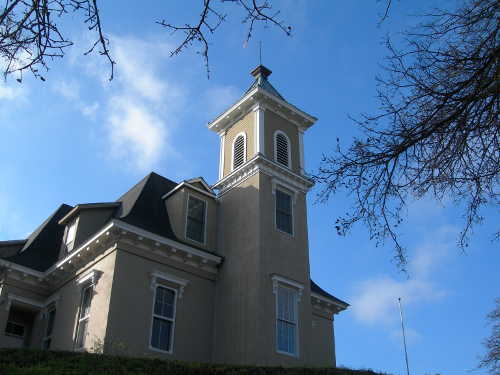
LOWER LAKE, Calif. – Lower Lake Schoolhouse Museum, located at 16435 Morgan Valley Road in Lower Lake was built in 1877.
It presents a stately demeanor standing on a hill at the end of Lower Lake’s main street.
Ralph or Leslie P. Nichols – depending on which document is read – was the architect and builder.
Nichols started work on the building in 1876 when the citizens of Lower Lake, who numbered 1,000, gained approval from the Board of Supervisors to form a school district.
Unfortunately Nichols drowned in Clear Lake when he was 37 years old, just after the building was constructed, within days of the first school session.
To honor him, the school was named Nichols School House.
The schoolhouse was built of brick, which was manufactured locally by the Nicolai Quarry, located one-half mile east of Lower Lake. The bricks were fired in a local kiln operated by Eli Johnson.
The building was designed with a Mansard, or Second Empire-style roof. This architectural style was popular in the period of 1855 to 1885.
Some people today think the Mansard style is a spooky style of architecture. Alfred Hitchcock used a house with the distinctive Mansard style in his movie, “Psycho.”
The Mansard style was considered majestic in the 19th century and originated in the Renaissance. The style derives its name from French architect Francois Mansart (1598-1666).
Mansart, who attended the Beaux Arts School of Architecture, Paris, France, brought about a resurgence of the style. This style was used in the Louvre Museum, and again when Paris was under reconstruction by Napoleon III in the 1850s.
Mansard-style roofs are tall, and narrow in style with two slopes on the four sides. They are efficient in design, as they allow for usable space in the attic.
The schoolhouse building suffered a fire in January of 1877, just after construction was completed.
According to information located by Lower Lake Schoolhouse Museum’s Jane Weaver, in “The Lake Democrat” newspaper, “On Wednesday morning last occurred in Lower Lake one of the most cruel disasters it has ever fallen to the lot of a Christian community to bear. At that hour the new schoolhouse, just roofed in, was discovered to be on fire, and now, nothing but its blackened brick walls are left standing.
“The people of Lower Lake have worked hard and stinted themselves in many ways that this edifice should rear itself over the heads of their children, and to have their long cherished purpose defeated and their work laid in ashes by a drunken loafer is enough to rouse them to commit some extravagance against the perpetrator should he be discovered.
“A man named Goforth, we are informed, sold on Tuesday his shirt for 4-bits and on that same evening purchased fifty cents worth of whiskey at Green’s Saloon. In a drunken condition he asked for a night’s lodging at a house near the new schoolhouse. During the night some one was heard in the building talking and shouting.
“After the fire, Goforth made his appearance in town and was immediately arrested. A lot of carpenter tools and unused lumber under the building were destroyed, together with the recently erected woodwork, the walls along remaining, it is hoped, uninjured. The loss has not yet been fully estimated, but it will reach over $1500.”
After the building was rebuilt, classes were held in its three large rooms – three grades in each room.
Back in “the good old days” there was no electricity, indoor plumbing or central heat. The heat for each room was supplied by woodstove.
Since there was no indoor plumbing, the teacher needed to fill water jugs for drinking each day, and place them with a cup near the schoolroom doors.
There was a playground for the all-important recess time where the parking lot is today.
The 1906 earthquake damaged the schoolhouse bell tower. Repairs came about through schoolhouse bonds.
School was taught at the Lower Lake Schoolhouse until 1935. Then, the Masonic Lodge purchased the building the same year. It was leased by a church, and over the years, gradually fell into disrepair.
After years of hard work and commitment, the schoolhouse was formally dedicated as the Lower Lake Historic Schoolhouse Museum on Oct. 21, 1993.
Today you can walk through time in the lovely old building and view wonderful displays of Lake County history.
Unique and beautiful Pomo Indian baskets and fine examples of their hunting tools are in evidence. There are many interesting farming tools, fabulous rock collections, items from the old dry goods stores, antique clothing, uniforms, and hundreds of fascinating artifacts from times-gone-by.
Curator Linda Lake, who was working at the museum when I stopped by, had many remarkable stories to tell about each of the interesting items.
One room is dedicated to the schoolhouse motif, and is outfitted with antique books, maps and desks – complete with inkwells that Johnny no doubt used to dip Suzy’s pigtails into when the teacher wasn’t looking!
Kathleen Scavone, M.A., is an educator, potter, writer and author of “Anderson Marsh State Historic Park: A Walking History, Prehistory, Flora, and Fauna Tour of a California State Park” and “Native Americans of Lake County.” She also writes for NASA and JPL as one of their “Solar System Ambassadors.” She was selected “Lake County Teacher of the Year, 1998-99” by the Lake County Office of Education, and chosen as one of 10 state finalists the same year by the California Department of Education.
- Details
- Written by: Kathleen Scavone
Konocti Regional Trails accepts statewide award for Web site
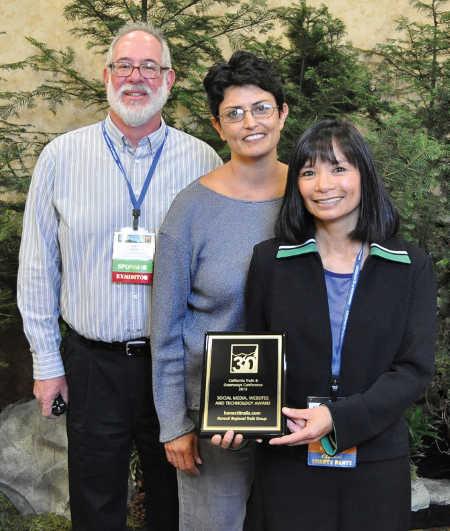
LAKE COUNTY, Calif. – The county's Konocti Regional Trails Web site has been honored with a statewide award.
On April 23, members of the Konocti Regional Trails (KRT) team and county of Lake representatives attended the annual California Trails and Greenways Conference to accept the award during the awards dinner at the Tenaya Lodge in Yosemite.
The Web site is located at www.KonoctiTrails.com .
Besides finding trails for hiking, horseback or bike riding, and paddling, visitors can sign up for the email/newsletter distribution list, trails events notifications and volunteer opportunities.
Gigi Stahl, former trails coordinator for county of Lake, and Mireya Turner, planner in the Lake County Community Development Department as well as Lakeport City Council member, accepted the award on behalf of Lake County.
The award was presented by Jeff Weinstein, president of the California Trails & Greenways Foundation.
The California Trails and Greenways Conference Awards acknowledge and show appreciation for worthy individuals, organizations, agencies and businesses that, through their hard work, integrity and social responsibility, have made outstanding contributions to promote, enhance or expand public awareness and use of trails and greenways in California during the year.
The conference theme for 2015 was “Building Connections: Enhancing the Links between Communities and Trails.”
The KRT Web site was presented with the Social Media, Websites and Technology Award from the California Trails and Greenways Foundation.
The award is given for “achieving excellence in design and creative approaches in developing trails or greenway information systems using technology, social media or Websites.”
The UCLA Interpretive Media Laboratory-LASHP Trails Mobile Web site and the S.F. Bay Trail Project-San Francisco Bay Trail Phone App were also award recipients in this category.
“Lake County and the KRT sharing the limelight with illustrious award recipients that include the aforementioned organizations as well as well-funded agencies like the county of Santa Clara, the East Bay Regional Parks District and the Lake Tahoe Basin Management Unit is a huge honor,” said Stahl. “It demonstrates the positive momentum that a small community can create in just a few years.”
Through the creative use of social media, calendaring, blog posts, videos, electronic newsletters, QR codes and downloadable trails maps, the group has been able to maximize a global presence, drawing recreational enthusiasts to Lake County with minimal expense.
KRT's use of Google Analytics propelled the County Marketing Program to place more emphasis on trails and outdoor recreational activities.
Working together, KRT has promoted local recreational retail and rental businesses, outdoors events such as the well-known Konocti Challenge and the local Road Scholar wildlife and birdwatching tours, as well as support of local photography and music talent.
All KRT outreach combines information on outdoor activities, blended with cultural, historical, geographical and environmental facts, providing each visitor with a better understanding and appreciation of Lake County's special qualities.
KRT has also encouraged regional destination tourism by collaborating with neighboring trails organizations through links, blog posts and events.
“The KRT Web site is a great example of how powerful a group of staff and gifted volunteers can be when we are passionate about trumpeting the message of Lake County's natural beauty to the greater community,” said Turner.
The mission of the California Trails Conference Foundation is to inspire recreational trail leadership through the annual California Trails and Greenways Conference in collaboration with the California Department of State Parks.
- Details
- Written by: Lake County News reports