 How to resolve AdBlock issue?
News
- Details
- Written by: Lake County News reports
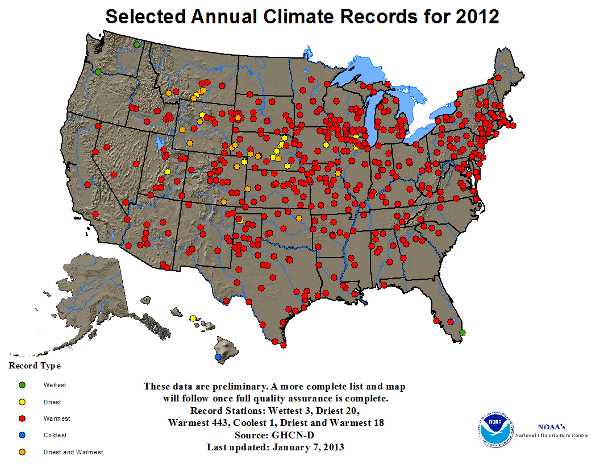
The year 2012 marked the warmest year on record for the contiguous United States with the year consisting of a record warm spring, second warmest summer, fourth warmest winter and a warmer-than-average autumn, according to the National Oceanic and Atmospheric Administration.
The average temperature for 2012 was 55.3°F, 3.2°F above the 20th century average, and 1.0°F above 1998, the previous warmest year, the agency’s National Climatic Center reported.
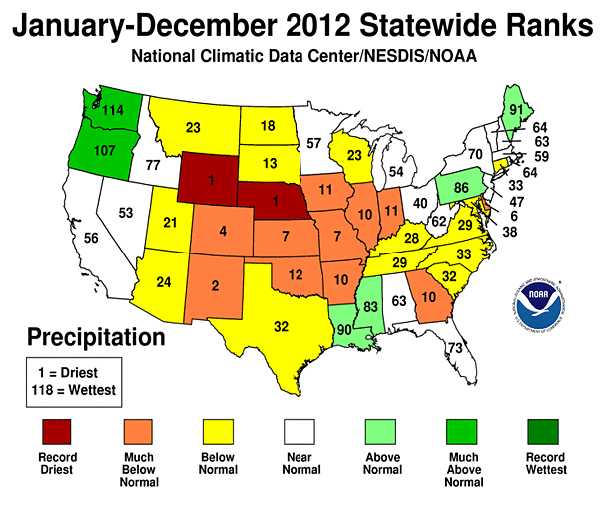
The average precipitation total for the contiguous U.S. for 2012 was 26.57 inches, 2.57 inches below average, making it the 15th driest year on record for the nation.
At its peak in July, the drought of 2012 engulfed 61 percent of the nation with the Mountain West, Great Plains, and Midwest experiencing the most intense drought conditions. The dry conditions proved ideal for wildfires in the West, charring 9.2 million acres – the third highest on record.
The U.S. Climate Extremes Index indicated that 2012 was the second most extreme year on record for the nation.
The index, which evaluates extremes in temperature and precipitation, as well as landfalling tropical cyclones, was nearly twice the average value and second only to 1998.
To date, 2012 has seen 11 disasters that have reached the $1 billion threshold in losses, to include Sandy, Isaac, and tornado outbreaks experienced in the Great Plains, Texas and Southeast/Ohio Valley.
Every state in the contiguous U.S. had an above-average annual temperature for 2012. Nineteen states had a record warm year and an additional 26 states had one of their 10 warmest.
On the national scale, 2012 started off much warmer than average with the fourth warmest winter (December 2011-February 2012) on record. Winter warmth limited snow with many locations experiencing near-record low snowfall totals.
The winter snow cover for the contiguous U.S. was the third smallest on record and snowpack totals across the Central and Southern Rockies were less than half of normal.
Spring started off exceptionally warm with the warmest March on record, followed by the fourth warmest April and second warmest May. The season’s temperature was 5.2°F above average, making it easily the warmest spring on record, surpassing the previous record by 2.0°F.
The warm spring resulted in an early start to the 2012 growing season in many places, which increased the loss of water from the soil earlier than what is typical.
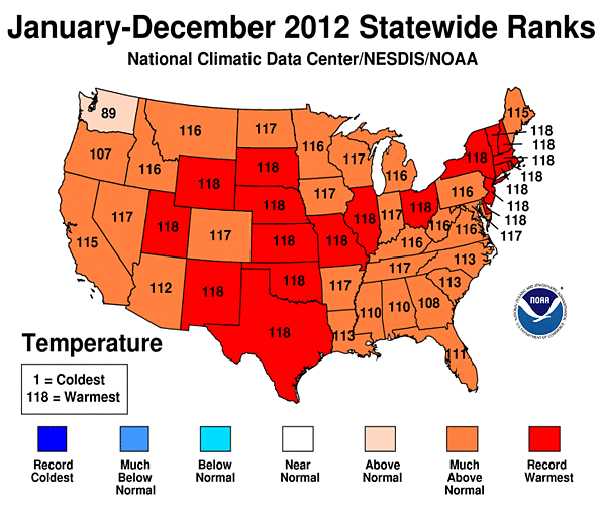
In combination with the lack of winter snow and residual dryness from 2011, the record warm spring laid the foundation for the widespread drought conditions in large areas of the U.S. during 2012.
The above-average temperatures of spring continued into summer. The national-scale heat peaked in July with an average temperature of 76.9°F, 3.6°F above average, making it the hottest month ever observed for the contiguous United States.
The eighth warmest June, record hottest July, and a warmer-than-average August resulted in a summer average temperature of 73.8°F, the second hottest summer on record by only hundredths of a degree.
An estimated 99.1 million people experienced 10 or more days of summer temperatures greater than 100°F, nearly one-third of the nation’s population.
Autumn and December temperatures were warmer than average, but not of the same magnitude as the three previous seasons.
Autumn warmth in the western U.S. offset cooler temperatures in the eastern half of the country. Although the last four months of 2012 did not bring the same unusual warmth as the first 8 months of the year, the September through December temperatures were warm enough for 2012 to remain the record warmest year by a wide margin.
Winter brought below-average precipitation to both coasts and above-average precipitation to the Southern Plains, slightly lessening drought conditions that plagued the region in 2011. The winter precipitation total was 89 percent of normal.
Spring precipitation was 95 percent of the 20th century average with below-average precipitation in the Rockies and Midwest and above-average precipitation in the Northwest and Upper Midwest.
Summer precipitation was 88 percent of normal with dry conditions in the central United States. The West Coast, Gulf Coast, and Northeast were wetter than average.
Autumn was drier than average for most of the central U.S., with wet conditions in the Northwest, Ohio Valley, and Northeast. The autumn precipitation total was 85 percent of average.
The widespread drought conditions of 2012 peaked in July with approximately 61 percent of the country experiencing drought conditions.
The footprint of drought during 2012 roughly equaled the drought of the 1950s which peaked at approximately 60 percent.
The size of the current drought and the drought of the 1950s are smaller than the drought episodes of the 1930s. The current drought has yet to reach the intensity or duration of the 1950s and 1930s national-scale droughts.
Wildfire activity during 2012 was above-average with 9.2 million acres burned the third most in the 13-year record. Numerous large and destructive wildfires impacted the western U.S. throughout the year.
The Waldo Canyon fire near Colorado Springs, Colorado destroyed nearly 350 homes and was the most destructive fire on record for the state. The Whitewater-Baldy Complex fire charred nearly 300,000 acres and was the largest on record for New Mexico.
Tornado activity during 2012 was below the 1991-2010 average of approximately 1,200. The year got off to a busy start with large tornado outbreaks in March and April causing significant damage in the Ohio Valley and Central Plains. May and June, typically the most active tornado months of the year, both had less than half of average tornado counts. The final 2012 tornado count will likely be less than 1,000 – the least since 2002.
- Details
- Written by: Lake County News reports
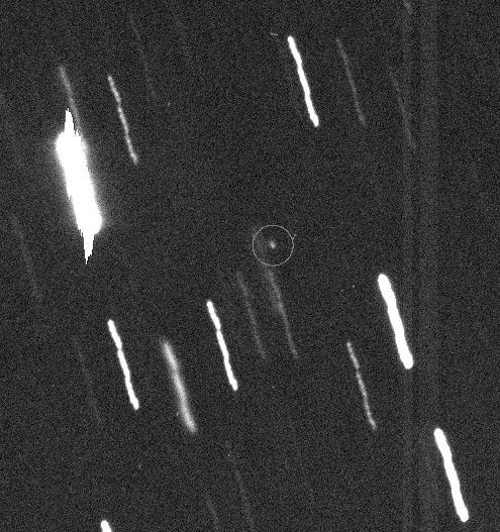
NASA scientists at the agency’s Jet Propulsion Laboratory in Pasadena, Calif., effectively have ruled out the possibility the asteroid Apophis will impact Earth during a close flyby in 2036.
The scientists used updated information obtained by NASA-supported telescopes in 2011 and 2012, as well as new data from the time leading up to Apophis’ distant Earth flyby yesterday (Jan. 9).
Discovered in 2004, the asteroid, which is the size of three-and-a-half football fields, gathered the immediate attention of space scientists and the media when initial calculations of its orbit indicated a 2.7 percent possibility of an Earth impact during a close flyby in 2029.
Data discovered during a search of old astronomical images provided the additional information required to rule out the 2029 impact scenario, but a remote possibility of one in 2036 remained – until earlier this week.
“With the new data provided by the Magdalena Ridge [New Mexico Institute of Mining and Technology] and the Pan-STARRS [Univ. of Hawaii] optical observatories, along with very recent data provided by the Goldstone Solar System Radar, we have effectively ruled out the possibility of an Earth impact by Apophis in 2036,” said Don Yeomans, manager of NASA’s Near-Earth Object Program Office at JPL. “The impact odds as they stand now are less than one in a million, which makes us comfortable saying we can effectively rule out an Earth impact in 2036. Our interest in asteroid Apophis will essentially be for its scientific interest for the foreseeable future.”
The April 13, 2029, flyby of asteroid Apophis will be one for the record books.
On that date, Apophis will become the closest flyby of an asteroid of its size when it comes no closer than 19, 400 miles (31,300 kilometers) above Earth’s surface.
“But much sooner, a closer approach by a lesser-known asteroid is going to occur in the middle of next month when a 40-meter-sized asteroid, 2012 DA14, flies safely past Earth’s surface at about 17,200 miles,” said Yeomans. “With new telescopes coming online, the upgrade of existing telescopes and the continued refinement of our orbital determination process, there’s never a dull moment working on near-Earth objects.”
NASA detects and tracks asteroids and comets passing close to Earth using both ground and space-based telescopes. The Near-Earth Object Observations Program, commonly called “Spaceguard,” discovers these objects, characterizes a subset of them and plots their orbits to determine if any could be potentially hazardous to our planet.
The Near-Earth Object Program Office at JPL manages the technical and scientific activities for NASA’s Near-Earth Object Program of the Science Mission Directorate in Washington. JPL is a division of the California Institute of Technology in Pasadena.
For more information about asteroids and near-Earth objects, visit http://www.jpl.nasa.gov/asteroidwatch .
Updates about near-Earth objects are also available by following AsteroidWatch on Twitter at http://www.twitter.com/asteroidwatch .
- Details
- Written by: Elizabeth Larson
LAKEPORT, Calif. – A man who had been a codefendant in the murders of a Maine couple pleaded guilty to a lesser charge this week and was released on his own recognizance pending sentencing next month.
Elijah Bae McKay, 30, of Lower Lake pleaded guilty to accessory to murder after the fact in connection to the January 2010 deaths of Frank and Yvette Maddox of Augusta, Maine, according to his attorney, Justin Petersen of Ukiah.
The Maddoxes were shot to death by Robby Alan Beasley, who had grown up with McKay in Maine and came west to work in McKay’s marijuana growing business.
Beasley, 32, was convicted last month and sentenced to two life terms last Tuesday, as Lake County News has reported.
The same day as Judge Andrew Blum handed down to Beasley two life sentences without the possibility of parole, plus 23 years for other charges, Senior Deputy District Attorney Art Grothe filed an amended complaint against McKay, who originally had faced murder and a number of other felony charges in the case.
Grothe’s amended complaint included only one charge, accessory after the fact to murder.
“I informed the court that my basis for making the motion to amend was that, in view of all the evidence produced during the investigation and trial of Beasley, it was my opinion that the current amendment most accurately reflected McKay’s participation in the murder and was what I felt we could properly obtain a conviction for should McKay chose to go to trial,” Grothe said.
Both Grothe and Petersen emphasized that there was no plea bargain or deal made in settling McKay’s case.
Petersen said the District Attorney’s Office simply gave McKay the opportunity to tell his side of the story in Beasley’s trial.
“Based on the credibility and compelling nature of Mr. McKay’s testimony, Mr. Grothe came to be convinced that my client was, in fact, not involved in the murders but was simply an accessory after the fact,” Petersen explained. “Based on that belief, Mr. Grothe amended the charges.”
During his testimony McKay admitted to providing Beasley with a 9 millimeter handgun for protection after his apartment was burglarized and several pounds of marijuana was stolen.
Beasley used the handgun to fatally shoot the couple during a confrontation along the side of Morgan Valley Road near Lower Lake, believing they had stolen the marijuana from him.
After the murders, McKay helped Beasley dispose of his clothes, cell phone and the Maddoxes’ pickup, according to his statements in court.
Petersen said he agreed with the amended complaint. “My client was never guilty of murder.”
He said he believed McKay was “hugely relieved when the DA’s Office came to believe what we already knew.”
Beasley, who is appealing his conviction, said at his Tuesday sentencing that McKay had lied in his testimony.
Grothe said McKay’s sentencing is set for Feb. 19 before Judge Blum.
The sentencing range for the charges is 16 months, two years or three years. On Tuesday McKay was released on his own recognizance due to the fact that under the available sentencing options he had already served all of the custody time available, Grothe said.
Petersen said McKay had been in jail for 26 months. He said the charge only required half time be served, meaning McKay had far exceeded the necessary time in custody.
Once the court proceedings are past, McKay plans to leave Lake County and move back east to be with his wife’s family, where he intends to start a new life, Petersen said.
Email Elizabeth Larson at
- Details
- Written by: Lake County News reports
NORTH COAST, Calif. – The captain of a commercial crab vessel was sentenced by the Sonoma County Superior Court for a misdemeanor violation committed while taking Dungeness crab from inside the Stewarts Point State Marine Reserve.
The Fish and Game Code and California Code of Regulations prohibit the take of any wildlife or deployment of fishing equipment in marine protected areas.
Steven Anello, 54, of Bodega Bay, was sentenced Jan. 3 to 36 months of informal probation, forfeiture of the proceeds of Dungeness crabs illegally taken, payment of a $10,000 fine, 20 hours of community service work and five days in jail, according to the California Department of Fish and Wildlife.
Anello also was ordered to stay out of Stewarts Point Marine Conservation Area during his probation, officials reported.
Between April 3 and 7, 2012, California Department of Fish and Wildlife officers observed Anello deploying crab traps into Stewarts Point State Marine Reserve waters. Officers located 23 of Anello’s traps inside the protected waters in the reserve.
It also was discovered the traps were not equipped with an escape device that allows crabs to escape from traps in the event traps are not raised or become lost.
The escape devices help minimize crab mortality and are also required by law under the Fish and Game Code.




