
 How to resolve AdBlock issue?
 Lakeport City Council approves water emergency, conservation measures
LAKEPORT, Calif. – On Tuesday night the Lakeport City Council unanimously approved a resolution instituting a stage one water emergency that includes requirements to conserve water.
During the public hearing on the item, City Attorney David Ruderman presented the resolution to the council, as Public Works Director Mark Brannigan was not at the meeting.
Ruderman gave the council an outline of actions taken by the state earlier this year in response to the drought, including a January gubernatorial drought emergency declaration and an April executive order in which Gov. Jerry Brown directed the State Water Resources Control Board to adopt emergency water conservation regulations.
Last month, the State Water Resources Control Board instituted a number of regulations that Ruderman said everyone must observe.
Those include no outdoor irrigation causing runoff onto pavement or nonirrigated land, no washing cars with hoses not equipped with shut-off nozzles, preventing use of potable water to driveways or sidewalks, and no use of potable water in decorative fountains unless they are circulating.
There also are additional requirements for urban and nonurban water suppliers, with Lakeport among the latter.
The difference between the two kinds of water suppliers is the amount of detail in their conservation plans and that smaller water suppliers don't have to report to the State Water Resources Control Board regarding implementation.
In Lakeport's case, Ruderman said the city has to enforce a limitation on irrigation ornamental landscapes with potable water to two days per week or implementing implement water conservation measures to achieve similar reductions when compared to last year.
Ruderman said the city has a water rationing procedure in its code.
He said that Brannigan wanted the council to understand that the city has a water supply – including its groundwater table – equal to what it had at this time last year.
“But we don't know what this fall is going to bring and he (Brannigan) thinks that it's prudent for us to look ahead and try to do what we can now” in order to avoid having to implement mandated restrictions in the future, Ruderman said.
He also noted that the State Water Resources Control Board can impose a $10,000 per-day fine on water suppliers that don't follow its mandates.
Councilwoman Stacey Mattina wanted clarification about outdoor water uses, asking if a tomato garden was not considered ornamental.
Ruderman said that gardens for food are exempt and that landscaping with a function – such as a soccer field – may be watered.
“It's time to get on board,” said Councilman Tom Engstrom.
Ruderman said the water emergency won't be in effect until it's published as a legal in the local newspaper.
City Manager Margaret Silveira said the city will notify water customers of the restrictions in mailings going out in the next billing cycle as well as online.
Mayor Kenny Parlet asked if the city's budget would be impacted if all city water users cut back significantly.
City Finance Director Dan Buffalo said no, that the city's rate structure allows for water rationing without a big impact to the bottom line.
The only public comment offered on the matter was from Scotts Valley resident Thomas Nickel, who wanted to know if the city might set up a water hot line to report waste issues.
Nickel said he sees a lot of waste in landscaping due to lack of monitoring, using the wrong sprinkler heads and not using drip irrigation.
Council members said they didn't want the issue of water use to become heated between neighbors, or for people to get in trouble for trying to keep up their lawns.
Silveira said neighbors will be doing each other favors by letting them know if water is running at night or if sprinklers are broken.
She said the goal is to reach out to people who keep having water issues, and to urge neighbors to talk to one another.
Engstrom moved to adopt the resolution, with the council voting 5-0.
Email Elizabeth Larson at
- Details
- Written by: Elizabeth Larson
Temporary restraining order filed against Lake County over Measure N marijuana rules
LAKE COUNTY, Calif. – A group of medical marijuana patients has served a temporary restraining order against the county of Lake in an effort to stop enforcement of Measure N, the county rules for medical marijuana cultivation voters passed in June.
The complaint was filed in federal court on Friday by a number of named and unnamed plaintiffs who are seeking a preliminary injunction.
The plaintiff group includes 60-year-old patient Mona Allen, who was growing six mature plants, 66-year-old patient Paul Ray Harris who was growing nine plants and 70-year-old patient Nina Faye Sikes who, together with her elderly husband, was growing 14 immature plants.
Defendants are the county of Lake, Sheriff Francisco Rivero, Undersheriff Chris Macedo, Lt. Loren Freeman of the California Department of Fish and Wildlife, Community Development Director Rick Coel and 50 unnamed individuals.
County Counsel Anita Grant said a hearing on the temporary restraining order request was held Tuesday afternoon in San Francisco.
She said the judge did not make a decision Tuesday, but instead took the matter under submission.
The case is alleging that the Lake County Sheriff's Office – which is responsible for enforcing Measure N – has been conducting unconstitutional raids on properties around the county without search warrants or abatement notices required under code enforcement law.
The plaintiffs claim violations of their state and federal constitutional rights, which protect against unlawful search and seizure, invasion of privacy and a denial of due process.
They also allege sheriff's personnel are ignoring patients’ refusal to search their property and prying open locked gates to gain access.
County officials have denied forcing their way into properties without consent.
In their declarations, Allen, Nina Sikes and her husband Elvin Sikes – all Clearlake Oaks residents – said their grows were eradicated by county officials on Aug. 1.
Allen said she was not at home at the time, and that law enforcement passed through two fences – prying one of them open – in order to get to the six mature and six immature plants she and her husband were growing on their one-acre parcel.
Elvin Sikes, who with his wife Nina had 14 immature plants on their half-acre parcel, alleged that law enforcement “burst through two closed fences without my consent” before chopping down the plants.
“I was at home at the time of the raid, but I did not voluntarily consent to any search or seizure,” Elvin Sikes said in his declaration.
“Although this case is about medical marijuana patients being unfairly targeted, it’s more about privacy and property interests that should be protected by the state and federal constitutions,” said Joe Elford, a San Francisco-based lawyer and chief counsel for Americans for Safe Access, who is working with attorney Jeremy Blank on behalf of the plaintiffs. “The county is not above the law, and it has an obligation to respect people’s constitutional rights when carrying out local policy.”
Last December, the Board of Supervisors unanimously approved Ordinance No. 2997, which bans outdoor cultivation in community growth boundaries; limits plant numbers on parcels larger than one acre outside of community growth boundaries to six mature or 12 immature plants; prevents grows on vacant parcels; limits indoor grows to 100 square feet or less; keeps outdoor cultivation 1,000 feet from schools, parks or other facilities serving children, and 100 feet from water bodies; allows collective grows not exceeding 48 mature plants or 72 immature plants on agriculture-zoned parcels of 20 acres or more; and makes the Lake County Sheriff's Office responsible for enforcement.
The ordinance ended up going on the June 3 ballot due to a successful referendum, with voters approving it 51.6 percent to 48.4 percent.
Measure N went into effect July 11, 10 days after the Board of Supervisors approved the final election results for June 3.
Last month, local officials – assisted by Freeman – conducted enforcements in the Spring Valley area.
During a Board of Supervisors meeting on Aug. 19, Freeman estimated 30 properties had been inspected in that community.
At that same meeting, Allen and a number of growers complained to the board about the enforcements and promised to sue.
Elford previously sued the county in Lake County Superior Court over its temporary medical marijuana cultivation rules in 2012.
That ordinance allowed for up to six plants to be grown outdoors on a half acre or less, 12 plants on parcels of half an acre to one acre, 18 plants on parcels one to five acres in size, 36 plants on five- to 40-acre parcels, and a maximum of 48 plants on parcels 40 acres and larger.
In that case, Elford argued those limits were not enough to satisfy the plaintiffs' medical needs.
In August 2012 Elford's three clients received a preliminary injunction which ran out at the end of that year.
The case was dropped in June 2013 before the permanent injunction stage and about a month after the California Supreme Court issued a decision in the City of Riverside v. Inland Empire Patients Health and Wellness Center Inc., which upheld the land use planning powers of local governments.
A local judge later denied Elford more than $150,000 in attorney's fees in the case.
Email Elizabeth Larson at
- Details
- Written by: Elizabeth Larson
Clearlake City Council selects design for new street lights
CLEARLAKE, Calif. – The Clearlake City Council on Thursday selected the design of new street lights coming to the city through a Pacific Gas & Electric street light replacement project.
PG&E estimates the cost of the project at $167,000.
Public Works Director Doug Herren said there may be some costs to the city if, once the project begins, it is determined that a pole must be relocated.
He said any such cost is expected to be minimal and would be covered by the gas tax fund.
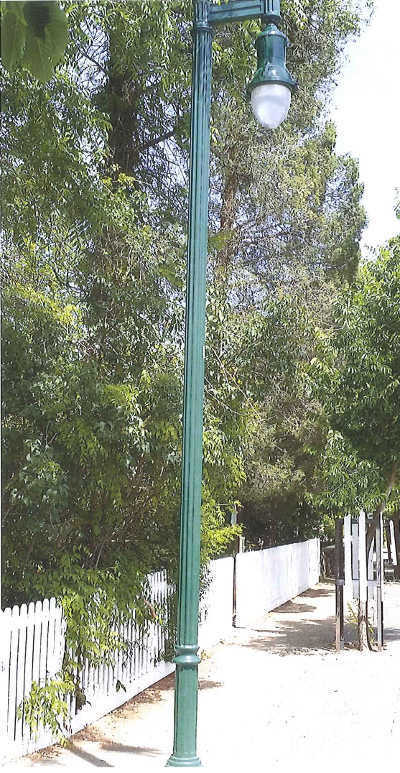
The council chose Charleston poles with tear drop light fixtures, as recommended by staff.
The poles are 16 feet tall with a 5-inch diameter, black in color and fluted, rather than smooth.
PG&E identified 37 center bore utility poles for replacement in its project, which it is conducting at its own expense while providing the city with cost-free design options.
PG&E Representative Robert Cherry worked cooperatively with Herren throughout the past several months surveying the light district, identifying utilities poles in need of repair and presenting the council with options for those to be replaced.
Options were described to the council in a PowerPoint presentation at the end of May.
PG&E representative Mark O'Leary said during the May presentation that decorative utility poles with either single or double light fixtures are replacement options eligible to the city at no cost.
O'Leary said the new fixtures have better optics and the poles are shorter – 14- or 16-feet – than those to be replaced.
“Closer to the ground, means more light on the ground,” O'Leary said.
Herren said Thursday that staff's recommendation is compatible with the new corridor plan, the Lakeshore Drive sidewalk conceptual improvement plans, and the Vision Task Force and its design guideline plans as well as the options offered by PG&E at no cost.
“These are $2,000 units and we're getting them for free,” Herren said.
Staff further recommended using single fixture lighting along the corridor and double fixture lighting in the park areas.
Corridor lights will use 70 watt bulbs and 100 watt bulbs will light the parks, he said.
Herren said the utility poles include shields that can be installed should any complaints about the lighting arise.
The cost to operate a 70 watt bulb is $11.92 per lamp, per month; 100 watt bulbs cost $13.58 per lamp, per month, according to Herren.
Herren said double fixture lights do not double the use cost. However, they do add to the cost at two-thirds the rate of the bulb, he said.
LED lighting is available at an additional expense to the city, according to Herren.
He said PG&E currently is undergoing similar LED upgrade projects within it system.
The street light replacement project currently is in San Francisco now and will make its way to Clearlake eventually, Herren said.
Email Denise Rockenstein at
- Details
- Written by: Denise Rockenstein
Supervisors to hold budget hearings Wednesday
LAKEPORT, Calif. – This week the Board of Supervisors will hold its annual budget hearings as it seeks to finalize the new 2014-15 fiscal year budget.
The all-day special meeting for the purpose of holding the budget hearings and considering the final recommended 2014-15 budget will take place beginning at 8:30 a.m. Wednesday, Sept. 3, in the board chambers on the first floor of the Lake County Courthouse, 255 N. Forbes St. in Lakeport.
During the meeting, county department heads go over highlights of their proposed budget with County Administrative Office staff and the board.
At its Aug. 12 meeting, County Administrative Officer Matt Perry held a workshop with the board to go over budget priorities and a snapshot of the budget documents.
Perry reported that total revenues for the coming year are estimated at $157.6 million, with total appropriations estimated at $179.7 million.
Those numbers could show minor changes or be fine-tuned by the time the board meets for the Wednesday budget hearings.
In addition to the proposed adoption of the new budget, the board will consider a proposed resolution establishing position allocations for fiscal year 2014-15 to conform to the adopted budget.
The supervisors also will consider whether or not to continue the county's general hiring freeze – which has been in effect for several years – and delegate authority to Perry to waive the hiring freeze as appropriate.
Email Elizabeth Larson at
- Details
- Written by: Elizabeth Larson
Lakeport City Council to consider declaring stage one water emergency, water conservation
LAKEPORT, Calif. – This week the Lakeport City Council is set to consider declaring a water emergency and implementing water conservation measures.
The council will meet for a closed session at 5:30 p.m. to discuss labor negotiations and a potential case of litigation before convening in open session at 6 p.m. in the council chambers at Lakeport City Hall, 225 Park St.
Public Works Director Mark Brannigan will take to the council the proposed water conservation resolution.
The council will be asked to adopt a resolution declaring a stage one water emergency along with implementing the state's mandatory water conservation regulation.
Brannigan's report explains that the proposed actions result from the State Water Resources Control Board enacting in July new emergency regulatory measures to respond to the state's continuing drought crisis.
The action by the State Water Resources Control Board followed Gov. Jerry Brown's statewide drought emergency declaration in January and an April executive order in which he directed the state water board to adopt emergency regulations to ensure that conservation measures are implemented.
The regulations include a prohibition against outdoor irrigation which causes runoff onto pavement or nonirrigated land; washing a car with a hose that is not equipped with a shut-off nozzle; any application of potable water to driveways or sidewalks; and use of potable water in a decorative fountain which is not recirculating, according to Brannigan's report.
Small water providers like Lakeport, Brannigan said, must implement a simpler conservation plan than its urban counterparts.
Requirements for water suppliers like the city of Lakeport include either limiting outdoor irrigation of ornamental landscapes with potable water to two days per week or implementing implement water conservation measures to achieve similar reductions compared to water use in 2013, according to Brannigan's report.
“The Stage I water rationing and mandatory water conservation is currently not expected to have a significant impact on the water enterprise revenue for this fiscal year,” Brannigan wrote.
Also on Tuesday, the council will conduct a public hearing and adopt the proposed ordinance amending Chapter 3.04 of the Lakeport Municipal Code establishing a city purchasing system.
The council also will present a proclamation celebrating Mildred Gill’s 100th birthday and offer certificates of appreciation to the sponsors of this year's National Night Out.
The Lakeport Police Department also will give a presentation on a new crime scene scanner.
On the meeting's consent agenda – items considered noncontroversial and usually accepted as a slate on one vote – are ordinances; minutes of the council's regular meeting on Aug. 19 and special meeting on Aug. 25; approval of the application 2014-018 for the annual Sea-Plane Festival to be held Sept. 25 to 28, subject to staff recommendations; and approval of an amendment to Resolution 2490 (2014) authorizing the application for a housing related park grant.
Email Elizabeth Larson at
- Details
- Written by: Elizabeth Larson




