
 How to resolve AdBlock issue?
 County of Lake files cross-complaint against Lakeside Heights property owners
LAKEPORT, Calif. – The county of Lake has filed a cross-complaint against the homeowners in north Lakeport's Lakeside Heights, alleging that the subdivision's residents and property owners were responsible for the issues that led last year to a landslide that destroyed homes and resulted in the declaration of a local emergency.
The cross-complaint was filed June 25 by Bradley, Curley, Asiano, Barrabee, Abel and Kowalski PC of Larkspur, the independent firm hired to represent the county in the case.
It names 46 property owners, including the Lakeside Heights Homeowners Association.
The action is part of a larger case filed last fall by the property owners in Lake County Superior Court after the county's liability administrator turned down separate tort claims filed by the property owners, as Lake County News has reported.
The decision to file the cross-complaint was made after the Board of Supervisors emerged from closed session on May 13, according to board minutes.
The minutes showed that Supervisor Anthony Farrington – whose district includes Lakeside Heights – moved to authorize filing the cross-complaint, with the board voting 4-0.
Supervisor Rob Brown, whose daughter and son-in-law own one of the subdivision's damaged homes, was absent for the vote, according to board records. Brown has recused himself from all discussions or actions relating to Lakeside Heights.
When asked by Lake County News about the reasoning behind the cross-complaint and whether the independent firm representing the county had suggested it, County Counsel Anita Grant said she could not answer those questions, citing attorney-client privilege and work product privilege.
Attorney Michael Green of the Santa Rosa law firm Abbey, Weitzenberg, Warren & Emery, who is representing the property owners in their suit, called the cross-complaint “a desperate move by the county to shift fault in this case to the homeowners who have lost everything as a result of the county’s failure to maintain its water utility system.”
He added, “Substantial leaks in the county water system caused the landslide that devastated Lakeside Heights. It is beyond dispute that water introduced to the hillside caused the landslide.”
Randall Fitzgerald, president of the Lakeside Heights Homeowners Association, said of the cross-complaint, “For Lake County government to pull this cynical and desperate legal tactic, suing hardworking taxpayers who face financial ruin because their homes have been destroyed, is a new monument to an old saying, 'adding insult to injury.'”
Two sides lodge allegations
In March 2013, the ground along Lancaster Road, which runs through the 29-home subdivision above Hill Road, began to sink, damaging homes and displacing a number of residents, who found their homeowners insurance wouldn't cover the damages.
The following month, the Board of Supervisors declared a local emergency.
In the time since, Lake County Special Districts has worked to improve the water and sewer systems, with utility companies reportedly undergrounding utilities in the subdivision. Leaks also were found in the county water systems, but county officials disputed the leaks were enough to cause the landslide.
Geological and engineering studies have been conducted in the area to try to determine how to stabilize the ground and find the sources of the slide, which had stabilized for some time but was reported to have started moving again earlier this year.
To date, two homes that were badly damaged were demolished by a contractor hired by the county; four more houses that have partially or completely fallen, along with a detached garage and a postal shelter, need to be demolished; two other houses that suffered damage continue to be occupied; one house is vacant and for rent; four houses have been foreclosed on by banks and are vacant; with the remaining homes 16 homes said to be occupied, according to residents.
The homeowners have alleged that the landslide and sinkholes that destroyed or damaged the homes began due to leaks in the county's water system in the area. That is a key argument in their lawsuit.
In turn, the county is arguing that the property owners “are responsible directly or vicariously, actively or passively, for the events and happenings herein referred to and caused or are responsible in whole or in part for the damages” sustained by the county.
The causes of action in the cross-complaint include negligence, equitable indemnity, comparative indemnity, declaratory relief and failure of lateral support, or negligence.
“Cross-Defendants, and each of them, at all times owed a duty to maintain their land so that their land would continue to provide lateral support to the public right of way below, and related improvements, owned and maintained by the County of Lake,” the suit states.
The cross-complaint alleges that the homeowners “knew or should have known that landscaping, vegetation, irrigation and uncontained waters on their land could cause soil on their land to lose strength and cause a failure of lateral support on their own property to the public use right of way, and related improvements, maintained and owned by County of Lake, and that landscaping, vegetation, irrigation and uncontained waters on their land should be contained, channeled and/or properly drained to prevent a failure of lateral support on their own property to the public right of way, and related improvements, owned and maintained by the county of Lake, and/or that the soil on their lands should be reinforced and ensure that lateral support would be provided to Cross-Defendants' and/or Cross-Complainants' property.”
Regarding the cross-complaint, Green noted, “My clients are now being sued by the county for simply engaging in standard home maintenance activities like watering their gardens. It should be noted that in spite of the county’s claim in its cross-complaint that my clients 'should have known' that irrigating landscaping on their property could cause a landslide, the truth is that county actually shut off the Lakeside Heights’ irrigation system for the winter approximately four months before the landslide occurred.”
Noting that the county's damages haven't yet been determined, the cross-complaint seeks to have the county be held harmless from any judgment or settlement in the main suit, and to be reimbursed for all legal costs due to defending itself and prosecuting the cross-complaint.
The county also is asking the court for an order determining the comparative degree of fault for each party and the apportionment of their respective responsibility to the county.
A response is due from the property owners by July 30.
Grant told Lake County News that the main part of the case is still in the discovery phase, which is when the sides obtain information and evidence from each other.
Email Elizabeth Larson at
- Details
- Written by: Elizabeth Larson
Lakeport City Council supports allowing Soper Reese Theatre additional right-of-way
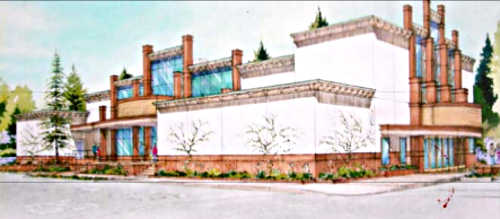
LAKEPORT, Calif. – The Lakeport City Council gave conceptual support on Tuesday to adjusting the boundaries of city-held right-of-way alongside the Soper Reese Theatre in order to allow for the building's renovations to continue.
The theater is located at 275 S. Main Street. The council voted unanimously to direct city staff to work with the theater to find a way to readjust the right-of-way line to the south building, along Martin Street.
As part of the discussion, theater Executive Director Mike Adams officially introduced a new architectural rendering of the building that shows it in its final form, a magnificent art deco-style building with an ornate marquee and area for an outdoor stage.
“This is the rollout of this conceptual design,” Adams said.
City Manager Margaret Silveira told the council that the need to cut into the right-of-way arose as the theater's board was planning for coming renovations and upgrades, specifically a new ramp and bathrooms along the building's south side to comply with the Americans with Disabilities Act.
Adams explained that the theater board put together a business plan in 2006 and went about raising money.
To date, they've raised $1.4 million for renovations, a figure which Adams reported doesn't include the $300,000 Jim and Florence Soper donated to purchase the building.
The $1.4 million figure includes more than $643,000 from Jim and Florence Soper; $200,000 from the city, a 20-year loan that will be forgiven if the theater continues to operate; $250,000 from the US Department of Housing and Urban Development, secured by Congressman Mike Thompson; $45,000 from the county of Lake; and $562,755 from individuals, organizations and businesses, Adams reported.
Regarding the city's contribution, Adams said it showed a lot of trust. “We have taken that very seriously in how we've tried to be stewards of this project.”
Expenditures to date total $1,150,000. Projects completed with those funds include the purchase and installation of a state-of-the-art sound system; purchase of a portable stage and audience seating; restored loge seating; the addition of new backstage dressing rooms and restrooms; the purchase and installation of a new video projector and movie screen; the construction of a piano garage to house the Lake County Symphony’s piano; installation of new HVAC and electrical systems; reroofing the building; reconfiguring and installing new exit doors; waterproofed and poured new stepped floor; construction of a new stage; installation of a building fire sprinkler system; patching and painting of the building's interior; conversion of the projection booth into a lighting booth; installation of the new theatrical lighting system; the development of operations and marketing plans; and implementation of policies to insure financial stability.
Adams said the theater has a reserve of $73,000, about one and a half times the facility's annual upkeep, plus a fund balance of $250,000.
The new projects ahead are comprehensive and visionary, and part of a longterm plan broken into seven phases to expand the theater, which Adams said can seat 300 people.
The first phase is the ADA restrooms and ramp, estimated to cost $150,000, he said.
The theater, built in 1947, has a lobby and restrooms that need upgrading, but those aspects of the building are grandfathered because they haven't had any renovations so far, Adams explained. The lobby renovation is anticipated to cost $75,000.
Other phases of the plan include expanding the lobby facade base plaster coat, $90,000; the Main Street facade and marquee, $95,000; the Martin Street facade and roof expansion, $75,000; complete building facade, $75,000; and the Martin Street stage and marquee, $100,000.
The entire seven phase-plan is expected to cost a total of $660,000. With $177,000 to come from the theater's fund balance, Adams said another $483,000 needs to be raised.
The theater board created its renovation plans before it had completed a survey of the property line, which board members assumed ran along the back of the sidewalk on Martin Street.
“We were, unfortunately, wrong,” Adams said.
Instead, the existing property line is 5.4 feet closer to the building, which means it would run through the middle of the proposed new bathroom addition, he said.
Adams said the theater board was requesting that the city consider abandoning that 5.4 feet of right-of-way. The resulting renovations would not cut into the existing southern sidewalk.
Looking down along Martin Street, most of the houses appear to be encroaching in the right-of-way, so Adams said widening the street at any point in the future seems unlikely.
City Engineer Scott Harter's written report to the council on the request also noted that the Martin Street intersection is “fully developed” with wide sidewalks on both the north and south sides.
“It is extremely unlikely that any further widening of the roadway would be required at the intersection. Because the roadway is fully developed, staff is supportive of researching options to relocate the ROW (right-of-way) line further south to accommodate the future projects,” Harter wrote.
Adams then showed the building's new conceptual exterior design, completed by Kelseyville architect Richard Hernaez, who accompanied Adams to the meeting.
The goal, Adams said, was to have the design reflect the great things going on inside the building.
“The building has become more than just a theater,” Adams said. “It's really becoming a community center.”
Adams noted that the major work ahead was “not going to happen overnight.”
However, he said the theater board believes the community will continue to be generous in its support. “We think the community is vested in this.”
“You guys have done so much,” noted Councilman Tom Engstrom.
“That will be the centerpiece of this community,” Engstrom added.
“And we'll have six more toilets!” said Councilwoman Stacey Mattina.
The rest of the council agreed that the plans were impressive, and Mayor Kenny Parlet said he was pleased to see that the theater board had a business plan that it was following. He said they had done a brilliant job of going through the phases, and it looks like it will really happen.
Engtrom moved to direct staff to work with the theater on adjusting the right-of-way, with the resulting documents to be brought to the council at a future meeting.
Mayor Pro Tem Martin Scheel seconded, with the council voting 5-0.
Adams and the group of theater board members in attendance thanked the council for its support.
Email Elizabeth Larson at
- Details
- Written by: Elizabeth Larson
Council discusses roundabout feasibility study, regional recycling program participation
CLEARLAKE, Calif. – The Clearlake City Council last Thursday discussed a contract for a feasibility study for a roundabout on Dam Road and the city's participation in a regional recycling program.
The items, originally on the July 10 meeting's consent agenda – which consists of items considered to be routine in nature and generally acted upon with a single motion – were pulled for discussion at the request of members of the public.
Neither item impacts the city financially. There is no cost for participation in the recycling program and the feasibility study is funded through a Lake Area Planning Council (APC) grant.
Authorization was provided for the city's renewal in the tri-county Recycling Market Development Zone (RMDZ), which also consists of Mendocino and Sonoma counties.
The RMDZ is a state program focused on promoting industry that uses recyclable materials as feedstock.
City Manager Joan Phillipe said the program offers a variety technical assistance services as well as access to a low-interest loan facility.
She said while there is no financial impacts to the city, there exist the potential for significant impact for local businesses providing access to low-cost loans and support.
Phillipe said Hospice Services of Lake County is currently the only local business participating in the program.
She said the business often receives donations of unusable clothing, which, through the program, are being recycled into usable cloths.
The RMDZ is administered by the Mendocino County Economic Development and Financing Corporation with the support of the Mendocino Solid Waste Management Authority. More information regarding participation in the program, is available through Clearlake City Hall at 14050 Olympic Drive.
The council also provided authorization for execution of a contract to perform a feasibility study for construction of a roundabout at the intersection of Dam Road and Dam Road Extension. The contract is with Omni Means Engineer Planning and is not to exceed $24,826.
“These are planning funds from the APC and are not directly from the general fund,” City Engineer Bob Galusha said, in addressing financial concern expressed by citizen Bill Shields.
Galusha said certain priorities are set by the APC to alleviate pressures from the state highway system. The project, he said, is in line with those priorities.
Galusha said the APC conducted a State Route 53 Corridor Study that focused on the area between highways 20 and 29.
He said the study was completed in 2011 and included a recommendation that the city plan to construct a roundabout at the Dam Road/Dam Road Extension intersection by 2020.
“This intersection is problematic in that it is so close Highway 53 and Dam Road there is not enough queuing or stacking room for cars coming off Highway 53 onto Dam Road,” Galusha said. “That is the primary reason that the State Route 53 Corridor Study recommended consideration for constructing a roundabout rather than installing traffic signals at the Dam Road and Walmart intersection.”
Galusha said the purpose of the study would ensure the recommended improvement can be constructed at a reasonable cost.
“The study would determine what additional right-of-way may be needed for the roundabout, which is very important at this time as we have interest from the property adjacent to Carl's Jr. to develop a commercial building on that site,” he said.
In addition, Galusha said the study includes a “fast path” analysis to ensure that the roundabout will provide the desired effect to slow entering, circulating and exiting traffic to maximize safety and improve traffic operations.
A detailed construction cost estimate also is to be prepared for the proposed roundabout.
Both items pulled from the consent agenda passed unanimously, with Councilwoman Jeri Spittler absent from the meeting.
Email Denise Rockenstein at
- Details
- Written by: Denise Rockenstein
Lakeport City Council gets update on Carnegie Library feasibility study
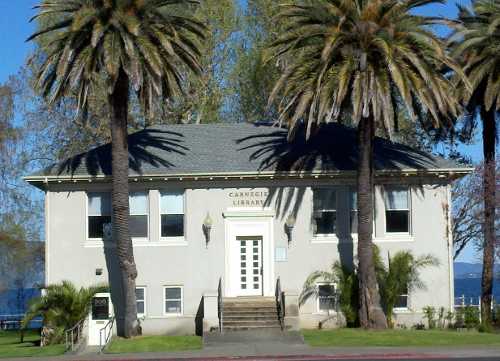
LAKEPORT, Calif. – A San Francisco architectural firm working on a feasibility study on future uses of the Carnegie Library presented an update to the Lakeport City Council Tuesday evening.
Architect Mike Garavaglia and architectural conservator Jacqui Hogans of Garavaglia Architecture made the presentation to the council.
Garavaglia Architecture was hired earlier this year to conduct the study of the 96-year-old building.
Built in 1918, the building was Lakeport's library until 1985, when library operations – which had outgrown the space – were moved to a new and larger building at 1425 N. High St.
On June 18, Garavaglia and Hogans led a visioning workshop at Lakeport City Hall to gather community input on how to preserve and use the building in the years to come, as Lake County News has reported.
Hogans said the firm's work is expected to continue into the fall, with goals including the creation of an achievable plan for a revitalized and economically stable facility.
Rehabilitation of the building is another goal, as is ensuring the safety of the building and those who use it, Hogans said.
One safety issue Hogans said will need to be addressed is the concern about flooding, which the building has been prone to over its lifetime because of its close proximity to the lake.
She noted that, for a building approaching its 100th birthday, the Carnegie Library is in very good condition. Deterioration to parts of the building – including its wooden window frames – is typical for its age.
Because the library is on the National Register of Historic Places – it was added in 2008 – the restoration of it must follow standards established by the secretary of the US Department of the Interior. Those guidelines, Hogans said, include protecting “character defining features” of the building, such as its wood shelving and circulation desk.
The building's site, at the heart of Lakeport's Library Park, also is important, and Hogans said the firm has looked at site conditions as it has evaluated the building's future uses.
Hogans reported that during the visioning workshop – in which about 30 people participated – participants shared their memories of growing up and visiting the library as well as their ideas about potential uses. The need for an elevator was almost unanimous among the group, she said.
Next steps in the process of completing the report, Hogans said, include continuing to research Lake County's economic and commercial needs – which will involve working with groups like the Lake County Chamber of Commerce and the local Realtors association – and assessing proposed uses.
Hogans said the report is 75-percent finished and it's the firm's goal to present it to the city in the very near future.
Garavaglia told the council that the library requires isolated repairs, and in the restoration process deferred maintenance and code upgrades – the latter relating to the Americans with Disabilities Act – need to be undertaken, which translates into construction costs.
The question, he said, is how to pay for those upgrades, with building rent one possibility.
He said that repairs and upgrades could easily run between $250,000 to $500,000.
The $250,000 figure should be sufficient to cover basic code work and upgrading the bathrooms, Garavaglia said.
However, if seismic work was undertaken on the building – which Garavaglia said it's not yet been determined is necessary – the costs could go much higher.
If the city were to rent the building, he suggested a figure of $1 per square foot for the 3,000-square-foot building, which could be used toward improvements.
He said that in the visioning workshop, community members didn't support commercial activity at the building.
Alternately, the city could simply pay for the upgrades without trying to rely on proceeds from a longterm lease agreement, Garavaglia said.
Councilman Marc Spillman said that when he and his family moved to Lakeport in 1999, one of the things that drew them was the Carnegie Library, which they spotted while driving through the city.
Looking down Second Street toward the building, “It's probably the best view in the city,” Spillman said.
Garavaglia said the federal rules for historic building renovations allow for additions like a deck off the back of the library, which was a recurring proposal in the visioning workshop.
Mayor Kenny Parlet was concerned about the cost of an elevator.
Garavaglia, however, noted that the library is not a large building and so can probably use a residential-style elevator that could run between $50,000 and $60,000.
Silveira said the June visioning workshop was well attended. “It was a very engaged group.”
Garavaglia agreed. “I thought the energy that was here in this community was very constructive,” he said, noting he appreciated that and that divisiveness makes his firm's work difficult.
During public comment, Carolyn Ruttan, the county's invasive species program coordinator, said she wants the building for the Clear Lake Environmental Research Center that she's forming.
“I want to bring science back to the shores of Clear Lake,” she said.
Suzanne Lyons, who attended the visioning workshop, asked if the interior of the building can be redesigned, and if the inside stairs – which she said seem to split the building in half – can be moved.
Garavaglia explained that Carnegie Libraries often were designed as very symmetrical buildings on pedestals. As such, the approach staircase is a very important aspect of the architecture which he said does tend to cut the building in half.
While the interior stairs are steep, they do meet code requirements, Garavaglia said. The exterior concrete stairs also are steep, and he said he might champion making them more gentle.
Garavaglia said his firm would dissuade the city from completely remodeling the interior of the building's main floor. However, he said the circulation desk is a cabinet that can be moved, and some of the shelving could be moved.
As for moving the interior stairs, the staircase would have to be turned at a 90-degree angle, which would be expensive and disruptive of the building's design, Garavaglia said.
There are fewer character defining aspects in the building's downstairs, where he suggested more changes could be made.
The council took no action at the end of Garavaglia's update. Formal action is not anticipated until the final report is submitted to the council.
Email Elizabeth Larson at
- Details
- Written by: Elizabeth Larson
Clearlake City Council takes first vote to place new sales tax measure on November ballot
CLEARLAKE, Calif. – The city of Clearlake will pursue a specific tax in the November election for use in citywide clean up and improvement.
The transaction and use tax, proposed at a half-cent, is estimated to generate $760,000 annually.
The Clearlake City Council has been hammering out details in its continued effort to pass a sales tax measure, introducing and conducting a first reading of an ordinance July 10 in order to set in motion the current proposal.
Past proposals have included road improvements and as much as a 1-percent tax.
Discussion since the narrow defeat of the previous measure in November 2013 have led to the omission of road improvements, inclusion of a sunset clause and a drop in the proposal amount to a half-cent.
Additionally, the new proposal requires the formation of an oversight committee for annual review of expenditures as well as the inclusion of language that would allow the council to reduce the tax to a quarter-cent after five years, if feasible.
The council had considered presenting the measure as a general tax when it looked at the possibility of a June ballot.
However, it was learned that a general tax must be presented on a ballot that includes election of council members. The June ballot did not include a municipal election, but the November ballot will.
Still, as a result of further discussion and consideration of public input, the council decided to seek a specific tax at the May 22 regular meeting.
Additionally, two members of the council, Joyce Overton and Jeri Spittler, had said they would not support a general tax.
Discussion of a general tax led to recommendation of forming a “task force” team in order to reconcile revenues being used by the police department, as the city's current Measure P requires 63 percent of the general fund be allocated directly to the department.
The term “task force” had led to debate in definition by way of its association with police services.
While the requirement for direct allocation to the police department has been eliminated with the proposal of a specific tax, the team concept remains; however, it is now identified as the Problem Oriented Solving Team (POST) in the new initiative. POST is to address code enforcement, animal control and crime reduction.
The proposed expenditure plan anticipates $760,000 in tax generated from a successful measure based on actual and projected sales tax projections. The expenditure plan is to be prepared annually using such projections and addressing needs.
City Manager Joan Phillipe said in the first several years, costs in some areas may be higher than in future years as equipment, contracts, achievements and targets are realized. The city would anticipate revenues about six months after implementation.
The expenditure plan for the POST in 2015-16 allocates anticipated revenues as follows: team personnel, $240,000; animal control, $142,000; training, $15,000; materials/supplies/vehicle(s), $60,000; contract services (towing), $40,000; abatement, $100,000; and contingency for cost allocation and other potential costs (i.e., legal expenses, noticing, community clean up day), $163,000.
Phillipe said the allocation for abatement would act as “seed money.” Abatement expenses would be placed on the property tax rolls, she said, and ultimately returned to the city.
A 10-year sunset clause has been added to the new proposal, meaning the tax will expire unless there is a determination that it is still needed. A measure must be placed before the voters for approval to extend it.
Phillipe said the addition of the sunset clause was a direct result of public input.
Additionally, the new proposal requires review in five years to determine if the tax can be lowered based on needs.
The Board of Equalization is to collect the funds generated by the tax in behalf of the city. Funds are to be placed in an established fund account and are not to be commingled with the general fund or any other fund account maintained by the city. Phillipe said the amount will fluctuate based on the economy.
Although Vice Mayor Gina Fortino Dickson brought up the option of a general tax, she later apologized recognizing the council's May 22 decision to seek a specific tax.
“I'm not feeling particularly confident that we could pass a special tax,” she said prior to hearing public comment, which included the input of only one person supporting a general tax.
Overton's initial comments opposed any measure at all. “I'm going to be honest. I don't think any tax is going to pass,” she said. “I'm done. The community is done. I don't think we should move forward with this at all.”
Councilman Joey Luiz disagreed with Overton's initial assessment and said the majority of the people have supported the initiative in the past.
“We've got issues,” he said. “We need the revenues and we need to find a way to get it in.”
Overton pointed out low voter turnout, which she said was not an accurate representation of the public's desire, a sentiment with which community member Bruno Sabatier agreed. Sabatier said he didn't think any tax would pass at this time.
Chuck Leonard, a former councilman, said he opposed a general tax and past efforts to pass it as such failed on every occasion.
“The people don't trust (a general tax),” he said. “I won't support it if it goes into the general fund but I hope nobody gives up on trying to improve the city.”
Russell Perdock also voiced support for continuing efforts. “Please pass this. Give us another chance. We will work and get it passed,” he said.
Council members and members of the public noted the importance of public education in getting the measure passed.
Businessman Dave Hughes said he once ran for a supervisorial position. “Every precinct I walked, I won,” he said. “In Lake County, knocking on doors is the answer.”
Marie Weathers, who identified herself a member of the senior community, said seniors are ready to pay the tax.
She said talking to people about the tax is essential and that she personally registered 75 people to vote in her assistance to pass the previous measure.
“My friends want (the city) cleaned up. You need to talk to people,” she said. “Yes, we want the tax and we want it to be the special tax not the general.”
Mayor Denise Loustalot agreed. “We need to clean our city up,” she said. “Somebody mentioned development. Nobody is going to want to develop here until we clean it up.”
Overton said she could support another initiative if there were increased participation from the council and the public to educate the voters about the proposal.
Overton's vote of support was necessary as the action required a four-fifths majority for the initiative to proceed and Spittler was absent from the July 10 meeting.
A second reading authorizing placement on the ballot is to be held during the July 24 regular meeting of the council.
That action also will authorize the city attorney to prepare the analysis of the measure and set forth its parameters.
City Clerk Melissa Swanson said $15,000 is budgeted for the November consolidated election, including costs associated with council seats and the ballot measure.
Email Denise Rockenstein at
- Details
- Written by: Denise Rockenstein




