 How to resolve AdBlock issue?
Clearlake City Council votes to support opening meetings with prayer
CLEARLAKE, Calif. – At its Thursday night meeting the Clearlake City Council provided direction to staff to develop guidelines for beginning each meeting with an invocation, or prayer, seeking positive spiritual guidance.
Opportunities for participation are to be extended to all organizations of faith in the community and spiritual leaders will be invited for inclusion on a calendar schedule.
“I welcome any help I can get in positive spiritual guidance,” Mayor Denise Loustalot said following a public discussion that was essentially balanced in its opinions regarding public prayer before council meetings.
It has been the city's position since its incorporation in 1980 not to have public prayer during its council meetings.
“Cities in California have taken a variety of positions on public prayer. Many do as Clearlake and have taken the position of not having them altogether,” City Attorney Ryan Jones said, recommending the city continue the practice.
Jones said some cities do permit public prayer with procedures that vary from city to city.
“Of the cities that allow prayer, some take the position of permitting nondenominational prayer offered by a member of the council or staff,” he said. “Other cities reach out to the community and permit local clergy to come to the council meeting and offer a sectarian prayer that is reflective of the clergy member's faith.”
Jones cited a May ruling by the United States Supreme Court concerning the town of Greece, New York, wherein members of the public may open city council meetings with expressly religious prayer if, over time, all faiths are welcome to participate.
He said most prayers can be from one religious faith provided a nondenominational policy is place.
“However, prayers must not proselytize, or disparage, any particular faith,” he said.
According to Jones, the town of Greece was not without its trouble in relation to the practice prior to the ruling this spring.
He said the town informally sought out prayer givers from local congregations. Findings noted, “at no point (the town) excluded or denied an opportunity to a would-be prayer giver. Its leaders maintained that a minister or layperson of any persuasion, including an atheist, could give the invocation. But nearly all the congregations in town were Christian; and from 1999 to 2007, all of the participating ministers were too.”
Two residents sued the town over the practice, alleging “that the town violated the First Amendment's Establishment Clause by preferring Christians over other prayer givers and by sponsoring sectarian prayers, such as those given 'in Jesus' name. They did not seek an end to the prayer practice, but rather requested an injunction that would limit the town to 'inclusive and ecumenical' prayers that referred only to a 'generic God' and would not associate the government with any one faith or belief.”
Jones said the court decision ruled that opening city council meeting with prayer – even sectarian or openly religious prayer – is not a violation of the Establishment Clause if certain procedures are followed.
Pastor Jim Lujan of Calvary Baptist Church said prayers before the meetings would seek to provide wisdom, bravery and changes in heart.
“I believe we have to have prayer here. It is important because we love the city,” Lujan said.
Pastor Larry Fanning cited an absence of prayer over the past 30 years. “We want to be a positive element in the community,” he said. “We would not be here to make conversions.”
Resident Jim Honegger said to be “preached to” in the environment of the city council would be wrong.
“If they want to pray for you, they can do so. They could have done it in the morning or (outside of the building),” Honegger said.
Chuck Leonard, a former member of the council, advised against creating dissent in the community.
“If they want to pray for you, no one is going to stop that from happening. They can pray for you before the meeting or they can pray for you now,” he said. “But if we start offending people and excluding others, there will be problems. (The courts) make mistakes. Don't help them along.”
Resident Beth Kaimen suggested an alternating schedule inclusive of all religions in the community be developed should the council allow prayer.
“And don't forget the Wiccans,” she said. “You have to open it up to all religions.”
Concerns addressing inclusion of “minority” religious leaders, such as Wiccans and Satanists, were discussed.
Lujan said policy language of some municipalities limit the invitation to “ordained” religious leaders only, thereby restricting those qualified to participate.
However, no specific direction regarding an ordination requirement was provided to staff in drafting the city's policy.
The policy goal is to establish a one-minute time limit for prayer or positive invocation at the start of meetings.
Additionally, if a religious representative is not present at any given meeting, a minute of silence may be observed.
Email Denise Rockenstein at
- Details
- Written by: Denise Rockenstein
City of Lakeport to pursue business route designation for portion of Highway 29
LAKEPORT, Calif. – The Lakeport City Council has given the go ahead for city staff to come back with a resolution to designate a portion of Highway 29 as a business route.
The council voted unanimously to give staff that direction at its Aug. 19 meeting.
The proposal was taken to the council by the Lakeport Economic Development Advisory Committee, or LEDAC, which gave a report to the council at last week's meeting.
LEDAC Chair Wilda Shock told Lake County News that Kelly Cox, Lake County's retired administrative officer, discussed the matter with the committee at its July 9 meeting.
LEDAC, established by the council in 2010, works to bolster the area's economy, and takes a regional economic development approach, which includes allowing members who are not city residents.
Shock and her vice chair, Mireya Gehring Turner, presented the business route to the council.
The proposal is for the city to work with Caltrans and the county of Lake to designate the Highway 29 business route, which City Manager Margaret Silveira – an ex officio member of LEDAC – noted during the meeting has as its goal getting more people off the main highway and into town.
LEDAC presented to the council three options for the proposed business route: option one, the Nice-Lucerne Cutoff to Highway 175; option two, Park Way to Highway 175; and option three, 11th street to Highway 175.
While LEDAC didn't formally recommend a route, Turner said the longer route represented in option one was a favorite. She noted that it's a beautiful route and she can't imagine anyone complaining about the chance to drive along Clear Lake.
Councilwoman Stacey Mattina moved to support option one as the business route, with the council voting 5-0.
City Clerk Janel Chapman told Lake County News that the matter will return on a future agenda, possibly for a September meeting.
Email Elizabeth Larson at
- Details
- Written by: Elizabeth Larson
Upper Lake high, elementary school district boards discuss unification proposal
UPPER LAKE, Calif. – Officials with Upper Lake's two school districts met Tuesday evening for the first joint discussion about the possibility of unification.
The joint meeting of the Upper Lake Union High School District and Upper Lake Union Elementary School District boards took place at Upper Lake Middle School.
Both the high school and elementary school boards voted unanimously in January to begin studying the process for unifying.
District officials said the elementary district – which includes Upper Lake Elementary School and Upper Lake Middle School – has 533 students, while the high school district, covering Upper Lake High and Clover Valley High continuation school, has 300 students.
Unification of local school districts is a topic that's been discussed many times over the years, and in the case of Upper Lake's schools, the process got going this year once both boards had enough members interested in pursuing the matter, Upper Lake Union Elementary Superintendent/Principal Valerie Gardner told Lake County News.
Lake County Superintendent of Schools Wally Holbrook facilitated the two-hour meeting, with county Superintendent-elect Brock Falkenberg also in attendance, along with Lake County Board of Education members Dr. Mark Cooper and Patricia Hicks.
Holbrook led the 10 board members, their superintendents, staffs and a small number of audience members through the 12 basic steps the two districts must follow if they choose to unify.
He also laid out guidelines for asking questions, urging board members to stay tough on issues but soft on people. Holbrook provided small colored cotton balls to meeting participants, explaining that if they felt upset or wanted to throw something, they could throw the cotton balls.
However, the meeting's tone was positive and constructive, and the only tossed cotton ball was thrown playfully by Holbrook himself at Upper Lake High School Superintendent/Principal Patrick Iaccino.
Holbrook told the boards that Lucerne Elementary School, which covers kindergarten through eighth grade, has chosen not to participate in the unification discussion, citing SB 1537, called the “Thompson Bill.”
“That's an option for them,” Holbrook said. “If they change their mind later, they can certainly do that.”
The bill – which went into effect in 1994 – was written by then-State Sen. Mike Thompson, who now represents a portion of Lake County in the US House of Representatives.
The Thompson Bill made it possible for a high school district to unify without affecting all of its feeder elementary districts.
Specifically, elementary districts are allowed to request that the State Board of Education exclude them from the unification process, allowing elementary schools to exist separately within the boundaries of a unified school district.
Lucerne Elementary Superintendent/Principal Mike Brown – who attended the Tuesday meeting – told Lake County News afterward that the topic of unification has come up about six times in his 24 years with the school.
At one point in the early 1990s a company was hired to do a report on possible unification, but Brown said the report didn't offer a conclusion about whether or not it was a good idea.
The last time an in-depth discussion regarding unification or consolidation within local schools occurred was in 2009, when the Board of Supervisors directed the School District Reorganization Feasibility Task Force to study the possibility of bringing together the county's seven districts.
Toward the end of the county's study, the Lucerne Elementary School Board passed a resolution saying it wanted to stay out of the unification process, Brown said, adding that community members also supported keeping Lucerne separate.
In the 2013 Lake County Grand Jury report, the grand jury urged districts around the county to begin the unification process, estimating there was the potential to save millions of dollars.
In its response to that report, the Lucerne Elementary School Board said it did not agree “that a larger district is necessarily a better district,” raised concerns about potential costs and the need to establish a countywide uniform salary schedule for teachers, and said there was no data to confirm that unification/consolidation would improve the education of the county's students.
Both Brown and education officials at the Tuesday evening meeting pointed to another use of the Thompson Bill by a small district.
Capay Joint Union Elementary School, a kindergarten through eighth grade school located within the boundaries of both Glenn and Tehama counties near Orland, used the bill to opt out of a consolidation with the high school and elementary school in nearby Hamilton City. The Hamilton City schools were unified by voters in fall 2008.
The 12 steps for unification
Holbrook said the first unification step – which sounds simple but requires a great deal of work to make it happen – is for both school boards to approve a petition to unify.
Having the district boards initiate the process, instead of having it come from voter petitions, is the most time- and cost-efficient way to carry out that first step, Holbrook said.
“That's what really starts the formal process,” he said, but for the two boards to take that action, they need to have a lot of information and be confident that they are well-prepared for the decision.
Step two is delivering the petitions to the Lake County superintendent of schools, which Holbrook said he believes will occur after Falkenberg takes office at the start of 2015. The superintendent's job is to make sure the petitions fulfill the requirements and have the necessary information.
In step three, the county superintendent sends the petitions to the county committee – in this case, the Lake County Board of Education – and the California Board of Education. Step four is the scheduling and holding of public hearings in each of the districts involved.
Step five involves a review of the 10 criteria necessary for unification, which Holbrook called “a huge step in this process.”
The 10 criteria, as stated from California Education Code Section 35753(a) through (j) are as follows:
- The reorganized districts will be adequate in terms of number of pupils enrolled.
- The districts are each organized on the basis of a substantial community identity.
- The proposal will result in an equitable division of property and facilities of the original district or districts.
- The reorganization of the districts will preserve each affected district's ability to educate students in an integrated environment and will not promote racial or ethnic discrimination or segregation.
- Any increase in costs to the state as a result of the proposed reorganization will be insignificant and otherwise incidental to the reorganization.
- The proposed reorganization will continue to promote sound education performance and will not significantly disrupt the educational programs in the districts affected by the proposed reorganization.
- Any increase in school facilities costs as a result of the proposed reorganization will be insignificant and otherwise incidental to the reorganization.
- The proposed reorganization is primarily designed for purposes other than to significantly increase property values.
- The proposed reorganization will continue to promote sound fiscal management and not cause a substantial negative effect on the fiscal status of the proposed district or any existing district affected by the proposed reorganization.
- Any other criteria as the board may, by regulation, prescribe.
After that multi-part review comes step six, in which the county committee either suggests approval or denial of unification to the State Board of Education.
Step seven involves the county superintendent of schools sending the State Board of Education his recommendation.
At that point, the school boards can consider applying for a waiver of election in the unification process, as well as a second waiver that allows the county superintendent to appoint the new members of the new district's first board, a process which Holbrook said saves time and reduces costs.
The State Board of Education schedules public hearings as part of step eight and in step nine that board considers the waivers and conducts the hearings.
In step 10, the State Board of Education approves or disapproves the unification petition and waivers, and in step 11 the State Board of Education sends notice of its action to the county superintendent.
Holbrook said step 12 would involve calling a local election for board members, if needed.
While that's the last step in the process, “It's really where I think the real work begins,” Holbrook said.
Board members, staffers ask their own questions
Next, Holbrook shifted the group to asking questions, which district staffers wrote down on large pads of paper.
Board members and staff asked about the potential financial impact of the consolidation to the Lake County Office of Education, which stands to lose $109,000 annually under the Local Control Funding Formula.
That formula gives the Lake County Office of Education $109,000 for each county district in exchange for services such as financial oversight and other support. Holbrook said that will be part of the overall analysis.
Falkenberg said the issue of that funding needs to be followed up on, as the Local Control Funding Formula was put in place since the state established rules for district unifications. “We're making some assumptions which may not actually play out in the long run,” he said.
Other questions related to negotiating new contracts with the employee unions, promoting sound educational performance for the districts' children, whether the five new board members would serve out their current terms or get new terms, what structure the new administration would have, how to address potential increases in facilities costs, when the new district would need to adopt board policies and how the community would be involved.
The next steps involve Falkenberg, Gardner, Holbrook and Iaccino reviewing the questions collected at the Tuesday meeting with a view to getting the answers for the boards in the weeks and months ahead.
At the same time, Gardner and Iaccino are planning to go to their boards in September to seek approval for sending letters to Holbrook's office expressing interest in pursuing unification and asking for assistance.
As the board members and staff were each given 30 seconds to wrap up with any final thoughts, comments reflected an appreciation of the chance to work and learn together in the process.
“This is the first thing that we've done together as boards,” said Upper Lake Union High School Board President Keith Austin. “I'm impressed with both boards.”
Rich Swaney, another Upper Lake Union High board member, said he hoped that – regardless of the outcome of unification – the two boards would meet together at least twice a year going forward.
Upper Lake Union Elementary Board Vice President Mel O'Meara thanked Holbrook, telling him, “I think you've made a huge difference here tonight.”
O'Meara said unification will take a concerted effort and a lot of good will. “I hope we keep up the tone we had tonight.”
Gardner said she knew making such big decisions wasn't easy, as they were talking about a complete restructuring that will impact peoples' jobs.
Iaccino thanked everyone in the room. “Just keep the kids in mind.”
Brown said it was the best, clearest discussion on unification among the half dozen or so he has heard over the years, and told Gardner and Iaccino they have his full support.
He told Lake County News after the meeting, “This was a big, big step, the two boards sitting in the same room and getting along.”
Email Elizabeth Larson at
- Details
- Written by: Elizabeth Larson
Council honors Youth Center campers
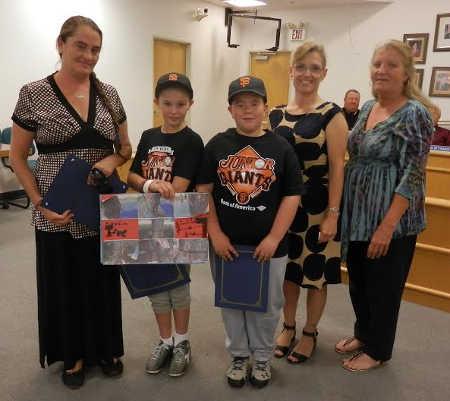
CLEARLAKE, Calif. – The Clearlake City Council recently recognized two Lake County Youth Center summer campers for their proactive approach in working with the city's Public Works Department.
Campers Jordan Berwick, 10, and Melissa Percy, 11, recently were on a walk at Redbud Park when they noticed a bench that was secured to a tree with a chain.
The chain was causing noticeable damage to the tree, which the campers brought to the attention of Public Works.
Public Works remedied the situation and gave accolades to the campers for likely saving the tree.
Jordan and Melissa were joined by Youth Center Volunteer Coordinator Lorilei Gamble at the council's Aug. 14 meeting, where they were honored.
Email Denise Rockenstein at
- Details
- Written by: Denise Rockenstein