 How to resolve AdBlock issue?
Keys to Lucerne Hotel pass to Marymount California University; facility now a college campus

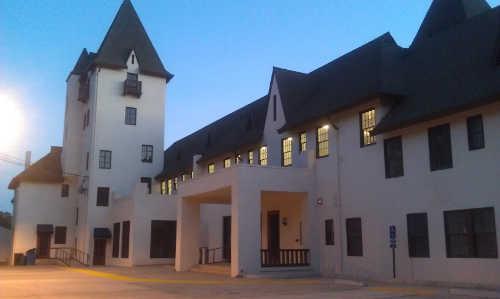
LUCERNE, Calif. – On Friday, the building at the center of the community of Lucerne officially became a college campus.
During a brief ceremony featuring county and university officials, campus Executive Director Michelle Scully received the antique keys – on an original keyring used from the days when the building was a hotel – from County Administrative Officer Matt Perry.
The county purchased the building and its accompanying seven acres in 2010 for $1.35 million from a church group that had owned it for many years. Another parcel also was purchased for $150,000.
Eric Seely, the county’s deputy administrative officer for special projects, has overseen the renovation. He told Lake County News that the purchase and county’s renovations total $5 million, with Marymount putting additional funds into preparing the facilities for students.
Scully called the process of turning the building into a four-year university campus “a long walk of faith and vision,” and a big day not just for the Lucerne community but Lake County as a whole.
“It’s been such a testament to this county and the heart of this county,” she said of the effort.
Scully hopes for the new “Lakeside Campus” to become a vibrant community hub of education and opportunity.
“Your vision has been extraordinary,” she told Perry as well as members of the Lake County Advisory Committee that had supported the building’s revisioning process.
Advisory committee members including community leader Wilda Shock, Lake Family Resource Executive Director Gloria Flaherty and Lake County Superintendent of Schools Wally Holbrook looked on during the key handoff.
Perry said he was pleased to be able to hand off the keys to the university, which has a 15-year lease for the building.
He acknowledged the support of the Board of Supervisors, Marymount President Dr. Michael Brophy and retired County Administrative Officer Kelly Cox.
“It’s been a great project,” said Perry.
A history major, Perry said he had always dreamed of being a part of renovating a historic building. Though he joked that the challenges sometimes resembled a nightmare, in the end it was “a dream come true.”
Perry said that one of the best ways to improve a community is to increase the available educational opportunities.
“We believe this will truly transform Lucerne,” he said.
For the county as a whole, however, Perry called it a historic occasion, pointing out that the building will now house the first four-year university to call Lake County home.
County residents will no longer have to travel or move away to pursue bachelor’s and master’s degrees, Perry said.
Cox was a major force behind the county purchasing, saving and preparing the building for its latest – and best – purpose.
He was out of the county on Friday so he couldn’t attend, but in an email message to Lake County News Cox expressed his delight with the opening of the Lucerne Hotel’s latest chapter.
“No one is happier than me about today's milestone!” he wrote. “It truly is a dream come true and will benefit current and future generations of Lake County residents. I have no doubt that Marymount will become a very important part of our community.”
An extensive process
Seely said the county’s part of the extensive building renovations – which has included a new roof, stucco repairs, a new paint job, awnings, new windows, new bathrooms and classrooms, repairs to the electrical system, landscaping, turning the swimming pool into a planter and a new elevator – are now complete.
When the county purchased the 75,000-square-foot building, there were many repairs to be made, he said.
A leaking roof resulted in the building’s north wing taking substantial water, which damaged the interior plaster, Seely said.
However, the building’s wood frame, stucco exterior, and interior lath and plaster were resilient enough that the county was able to move forward on renovations that ultimately saved the structure.
Seely said there were no particular surprises during the project, although there were little discoveries that echoed the building’s colorful past.
Those included finding a Gordon’s gin bottle stuffed into the wall of one of the building’s many original bathrooms. The bottle’s glass color indicated that it was produced in Great Britain not the United States – which at the time was under Prohibition – giving a glimpse into the alcohol smuggling trade.
They also found another alcohol bottle stuck under a stairwell, where it had remained since 1936, after Prohibition was over. Seely guessed it was left there by one of the men working on installing the building’s many sprinklers.

He said they also found Prince Albert tobacco cans. Besides the booze and cigarettes, they didn’t find any money or newspapers, such as he’s found during other renovations projects he’s overseen, like the Ely Stage Stop in Kelseyville.
The most expensive single aspect of the building’s upgrade, according to Seely, was the $400,000 elevator, needed to make it compliant with the Americans with Disabilities Act.
Originally the county had received a bid for $850,000, but the county worked with an architect to design the project and put it back out to bid for construction, which Seely said led to three new bids. From those the county chose winning bidder.
Seely said the Lucerne Hotel is the largest renovation project he’s managed based on price tag, not far ahead of the $3.5 million new Middletown Library and senior center.
He said there will be future renovations on the Lucerne Hotel – anticipated to include residential housing, an upgrade of the building’s spacious kitchen and additional electrical upgrades – but those will be up to Marymount to complete.
The university so far has made significant upgrades by creating a high-tech, fiber optic infrastructure in the building, as well as furnishing it, he said.
Any time during the 15-year lease – which was signed in October 2012 – Marymount can exercise its option to purchase the building outright. Seely said there are incentives for the university to purchase the building earlier in the lease’s lifetime.
The campus’ first semester of classes will begin this fall, with the first day of college being Monday, Aug. 25.
Campus enrollment currently is at about 30 for bachelor’s and master’s degree students, with at least 10 county employees planning to take professional development classes at the campus, said Sharon Maher, the Lakeside Campus enrollment coordinator.
Putting those numbers in perspective, the university’s chief academic officer, Dr. Ariane Schauer, said that when Marymount started its bachelor’s program four year ago, it had 40 students across its two Southern California campuses in Rancho Palos Verdes and San Pedro.
Today, 60 percent of the 1,000 students who attend Marymount’s campuses are seeking their bachelor’s degrees, Schauer said.
Maher said all of the students enrolled for the fall semester are local, with many of them choosing to attend Marymount rather than schools like Sonoma State or Sacramento State.
She said many of those students also are transferring either from Mendocino College or Yuba College, which was made possible thanks to transfer agreements that Marymount established with those two local community colleges.
“That partnership” – with the community colleges – “is key,” Schauer noted.
Schauer also explained that one of the university’s educational emphases at the Lakeside Campus will be training entrepreneurs to build their own businesses and, in the process, to improve their community.
After she took the keys from Perry on Friday afternoon, Scully looked up at the hotel’s seven story tower – which makes it Lake County’s tallest building – and pointed out that in the 1920s someone had the wherewithal to build such an impressive structure.
“It’s been waiting a long time to have its moment, and I think it’s here,” she said.
Email Elizabeth Larson at
- Details
- Written by: Elizabeth Larson
Clearlake City Council votes to place 'Measure R' sales tax proposal on November ballot
CLEARLAKE, Calif. – The Clearlake City Council last Thursday gave its approval to a second and final reading of an ordinance to place a sales tax measure before the voters in November.
Councilwoman Jeri Spittler acted against the majority of the council by casting the only dissenting vote on the item.
“I can't believe you are doing this again,” Councilman Joey Luiz said to Spittler. “That you would go against what (the council) is trying to accomplish.”
Passage of the ordinance will place “Measure R” on the November ballot as a specific transaction and use sales tax, proposed at a half-cent.
A successful initiative would generate an estimated $760,000 annually for use in citywide clean up and improvement.
Similar initiatives have been presented to the voters in recent elections, the most previous being Measure H, which showed majority support but fell 177 votes short of gaining the two-thirds vote it needed to pass as a specific tax.
After the narrow defeat of Measure H last November, the council held several public discussions, including a town hall meeting, in which it attempted to identify the public's will regarding if and how the council should proceed with presentation of a new sales tax initiative.
Discussions resulted in the identification of public support for continuing efforts to secure sales tax revenues to improve the city. However, results also showed a public desire to change the initiative.
Mayor Denise Loustalot had said early in the series of discussions that, regardless of how it proceeds, she wanted to ensure individual members of the council would uphold the decisions made by the whole.
Spittler had actively opposed Measure H, and had placed a “No on H” sign in the window of her business on Lakeshore Drive, the city's main thoroughfare.
Measure H had sought a one-percent specific sales tax for road improvements (75 percent) and code enforcement/animal control (25 percent).
Spittler had taken particular issue with which roads would benefit from the sales tax. Continued discussions led to identification of a public desire to remove the road component and reduce the sales tax to a half-cent. Public input also placed higher priority on code enforcement and crime suppression.
Mike Vandiver, who campaigned for the passage of the Measure H, said during the March 13 community meeting that code enforcement is the priority and splitting the tax would allow time to then develop a better plan for the roads.
Luiz and Councilwoman Joyce Overton had agreed with Vandiver's assessment.
“My research shows, (constituents) want code enforcement,” Overton said on March 13. “Not just code enforcement, they want a task force. They want to be safe.”
Spittler first took issue with the term “task force” when it was introduced as reconciliation to presenting the initiative as a general tax in relation to a Measure P, which currently requires 63-percent of the general fund be directly allocated to the police department.
Formation of a task force was to provide compliance with Measure P while providing a means to fund the services for which the tax was intended.
Several members of the public urged the council against seeking a general tax throughout the continued discussions.
Vice Mayor Gina Fortino Dickson had suggested doing so because the council's option to place a general tax is limited and the next opportunity would not return for two years. A general tax, which could be passed with a simple majority vote, can only be placed on a ballot that includes council member elections.
During the council's May 22 discussion on the sales tax measure, after it was decided that a general tax would not be sought, Spittler – raising the issue of the tax going to fund a task force under the police department – questioned why the city would not specify funds will pay the salary of one officer.
Fortino Dickson had responded during that discussion, saying she saw no point in specifying funds for a “police officer” when one of the reasons cited for not pursuing a general tax is because allocation requirements of Measure P.
She said needs of the program are likely to change and while the need for a police officer may exist in the beginning, program needs may change.
Fortino Dickson also had said the proposal should be written in such a way that allows for best operation in compliance with a voter-approved expenditure plan.
While the requirement for direct allocation to the police department has been eliminated with the proposal of a specific tax, the team concept remains; however, it is now identified as the Problem Oriented Solving Team (POST) in the new measure. POST is to address code enforcement, animal control and crime reduction.
Projected costs; sunset clause added
City Manager Joan Phillipe said that in the first several years the measure is in place, costs in some areas may be higher than in future years as equipment, contracts, achievements and targets are realized. The city would anticipate revenues about six months after implementation.
The expenditure plan for the POST in 2015-16 allocates anticipated revenues as follows: team personnel, $240,000; animal control, $142,000; training, $15,000; materials/supplies/vehicle(s), $60,000; contract services (towing), $40,000; abatement, $100,000; and contingency for cost allocation and other potential costs (i.e. legal expenses, noticing, community clean up day), $163,000.
Phillipe said the allocation for abatement would act as “seed money.”
Abatement expenses would be placed on the property tax rolls, she said, and ultimately returned to the city.
A 10-year sunset clause is added to the new initiative and will require review after five years to determine if the tax should be lowered to a quarter cent.
At the May 22 meeting, District 2 Supervisor Jeff Smith had suggested review after five years with the possibility of lowering the tax in response to Spittler when she suggested the sunset clause be set at five years and that it be proposed at a quarter cent.
Additionally, the new proposal requires the formation of an oversight committee for annual review of expenditures.
Throughout the series of discussions both Spittler and Overton said they opposed a general tax; however, the latter said on Feb. 27 – after the council voted 3-2 to seek a general tax in the June election – that she would uphold the council's decision and do what she could to support the effort.
Prior to open discussion on July 10, before the ordinance had its first reading, Overton said she did not think the community wanted to be subjected to another tax proposal.
However, after hearing public comments, which included those requesting another chance to pass it, she said she could support another initiative if there were increased participation from the council and the public to educate the voters about the proposal.
Spittler, who was not present for the July 10 meeting, has adamantly opposed a general tax. However, at no point during the discussions did she say directly that she would not support a specific tax.
Luiz said the council has made every effort to address Spittler's concerns and voiced his frustration with her opposition to the council.
“In Measure H, it was the roads,” he said.
“I am not going to endorse it. I'm just not comfortable putting a tax out there when (the voters) already said no twice,” Spittler said. “If this is what you want to do, this is your decision. You have your decision; you have yours and I have mine.”
Loustalot said the proposal has been changed to please the public.
Fortino Dickson voiced a need for unity and participation among members of the council. She requested clarification regarding what actions each of them may take as members of the council in relation to the ballot campaign.
City Attorney Ryan Jones said he will provide a short presentation regarding the appropriate actions of members of the council in promoting the initiative.
An impartial analysis by the city attorney is due by Aug. 7 as are arguments for and against the proposed measure. Rebuttal arguments are due by Aug. 18.
Email Denise Rockenstein at
- Details
- Written by: Denise Rockenstein
Clearlake City Council adopts new fiscal year budget
CLEARLAKE, Calif. – The Clearlake City Council passed the city's fiscal year 2014-15 budget on Thursday.
The vote was 3-1-0 vote, with Councilwoman Jeri Spittler casting the dissenting vote. Councilwoman Joyce Overton excused herself for unknown reasons earlier in the meeting prior to the budget discussion and subsequent action.
Operational budget expenditures in the general fund total about $4.5 million, of which about $2.7 million is allocated to the police department.
Finance Director Chris Becnel, who began employment with the city of Clearlake on July 1, said the budget is “fairly balanced.”
“It's about $37,000 (in expenditures) more than (revenues) taken in but we do have the reserves to cover that,” he said.
City Manager Joan Phillipe said a fiscally conservative approach was used in developing the budget and that all department heads were involved in the process.
In addition, two budget workshops were conducted that included the participation of council members.
Phillipe said financial management policies that were adopted last year established specific reserve accounts, which – as revenues increase in coming years – will bring the city to a healthier overall position and enable it withstand economic downturns much better than it otherwise would.
“As I cautioned during discussions in developing the city's goals and have continued to caution since, as revenues begin to increase, the city cannot allocate them to increased expenditures,” Phillipe said. “Rather, the belt tightening will have to continue and the reserve accounts will need to be funded, including those that address future liabilities.”
The general fund is projected to have a positive ending fund balance of $622,238. However, when the city's $150,000 risk management reserve, as required by the city's insurance, is subtracted, a projected $472,238 fund balance remains.
Additionally, with reserve for economic uncertainty set at 5 percent, totaling $226,136, an unallocated fund balance of $246,102 remains.
“That doesn't mean those funds are there waiting to be spent,” Becnel said.
Phillipe said budget projections include a $166,000 anticipated increase in sales tax revenues.
Decreases in revenues, she said, include the following: school resource officer ($101,722), property taxes ($139,229) and transfers in from gas tax and the economic development fund.
According to Phillipe, expenditure decreases are projected as follows: city council health insurance reduction, $30,542; general plan draft environmental impact report, as it nears completion, $80,000; city liability insurance premium reduction, $116,846; and audit cost reduction, $23,000.
Phillipe said salary and benefits costs are projected to increase $14,469 because of scheduled step increases, longevity pay, a projected 5-percent increase in health insurance premiums and increased Cal PERS rates.
“With the implementation of the tiered retirement system, new employees have saved the city money on retirement costs,” she said.
Phillipe outlined new aspects of the budget as follows:
- Measure P Fund costs are now balanced to Measure P revenues (Measure P requires 63 percent of the general fund be allocated to the police department).
- The economic development and the building development funds were closed and are now included in the general fund.
- A new parks and development fund was established to account for the $50,000 received from Lake County for improvements to Highlands Park.
- Transfer of $100,000 from the Supplemental Law Enforcement Services Fund to the general fund to finance front-line police personnel costs. Phillipe said this also occurred in last year's budget.
- Planned police officer position vacancy resulting in a cost savings of $60,529.
- A total of $62,727 in transfers to the general fund for administrative cost allocation charges provided to other funds, as supported by a consultant's cost allocation plan. Phillipe said the gas tax fund is not contributing this year as funds are not available because of active street improvement projects.
- The first year of loan repayments to the general fund from the redevelopment successor agency is budgeted in the amount of $103,933. Of that amount, 20 percent or $20,787 must, by law, be allocated to the low/moderate income housing fund, Phillipe said. The successor agency oversees the dissolution of the redevelopment agency.
- A first installment payment on a $241,000 debt owed from the general fund to the successor agency is budgeted at $48,200. Phillipe said the net effect of this transaction and the aforementioned loan repayment from the successor agency is an increase of $34,946 to the general fund.
- A new capital projects fund is established to transfer the available project funds out of the successor agency. Phillipe said this will enable better tracking of the projects as they progress. The current transfer is $500,000.
- The budget includes health insurance coverage for council members only and not extended to their families.
- The budget includes funds associated with potential costs for animal control.
Despite Becnel's emphasizing the importance of getting a budget in place for the coming year being that the previous budget has already been extended, Spittler requested more time to review the document.
While she claimed the document is convoluted and difficult to understand, other members of the council praised staff for its easy comprehension.
Vice Mayor Gina Fortino Dickson offered to go over the document with Spittler page-by-page at another time and clarified that the budget before them was a working document that can be amended as needed.
Fortino Dickson said the document is finalized at the time of the midyear budget review, which was reiterated by Phillipe.
Spittler continued citing expenditures of $20,000 or less that she said caused her concern.
Expenditures cited by Spittler involved building maintenance costs and equipment costs within the public works budget.
Councilman Joey Luiz described those expenditures as being minuscule and said concerns brought up by Spittler were addressed in detail during the budget process.
He said if Spittler had further concerns, she should have addressed them during the budget workshops, which were held in June and July.
“We've been working on this for weeks,” Luiz said. “It is not beneficial to hold off (on adoption). It keeps department heads from spending (accordingly) to their budgets.”
Email Denise Rockenstein at
- Details
- Written by: Denise Rockenstein
Redbud Audubon works with city of Clearlake to raise awareness of wildlife
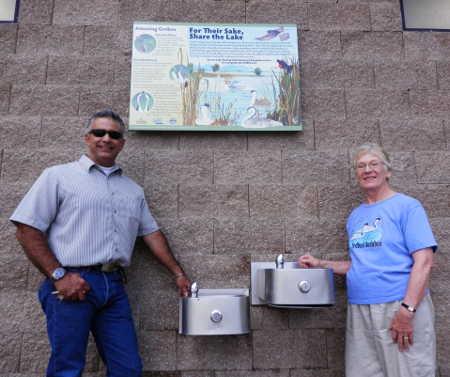
CLEARLAKE, Calif. – The Redbud Audubon Society recently gifted the city of Clearlake with an illustrated sign meant to remind the public of the importance of protecting wildlife on Clear Lake.
The “For Their Sake, Share the Lake” sign was installed last week at Redbud Park on Onorato Hall, the restroom facility in the area of Thompson Harbor boat launch.
The sign describes the mating and nesting habits of the Western and Clark's grebes and the potential dangers posed by boaters.
“During the summer breeding season, these birds build colonies of floating nests that can be threatened by speedboats, jet skis and water skiers,” Redbud Audubon President Marilyn Waits said. “The new sign faces the boat launch to alert boaters to keep a distance from the nesting grebes and their chicks.”
Waits said the signs will help residents and tourists understand the importance of “sharing the lake” and being mindful of its wildlife.
She said researchers from UC Davis identified a need for public education regarding the potential for endangering the grebe without intention.
Four additional signs, to be placed at locations around the lake, will assist in raising public awareness, Waits said. Locations include Clear Lake State Park and Lakeside Park in Kelseyville; Library Park in Lakeport; and Lucerne Harbor Park in Lucerne.
The grebe nesting season coincides with the boating season, which increases the risks for grebe survival.
Waits said grebes build floating nests that can be flooded or broken apart by boat wakes. Wakes also can cause the eggs to roll out of the nest.
In addition, she said, grebes carry their young on their backs, which make them vulnerable to boat strikes.
The signs cites a comeback in grebe populations following bans of market hunting, egg collecting and toxic pesticides.
According to the Redbud Audubon Society, grebes in California are suffering heavy losses because of oil spills, exposure to which causes them to lose the ability to regulate body temperature.
The signs state the public's help is essential in making Clear Lake a safe place for recovery of the grebe population.
“You can enjoy boating while taking care that grebes survive to re-populate this wildlife area,” the signs say.

The signs describe the grebe as a “dynamic diver” that can appear and disappear quickly. They also tells of the grebes' mating rituals.
In the “rushing ceremony” two or more grebes will rise up together, rhythmically bobbing their heads and skimming rapidly across the service of the water.
Next comes the “weed ceremony,” which is accented by shrill calls, diving and the co-presentation of freshly picked plants. Following this courtship, colonial nest building commences.
Aquatic plants in Clear Lake create ideal conditions for floating nest construction. The signs remind lake users that the damage or loss of habitat has the potential of reducing the survival chances of the grebe.
Waits said the signs carry a 10-year warranty.
In addition to the public education sign, Redbud Audubon Society donated a fishing line recycle bin, which also is in place at Redbud Park.
“Tangled fishing line kills many birds and other wildlife,” Waits said. “Volunteers from Audubon and Sea Scouts collect the discarded line from the bins on a regular basis and the discarded monofilament line is mailed to a recycling manufacturer in the Midwest to be made into new products.”
Waits said donations of the signs and fishing line recycling bins, which total 18, were made possible through the organization’s six-year Grebe Conservation Grant from the Luckenbach Trustee Council.
She said Redbud Audubon is one of three chapters in Northern California participating in the grant program, which also provides funding for the organization’s partnership with the Lake County Department of Water Resources for placement of speed buoys around grebe colonies as well as for research monitoring by Pacific Union College.
Email Denise Rockenstein at
- Details
- Written by: Denise Rockenstein