
 How to resolve AdBlock issue?
 Progress continues on Lake County Land Trust lakeside property purchase; matching grant offered for $25,000
LAKE COUNTY, Calif. – The purchase of a 31-acre lakeside parcel on the Big Valley shoreline by the Lake County Land Trust is progressing nicely with $75,000 raised towards the $225,000 purchase price, plus the offer of a $25,000 matching grant by the Pitzer Family Foundation.
That means if the Land Trust is able to raise $25,000 locally, the foundation will contribute $25,000 for a total of $50,000 more towards the purchase of this beautiful shoreline parcel near Kelseyville.
The property features lakefront, wetlands, upland wet meadow, pasture and oak trees.
The protection of the parcel is part of an effort to protect the remaining wetlands and riparian forests between Clear Lake State Park and the southern edge of Lakeport.
The Land Trust has developed a conceptual area protection plan, a conservation plan for the area, in partnership with the California Department of Fish and Wildlife. The plan is in the final stage of review at CDFW before it can be adopted by the department.
Purchase of this Big Valley Wetland shoreline parcel will be the keystone of the Land Trust’s conservation effort. The parcel is located on Clipper Lane and is owned by George Melo.
The Land Trust holds an option to purchase the property and is very excited about the success it has experienced so far in raising a significant amount of the funds locally.
The offer of a $25,000 matching grant also is exciting and offers a keen incentive for others to join in the effort to purchase this valuable parcel for the health of Clear Lake and the numerous fish and wildlife that require this lakeside habitat for their continued existence.
The Land Trust offered many thanks to the numerous businesses and individuals who have donated to this project so far.
They include John Sheridan and Andrea DuFlon, $20,000; Charlotte Griswold, $5,000; Val and Tom Nixon, $1,000; Harry and Roberta Lyons, $1,000; Michael Friel, $1,000; Kristine Groff, $1,000; William and Carol Lincoln, $1,000; Sasha and John Reynolds, $1,000; Bernard and Lynne Butcher, $1,000; Russell and Joyce Porterfield, $1,000; the Lake County Land Trust’s Robert Morse and John Graham bequests, $15,000; Pitzer Family Foundation, $10,000 plus pending $25,000 matching grant; Keeling-Barnes Family Foundation, $1,000; The Lodge at Blue Lakes, $1,000; the Lake County Board of Supervisors’ Fish and Wildlife Advisory Committee, $3,000; several anonymous donors and some smaller donors. All are very much appreciated.
For information or to make a donation, call the Lake County Land Trust at 262-0707, visit www.lakecountylandtrust.org or send a donation to P.O. Box 711, Lower Lake, CA 95457.
In making donations, designate “Melo wetlands” in the correspondence or on the subject line of the check.
All donations received as of the publication date of this article will be doubled in value up to $25,000 by the matching grant challenge.
- Details
- Written by: Lake County News reports
Yes on Measure N Committee to hold May 1 public meeting
KELSEYVILLE, Calif. – The group of Lake County residents who have formed a committee to support the passage of Measure N will hold a public meeting this week.
Citizens for a Safer Lake County – Yes on Measure N will hold the meeting beginning at noon Thursday, May 1, at St. Peter's Catholic Church, located at 4085 Main St. in Kelseyville.
Measure N is a county ordinance to govern the cultivation of medical marijuana passed unanimously by the Lake County Board of Supervisors last Dec. 17.
It has been placed on the June 3 primary ballot due to a referendum effort that gathered enough signatures earlier this year.
The citizens committee is active and engaged in the process of building public support and raising the funds needed to win the campaign for Measure N.
For more information about Yes on N, please attend the informational and task-oriented meeting on May 1, contact the citizens committee at
- Details
- Written by: Lake County News reports
Pischke remembered for service, dedication to family, community involvement
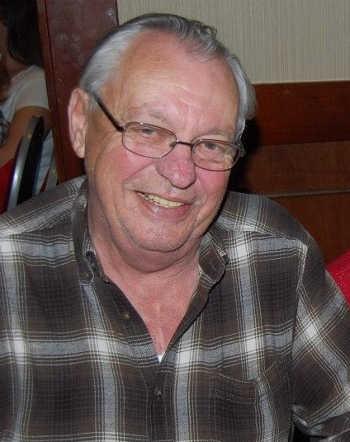
LAKEPORT, Calif. – A former Lakeport City Council member and mayor who devoted himself to making Lakeport a better place and to helping children both at home and around the world has died.
Arlin A. Pischke died Sunday following a brief illness. He was 75 years old.
“We’ve lost a great member of the community,” said Eric Wheaton, a fellow Kiwanian who called Pischke “a great friend.”
Pischke was a businessman, a founding member of the Lakeport Kiwanis Club, was elected to the Lakeport City Council twice – serving two terms as mayor – and a longtime and dedicated member of St. Mary Immaculate Catholic Church.
Yet, his large and affectionate family was his proudest accomplishment. He and wife Rose raised six children and had 16 grandchildren, whose activities he followed with dedication and pride.
Just days before Pischke died, at what would turn out to be his last Lakeport Kiwanis meeting, his granddaughter Savannah Rasmussen made a presentation to the club. Fellow Kiwanian Dennis Rollins recalled that Pischke was “beaming” as he watched his granddaughter speak.
“He was so proud of his family,” said Rollins.
Son-in-law Brad Rasmussen, the city of Lakeport’s police chief and also a member of Kiwanis, said that Pischke – who arrived in Lakeport in 1978 – was active in the community and wanted to make Lakeport a better place to live.
Pischke was born Jan. 15, 1939, in Ripon, Wis.
He attended some college and went on to serve in the United States Army Reserve from February 1957 to January 1959, the US Navy from January 1959 to February 1963, and the US Navy Reserve from February 1963 to July 1967.
During his time in the Navy he worked in a military justice court as a yeoman, the equivalent of a civilian court reporter.
Later he and Rose would move from El Monte, Calif., back to Wisconsin, where he owned a sporting goods store in Ripon for a year. Daughter Karyn was born there before they moved back to California, to West Covina, and from there to Lakeport in 1978, where he opened the ran the Summitt Title Co.
The same year that he arrived in Lake County, he became a charter member of what was then known as the Northshore Kiwanis Club, based in Nice, according to Rasmussen.
Pischke served as the club’s president from 1979 to 1980, and in 1980 the club became the Lakeport Kiwanis, Rasmussen said.
From 2003 to 2004 Pischke would serve again as the Lakeport Kiwanis president. “The Kiwanis was a big deal in his life,” according to Rasmussen.
“He was always the most positive person,” said Rollins, adding, “He was always there and always took a positive approach to things we ought to do.”
Rollins and Wheaton both recalled Pischke as a kind and generous man, who was always willing to pitch in and do everything from selling raffle tickets to putting on pancake breakfasts.
Wheaton added that Pischke would have given anyone who needed it the shirt off of his own back.
Pischke also didn’t hesitate to take on leadership roles for club projects. Among the projects close to Pischke’s heart were those that centered on children.
“He was really committed to serving the children of the world” – Lake County’s children as well as those elsewhere around the globe, Rasmussen said.
Those projects, Rasmussen said, included the Kiwanis Family House, which provides temporary housing and support to families of seriously ill or injured children and adults being treated at the University of California, Davis, Medical Center in Sacramento.
Rasmussen said Pischke also did a lot of work supporting international Kiwanis programs to eliminate neonatal tetanus and iodine deficiency.
“He always put others before himself,” Rasmussen said.
Wheaton remembered another side of Pischke. “Arlin was the consummate happy man.”
When Pischke started to tell a story, he always began with a big, hearty laugh, Wheaton said.
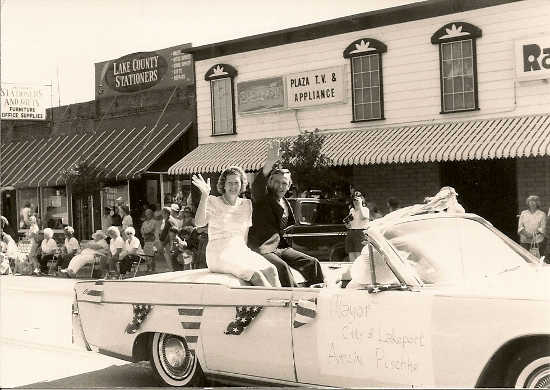
On the civic level, Pischke served two terms on the Lakeport City Council, taking office in April 1982 and finishing his tenure in April 1990, according to City Clerk Janel Chapman.
During those eight years on the council, Pischke was mayor twice – from April of 1984 to April 1985, and from April 1988 to April 1989, Chapman said.
Pischke made appearances at council meetings up until recently, whether it was to weigh in on important community matters or to watch another grandchild be honored for an accomplishment.
For 36 years, Pischke was very involved in his church, Mt. Mary Immaculate, where he served on the board that supported the building of the new church in the mid-1980s, Rasmussen said.
When he wasn’t busy helping build churches, govern the city or working on Kiwanis projects, Pischke enjoyed woodworking, gardening and fishing on Clear Lake. Rasmussen said his father-in-law loved living in Lakeport, with his view of the lake.
But, Rasmussen added, the most important thing was spending time with family and the grandchildren.
Arlin Pischke is survived by wife, Rose; and his six children, son, Arlin and wife, Danielle; daughter, Kathy and husband Dave Schultz; daughter, Allyson and husband Scott Quinlan; daughter, Karyn and husband Brad Rasmussen; son, Kevin and wife Dena Pischke; and daughter, Susan and husband David Wolf.
He also leaves behind his 16 grandchildren, Andrew, Megan, Cooper, Paige, Zeke and Fisher Pischke; Cody, Kelsey and Samuel Quinlan; Stephanie and Savannah Rasmussen; Jake, Josh and Sarah Schultz; and Logan and Ciara Wolf.
A memorial service will be held at 11 a.m. this Saturday, May 3, at St. Mary Immaculate Catholic Church, 801 N Main St, Lakeport, with a graveside service to follow at St. Mary’s Catholic Cemetery, located on Highway 175 one mile from the intersection of Highway 29 and 175.
The Lake County Military Funeral Honors Team will render military honors – including a rifle volley and the playing of “Taps” – during the graveside service.
A reception will take place after the graveside service at the St. Mary Immaculate Parish Hall next to the church.
In lieu of flowers, Pischke’s family asks that donations be made in his memory to the Kiwanis Family House, www.kiwanisfamilyhouse.org .
Checks to the Kiwanis Family House also may be mailed to the Lakeport Kiwanis Club at P.O. Box 1027, Lakeport, CA 95453-1027.
Email Elizabeth Larson at
- Details
- Written by: Elizabeth Larson
Candidate forums planned in May
LAKE COUNTY, Calif. – The Lake County Chamber of Commerce, in partnership with Lake County News, is presenting a series of candidate forums in May.
Planned to be held over four nights beginning at 6 p.m., the forums will take place in the Board of Supervisors chambers on the first floor of the Lake County Courthouse, 255 N. Forbes St. in Lakeport.
The forums will be held on the following dates:
- Thursday, May 1: District attorney candidates.
- Monday, May 5: District 3 supervisors candidates.
- Thursday, May 8: Assessor-recorder candidates.
- Tuesday, May 13: Sheriff candidates.
At this time all candidates for the district attorney and sheriff races have confirmed they will attend and participate in their respective forums.
The forum organizers are actively seeking questions from the public for all of these forums.
The public may submit questions by responding to a blog posted on the Lake County Chamber Web site at www.lakecochamber.com . Questions also may be faxed to 707-263-5104 or bring them to the chamber office at 875 Lakeport Blvd., Vista Point in Lakeport.
The format of the forums will be as follows: Cards will be made available at the forums for questions; those questions will be vetted for duplication of previously submitted questions and appropriateness. In addition, organizers are asking each candidate to submit one question for their forum, if they wish.
When the forums begin, there will be a three-minute opening statement for each candidate; each question will be posed to each candidate who is given a two-minute response time; a one-minute rebuttal will then be provided to each candidate on that question. At the end of the questioning period, each candidate will be given a two-minute closing statement.
It's the goal of the forums to facilitate the public gaining more information on all the candidates in these races in order to become more informed voters.
- Details
- Written by: Lake County News reports
County of Lake collaborates with homeowners, tribe on road projects
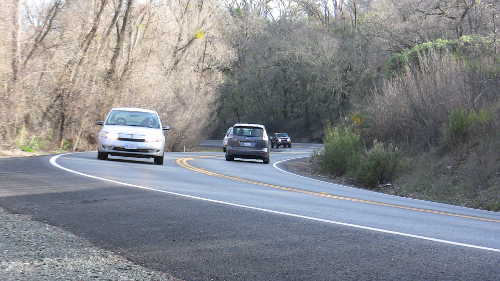
LAKE COUNTY, Calif. – Lake County has encountered a lot of bumps in its efforts to improve the surfaces of its roads. But it may be turning the corner to a brighter future of smooth roads through a system of collaboration.
Collaboration between property owners and county government, and collaboration between local pols and the band of Pomo Indians residing in the area suggest that a new paradigm for progress is in the making.
The homeowners of Clear Lake Riviera struck an agreement with the Lake County Board of Supervisors in which they are taxing themselves about $125 a year for the next seven years to pay for resurfacing a particularly choppy road conditions in the vicinity of Tenaya Way and Chippewa Trail.
“We were lucky that the board listened,” said Tom Nixon, a Clear Lake Riviera resident and principal liaison with the county. “We told them we want to help you help us fix the roads. I told (the Board of Supervisors) that we could be part of the solution. We're willing to pony up.”
Under terms worked out with the county, a 58-42 percent agreement on costs for the project was established between the subdivision homeowners and the county.
But, before securing this agreement there was a labyrinth of what Nixon calls “pothole politics.”
Opposition included multi-lot owners who would have to pay $166 for each lot, later reduced to $125.
“I own two lots,” said Nixon. “But I can afford to do it; we can all afford to do it. For $13 a month? We spend that in a week in a coffee shop.
“If you don't like what I got, what have you got? Put it on the table. Tell me how you're going to fix the problem,” he told dissidents.
No one did.
When the Clear Lake Riviera was originally developed in the 1970s, its homeowners association bore responsibility for maintaining the roads.
In time, the association voted to shed itself of that responsibility and turned it over to the county. But the county plainly didn't have the funds to cover road repair in the subdivision.
“There's not really enough money to come up and fix these roads,” said Nixon. “We don't get the money from gasoline taxes and stuff like that.”
Consequently, Nixon added, “Ever since we purchased our home here in the 1980s the roads have been going downhill.”
The areas most in need of repair were where large trucks coming into the subdivision torque their gears to go uphill. The erosion went on for years, until Bob Lang, a resident, took the matter in hand.
“Bob was getting tired and angry about the deteriorating roads in his neighborhood,” recalled Nixon. “One day he decided to put handwritten notes on his neighbors' doors, requesting they join him in a meeting in his driveway one morning. A handful of folks showed up, a (Fix Our Roads) committee was formed and a strategy was formed that involved street captains, a website, county liaison, mailers and door to door contacts.”
Lake County Supervisor Rob Brown, whose district District Five encompasses Clear Lake Riviera, attended the first meeting of the homeowners and shepherded it through the Board of Supervisors.
Brown's guidance led to a board vote to allow the residents of the projected repair area a chance to vote for or against the improvement as a simple majority. This followed an election in which a majority of residents voted to assess themselves for a complete full-depth repair of the roads.
The road repair agreement was by no means a county landmark.
“It's been done seven or eight times,” said Brown. “We did Buckingham, we did them in West Riviera Heights, Orchard Shores and Kelseyville. These things can be done anywhere with residents. We try to get (agreements) closer to 50-50.
“I started pushing (the Clear Lake Riviera homeowners' proposal) because I've become pretty attuned and knowledgeable on how to process work and what the costs are. So I've become successful advocating for them and I definitely am a proponent for them,” Brown added.
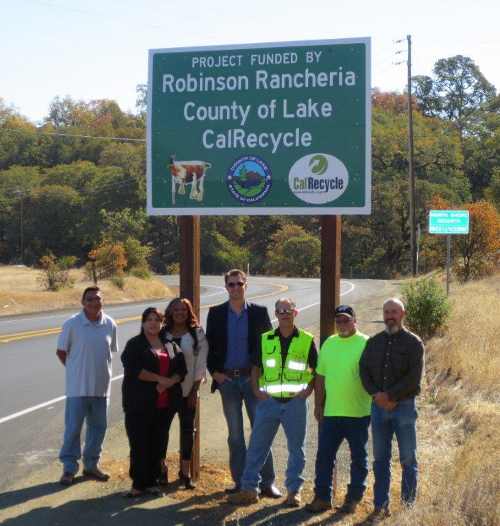
The partnership between the county and the tribes was launched by the Pomo Indians of Robinson Rancheria, who approached county director of public works Scott De Leon with an offer of funding.
“They came to us and said, 'We've got some funds and we'd like to partner with you on a project,'” said De Leon. “It was gaming litigation money – money they pay the state. There is a commission that reviews application money and we got a notice that the commission is accepting applications and nominations for projects.”
The county, said De Leon, has received tribal funding that has gone into impacts on roads in the Konocti Vista area “which we've used on a couple of projects.”
Robinson Rancheria, meanwhile, has used funding from the federal economic stimulus package signed into law on Feb. 17, 2009, for a project to improve the county-owned Nice-Lucerne Cutoff.
“We had a little bit of extra road money left over from a high-priority project funded at the Rancheria roads this past summer,” said Anthony Duncan, the GIS/GPS (map) specialist for the band of Pomo Indians at Robinson Rancheria.
“The project that we did was a 10th of a mile on the east side of Rodman Slough,” he said. “We are still in touch with county transit (regarding) other routes that are reconstructed or constructed specifically all around the rancheria,” Duncan added. “In actuality, we are trying to turn over some of the county routes that they are having trouble maintaining. If ownership cannot be turned over we still want to help in rehabbing or reconstructing these roads.”
Brown pointed out that gaming funds are not provided “for all the roads, just to the roads that are impacted by gambling,” in other words, roads that lead to a casino.
“But there are a couple of projects that they have done that contribute money to roads, as well as to the sheriff's department and the DA (district attorney) that is a huge benefit to us,” he said.
Both Brown and De Leon are certain the tribes' contribution will be a part of the aforementioned new paradigm for maintaining and upgrading the county's roads.
“We have been neighbors,” Duncan reasoned. “Not just locally, but on county and state routes. There will be tribal help for roads that go to the grocery stores, the hospitals, and the schools.
“Everybody is strapped for money so we're going to have to pull our resources together . . . and we're not the only ones doing it,” Duncan added. “I'm sure counties and tribes working together is done all across the country.”
“We're able to do a lot more work by partnering with the tribes,” said De Leon.
“I'm hopeful that the projects we just completed on the Nice-Lucerne Cutoff and on Soda Bay Road with two different tribes will show that we can work collaboratively to get things done,” he said.
“I don't think it's a secret that historically there has been a mistrust between tribes and government,” De Leon added. “It's a very deep-seated mistrust and I'd like to think that the projects that we're working on is a good start to working together.”
Email John Lindblom at
- Details




