
 How to resolve AdBlock issue?
 Supervisors approve first reading of ordinance to establish pass-through fee for cable access TV station
LAKEPORT, Calif. – On Tuesday the Board of Supervisors gave initial approval to a pass-through fee on Mediacom customers to support the county cable access station, although questions remain about whether the fee will become permanent due to a change in state law that goes into effect this fall.
The pass-through fee for TV8, the Public, Education and Government (PEG) station housed in Clearlake City Hall, will amount to an estimated 1 percent on the bills of Mediacom customers.
The fee is estimated to bring in between $51,000 and $55,000 annually to the volunteer-run station.
Shawn Swatosh, Mediacom’s senior operations manager for Northern California, reported to the board that 12 percent of customers will see a 35 cent monthly increase on their bills, while 88 percent will see from 74 cents to $1 or more, depending on their video services.
In 2011 the Board of Supervisors had indicated it would support the fee if the cities of Clearlake and Lakeport did. That same year Clearlake approved the fee, with Lakeport following suit in July 2012.
The supervisors have delayed a decision since last year, concerned about whether the pass-through fee actually constitutes a tax.
Proposition 26, passed in 2010, requires that new taxes be placed on a ballot and receive a two-thirds vote of approval in order to be implemented.
County Counsel Anita Grant has been researching the matter. She told Lake County News this week that the matter is still up for interpretation.
“The law’s undecided,” she said.
She told the board that the California League of Cities said such franchise fees can be put in place without going to the ballot, but there are cautions that the matter ultimately must be decided by the courts.
PEG Board Chair Denise Loustalot and Vice Chair Ed Robey asked the supervisors to support the pass-through, citing the need for a reliable source of revenue for the station.
Clearlake City Manager Joan Phillipe also encouraged the board to take the proactive view and see the pass-through as a franchise fee, not a tax.
Swatosh cited a letter Mediacom’s legal counsel sent the board last year which concluded that the pass-through was a special tax and needed to go to the voters.
“They should be the ones to decide,” Swatosh said of voters.
Supervisor Denise Rushing said she wasn’t surprised to hear that Mediacom wasn’t in favor of additional fees. She said the cable industry has been lobbying for decades for decreased franchise fees and less local control.
She asked how the gap would be filled if the county did not have the PEG station.
Swatosh , who at one time had been on the PEG Board, said he had hoped the station would do significant fundraising and appoint a manager to oversee that effort.
If the customers want the channel, they should have the opportunity to vote, said Swatosh. “That’s our position.”
Supervisors Rob Brown and Jim Comstock both held that the fee was a tax, and that Mediacom subscribers should be able to choose.
Brown said it’s a matter of spending someone else’s money, and among the many calls he’s received about the proposal from Mediacom users, none have supported it.
Comstock said the station should seek local sponsors.
“The legal issues are going to be decided by the courts,” Comstock said. “All taxes aren’t fees but all fees end up being taxes.”
Board Chair Jeff Smith, who previously served on the PEG Board, said the channel has tried a lot of things, including sponsorships, to raise funds, but they haven’t worked.
The pass-through would make a difference for the station, he said. “It has so much opportunity.”
“You don’t know what you’ve got until it’s gone,” said Rushing, suggesting there would be significant community reaction if the station disappeared.
She said she has been concerned about the station’s leadership but believed there has been a positive shift. Rushing said there is a source of ongoing funding available – referring to the pass-through – but that the mechanism probably won’t last long, as the industry has a history of lobbying against local control.
Supervisor Anthony Farrington said he felt the channel has been underutilized when getting out important information to the community, and wanted assurances that the station would work with the county on communicating about issues like invasive mussels. He said he sees a lot of repetitive, slanted content, and wanted to see more diversity.
“We want to do exactly what you’re saying,” said Robey.
Robey suggested the station could get college students to produce shows. He also noted that a seat on the PEG Board is being held open for a representative from the city of Lakeport. “We want to get the whole community involved.”
The board eventually approved the first reading of the pass-through ordinance 3-2, with Brown and Comstock voting no. The second reading is scheduled for April 23.
However, there is still one matter to be settled.
During the Tuesday discussion Farrington asked if the board would be able to rescind the ordinance at some point in the future if it wasn’t pleased with the results.
Grant told Lake County News that she will be researching the answer to Farrington’s question.
It’s a concern because this November, based on changes in state law, the state will take over all such franchises.
Grant said the law appears to indicate that when the state takes over, all local franchise agreements and their terms may remain in place at the discretion of the state, and local governing bodies would not be able to make any changes.
That could mean that the supervisors would not be able to withdraw support for the pass-through if the station failed to show significant improvement.
Grant said she hopes to have clarification on that issue for the board by the April 23 meeting.
Email Elizabeth Larson at
- Details
- Written by: Elizabeth Larson
Final approval of Clearlake taxi ordinance pending; business continues to raise objections
CLEARLAKE, Calif. – At its Thursday meeting the Clearlake City Council will consider final approval of a new ordinance to regulate taxis and other for-hire vehicles in the city, a move the city manager said is needed but which has met with continued objections from a city taxi operator.
The council will meet beginning at 6 p.m. Thursday, April 11, in the council chambers at Clearlake City Hall, 14050 Olympic Drive.
The 16-page document sets out new guidelines and conditions for how taxis and for-hire vehicles can operate in the city, with new requirements for insurance, permits, garaging and drug testing, and an allowance for the council to set maximum rates by resolution.
While City Manager Joan Phillipe said the document is needed to update an outdated and and rarely followed existing ordinance, one of the city’s three taxi companies has continued to object to its provisions, calling them burdensome and unnecessary.
“This is not just an ordinance, this is what’s called a regulatory structure,” Clearlake Cab driver Dante DeAmicis told the council at its March 28 meeting.
According to Joan Phillipe, getting a final draft of the ordinance completed and before the council has been an ongoing effort.
By the time the latest proposed draft appeared before the council at its March 28 meeting, at which time it was approved on its first reading, it was the sixth time that the ordinance had come before them in one shape or form, Phillipe said.
Phillipe told Lake County News this week that the city has a taxi cab ordinance that has been in effect since 1983.
In addition to that ordinance largely not being followed, “It it so dated that there are things in there that don’t make sense anymore,” she said.
A new taxi provider had approached the city about a business license, and at that point Phillipe said she and city staff began to review what already was on the books, which they determined needed updating.
Last year city staff had brought forward a different version of the ordinance that was the result of work by city staff in 2009 and 2010 – prior to Phillipe’s 2011 arrival – and was based on another small city’s ordinance, Phillipe said.
Clearlake’s attorney reviewed that earlier draft ordinance, determined it was out of date and then did the work to update it, Phillipe reported.
So far, the city has gotten significant pushback on its drafts from Clearlake Cab, with DeAmicis submitting several documents outlining his concerns to the city on the previous drafts and the most current one up for final approval.
Among the chief items of dispute is insurance requirements of $250,000 per person for bodily injury and $1 million per incident occurrence, with combined single limits of $1 million per occurrence.
Margie Huit, owner and operator of Clearlake Cab, told the council last month that the new insurance requirement is excessive, considering her small business’ already narrow profit margin.
Huit, who holds two jobs outside of her cab business, said Clearlake Cab made only $32,500 in 2012.
Currently, Huit’s insurance costs her about $7,500 annually, an expense that she said would rise to about $13,000 annually under the new regulations.
New permitting for drivers and vehicles would cost her another $700 annually. She added that doesn’t cover the cost for driver drug testing, which – along with fingerprinting – is a provision for issuing driver permits.
Huit also questioned if her company – one of three operating in Clearlake – would have to build a garage or pay to garage its vehicles, based on the ordinance’s language.
At the March 28 meeting, several city residents supported Huit’s point of view.
“This is a classic case of bureaucratic nonsense,” said city resident Pete Gascoigne, who urged the council not to pass the ordinance.
Another city resident, Estelle Creel, suggested that the increased requirements and costs ultimately could hurt the city’s seniors, who use the taxi services.
While the $1 million insurance requirement sounded high, council members said other businesses have similar requirements.
Councilmember Joyce Overton suggested that umbrella coverage could be more affordable for Huit.
DeAmicis’ criticisms of the document – and the process to create it – have continued. He’s alleged that Huit did not receive emails the city sent out about the ordinance’s development or an invitation to a Feb. 5 meeting for officials to meet with taxi companies. City officials said no one appeared at that meeting.
He’s asked city officials to change the language that would bar permitting drivers who have had previous felony convictions, suggesting instead a felony exclusion period of 10 years with a spotless record, and said that in reviewing a driver’s record it should be based on “points” or at fault collisions.
He also believes the ordinance will result in higher fares and impacts – including long waiting times – for seniors and the businesses and organizations that serve them, as taxis have to pass on the “artificially mandated overhead” by raising fares for customers.
Another objection he’s raised is that the city, in its new ordinance, is treating taxi companies like vendors, even though they are under no government contract and don’t receive any material benefit from the city.
DeAmicis has dismissed the document as a “recycled boilerplate,” a criticism that Phillipe responded to by pointing out that it’s based on language that has been reviewed and meets legal requirements.
She said the $1 million insurance requirement is “pretty standard,” pointing to Public Agency Risk Sharing Authority of California guidelines.
Phillipe said she knows Clearlake Cab is quite concerned, but said other cab companies in the city have not shown up to discussions about the matter.
“They have not said to us that they were not intending to comply,” she said of the other taxi companies.
For comparison, across the lake in Lakeport, City Manager Margaret Silveira told Lake County News that Lakeport does not have a taxi cab ordinance currently; there had been one that was repealed in 1993.
However, although they don’t have an ordinance now, “We’ve been talking about revisiting that,” she said.
She hasn’t reviewed Clearlake’s ordinance, but added, “It’s important to have some type of ordinance for taxi cabs,” with safety being one of the concerns.
As such, the Lakeport City Council may soon be looking at its own taxi ordinance, she said.
“We would like to bring this issue to the council at some time in the near future,” Silveira said.
Email Elizabeth Larson at
041113 Clearlake City Council - Second Reading Taxi Ordinance by LakeCoNews
- Details
- Written by: Elizabeth Larson
Lakeport receives federal grant and low interest loan for water, sewer system projects
LAKEPORT, Calif. – The city of Lakeport has received approval for $3.9 million in federal funding to make needed upgrades to its water and sewer systems.
The United States Department of Agriculture’s Office of Rural Development has approved the funds which include $3,182,000 to be repaid over 40 years at a low interest rate of 1.875 percent and a $750,000 grant, according to Congressman Mike Thompson’s office.
“This money will create jobs and save tax payer money by improving Lakeport’s water infrastructure,” said Thompson. “These are the kinds of smart investments we need to make to get our economy back on track and support our rural communities. I am proud to have worked to help get these funds for Lakeport.”
The USDA funds will cover just under half the estimated $8 million price tag for all of the water and sewer projects the city must complete in order to comply with state regulatory requirements.
The projects include the installation of approximately 2,300 new water meters; a new supervisory control and data acquisition control system; the purchase of the Green Ranch, where two of the city’s drinking water wells are located; sewer pond desludging; recoating water tanks; upsizing of an undersized Main Street sewer line between Clearlake Avenue and Sixth Street; a new water main loop; replacement of the Clear Lake Avenue Sewer Lift Station; and replacement of the sewer main conduit under Highway 29 between Parallel Drive and Bevins Street.
City Manager Margaret Silveira said the city is waiting for the USDA to release the funding.
She said there is still engineering to be completed on the projects – some preliminary work was done for the federal application – so it will be at least a few months before the projects can start.
Silveira said the city expects some of the water and sewer projects will be conducted jointly, as it’s less expensive that way. “They kind of have to go hand in hand,” she said.
The grant and loan from the USDA will be combined with new revenue through rate increases to complete the projects, according to the city.
Last October, the Lakeport City Council voted to double city water and sewer rates over the next five years due to the need that the city said existed to address the condition of the water and sewer facilities.
City officials said the water enterprise funds couldn’t meet bond obligations and the city’s water and sewer systems were running in the red, as Lake County News has reported.
At the time, city Utilities Director Mark Brannigan had said that if the federal funding was approved it could help reduce customers’ bills by several dollars a month.
Email Elizabeth Larson at
- Details
- Written by: Elizabeth Larson
Additional county funds approved for addressing Lakeside Heights landslide
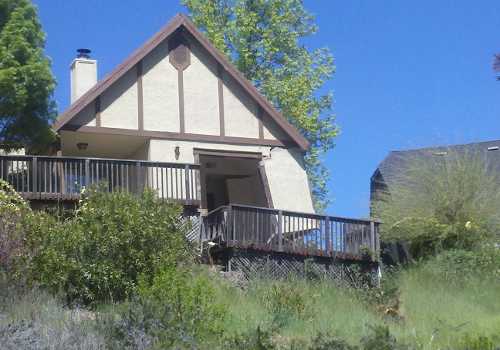
LAKEPORT, Calif. – Several red-tagged homes and continued hillside movement at a north Lakeport subdivision remain a focus of concern for county officials, with the Board of Supervisors approving additional expenditures to deal with what was termed a “catastrophic event” at the board’s Tuesday meeting.
The 29-home Lakeside Heights subdivision continues to show earth movement in areas along Lancaster Road, which runs around the edge of the hilltop cluster of mostly Tudor-style homes.
Last month, the subdivision began to show signs of a saturated, slipping hillside, which in turn damaged several homes.
While a leak report completed last week suggests that the source of the water in the saturated hillside could be coming from a homeowners association-owned 2-inch irrigation pipe, Special Districts Administrator Mark Dellinger told Lake County News on Tuesday, “We don’t know absolutely the source of the ground water that is influencing the landslide.”
Study of the site is continuing. The goal now, said Dellinger, is to remove the water in an effort to slow or stop the earth movement.
In order to do that, Special Districts – at the suggestion of its geotechnical firm – plans to have five horizontal bores drilled on the slope above Downing Drive, “And to get that done as soon as possible with the goal of dewatering that hillside,” Dellinger said.
The bores could be 50, 75 or 100 feet long, and would include pipes that will run into a nearby drain, he said.
Dellinger said he wasn’t sure of a timeline for completion of the bore drilling, but the goal was to complete the work as quickly as possible.
On Tuesday morning, Dellinger went to the Board of Supervisors to give an update on the situation and to request approval for covering additional costs in addressing the hillside slippage.
As of Tuesday, Dellinger said Special Districts had spent $18,330 on geotechnical work related to Lakeside Heights, out of $25,000 the board had approved late last month.
Altogether he asked for an additional $55,030 to cover the cost for drilling additional borings as well as the horizontal bores to drain the hillside.
While the board gave its unanimous approval, the supervisors also wanted the Lakeside Heights Homeowners Association to be brought into the discussion and for county staff to look at state and federal funding sources.
Board members voiced their concerns about people losing their homes to a landslide – the last thing many would expect, Supervisor Jim Comstock said – as well as safety, financial responsibility and potential construction defect issues at the subdivision, where building began in the early 1980s.
Supervisor Anthony Farrington said the ground saturation – along with the area’s soils and “interesting construction” in terms of the homes’ slab foundations – led to a “perfect storm.”
Referring to a large chunk of concrete and rebar that has popped out of the earth at the landslide area, Farrington wondered if it was placed in those lots to stabilize the hill.
“I know there’s a lot of finger pointing and there should be,” said Farrington. “The residents have a right to be concerned.”
Dellinger said that a monitoring bore drilled into the hillside snapped off at a depth of about 24 feet, and another also showed continued movement in the ground.
He said the geotechnical engineers have identified two slide areas, an older one down the hill from the subdivision under some oak trees, and another slide near 5396 and 5406 Lancaster Road, where two of the five red-tagged homes are located.
Most of the slide problems are on what Dellinger said are the “fill side,” which he said is in the area of Lancaster Road facing Hill Road.
There also is the matter of the red-tagged homes. Dellinger suggested that removing the damaged homes as quickly as possible – and thereby lessening the weight on the hillside – could help with stability.
However, Community Development Director Rick Coel said Tuesday that he’s not prepared to rush into summary abatements for a variety of reasons, including potential cost to the homeowners who already are faced with the hardship of losing the houses.
“It’s much better if they do it,” he said of removing the homes.
Otherwise, the county must hike a contractor at prevailing wage rates, which can significantly increase cost, Coel said.
“At the same time we want to get the weight of those structures off if we can,” he said.
Coel said Special Districts wants to get the hillside dewatered before equipment is brought in, and in the meantime he plans to meet with County Counsel Anita Grant, Dellinger and the geotechnical engineer to pin down a strategy.
He said it hasn’t yet been determined which of the structures are salvageable, but pointing to the separating foundations and most badly damaged of the homes, Coel said, “Those structures need to be demolished.”
Email Elizabeth Larson at
Lakeside Heights Sewer and Water Overview
- Details
- Written by: Elizabeth Larson
Supervisors honor five who rescued Lucerne woman from submerged pickup
LAKEPORT, Calif. – Four men and a woman who came to the rescue of a Lucerne resident whose pickup went into Clear Lake last month were honored by the Lake County Board of Supervisors on Tuesday.
Northshore Fire EMT Laura Carr, sheriff’s Lt. Chris Chwialkowski, Deputy Nick La Velle, Frank Haas of Lower Lake and Lucerne resident Doug Arnold received commendations from the board and standing ovations from the gallery at the Tuesday morning meeting.
The group previously came together in unexpected but heroic fashion on the afternoon of Thursday, March 21.
On that day, Ann Adams, 71, was driving westbound on Highway 20 toward Nice and was just west of Lucerne when she lost control of her pickup, which shot off the roadway and went out into Clear Lake, as Lake County News has reported.
Arnold, who had been driving behind Adams, pulled over and swam out in an effort to rescue her from the sinking pickup, but with the windows up he couldn’t get her out, he had told Lake County News at the scene.
He swam back to shore to get help, and that’s when Haas passed by, pulling over and coming back to call 911 and offer help.
La Velle and Chwialkowski, who were in the area, responded to the dispatch of the call, and when they arrived quickly shed their uniforms to swim out to the pickup, with Chwialkowski using a sledgehammer from Haas’ work truck to bust out the pickup’s window.
Carr also swam out, and the group safely brought Adams to shore. She later was flown out to a trauma center.
“Fortunately, events like this don’t happen every day,” however, when they do, it’s nice to know there are people in Lake County like the five rescuers who are willing to take action, said Supervisor Rob Brown, who presented the commendations.
He told La Velle, one of the newest deputies, “You did the right thing. I wouldn’t expect anything less of you.”
As for Chwialkowski, Brown said the March rescue wasn’t the only time the sheriff’s office veteran had saved a life, noting he’s saved many citizens – and even some fellow deputies – in his time.
“He said he’d like to think anyone would have done this,” Brown recalled of a recent conversation with Chwialkowski.
Board Chair Jeff Smith told the group, “Thank you very much for what you all did.”
Email Elizabeth Larson at
- Details
- Written by: Elizabeth Larson




