How to resolve AdBlock issue?
 Lake County Veterans Court team and participants work to change lives
LAKEPORT, Calif. – Life has a series of paths, some easy, some hard. While the easiest route is often the most tempting, sometimes the harder way is the one that leads to a better place.
On Wednesday, attorneys, court officials, probation officers, representatives of the District Attorney’s Office, family members, veterans and a retired judge converged in Lake County Superior Court’s Department 1 for a celebration of people who – for all the right reasons – chose the tougher option for resolving their legal and personal problems.
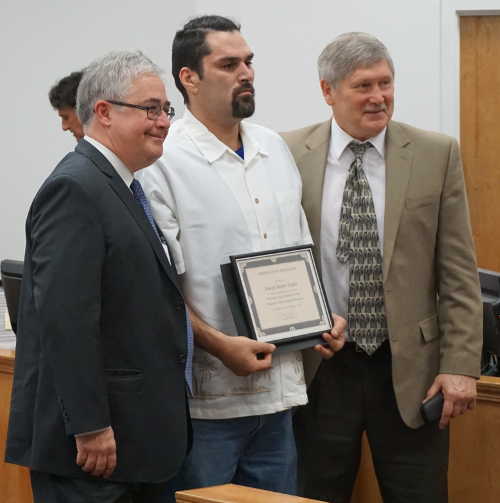
After nearly two years in existence, the Lake County Veterans Court on Wednesday celebrated its first graduate, Joseph Taylor, 43, of Clearlake.
In addition to Taylor, several other veterans were honored that day for their efforts to get their lives back on track through individually tailored treatment – rather than a possible jail sentence – offered by the Lake County Veterans Court.
The attorneys, court officers and other officials who make up the veterans court team expressed pride in Taylor’s achievement while, at the same time, acknowledging that it was anything but assured. Quite the opposite.
“He’s had a tough road,” Chief Deputy District Attorney Richard Hinchcliff, part of the team of local officials guiding the program, told Lake County News. He also was on hand for Taylor’s graduation. “We were all surprised that he actually made it through.”
Hinchcliff said Taylor has been the toughest one yet of the veterans the court has serviced. “If he can make it through vets court, anyone can,” he said.
Taylor agreed that he is challenging. “I’m going to be the most difficult case that they have.”
Today, his outlook is improving, if slowly. He acknowledges that he still struggles. However, he noted, “I have my first sense of stability in my life” thanks to the Lake County Veterans Court.
“He’s an inspiration to the other guys,” said defense attorney Angela Carter, who manages the county’s indigent defense contract and sits on the committee that manages the veterans court. She sat beside Taylor at his graduation and gave him a congratulatory hug.
“Joe is a star,” said retired defense attorney Barry Melton, who also was present for the convening of the veterans court on Wednesday.
Melton, like the others, recognized the challenges Taylor has had, noting that after his military service, “He didn’t come back the same.”
The outcomes in veterans court come through a lot of hard work, gritty resolve and commitment not just from the participants but from the local officials behind the scenes who launched the court and have been keeping it moving forward in the face of potential funding cuts.
When it began in 2015, Lake County Veteran Court had just two veterans. Today the program is serving 10 veterans and has room for up to 40, said Hinchcliff.
The program has had an impact on its participants, he said. They have gotten off of drugs and are able to start having productive lives again. They’re spending more time with their families and, in one man’s case, he’s raising his children rather than being in prison.
Still another man going through the program who was in court on Wednesday recently received a prosthetic leg. “That’s changing his life,” Hinchcliff said.
The Lake County Veterans Court program also recently got more good news: The state has extended its grant funding for another year. The funds had been set to run out at the end of April, but now will continue through the end of April 2018, court officials said.
Launching the Lake County Veterans Court
The U.S. Department of Veterans Affairs reports that there are “significant numbers” of veterans in the criminal justice system, with mental health and substance abuse being among the contributing factors.
Concerns for veterans in the criminal justice system gave rise to the creation of the model of a veterans treatment court in 2008. That year, the Center for Mental Health Service of the US Substance Abuse and Mental Health Services Administration convened a conference with a variety of law enforcement, courts, veterans organizations and federal agencies to provide veterans with mental health treatment and keep them out of the criminal justice system.
Later in 2008, the first veterans treatment court was started in Buffalo, New York. By August 2010, there were 41 veterans treatment courts nationwide, the National Center for PTSD reported.
A May 2016 report on veterans courts from the National Institute of Corrections estimated that as of January of that year there were more than 260 veterans courts nationwide and hundreds more being developed.
According to the California Veterans Legal Task Force, as of July 2016 there were 26 veterans courts across California, including Lake’s.
The veterans court model, as local and state officials explain, is a hybrid court that uses a drug court-type approach to dealing with the many issues veterans in the court system face – including addiction and mental health issues, the latter sometimes the result of post traumatic stress from time in service and combat.
They add counseling, residential treatment, counseling groups, assistance from the Veterans Service Office and Behavioral Health and more to an 18-month program that is more stringent than most court experiences.
For those who participate, it requires the willingness to commit to recovery and personal responsibility, which the people who administer the program say can help them break the kinds of damaging behavioral cycles that get them into the criminal system in the first place.
Lake County has a large per-capita veterans population, estimated by local officials to be as high 12 percent. It is also home to its own VA Clinic, located in Clearlake, an active Veterans Service Office and many veterans groups who play important roles in the community.
As such, a veterans court approach – meant to more thoroughly address their unique needs and stop recidivism – was a direction local officials wanted to pursue.
A few years before the local veterans court’s formation in 2015, the groundwork was starting to be laid, according to Chief Probation Officer Rob Howe, who said he, along with Court Executive Officer Krista LeVier and Judge Richard Martin had attended a two-day conference on collaborative courts, which include veterans courts.
By that time, members of the local justice system already had seen the need for such a court, thanks to Lake County’s large veteran population. “It made sense,” Howe said in a 2015 interview.
LeVier said there had been local-level discussions about the type of collaborative court they wanted to establish, with a veterans court “obviously at the top of the list” due to the higher-than-average veteran population in Lake County and a passion among local officials for serving veterans.
“That’s how we got started,” she told Lake County News in the months after the program first began.
Soon, a funding opportunity arrived. The state’s Budget Act of 2014 appropriated $15 million from the Recidivism Reduction Fund Court Grant Program for a competitive grant program to be developed and administered by the Judicial Council.
That program’s intent, according to state documents, was to “support the administration and operation of trial court programs and practices known to reduce adult offender recidivism and enhance public safety.”
A December 2014 deadline was set for applications. A total of 38 proposals were submitted to the Judicial Council, including one from the Lake County Superior Court for a $439,613 grant in order to start its first veterans court.
In February 2015, the Judicial Council voted to allocate grants under the program totaling $13.6 million to 27 superior courts throughout California.
The Lake County Superior Court was among the courts receiving awards, getting its full request, with the state reporting that the project period was to extend from April 1, 2015, to April 30, 2017.
The grant announcement said Lake County Superior Court received the funding “for the planning and implementation of a veterans treatment court. The target population is local veterans and active-duty service members who are moderate- to high-risk felony offenders. The project prioritizes offenders with substance abuse-related offenses or histories and minor children. Both the total and project numbers to be served are 40.”
With the grant funds received, the Lake County Superior Court and its local partners got to work implementing the program, which Howe said was modeled after one already implemented in Solano County.
LeVier said the work started in the spring of 2015, shortly after the Lake County Superior Court was notified of the grant award.
The first court calendar for veterans court followed in July of that year, with referrals of potential candidates coming from Judge Andrew Blum, who was handling felonies, she said.
Howe would give the Board of Supervisors an update on the program in September 2015.
Today, the committee that runs the program includes Commissioner Doug Thiele, who presides over the cases and succeeded Vincent Lechowick, who was the original commissioner before retiring; court staffer Melissa Perry; a court reporter; Carter; District Attorney’s Office representatives, which include Hinchcliff and Rachel Abelson; Kristine Weigel of the Lake County Probation Office; Veterans Service Officer Saul Sanabria; Will VanSant-Glass, a veterans justice outreach specialist with the San Francisco VA Medical Center who serves Lake, Mendocino and Humboldt counties; and Chris Taliaferro, the Employment Development Department’s Disabled Veterans Outreach Program specialist.
To be eligible, veterans court participants must be veterans or active duty military, with an allegation of service-connected sexual trauma, traumatic brain injury, post-traumatic stress disorder substance abuse, or mental illness, according to its founding documents.
The program is rigorous. It includes an intensive level of supervision that not everyone will agree to follow, Hinchcliff said.
It includes creating a program specific to each individual. There is drug screening, residential and outpatient drug rehabilitation, group meetings such as Alcoholics Anonymous and Narcotics Anonymous, counseling for PTSD, work to get them stable living situations and jobs.
There are other services and methods of support the team offers participants. Perry said she keeps a box of gift cards for various local stores on hand when veterans need assistance with shopping needs. She also has gift cards to the local cinema so vets can take their children to a show.
Additionally, she’s the one in charge of the mementos of achievement such as the certificates and dog tags given to Taylor and his fellow vets on Wednesday.
Originally, the local veterans court was limited to felony offenders only, which concerned Hinchcliff because he believed those committing misdemeanors such as public intoxication or petty theft would be the easiest to help.
He said Perry received permission to let misdemeanor offenders join, although there is limited participation from that group so far. That’s because for many of them, they’re looking at short-term jail sentences of 30 to 60 days. Instead, they would have to agree to the 18-month program. Still, people who want help and want to break their individual cycles will do it, he said.
They do have some misdemeanor participants, although on Wednesday one of them made clear he wasn’t happy with the program, and so was becoming the first participant to be removed from the program and sent back to the regular criminal court system. Hinchcliff said the man didn’t have any incentive to comply with the program’s requirements.
Hinchcliff said the program can take dozens more participants than it currently has. “We have to get people that want to get into vets court and qualify,” he said. “Most people won’t do that.”
Also, he pointed out, “We don’t let just anybody in.”
Carter added that participants have to agree to participate for at least 18 months and have been granted probation in order to be admitted. Beyond that, they have to agree to the terms of treatment, stable housing and more.
“It’s probation on steroids,” she said.
For all of its rigor, it’s working, said Hinchcliff. “It makes us feel good that we’re trying to help some of these people out and it’s succeeding.”
Getting into the program
Taylor was a wrestling and football star at Lower Lake High School. After his 1992 graduation, he entered the United States Army, serving from 1996 in areas including the Persian Gulf Theater, where he experienced combat.
He left the military not long after Priscilla, his wife, high school sweetheart and mother of his two sons, was diagnosed with cancer. She died in November 1999, and he said at that point his life unraveled.
Between the PTSD he lives with from his combat experiences and his wife’s death, “I couldn’t adjust to society.”
Taylor’s life devolved into a series of criminal cases resulting in 24 violent violations, among them attempted murder and assault with a deadly weapon, he said in an interview with Lake County News. He would be in and out of prison between 2003 and 2008. His children would be raised by a local pastor and his wife.
In 2015, he was back in the local jail, when Veterans Service Officer Saul Sanabria visited him and encouraged him to enter the program, which was supposed to solve probation issues and also help him get his service-connected pension.
Veterans court team members were concerned at times that Taylor might not make it through the program. But they stepped up to assist.
Taylor, who admits he doesn’t bond well with other people who haven’t had his type of combat experiences, nevertheless developed respect for team members who kept their word to him. “Honor goes a long way with me.”
Those who earned his praise included VanSant-Glass, “who proved beyond any doubt that it’s more than a job to him.”
He said he also liked getting advice and help from Hinchcliff, although sometimes it veered into tough love.
During one of his court appearances earlier in the program, Taylor began to complain about the program. Hinchcliff gave him a stern dressing down – or, in his less formal description, a chewing out – during that court session.
“It straightened him out,” said Hinchcliff, and Taylor moved forward in a positive direction. “We didn’t cut him any slack.”
One of those getting special praise from Taylor is defense attorney William Conwell, who Taylor said was always there for him and whose support and friendship helped him get through the program.
He’s known Taylor for a long time, Conwell said. “Joe is a special guy.”
Conwell is himself “an informal part of the apparatus” of the veterans court, explaining that sometimes team members call him to ask for him to help out.
At the Wednesday court appearance and afterward, Melton and team members also recognized Conwell for his efforts, which have included driving Taylor to medical appointments in San Francisco.
Conwell is self-effacing about the support he’s offered. “It’s nice being able to help someone through a very bad period of their life,” he said. “I was placed in a position where I could help them.”
To Conwell, there has been a change in Taylor, who is improving, and who made the commitment to complete the program “as a matter of pride.”
A day in Lake County Veterans Court
Carter said veterans court convenes twice monthly. On the days that court convenes, the committee that runs it meets ahead of time to go over cases as part of their effort to individualize treatment.
Cases first come to Carter’s attention, with a list of veterans who are booked into the jail and charges given to her. She then provides that information to the attorneys on the county defense contract so that the veterans court option can be explored.
On Wednesday, seven men – including Taylor – appeared in veterans court. Five of them received praise for their efforts, one man who had been referred said he opted not to participate and the seventh man who complained about the process and was expected to be referred out.
The atmosphere of the proceedings is markedly different from what one might encounter in a regular criminal court.
Commissioner Thiele, in a professional but easygoing manner, discussed each of the cases with the participants, giving encouragement and suggestions.
He urged one man to consider a return to Alcoholics Anonymous meetings, checked on treatment status for another, praised them for keeping appointments, encouraged them in health goals and finding steady, safe housing situations.
For those making progress, he and others remarked on their achievements, and there were frequent rounds of applause.
When Taylor came forward, Thiele recounted his challenges and praised Taylor’s parents for their support. He also invited Taylor back as a returning graduate on June 21.
Taylor even read a statement – more accurately, a poem in verse – to explain his experiences, thanking both the veterans court team and God for getting him to where he was. In turn, the team lauded him for the efforts he had made on his own behalf.
“I’m really proud of you,” said Hinchcliff, shaking Taylor’s hand. “You made it.”
Carter said Taylor has come a long way, and his participation is meaningful for all of the veterans in the program.
Particularly meaningful for Taylor was the appearance of Lechowick, who had vowed that upon retiring he would never return to court unless it was to see Taylor graduate from the program. Lechowick kept his word.
“You took the longer road. You took the harder road,” but ultimately it was the better road, Lechowick told Taylor.
By participating in veterans court, Lechowick said Taylor had broken his personal cycle of being in and out of the criminal justice system, and he encouraged him to return and mentor others.
Lechowick also recognized the team that has kept the veterans court moving forward, as well as Conwell. He added, “I thought this was going to die” due to lack of funding.
Both Conwell and Taylor later recognized Lechowick for making his final return trip to court for the graduation. “Lechowick really did keep an eye out,” Conwell said.
What’s ahead
Taylor’s isn’t a ride-off-into-the-sunset story, at least not yet.
He still has legal issues to resolve, including probation that he said he was led to understand that veterans court would remove and $1,000 fines that he’s trying to work off through community service.
There are his own anger issues to face on a daily basis, a desire toward reclusiveness that he acknowledges isn’t necessarily good for him. He’d prefer to not live in the middle of town, and says he struggles to deal with people.
And there are the very real, everyday demands of paying the bills and just getting by.
He said he’s still waiting to be approved for the service-related pension Veterans Service Office staff indicated he’s eligible to receive, and which so far appears caught up in a bureaucratic tangle.
In the meantime, he’s unable to make ends meet, and says people frequently lend him money that he’s so far been unable to repay. He’d like to find some kind of work, like landscaping.
Still, he’s remaining hopeful.
Team members indicated that the support network created for Taylor and other veterans will continue even once they’re past the veterans court program.
Those who are extending their commitment include Conwell. He said he’ll continue to help Taylor, and expects to work with him on those remaining probation and fine issues that have yet to be resolved.
When considering all of the veterans that have come through the veterans court program, Carter said it’s hard to stop wanting to offer them help and support.
“You get attached to them,” said Carter. “They’re laying it all out there in a big way.”
Email Elizabeth Larson at
- Details
- Written by: Elizabeth Larson
Police: Missing Lakeport man believed to be in Bay Area, Silver Alert issued
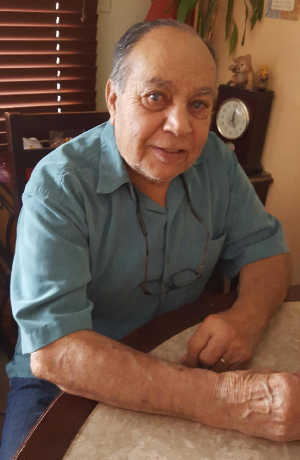
LAKEPORT, Calif. – Police said Friday that an older Lakeport man who went missing on Thursday has been tracked to the Bay Area, and due to concerns for his safety he’s been entered into the Silver Alert System.
On Thursday, Gilbert Navas, 70, left his home at 10:30 a.m. in a Toyota Tacoma pickup to go to Sutter Lakeside Hospital, but didn’t arrive at the hospital, as Lake County News has reported.
On Friday just after 10 a.m., the Lakeport Police developed information that Navas had rented a vehicle at Enterprise Rent-A-Car in San Francisco on Thursday at 6:25 p.m. and checked into a motel in San Jose at 11:50 p.m.
Officers contacted Enterprise Rent-A-Car and Pacific Motor Inn, and through photographs, positively identified Navas as the person who rented the car and checked into the motel. San Jose Police attempted to contact Gilbert at the motel but found he had already left, according to the Lakeport Police report.
Based on information provided by employees at Enterprise Rent-A-Car and Pacific Motor Inn, Navas is looking for his family in the Bay Area and police believe he is disoriented and confused.
Navas is now driving a 2016 four-door Silver Hyundai Sonata with license plate number 7PBU113. His whereabouts on Friday were unknown.
Police said Navas and the vehicle have been entered into the Silver Alert System through the California Highway Patrol.
Anyone with information about Navas’ whereabouts is asked to contact the Lakeport Police Department at 707-263-5491.

- Details
- Written by: Lake County News reports
Police search for missing man
LAKEPORT, Calif. – The Lakeport Police Department is asking for the community’s help in locating a man reported missing after he failed to show up for an appointment on Thursday morning.
Gilbert Navas, 70, was entered into the Missing Persons System, according to a Thursday night report from police.
Navas left the city at 10:30 a.m. Thursday en route to Sutter Lakeside Hospital, but police said he never arrived.
He was last known to be driving a 2002 Silver Toyota Tacoma pickup, with the California license plate number 03481G1.
Navas is described as a Hispanic male adult, 5 feet 7 inches tall, 180 pounds, with hazel eyes, gray hair and balding, and a scar above his left eye. A description of his clothing at the time of his disappearance was not available.
Anyone who sees Navas is asked to call the Lakeport Police Department at 707-263-5491 or the nearest law enforcement agency.
- Details
- Written by: Lake County News reports
Police continue investigation into pepper spray incident at Lakeport store
LAKEPORT, Calif. – Police continue to follow up on leads in an effort to identify the individual responsible for releasing what is believed to have been pepper spray in the Lakeport Safeway on Sunday.
The incident at the store on 11th Street was first reported at about 3:30 p.m., when many customers and employees near the checkstands at the front of the store began to choke and have breathing problems, as Lake County News has reported.
The Lakeport Police Department reported that several people were checked out by firefighters at the scene and one person was transported to the hospital.
On Tuesday, Lakeport Police Chief Brad Rasmussen said his officers were still following up on leads in order to identify the individual responsible.
“We are still seeking any victims or witnesses,” he said.
He said they’ve seen people posting online about being affected by the incident, but they’re not sure that those individuals have called to make a report.
“We still need their information and help if they have not reported in yet,” Rasmussen said.
Anyone with information about the case is asked to contact the Lakeport Police Department by sending a private message on its Facebook page @LakeportPolice, emailing investigating Police Officer Mark Steele at
Email Elizabeth Larson at
- Details
- Written by: Elizabeth Larson
Supervisors approve hiring outside legal counsel for sheriff in correctional officers’ lawsuit
LAKEPORT, Calif. – The Board of Supervisors has reversed a decision it initially made in January and agreed to hire an outside attorney to represent Sheriff Brian Martin in a lawsuit filed against him and the county by the Lake County Correctional Officers’ Association.
At its March 7 meeting, the board voted unanimously to approve an agreement with Ewing and Associates to represent Martin, in an amount not to exceed $30,000.
The association filed suit against Martin and the county in December citing breach of contract, as Lake County New has reported.
In January, the board had denied Martin’s request for outside counsel. Martin asserted that the County Counsel’s Office had a conflict of interest and couldn’t offer him the representation he needed in the case.
At that time, the board asked for an attempt to be made to construct an “ethical wall” in the County Counsel’s Office so Martin could also be represented by that office.
However, Martin told Lake County News that the board later decided to grant his request for outside counsel, which Supervisor Rob Brown separately confirmed.
“There’s issues that are important to the office of the sheriff that are completely separate than the county,” Martin said.
In a statement released to Lake County News, the Lake County Correctional Officers’ Association said that in 2011 it settled a lawsuit and two unfair labor practice charges filed at the Public Employment Relations Board against the county and then-Sheriff Frank Rivero.
The association said in the settlement both sides agreed that correctional officers would continue to be armed while on duty outside of the Lake County Jail. It also required the sheriff to issue concealed weapons permits at no cost to all correctional officers so that they may also be armed off duty if they chose.
The agreement said the county counsel and sheriff signed off on the agreement, which the board ratified, and the association therefore asserted that it’s legally binding.
The lawsuit cited specific breaches of the contract, including one in December 2015 when it said Martin told the association’s representative that his office would not waive California Department of Justice fees or other fees required by outside agencies for correctional officers applying for a concealed weapons permit.
In March 2016, the county of Lake sent an email to all Lake County correctional officers entitled “Directive Effective Immediately” in which it stated that unless they have or are going to have direct contact with inmates for transport or supervision, they cannot carry their duty weapons while at work.
The association said its leaders and its legal team at Mastagni Holstedt, APC demanded last year that Martin follow the agreement after issues arose between the two sides, later filing the suit, which they said is about the inviolability of contracts and the rule of law.
“I think people should honor their agreement,” attorney David Mastagni told Lake County News in a Monday interview.
For his part, Martin said he wasn’t a party to the original settlement, and he believes that several of the settlement’s terms contradict state law.
He said the law says that sheriffs or police chiefs decide who gets concealed weapons, and the agreement with the association affects his discretionary decision making ability. “It seems to me that this is pretty clear.”
Martin added, “All I’ve been doing is following what the law says, not the settlement agreement, because I felt that the settlement agreement is a contradiction from what the law says.”
He’s also concerned about precedent for himself and future sheriffs to exercise their decision making ability as a result of following the agreement.
Mastagni, however, dismissed Martin’s concern about precedent. “An agreement does anything but set a precedent,” he said, adding that precedent comes out of court decisions.
Overall, the suit “hasn’t impacted us at all,” Martin said of his agency’s operations.
With no court date yet set for the case, Martin said he’s already met with attorney Mike Ewing, who will follow up by filing Martin’s formal response to the suit. He said the county already has filed its separate response.
Mastagni said his firm will look forward to getting the sheriff’s response. “We’ve got to know why he thinks he can break a deal.”
As for how the case might proceed, Mastagni said, “I think it’ll go to court but I’m not worried about it.”
Email Elizabeth Larson at
- Details
- Written by: Elizabeth Larson