How to resolve AdBlock issue?
Refresh this page
How to resolve AdBlock issue?
Refresh this page
Lake County News,California
  • Home
    • Registration Form
  • News
    • Community
      • Obituaries
      • Letters
      • Commentary
    • Education
    • Veterans
    • Police Logs
    • Business
    • Recreation
    • Health
    • Religion
    • Legals
    • Arts & Life
    • Regional
  • Calendar
  • Contact us
    • FAQs
    • Phones, E-Mail
    • Subscribe
  • Advertise Here
  • Login

Gov. Newsom signs consumer protection bill cracking down on veteran fraud and abuse, launches tax cut for vets

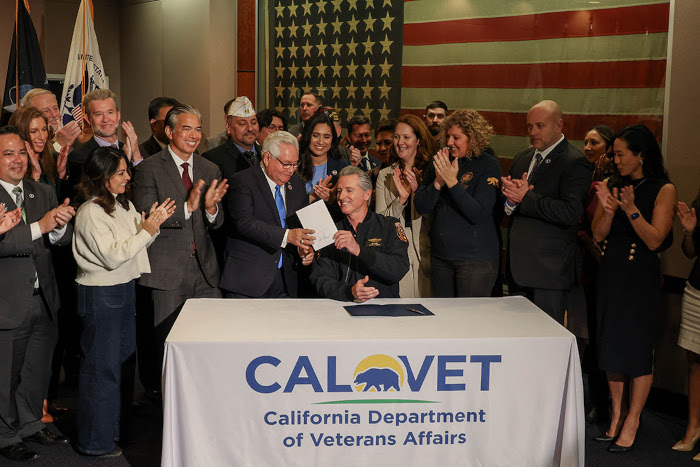
Gov. Gavin Newsom signed consumer protection legislation on Tuesday, Feb. 10, 2026, meant to protect veterans. Photo courtesy of the Governor’s Office.


Gov. Gavin Newsom on Tuesday signed landmark consumer protection legislation to crack down on fraudulent practices targeting veterans and service members navigating the federal benefits system, strengthening California’s nation-leading protections for those who served.

For years, lax federal enforcement allowed predatory claims businesses to flourish nationwide — with unaccredited operators charging illegal and excessive fees while misleading veterans seeking help with U.S. Department of Veterans Affairs benefits. The new law puts a stop to these benefit-stealing scams, establishing clear guardrails, oversight, and enforcement to protect veterans from being exploited.

The legislation builds on California’s comprehensive commitment to veterans — including a new $20,000 state income tax credit, signed into law by Gov. Newsom and taking effect this year — putting real money back in veterans’ pockets while protecting them from fraud.

“We owe our veteran community a debt of gratitude – for their years of service and sacrifice. By signing this bill into law, we are ensuring veterans and service members get to keep more money in their pockets, and not line the coffers of predatory actors. We are closing this federal fraud loophole for good,” said Newsom.

By signing SB 694 by Sen. Bob Archuleta (D-Pico Rivera) into law, California is providing additional protections for veterans by limiting who may charge fees for assistance with benefits claims administered by the federal government and by strengthening consumer protections under California law. 

Key provisions of the bill include:

Requiring federal accreditation before any person may prepare, present, or prosecute a veteran’s claim for benefits.

Prohibiting unauthorized fees, except as expressly allowed under federal law, and expanding the California Consumer Legal Remedies Act to cover veterans’ benefits claims.

Protecting veterans’ privacy and security by prohibiting the sharing of login credentials, access to secure government systems using another person’s credentials, or requiring veterans to provide PINs associated with Common Access Cards.

“It’s been a long road, but Senate Bill 694 will finally provide a framework to protect our veterans from being defrauded when seeking assistance to apply for the benefits they deserve from the VA. I want to thank Senator Archuleta for his hard work on this important issue, and Gov. Newsom for signing SB 694 into law,” said Senator Sabrina Cervantes (D-Riverside).

“I am grateful to Gov. Newsom for his leadership in fighting for one of the most vulnerable populations in our state,” said Sen. Archuleta. “With SB 694 California emboldens its promise to stand up for veterans ensuring they aren’t exploited for profit by predatory companies. This new law builds on the principle that veterans should not be charged, much less gouged, when seeking assistance for applying to their disability benefits which they rightfully earned in the service of their country,” said Senator Bob Archuleta (D-Pico Rivera).

“As chair of the Assembly Military and Veterans Affairs Committee and the daughter of a disabled veteran, alongside so many, we fought to protect disabled veterans from illegal fees charged by predatory claims sharks. Veterans who earned their disability benefits through service and great sacrifice deserve every penny, and with the governor’s signature of SB 694, we are making it clear that California will always protect our veterans and hold these predatory corporations accountable,” said Assemblymember Pilar Schiavo (D-Santa Clarita).

California has one of the strongest veteran support networks in the nation, including County Veteran Service Officers (CVSOs) who provide free, federally accredited assistance to veterans statewide. In 2024-2025, they filed 316,000 claims, securing an estimated $687 million in new or increased federal benefits for California veterans and their dependents.  In that same year, CVSOs served nearly 1 million veterans and family members throughout the state in person, by phone, and email.

However, the absence of federal penalties have allowed predatory actors to target veterans across the country.

“Today, I am proud to stand with a coalition of veterans organizations in celebration of the signing of SB 694, legislation that continues our commitment to vigorously protect those who have sacrificed so much to protect us," said Attorney General Rob Bonta. “Claim sharks pose a financial risk to veterans who need help with their benefits claims. SB 694 will degrade and deter the ability of these predatory individuals or companies to exploit veterans seeking help accessing their benefits. I thank Senators Archuleta and Cervantes, and Assemblywoman Schiavo, for authoring this legislation and Gov. Newsom for signing it into law and making it clear: If you want to charge veterans for help with their benefits claims, you must be accredited by the VA."

“SB 694 is a major victory for California’s veterans and their families. For too long, bad actors have preyed on veterans seeking the benefits they earned, exploiting trust through false promises, illegal fees, and deceptive practices,” said the California Department of Veterans Affairs Secretary Lindsey Sin. “This law puts a stop to claims sharks and strengthens protections that ensure veterans can access help safely and with dignity. We’re grateful to Gov. Newsom for standing firmly with California’s veterans, and to the coalition of legislators, the County Veteran Service Officers and Veteran Services Organizations who led this effort.”

“As a Navy veteran, I know firsthand how complex navigating benefits can be—and how devastating it is when bad actors exploit those who served. This law sends a clear message: California will not tolerate fraud against veterans. Combined with the new $20,000 tax credit, we’re putting real protections and real dollars back into the hands of those who sacrificed for our country,” said Josh Fryday, GO-Serve Director and California Chief Service Officer.

Quality of life for military families

There are about 160,000 active-duty service members and nearly 1.5 million veterans who call California home. Through legislative action, budget investments and key partnerships, California continues to stand up for our esteemed military members and veterans.

Veterans tax benefit

As armed services personnel and families file for taxes this year, Gov. Newsom included a new state income tax break for military retirees and their surviving spouses. For the first time, veterans receiving military retirement pay and families receiving payments from the federal Survivor Benefit Plan will be able to exclude up to $20,000 of their income each year from state income taxes. This tax cut helps retain retired service members in the state, while strengthening California’s workforce and local economies.

Helping military-connected students

In 2025, Gov. Newsom also signed AB 88 and SB 67, which extend eligibility for the Cal Grant and Middle Class Scholarship Program to dependents of a member of the United States Armed Forces who maintains California as their state of legal residence. In addition, to reduce the burden on military-connected pupils and their families, the state is publicly recognizing and designating specific public schools as California Purple Star schools.

Giving back to our veterans

Through the California Department of Veterans Affairs (CalVet), the state provides resources and support to veterans and their families through state and federal benefits they have earned through their selfless military service. 

Connecting veterans with services: The California Transition Assistance Program (CalTAP) informs separating service members and veterans about their earned benefits and connects them with local service providers. Since 2017, CalTAP has served over 12,000 service members and veterans across all major military installations and college campuses in California.

Tuition fees waived: The CalVet College Tuition Fee Waiver Program waives tuition fees at California public colleges and universities for children and spouses of qualified veterans, including those who are disabled, deceased, or 100% service-disabled. This covers attendance at California State University, University of California, and California Community Colleges. Gov. Newsom previously signed AB 1745 to expand eligibility by raising income caps for veteran dependents.

Providing home ownership: For more than a century, the Home Loans program has assisted nearly 450,000 veterans achieve the dream of home ownership, with one of the lowest foreclosure rates in the nation and at no cost to taxpayers.

Child care access: The Department of Social Services worked with the Department of Defense to implement the Military Child Care in Your Neighborhood Plus program, expanding access to civilian childcare for military families.

Veteran designation: Eligible veterans can add the word “VETERAN” to the front of their driver’s license or ID card to signify their military service. This designation provides easier access to veteran benefits and privileges without the need to carry a Certificate of Release or Discharge from Active Duty.

Pathway to citizenship: CalVet has helped more than 800 veterans and their families take an important next step after active duty – becoming naturalized citizens. 

California’s Veterans Homes: There are eight veterans homes throughout seven counties statewide, which deliver top-rated care to more than 1,500 veterans through long-term residential and medical care for eligible veterans, their spouses and partners

Helping homeless veterans and improving mental health

Finding affordable homes can be extremely difficult for veterans, especially if they have experienced post-traumatic stress disorder, have suffered from a traumatic brain injury, or live with mental-health issues. Remaining stably housed can be even more difficult, especially without mental health support.

Prop 1, which was championed by Gov. Newsom and approved by voters in 2023, is supporting veterans and transforming California’s mental health systems with a $6.4 billion Behavioral Health Bond for housing, services, and treatment for veterans and people experiencing homelessness.

More than $2.1 billion of this funding is available for local Homekey+ projects. Homekey+ provides funding for local communities to build residential care settings and expand access to behavioral health treatment, with approximately 50% of the funding set aside for projects serving veterans.

In addition, through the California Veterans Health Initiative Mental Health Support Grant Program, $38 million in grant funding has helped families access free mental health care in urban and rural areas.

The Veterans Housing and Homelessness Prevention program helps develop new affordable housing specific for veterans and their families who are experiencing homelessness or have extremely low income. CalVet so far has awarded $580.5 million in permanent loan financing to 99 multifamily affordable, permanent, supportive housing projects through eight competitive rounds of funding. 

As of October 2025, 75 projects have completed construction, with 5,190 units occupied or in the process of leasing. Once all awarded projects are built, California will have added 6,561 units of affordable, permanent supportive housing.

These strategies are working. In 2024, California achieved the nation’s largest reduction in veteran homelessness. In addition, California is outperforming the nation in reducing homelessness, with a 9% reduction in unsheltered homelessness in 2025.

Economic development and workforce initiatives

California is home to more than 30 federal military installations, with the U.S. Department of Defense directly employing more than 236,000 people in California.
California Jobs First: Designated space, defense, and satellite industries as top statewide economic priorities.

Military training: Created workforce pathways to translate military training into academic and professional credentials.

Economic success: Produced the California Military Economic Impact Study, delivering a data-driven assessment of the state’s defense economy and its $66 billion annual contribution. The report continues to inform statewide workforce, infrastructure, and investment strategies.

Details
Written by: Lake County News Reports
Published: 11 February 2026

CHP’s Clear Lake Area office welcomes new officer

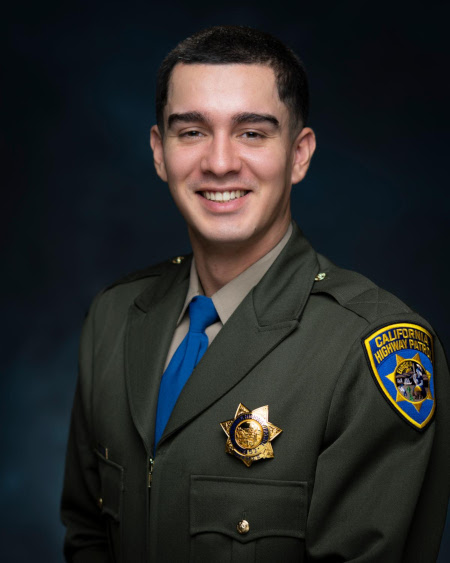
California Highway Patrol Officer Dante Ramirez has joined the agency’s Clear Lake Area office in Kelseyville, California. Photo courtesy of the CHP.


LAKE COUNTY, Calif. – The California Highway Patrol’s Clear Lake Area office is welcoming its newest officer.

Dante Ramirez of Crescent City has successfully completed cadet training at the California Highway Patrol Academy.

He is assigned to duty at the CHP's Clear Lake Area office, located in Kelseyville.

Officer Ramirez graduated from Del Norte High School in 2020. 

Before attending the CHP Academy, he worked as an apprentice carpenter at Fern Hook Cabins. 

He is proud of himself and his roommates for overcoming the academy's challenges.

At the CHP Academy, cadet training starts with nobility in policing, leadership, professionalism, ethics, and cultural diversity. Training also includes mental illness response and crisis intervention techniques. 

Cadet instruction covers patrol operations, crash investigation, first aid, and the arrest of suspected violators, including those who drive under the influence of alcohol or drugs. 

During their six months of training, the cadets also receive training in traffic control, report writing, recovery of stolen vehicles, assisting the motoring public, issuing citations, emergency scene management, and knowledge of various codes, including the Vehicle Code, Penal Code and Health and Safety Code.

Ramirez was one of 129 new officers who graduated from the Academy on Friday.

“These new officers represent the future of public safety in California. The badge they were given is on loan from the people of this state, and every day they must earn the right to wear it through professionalism, ethical conduct and accountability to the public they serve,” said CHP Commissioner Sean Duryee.

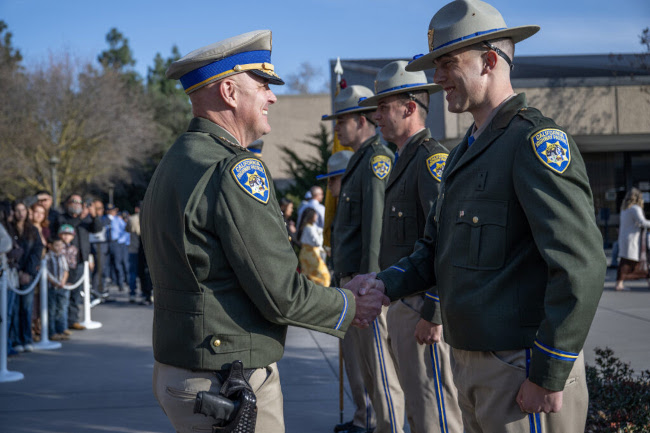
CHP Commissioner Sean Duryee, at left, speaks to a newly graduated officer on Friday, Feb. 6, 2026. Photo courtesy of the CHP.
Details
Written by: Lake County News Reports
Published: 07 February 2026

Tribes cite ongoing federal review and judicial warnings in opposing Scotts Valley ‘preview casino’ in Vallejo


NORTHERN CALIFORNIA — The Yocha Dehe Wintun Nation, the Kletsel Dehe Wintun Nation, the Lytton Rancheria of California, and the United Auburn Indian Community this week expressed serious concern as the Scotts Valley Band of Pomo Indians moves toward opening a temporary “preview casino” in Vallejo, while the U.S. Department of the Interior continues an active reconsideration of the project’s gaming eligibility.

The group said that any move to proceed at this time would come despite a clear warning from the federal court overseeing the matter that Scotts Valley would be “ill-served” by relying on the temporary restoration of gaming eligibility while the Department completes its reconsideration, which the court has directed be conducted expeditiously and thoroughly.

“The court was explicit that its ruling should not be viewed as a green light to proceed with gaming activity while the federal review is ongoing,” said Anthony Roberts, chairman of the Yocha Dehe Wintun Nation. “Moving forward with this short-term cash grab ignores the Court’s warning, disrespects the reconsideration process, and jeopardizes the City of Vallejo’s limited public safety and other resources for its citizens.”

Lake County News reached out to a representative for Scotts Valley but so far has not received a response.

The tribes emphasized that the issue is not competition, but respect for the rule of law, tribal sovereignty, and the integrity of the federal review process, particularly where significant questions remain about gaming eligibility, historical connection to the land, and potential environmental and cultural impacts.

“Our concern here is specific and process-based,” said Chairman Wright of the Kletsel Dehe Wintun Nation. “Where the Department of the Interior is actively reconsidering gaming eligibility, and the court has cautioned against reliance on interim decisions, moving forward with gaming activity at this site before that review is complete risks undermining trust in the process and creating avoidable conflict among tribes and local communities.” 

“This is not about opposing economic development,” said Chairperson Andy Mejia of the Lytton Rancheria of California. “It is about ensuring that development occurs lawfully, responsibly, and in a manner that honors tribal history and federal law. Proceeding with a casino, even a so-called ‘preview’ facility, while the Department of the Interior is actively reconsidering its own decision risks undermining the integrity of the federal review process.”

The tribes noted that the Department of the Interior has explicitly acknowledged that its earlier approval may have been based on legal error. They further noted that substantial evidence submitted by local tribes was not considered, raising serious questions about whether the Vallejo site qualifies for gaming under the Indian Gaming Regulatory Act.

“Rushing forward in the face of unresolved legal questions does not create certainty or shared prosperity,” said Chairman John Williams of the United Auburn Indian Community. “It puts Vallejo, the Tribe, and neighboring communities in an untenable position if the Department ultimately determines that the land is not eligible for gaming.”

The tribes reiterated their call for the Scotts Valley Band to pause any gaming operations until the federal reconsideration is complete and a final, lawful determination is issued.

“We respect the sovereignty of all Tribes,” the joint statement concluded. “That respect includes honoring the courts, the federal process, and the rights of neighboring tribes whose ancestral, cultural, and historical ties to this land are at stake.”

Details
Written by: Lake County News Reports
Published: 07 February 2026

What Olympic athletes see that viewers don’t: Machine-made snow makes ski racing faster and riskier – and it’s everywhere

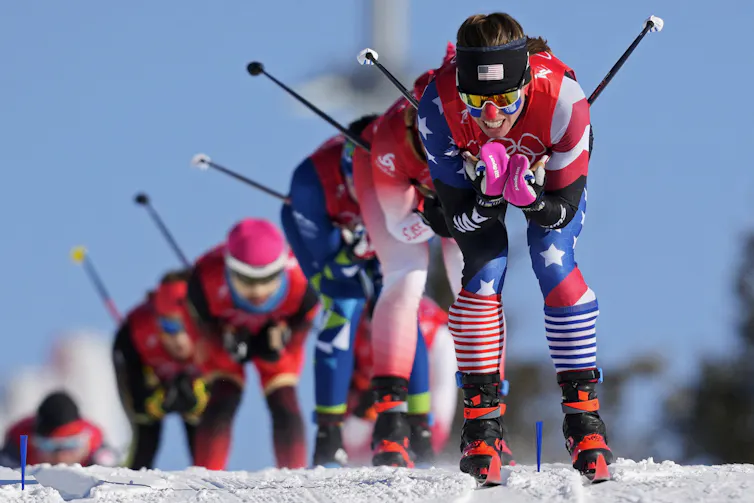
U.S. skier Rosie Brennan leads a group during the women’s team sprint classic cross-country skiing competition at the 2022 Winter Olympics. AP Photo/Aaron Favila

When viewers tune in to the 2026 Winter Olympics, they will see pristine, white slopes, groomed tracks and athletes racing over snow-covered landscapes, thanks in part to a storm that blanketed the mountain venues of the Italian Alps with fresh powder just in time.

But at lower elevations, where cross-country and other events are held, athletes and organizers have been contending with rain; thin, sometimes slushy snow; and icy, machine-made surfaces.

“Most of our races are on machine-made snow,” 2026 U.S. Olympic team cross-country skier Rosie Brennan told us ahead of the Games. “TV production is great at making it look like we are in wintry, snowy places, but this year has been particularly bad.”

A male skier races down a slick track with flags flying along the wall beside him
Machine-made snow increasingly makes the Winter Games possible. It’s also slicker to race and harder to fall on. Here, Olympic skier Ben Ogden of the U.S. competes during the sprint of the FIS Cross-Country World Cup Tour de Ski in Toblach, Italy, on Dec. 28, 2024. Federica Vanzetta/NordicFocus/Getty Images

As scientists who study mountain snow, water resources and the human impact of warming winters, we see winter’s changes through data: rising temperatures, shrinking snowpack, shorter snow seasons.

Olympic athletes experience changing winter conditions personally, in ways the public and scientists rarely do. Lack of snowfall and more frequent rain affect when and where they can train, how they train and how dangerous the terrain can become.

We talked with Brennan and cross-country skiers Ben Ogden and Jack Young as they were preparing for the 2026 Winter Games. Their experiences reflect what many athletes describe: a sport increasingly defined not by the variability of natural winter but by the reliability of industrialized snowmaking.

What the cameras don’t show

Snowmaking technology makes it possible to create halfpipes for freestyle snowboarding and skiing competitions. It also allows for races when natural snow is scarce – the 2022 Winter Olympics in Beijing relied entirely on machine-made snow for many races.

However, machine-made snow creates a very different surface than natural snow, changing the race.
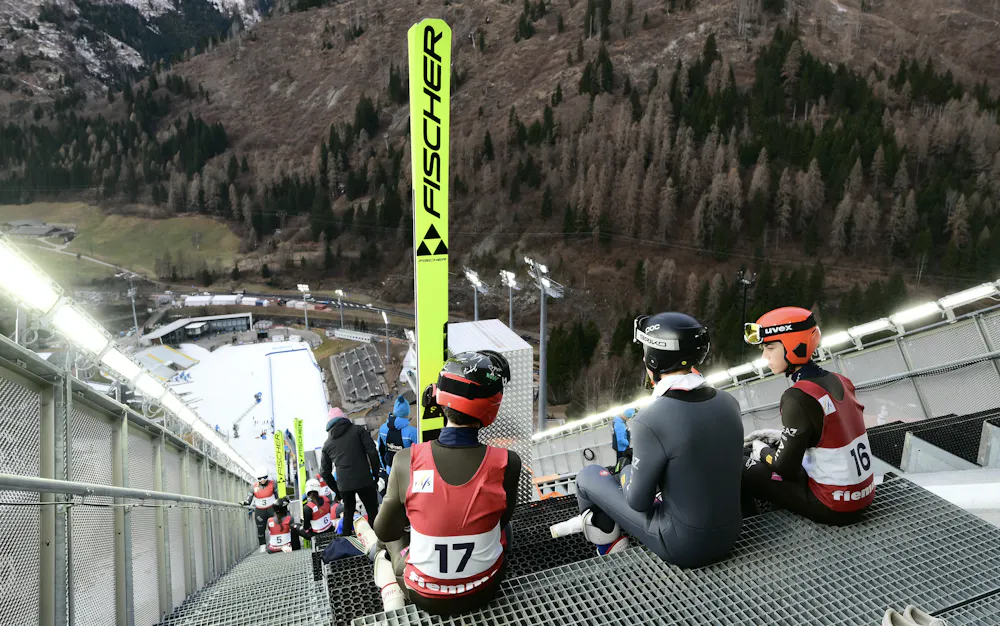
Three skiers sit at the top of a ski jump. Their view shows how much dry, snow-free ground is around the jump area
Athletes train at the ski jumping arena prior to the Open Italian Championship in Predazzo, a 2026 Winter Olympics venue, on Dec. 23, 2025. Stefano Rellandini/AFP via Getty Images

In clouds, each unique snowflake shape is determined by the temperature and humidity. Once formed, the iconic star shape begins to slowly erode as its crystals become rounded spheres. In this way, natural snow provides a variety of textures and depths: soft powder after a storm, firm or brittle snow in cold weather, and slushy, wet snow during rain or melt events.

Machine-made snow varies less in texture or quality. It begins and ends its life as an ice pellet surrounded by a thin film of liquid water. That makes it slower to change, easier to shape, and, once frozen, it hardens in place.

‘They’re faster, icier and carry more risk’

When artificial snow is being made, the sound is piercing – a high-pitched hiss roars from the pressurized nozzles of snow guns. These guns spew water mixed with compressed air, and it freezes upon contact with the cold air outside, creating small, dense ice particles. The drops sting exposed skin, as one of us, Agnes Macy, knows well as a former competitive skier.

Snow machines then push out artificial snow onto the racecourse. Often, the trails are the only ribbons of snow in sight – a white strip surrounded by brown mud and dead grass.

Female skiers race through a town with a church beside them, fans along the track and lots of snow-free ground outside the snowy race course.
The surrounding landscape was mostly snow-free when Rosie Brennan competed in the individual sprint at an FIS Cross-Country World Cup event in Drammen, Norway, on March 3, 2022. Federico Modica/NordicFocus/Getty Images

“Courses built for natural snow feel completely different when covered in man-made snow,” Brennan, 37, said. “They’re faster, icier, and carry more risk than anyone might imagine for cross-country skiing.”

There’s nothing quite like skiing on fresh snow. After a storm brings a blanket of light, fluffy powder, it can almost feel as though you’re floating. The snow is forgiving.

On artificial snow, skiers carry more speed into downhill runs. Downhill racers may relish the speed, but cross-country skis don’t have metal edges like downhill skis do, so step-turning or skidding around fast, icy corners can make an athlete feel out of control. It “requires a different style of skiing, skill sets and strengths than I grew up learning,” Brennan said.

How athletes adapt, with help from science

Athletes must adjust their technique and prepare their skis differently, depending on the snow conditions.

At elite levels, this is science. Snow crystal morphology, temperature, ski base material and structure, ski stiffness, skier technique and environmental conditions all interact to determine an athlete’s speed.

How snow forms. NBC News Learn.

Before cross-country, or Nordic, races, ski technicians compare multiple ski pairs prepared with different base surfaces and waxes. They evaluate how quickly each ski glides and how long it maintains that glide – traits that depend on the friction between the ski and the snow.

Compared to natural snow, machine-made snow generally provides a more durable and longer-lasting surface. In cross-country racing, that allows for more efficient and stronger pushes without skis or poles sinking deep into snow. Additionally, improvements in the machines used to groom snow now provide harder and more homogeneous surfaces that permit faster skiing.

Two male skiers on tangled on the ground after a crash.
Russia’s Alexander Terentev, right, and Czech Republic’s Michal Novak crash during a men’s cross-country sprint quarterfinal race at the FIS Nordic World Ski Championships in Oberstdorf, Germany, on Feb. 25, 2021. AP Photo/Matthias Schrader

While fast skiing is the goal, ski crashes are also the most common cause of injury in the Winter Olympics. With machine-made snow, ski jump competitors and anyone who falls is also landing on a harder surface, which can increase the risk of injury.

Why winters are changing

Weather can always deal surprises, but long-term climate trends are shifting what can be expected of a typical winter.

In the Alps, air temperature has increased by about 3.6 degrees Fahrenheit (2 degrees Celsius) since the late 1800s, before rising fossil fuel use began increasing the levels of greenhouse gases trapping heat in the atmosphere. Globally, 2025 was the third-warmest year on record, following 2024 and 2023.

For mountain regions, these warmer conditions have consequences. Snow melts earlier and more frequently in midwinter, especially during warm spells that used to be rare.

Midwinter snowmelt events are occurring more often at higher elevations and earlier in the season across many mountain ranges of western North America. At the same time, the snow line – the elevation where precipitation shifts from snow to rain – is moving upslope.

Warming in high mountain environments is also causing the threshold where rain turns to snow to rise by tens of meters per decade in some regions. This means storms that once blanketed entire valleys in snow now may deliver snow only to upper slopes, with rain falling below.

Male ski racers turn a corner on a race course.
Taking sharp corners on icy surfaces isn’t easy on cross-country skis. Here, U.S. Olympic skier Jack Young competes in the individual sprint finals of the FIS Cross-Country World Cup Oberhof on Jan. 17, 2026, in Oberhof, Germany. Leo Authamayou/NordicFocus/Getty Images

Together, these changes mean that many winter storms produce less snow, over less area, and for shorter durations than they did a generation ago.

Training venues

The changing winter landscape has also transformed how athletes train. Traditional training venues, such as glaciers once used for summer skiing, have become unreliable. In August 2025, the Hintertux Glacier – the only year-round training center operating in Austria – announced its first temporary closure.

“It’s been increasingly hard to make plans for locations to train between races,” Brennan said. “Snow reliability isn’t great in many places. We often rely on going to higher elevations for a better chance of snow.”

Athletes race on short skis on wheels.
Biathlon athletes practice their sport on wheels at the Loop One Festival in Munich’s Olympic Park on Oct. 19, 2025. Sven Hoppe/picture alliance via Getty Images

Higher-elevation training can help, but it concentrates athletes in fewer places, reduces access for younger skiers due to the remoteness and raises costs for national teams. Some of these glaciers – like Canada’s Haig Glacier or Alaska’s Eagle Glacier – are accessible only by helicopter. When skiers can’t get to snow, dryland training on rollerskis is one of the only options.

Winter athletes see the climate changing

Because winter is their workplace, athletes often notice subtle changes before those changes show up in long-term statistics.

Even athletes in their earlier 20s, like Young, said they have noticed the rapid expansion of snowmaking infrastructure at many racing venues in recent years. Snowmaking requires large amounts of energy and water. It is also a clear sign that organizers see winters becoming less dependable.

Winter athletes like Canadian Dahria Beatty are seeing their environment change as temperatures rise.

Athletes also witness how communities are affected when poor snow conditions mean fewer visitors. “In the Alps, when conditions are bad, it is obvious how much it affects the communities,” Ogden, 25, said. “Their tourism-based livelihoods are so often negatively affected, and their quality of life changes.”

Many winter athletes are speaking publicly about their concerns. Groups such as Protect Our Winters, founded by professional snowboarder Jeremy Jones, work to advance policies that protect outdoor places for future generations.

A wintry look, but an uncertain future

For athletes at the 2026 Olympics, the variability within the Olympic region – snow at higher elevations, rain at lower ones – reflects a broader truth: The stability of winter is diminishing.

Athletes know this better than anyone. They race in it. They train in it. They depend on it.

The Winter Games will go on this year. The snow will look good on television. But at the same time, winter is changing.The Conversation

Keith Musselman, Assistant Professor in Geography, Mountain Hydrology, and Climate Change, University of Colorado Boulder and Agnes Macy, Graduate Student in Geography, University of Colorado Boulder

This article is republished from The Conversation under a Creative Commons license. Read the original article.

Details
Written by: Keith Musselman, University of Colorado Boulder and Agnes Macy, University of Colorado Boulder
Published: 07 February 2026
  • 1
  • 2
  • 3
  • 4
  • 5
  • 6
  • 7
  • 8
  • 9
  • 10

Public Safety

  • Lakeport Police Department celebrates long-awaited new headquarters

  • Lakeport Police Department investigates flag vandalism cases

  • Lakeport Police Department thanks Kathy Fowler Chevrolet for donation

Community

  • Hidden Valley Lake Garden Club installs new officers

  • 'America's Top Teens' searching for talent

  • 'The Goodness of Sea Vegetables' featured topic of March 5 co-op talk

Community & Business

  • Annual 'Adelante Jovenes' event introduces students, parents to college opportunities

  • Gas prices are dropping just in time for the holiday travel season

  • Lake County Association of Realtors installs new board and presents awards

  • Local businesses support travel show

  • Preschool families harvest pumpkins

  • Preschool students earn their wings

How to resolve AdBlock issue?
Refresh this page