How to resolve AdBlock issue?
 Supervisors begin hearings for 2025-26 recommended budget
LAKEPORT, Calif. — The Board of Supervisors on Tuesday held the first day of hearings with county departments as part of the process to finalize the budget for the new fiscal year.
The hearings, which will continue on Wednesday, are the prelude to a summer of budget fine-tuning, with the final budget hearing set for Sept. 23.
The cities of Clearlake and Lakeport, by law, are required to finalize and adopt their new fiscal year budget by June 30.
The county, however, has latitude to wait until the fall to finalize its budget.
Under state law, the Board of Supervisors must approve a recommended budget by June 30 and then the final budget must be adopted by Oct. 2.
The hearings began on Tuesday morning in the board chambers, where numerous department heads and staff gathered to hear the budget overview from the County Administrative Office and wait to present their own budget to the board.
Deputy County Administrative Officer Casey Moreno presented the overview to the board.
Moreno’s presentation went over the recommended appropriations, totaling $418,634,111 for all funds, up from $397,175,387 in the 2024-25 fiscal year.
The county’s primary source of funding by far is the state, which in this year’s budget will provide $143,405,086, or 52%, of the county’s revenue.
The other revenue sources Moreno outlined in her report are taxes, $45,803,102 or 17% of overall revenue; the federal government, $41,340,384 or 15%; charges for service, $12,199,244 or 4%; other government, $8,674,051 or 3%; operating transfers, $8,231,852 or 3%; interest and rent, $7,885,474 or 3%; licenses and permits, $4,000,039 or 1%; miscellaneous, $1,895,799 or 1%; and fines and penalties, $1,315,358 or 1%.
On the appropriations side, services and supplies amounts to 36% of spending at $158,486,321, followed by salaries and benefits, $127,925,992 or 29%; construction in
progress, $68,505,517 or 16%; other charges, $51,968,824 or 12%; capital assets, $16,115,160 or 4%; and contingencies, $4,696,860 or 1%.
In the general fund, totaling a proposed $99,735,475 for 2025-25, revenues come primarily from taxes, $40,421,110 or 45.57%, with the state providing $22,079,705 or 24.89%, with numerous other smaller revenue sources — including the federal and other government sources, charges for services, interest, rent, concessions, fines, forfeitures, licenses, permits and penalties.
Over half of general fund spending, $58,430,017 or 52.69%, is for salaries and benefits, followed by services and supplies at $34,346,328 or 30.97%, and other expenses including construction in process, capital assets, contingencies and other charges.
Moreno said the budget calls for removing nine general fund positions — from the auditor-controller, information technology, district, attorney, sheriff, probation and planning departments — as part of union negotiations that recently wrapped up and led to a series of raises approved last week.
She said the county is doing better regarding its employment vacancy rate thanks to removing vacant positions and more aggressive hiring practices. That has reduced the vacancy rate to 13.6% for the general fund and 16% for non general fund positions.
When the county began its series of major salary increases in 2020 and 2021, totaling $21 million, the county’s vacancy rate was around 21 percent. At that time, the County Administrative Office said it was aiming for a vacancy rate of 10% or below.
During her presentation, Moreno had spoken about the goal of having a “structurally balanced’ budget, which means no use of one-time revenue for ongoing expenses.
She also called the recommended 2025-26 budget “perfectly balanced.”
However, during the initial board discussion on the budget overview, District 2 Supervisor Bruno Sabatier pointed out that while staff said the budget was balanced, that did not take into account the board’s votes at its June 17 meeting to approve four-year contracts with nine employee groups, resulting in approximately $5,278,704 in raises.
Sabatier was the lone dissenting vote on each of those nine votes.
He said that as a result of those raises, the budget won’t be balanced as of July 1, when those raises take effect, meaning the county already is $5 million in the hole as the new fiscal year starts.
Sabatier said the county has to figure out how to tighten budgets to be more realistic, noting they have been “fluffed.”
While the county took out nine positions, he said he’s still seeing as many as 15 positions being added, and the situation is not sustainable in the long run.
Sabatier raised concern about budget figures that he said showed $418 million in spending with only $341 million in revenues.
Assistant County Administrative Officer Stephen Carter said what balances the budget is an $86 million carryover from the prior year’s budget, which also helps front load the Social Services Department’s budget, which is necessary on an annual basis.
Sabatier also voiced concern about what he said was “a rather large carryover number.”
Updates to proposed department budgets
As the day progressed, the board worked its way through the majority of departments with mostly unanimous votes.
Departments where budget adjustments are being sought include the Registrar of Voters Office, seeking reclassification of one position and inclusion of a half-time position. Over the last few months Registrar Maria Valadez has been asking the board for additional budget support but so far has not received approval.
During his presentation, Public Services Director Lars Ewing made what he said were “extraordinary requests” for additional funds for a project at Hammond Park in Nice. That project was estimated at $2.3 million but an additional $300,000 is needed to reach the amount of the lowest bidding contractor.
The board approved the additional funds for Hammond Park, which Ewing requested come from the parks capital reserve fund, and $100,000 for the design of an enclosure to make the Middletown Pool available year-round.
The board will continue its hearings on Wednesday at 9 a.m.
Still to be considered are the budget presentations for the Public Works Department, Lake County Sheriff’s Office, the Assessor-Recorder’s Office, and the Board of Supervisors and County Administrative Office, which also covers the civil grand jury and the Public Defender’s Office.
The meeting can be watched live on Channel 8, online at https://countyoflake.legistar.com/Calendar.aspx and on the county’s Facebook page. Accompanying board documents, the agenda and archived board meeting videos also are available at that link.
To participate in real-time, join the Zoom meeting by clicking this link.
The meeting ID is 865 3354 4962, pass code 726865. The meeting also can be accessed via one tap mobile at +16694449171,,86533544962#,,,,*726865#. The meeting can also be accessed via phone at 669 900 6833.
Email Elizabeth Larson at
- Details
- Written by: Elizabeth Larson
Lakeport Planning Commission approves Safeway plan to divide shopping center property
LAKEPORT, Calif. — The Lakeport Planning Commission has approved an application from Safeway to subdivide the property that is the location of its 11th Street shopping center.
The commission took up the matter at its June 11 meeting.
Safeway Inc. applied to the city for a tentative parcel map to divide a lot at the Willow Tree Shopping Center into two separate legal lots located at 1071 and 979 11th St., Associate Planner Victor Fernandez told the commission.
The tentative parcel map divides the 12.15-acre shopping center into two legal parcels. Fernandez said the first parcel is approximately 4.63 acres and the second is 7.52 acres.
The project’s map shows the grocery store, located on the first parcel, is 46,885 square feet. The second parcel has the remaining commercial space including the CVS store, the Community First Credit Union building and other individual shops, totaling over 73,000 square feet.
That total doesn’t include the 3,500 square feet of the former Perko’s restaurant.
Commissioner Nathan Maxman pointed out during the discussion that the map of the property still showed the Perko’s restaurant which was demolished in February.
Safeway has owned the shopping center since 2007, taking ownership in August of that year. The Safeway store has been located at the 11th Street site since 1981.
Albertsons acquired Safeway in January of 2015. City documents showed it was Albertsons who communicated with the city for the Safeway project.
Late last year, Safeway celebrated the Lakeport store’s grand reopening, which included updates to the building and parking lot.
Fernandez’s written report to the commission explained that Safeway is pursuing the subdivision of the property “solely for administrative and operational purposes, such as facilitating financial restructuring, enabling the potential future leasing or sale of individual buildings, and allowing for greater flexibility in the long-term property management strategy.”
Fernandez said Safeway reached out to city staff in September 2024 to begin the process.
Originally, he said the company wanted to pursue dividing the property under a ministerial lot line adjustment. However, it was determined during the process that the property was one legal lot of record, with two addresses.
The changes will ultimately split the Safeway store off from the rest of the property, but nothing else will change — such as the traffic circulation.
What also will remain in place is shared infrastructure, from parking areas to drainage and utilities, Fernandez reported.
Fernandez said Utilities Director Paul Harris asked for some changes due to long running issues with the city being able to access water meters at the site. As a result, Safeway agreed to add that access to the parcel map.
He said planning staff also concluded that dividing the property is exempt under the California Environmental Quality Act, or CEQA.
Commissioner Mary Claybon offered both motions for the item — first, finding it categorically exempt, and second, that it is in compliance with the Lakeport Zoning and Subdivision Ordinance, consistent with the Subdivision Map Act and aligns with the Lakeport General Plan.
Both motions were approved in 4-0 votes, with Commissioner Mark Mitchell absent.
Fernandez told Lake County News that the Safeway lot division will need to go to the Lakeport City Council for approval before it can be finalized.
“Following the approval of the Tentative Parcel Map, and in accordance with the Subdivision Map Act, the applicant has two years from the Planning Commission approval date to obtain City Council approval of the Final Map. This next phase involves a more technical review, during which the City Engineer and City Surveyor evaluate the Final Map to ensure compliance with all applicable codes and ordinances,” he said in a Tuesday email.
As of Tuesday, Fernandez said Safeway hadn’t submitted a final parcel map application, “so we do not have an anticipated date for when it will appear before the City Council.”
Email Elizabeth Larson at
- Details
- Written by: Elizabeth Larson
Legislators join with Cal State University leadership to announce ‘Sonoma State Commitment’
Senate President pro Tempore Mike McGuire, Sen. Christopher Cabaldon, Assembly Majority Leader Cecilia Aguiar-Curry, Assemblymember Damon Connolly and Assemblymember Chris Rogers have announced the launch of the Sonoma State Commitment initiative, following months of turmoil at Sonoma State University.
In its announcement, the group said the initiative “marks a turning point for the entire North Bay region, building brighter futures and stronger communities for all.”
“The historic initiative will be the start of the university’s next chapter and long-term turnaround plan, which will provide tens of thousands of students in the North Bay region — and from every corner of the Golden State — with life-changing educational opportunities, brighter economic futures, and stronger communities,” the legislators said in the Tuesday announcement.
The initiative will start with a $45 million state investment which will grow and stabilize SSU’s key programs, and restore some faculty positions and academic degrees at the campus. This transformational funding is embedded in the state budget, which will be voted on later this week by the Legislature before heading to Governor Newsom’s desk for final signature.
Key components of the Sonoma State Commitment include: building a first-of-its-kind career center to connect students and graduates with local employers, launching an aggressive recruitment campaign to expand college access for thousands of students, investing in new academic degrees to address regional and statewide workforce needs, growing SSU’s nursing program to meet the growing demand from patients, regional hospitals and health centers, restoring some key faculty positions to ensure academic success, and helping fund Sonoma State’s Athletics program over the next few years.
The long-term recovery plan is the result of months of collaboration and community engagement with state leaders, and represents a turning point for SSU, which has been the home of the North Bay's brightest minds for generations.
"Sonoma State’s impact on our region is nothing short of profound. SSU has always been — and will always be — a regional powerhouse in higher education and economic activity, changing lives one student at a time. The Sonoma State Commitment will be the catalyst that will deliver on the vision of countless students, dedicated faculty and staff, and community members who have stepped up and spoken out in support of this beloved institution," said Pro Tem McGuire (D-North Coast). "I'm grateful to Senator Cabaldon, Assembly Majority Leader Aguiar-Curry, Assemblymember Connolly, Assemblymember Rogers, and Congressman Thompson, along with CSU Chancellor Garcia, for coming together to solve the impossible and never giving up on SSU. Without a doubt, we have much more work ahead but we all look forward to continue digging deep with the community, students, faculty and alumni to ensure that Sonoma State's future is bright for generations.”
“Over the last several months, we have listened to the SSU community detail many problems and potential solutions throughout multiple public forums and meetings, and today, we are ready to stand behind the Sonoma State Commitment to put these solutions into action. I am impressed by the collaboration of campus stakeholders, faculty, leadership, and most all, SSU students, for speaking up and standing proud for the future of all Seawolves. This wouldn’t have happened without the leadership of the entire North Bay legislative delegation, and I look forward to continue supporting and shaping SSU’s success story for years to come,” said Assemblymember Connolly (D-San Rafael).
"This $45 million state budget allocation is a big win for Sonoma State University and for the community, students, and faculty who spoke up for their beloved campus. Sonoma State can use this critical infusion of funding to restore at least some of the cuts planned for the coming year and, even more importantly, to chart a path toward becoming an institution more students choose to attend. If my bill, SB 640, is enacted as I hope, Sonoma State and other under-enrolled CSU campuses could receive a boost with the automatic admission of every qualified high school student in the state,” said Sen. Cabaldon (D-Yolo).
“I'm grateful to Pro Tem McGuire and the North Bay legislators for their non-stop support of SSU. This comeback plan serves our students and benefits the legacy of this incredible university that has supported young minds and the North Bay community for so many years," Assemblymember Rogers (D-Santa Rosa) said.
“Higher education opens doors for people wanting to improve themselves. It strengthens our communities throughout California, and has contributed significantly to us becoming the fourth-largest economy in the world,” said Assembly Majority Leader Aguiar-Curry (D-Winters). “As the backbone of higher education for the region, it’s a destination for high school and community college students from Lake, Sonoma, and Napa counties in my Assembly district. I’m looking forward to seeing Sonoma State meet its potential for decades to come.”
"A diverse group of community members and hundreds from the campus community came together to support Sonoma State during these hard times, and I'm grateful for the milestone we've reached today with the Sonoma State Commitment and significant state investment. SSU faculty, staff, and students are the heart of our community, and we will all continue to work together to cement SSU's role leading the future of innovation and education in the Golden State," said U.S. Congressman Mike Thompson (CA-04).
“The Legislative leaders and SSU leadership have listened carefully to the community and understand that Sonoma State is so much more than a university but also an economic powerhouse, a community hub, and a place where lives are changed for good. We’re excited to launch the Sonoma State Commitment initiative and we can’t thank Pro Tem McGuire and the North Bay Legislative Delegation enough for investing in the future of this state right here at SSU. We’re confident this long-term recovery plan will catapult SSU into its next chapter of prosperity and innovation,” said Sonoma State Interim President Emily Cutrer.
“Many of our hard-working faculty members have had their worlds turned upside down since the devastating budget cuts were announced this January. For some, this has been the fight of their careers and today, we have been handed a huge win in reclaiming SSU as a storied institution for higher learning. The faculty look forward to working with SSU leadership to ensure this $45 million investment is implemented and key academic positions are reinstated,” said CFA Sonoma State chapter President Emily Asencio.
"Intercollegiate athletics brings tremendous value to Sonoma State University. These talented student-athletes come here to perform at the highest level while balancing their academic pursuits with the intense demands of collegiate competition. It’s great preparation for their futures and a meaningful way to elevate the visibility of Sonoma State across California while proudly competing on the NCAA’s national stage. I’m especially proud of the many student-athletes who have courageously spoken up since January, sharing just how profoundly losing athletics has impacted them and our campus community. Their voices were instrumental in shaping the path forward and securing the resources that could bring a transformative impact to Sonoma State, allowing intercollegiate athletics to not only continue but truly thrive for years to come — building on an already rich tradition of excellence,” SSU Senior Director of Athletics Dr. Nicole Annaloro said.
“At Redwood Credit Union, we know that local employers like us depend on Sonoma State to grow and thrive. From healthcare to finance, employers want to attract the highly-skilled workforce that SSU helps produce, and students depend on a robust local economy for everything from internships to part-time jobs to their next career move after graduation. I’m thrilled to see the Sonoma State Commitment unveiled this week, knowing what a strong and stable university means to our region’s top employers and growing industry sectors in the North Bay,” said Redwood Credit Union President and CEO Brett Martinez.
In addition to $45 million to directly support Sonoma State, the state will also allocate an additional $5 million to the CSU system to assist low enrollment campuses with expanded student outreach and recruitment efforts.
In another positive development, the state budget also reflects a rejection of the proposed 7.95% reduction to the CSU budget which was presented earlier this year, restoring an additional $5 million to $6 million in funding directly to SSU, in addition to the $45 million secured for the Sonoma State Commitment.
A third community forum on the future of Sonoma State will be scheduled on campus in the coming weeks, focused on the launch of the Sonoma State Commitment.
- Details
- Written by: LAKE COUNTY NEWS REPORTS
Record 8.9 million people expected to travel domestically July 4 week
A record 72.2 million people are expected to travel at least 50 miles or more from home over the Independence Day holiday period from Saturday, June 28 to Sunday, July 6, according to a new report from AAA.
This represents an increase of 1.7 million domestic travelers compared to last year and 7 million more than in 2019.
More than 8.9 million Californians are expected to travel for the holiday, marking an increase of nearly 182,000 compared to 2024 and over 615,000 from than in 2019.
AAA’s Independence Day forecast includes two weekends instead of one to better reflect the flow of holiday travelers.
“Summertime is one of the busiest travel seasons of the year, and July 4 is one of the most popular times to get away,” said AAA Mountain West Group spokesperson Doug Johnson. “Following Memorial Day’s record forecast, AAA is seeing strong demand for road trips and air travel over Independence Day week. With the holiday falling on a Friday, travelers have the option of making it a long weekend or taking the entire week to make memories with family and friends.”
Independence day travelers by mode of transportation
By car: AAA projects 61.6 million people will travel by car, a 2.2% increase over last year, and the highest volume on record. This Independence Day holiday period is expected to see an additional 1.3 million road travelers compared to 2024. In California, more than 7 million people will be traveling by car throughout the Golden State.
By air: Air travel is also projected to set a new record. AAA expects 5.84 million travelers will fly to their destinations; that’s 8% of all Independence Day travelers. This year’s projection is a 1.4% increase over the previous record set last Independence Day week of 5.76 million air travelers. In California, more than 1.2 Million residents will be flying this holiday weekend, about 24,000more than in 2024.
By other modes: AAA projects 4.78 million people will travel by bus, train, or cruise, a 7.4% increase over 2024. This year’s number is just shy of the 2019 record of 4.79 million. Cruising is driving the popularity of this category, particularly this time of year, when Alaska cruise season is in full swing. About 593 thousand Californians are expected to travel by bus, train, or cruise.
July 4th travel tips
Save on gas. Use the AAA Mobile App to find the cheapest gas stations along your route, plan your trip, request roadside assistance and more.
Be road trip ready. Pack an emergency kit and get a pre-trip inspection to prevent common breakdowns like dead batteries and blown tires.
Avoid speeding. Fuel economy peaks around 50 mph on most cars, then drops off as speeds increase. Reducing highway speeds by 5 to 10 mph can increase fuel economy by as much as 14%.
Hit the road early. Wednesday, July 2 and Sunday, July 6 are projected to be the busiest travel days with 12 p.m. to 8 p.m. being the most congested hours. Keep in mind construction, crashes, or severe weather could impact your travel times.
Stay alert while driving. Avoid distractions while on the road and slow down, move over for emergency vehicles, tow trucks, or disabled vehicles on the side of the road.
- Details
- Written by: LAKE COUNTY NEWS REPORTS
Cal Fire unit showcases firefighting helicopters and helitack crews
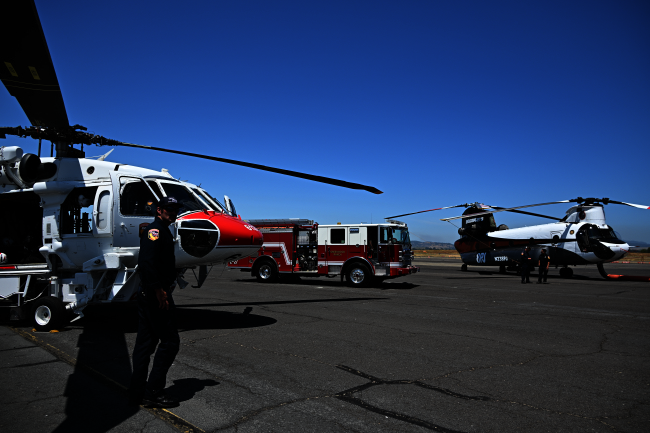
NAPA COUNTY, Calif. — As cool winds blew and aircrafts taxied nearby, Cal Fire’s Sonoma-Lake-Napa Unit showcased its aerial firefighting muscles — helicopters and crews — at the Napa County Airport on Monday.
Each of the three helicopters on display is based in a different county within the unit: a Cal Fire Hawk — a Sikorsky S-70i in signature red-and-white — with its helitack crew stationed at the Boggs Mountain Helitack Base in Lake County.
Also featured were a Boeing CH-47D Chinook based at the Napa County Airport and a Sikorsky UH-60A+ Blackhawk based at the Charles M. Schulz Sonoma County Airport.
The later two are contracted with Cal Fire for exclusive aerial firefighting operations this summer into the fall.
“These aircraft displayed behind me today represent a strategic investment in wildfire preparedness and rapid response," said Unit Chief Matt Ryan in his speech. “Cal Fire has deployed aircraft across California ahead of peak fire conditions to ensure a rapid, aggressive initial attack.”
Ryan highlighted the helicopters’ capability.
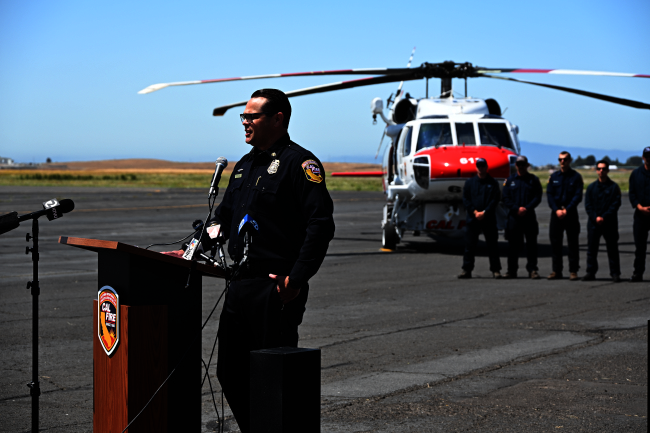
The Fire Hawk is “a state-of-the-art firefighting helicopter as an initial attack with wildfire suppression and rescue operations, Ryan said. It delivers a helitack crew directly to the fire line with 1m000 gallons of water.
The Chinook can carry up to 26,000 pounds, delivers up to 2,300 gallons of water and is qualified for night operations; The Blackhawk has a capacity of 1100 gallons of water designed for rapid deployment.
“These aviation resources are key to achieving one of Cal Fire's core objectives — containing 95% of wildfires at 10 acres or less,” Ryan said. “Together, our air and ground resources enhance our ability to protect the lives, property and natural resources of California.”
As Ryan spoke, firefighters in dark blue uniforms stood against the backdrop of their towering mechanical counterparts.
Since 2021, Napa County “has seen just eight wildfires that exceeded 10 acres in size, an average of just two per year,” said the county’s Board of Supervisors Chair Anne Cottrell during her speech. Over the 10 years prior to 2021, Cottrell said, Napa had 46 wildfires over 10 acres — nearly five a year.
The reduction in wildfire was “remarkable” and “a testament to Cal Fire’s rapid response strategy,” she said.
The unit’s Public Information Officer Jason Clay told Lake County News that aircraft or helicopters are “strategically positioned throughout California” to be able to respond to any fire across the state within 20 minutes.
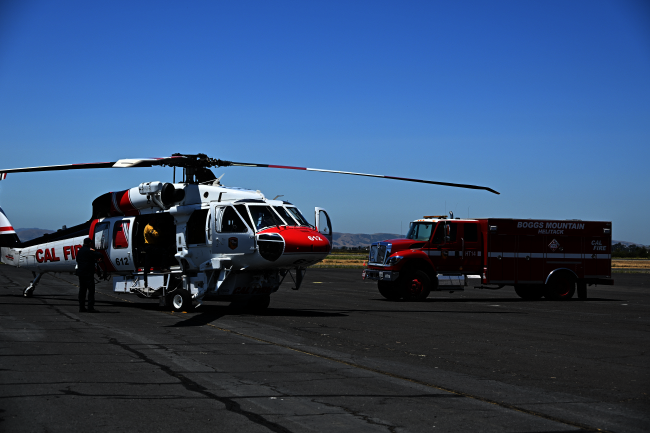
The Fire Hawk and helitack team based in Lake County
It took the Fire Hawk 15 minutes to fly the helitack team from their base in Boggs Mountain, Lake County to the event in Napa, according to the crew. By car, the trip would have taken two hours.
For some firefighters there, the commute to work is even longer.
Jake Gallant, a firefighter who lives in San Luis Obispo, said he has a four-hour drive to Lake County. “I have the farthest commute,” he said with a laugh.
Gallant explained that their shifts are “three days on, four days off” so that he does not have to make the drive every day.
“I mean, it’s actually pretty common in Cal Fire for people to live further away from where they work,” he said. “I wouldn't get this opportunity to work on a Cal Fire Hawk closer to where I live. So it’s worth it to me.”
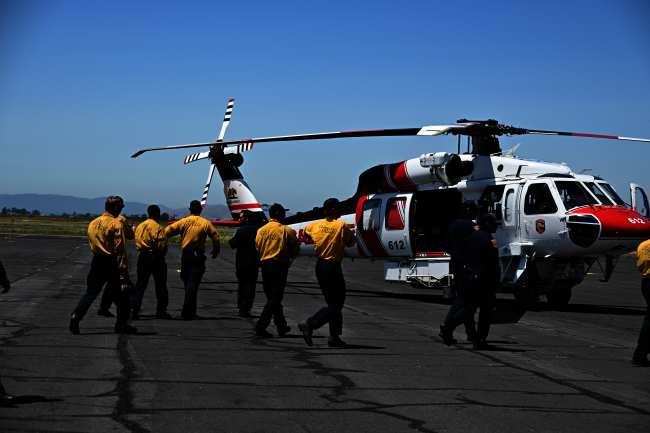
Gallant has spent three of his seven years in firefighting on the helicopter crew. “I love it. It’s the best job I ever had,” he said.
Before firefighting, Gallant said he had done many jobs in construction, moving — mostly manual labor.
“Well, they do a lot of manual labor,” Gallant said of transitioning to firefighting. “And I’m pretty good at that, so might as well do something cool with it.”
This year, the heliteck crew has attended and landed for 13 fires so far, according to Fire Captain Chris Batey who has been in firefighting since 2001 and came to the base four years ago.
Speaking of the fire trends throughout the year, “We get highs and lows,” Batey said. “Last year we started off much busier than this year — we went straight into a couple fires that burned down 10,000 acres each.”
“This year, it’s been really slow — small fires, not doing a whole lot — which is the way we like it; it’s way better,” Batey said.
In 2024, the Boggs Mountain helitack team landed and took action on 54 fires, Batey and Gallant recalled. “There's probably 100 more that we started to but they didn't need us, or we were canceled,” Gallant added.
Batey told Lake County News that it costs about $7,000 an hour for the Fire Hawk and crew to work on an ongoing fire, covered by the unit’s operating budget.
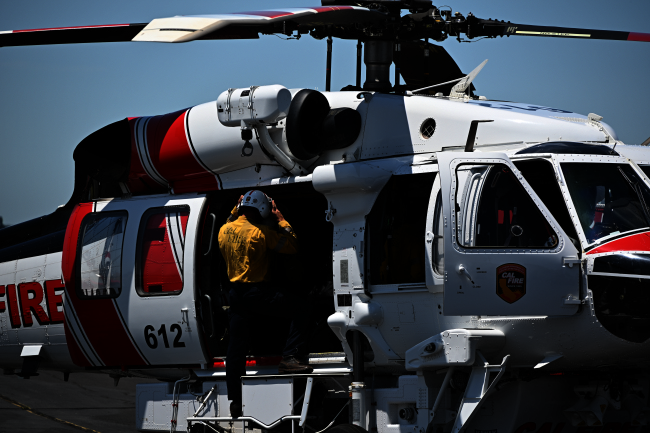
This Fire Hawk-Sikorsky S-70i is the only helicopter at the helitack base right now, according to Gallant. The aircraft and the crew, while showing up in the event, were actively on call.
“So if there is a fire, we will leave,” Batey said.
For the pilot, Michael Schanley, firefighting from the sky has “a tremendous amount of variables — whether it’s the wind, the heat.”
Schanley has been with Cal Fire for six years of his total of 38 years primarily for aerial firefighting, having previously worked as a contractor.
He likened the job to a boxing match. “I have an opponent in a fire, and the fire doesn't just wait for me to go make another drop,” Schanley said in explaining his theory.
“The fire is doing its thing and we're chasing it right?” he said. “We chased it down. And then at some point, we kind of reached an equilibrium, and then we started getting the upper hand — getting a little head of the fire, and we're doing our part. And then eventually it goes out …”
“Mike, I think we got a job at Contra Costa,” a crew member interrupted.
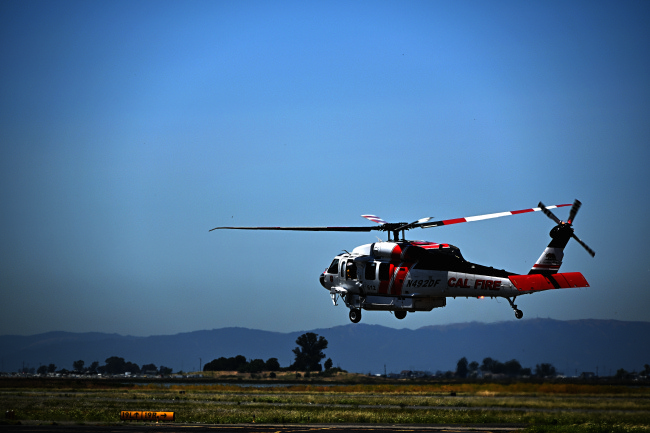
The conversation ended. Quickly, dark blue uniforms were swapped for bright yellow as the Fire Hawk’s engine started humming, rotors spinning, kicking up dust on the ramp before taking off.
Four minutes later, they arrived at the fire scene.
Email staff reporter Lingzi Chen at
- Details
- Written by: LINGZI CHEN