
 How to resolve AdBlock issue?
 Clearlake Planning Commission meets June 10
LAKE COUNTY, Calif. — The Clearlake Planning Commission will meet this week to hold two public hearings.
The commission will meet beginning at 6 p.m. Tuesday, June 10, in the council chambers at Clearlake City Hall, 14050 Olympic Drive.
The agenda can be found here.
Submit comments and questions in writing for commission consideration by sending them to Administrative Services Director/City Clerk Melissa Swanson at
Community members also can participate via Zoom. To register, visit this link. After registering, you will receive a confirmation email containing information about joining the
webinar.
The meeting also can be watched on the city’s YouTube account.
To give the planning commission adequate time to review your questions and comments, please submit written comments before 4 p.m. Tuesday, June 10.
On the agenda are two public hearings.
The first is to consider a conditional use permit and categorical exemption to allow a tattoo parlor within an existing commercial building at 15140 Lakeshore Drive.
The second hearing is for consideration of a conditional use permit and categorical exemption to allow tobacco sales within an existing commercial building, formerly Clear Lake Electronics, located at 14270 Lakeshore Drive.
At Tuesday’s meeting there also will be reports from the city manager and commissioners, and discussion of future agenda items.
Email Elizabeth Larson at
- Details
- Written by: Clearlake Planning Commission
Lakeport Economic Development Advisory Committee to meet June 11
LAKEPORT, Calif. — The Lakeport Economic Development Advisory Committee will meet this week to discuss projects, business outreach and its membership.
The committee, or LEDAC, will meet via Zoom from 7:30 to 9 a.m. Wednesday, June 11, in the council chambers at Lakeport City Hall, 225 Park St.
The meeting also will be available via Zoom.
The meeting ID is 842 2886 1335, pass code is 594383 or join by phone, 1 669 900 6833.
The meeting is open to the public.
On the agenda are economic development updates from Ben Rickelman, Lake County deputy county administrative officer for economic development, and Nicole Flora, executive director of the Lake County Economic Development Corp.
Chair Wilda Shock said city staff will lead the discussion about next steps in engaging LEDAC members and volunteers in the Business Outreach Working Group.
There also will be updates about the city’s projects and budget, Shock said.
LEDAC also will discuss expansion of its membership.
The committee will next meet on Aug. 13.
LEDAC advocates for a strong and positive Lakeport business community and acts as a conduit between the city and the community for communicating the goals, activities and progress of Lakeport’s economic and business programs.
Members are Chair Wilda Shock, Bonnie Darling, Candy De Los Santos, Pam Harpster, Lissette Hayes, Amanda Martin, Euline Olinger, Carl Porter, JoAnn Saccato, Laura McAndrews Sammel, Marie Schrader and Tim Stephens. City staff who are members include City Manager Kevin Ingram and Community Development Department Director Joey Hejnowicz, Associate Planner Victor Fernandez and Chief Building Officer Bethany Moss Childers.
Email Elizabeth Larson at
- Details
- Written by: Elizabeth Larson
Town hall presents opposing views on controversial plan to decommission Potter Valley Project
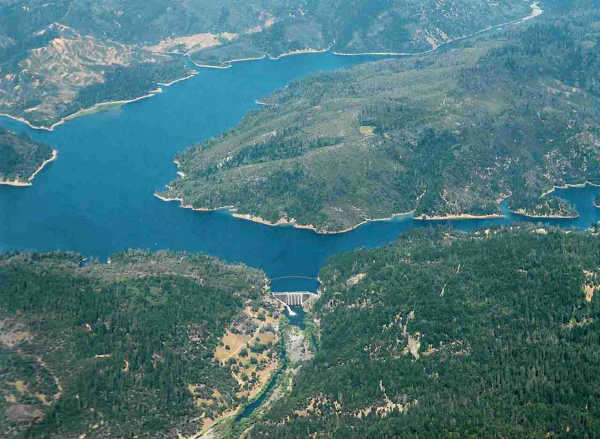
The Scott Dam at Lake Pillsbury in Lake County, California. File photo/courtesy of Pacific Gas and Electric Co.
LAKEPORT, Calif. — The vastly different viewpoints around whether or not the Potter Valley Project should be decommissioned — and dismantled — took center stage at a special event in Lakeport at the end of May.
The Lake County Chamber of Commerce hosted the Lake Pillsbury and Potter Valley Project town hall on the evening of Wednesday, May 28, at the Soper Reese Theater in Lakeport.
The Potter Valley Project includes the Potter Valley powerhouse, Cape Horn Dam and Van Arsdale Reservoir, Scott Dam and Lake Pillsbury.
Pacific Gas and Electric Co. has operated the project for decades but in 2019 the corporation abandoned its license for the hydroelectric facility after determining it was “uneconomic” for its customers to maintain.
The negotiations about the future of the project, and in particular Lake Pillsbury — located in northern Lake County — have seen Lake County largely sidelined by larger regional and political interests.
However, in recent months, town halls in other areas including Sonoma County made clear that many communities around the region stand to lose resources and are in alignment with the opposition by Lake County leaders to the project’s decommissioning.
At the May 28 meeting, the chamber hosted a cross section of panelists who offered their perspectives in timed increments for the first two hours.
Panelists were Lake County supervisors E.J. Crandell and Bruno Sabatier; Carol Cinquini and Frank Lynch of the Lake Pillsbury Alliance; water activist Nikcole Whipple; Cloverdale Mayor Todd Lands; and Lake Pillsbury Fire Chief Larry Thompson.
Close to 100 people in attendance in the theater and more watching on the livestream.
Supervisors present their case
Crandell, who represents the Northshore, and Sabatier, whose district includes the city of Clearlake, spoke together, explaining that they’ve been giving their presentation at different meetings.
“I’ve never been so passionate about something not in my district,” said Sabatier, explaining that what is happening around Lake Pillsbury is “horrific.”
He said PG&E has given a Cliff Notes version of its surrender plan, with the final plans to be done after the surrender is approved. He said they still don’t know how restoration or fire mitigation will be handled.
On the topic of fish, Crandell said, “The dam right now currently helps the fish survive,” with the cool water flow what’s ensuring they live. He said in 2022 Cal Trout asked the Federal Energy Regulatory Commission, or FERC, to tell PG&E to keep the water flowing by raising the dam’s gates because the fish were being burned.
On the economic side, the lake and its surrounding communities bring $40 million in property value and Lake County’s government receives $850,000 in tax revenue. That is a significant potential loss for one of the poorest counties in the state, Crandell said.
Likewise, Sabatier said if the lake goes away, it won’t just take away higher property values but also there will be no public utility to ensure water supply to residents.
The two supervisors and others panelists urging saving Lake Pillsbury emphasized that it’s one of the best water sources to fight fires in one of highest fire areas in California.
During the effort to suppress the Mendocino and August complexes, two of the largest fires in state history, Lake Pillsbury was a key source for the water used for fighting them. Sabatier also said that they don’t talk about the number of smaller fires put out with the lake’s water. Without it, Lake Mendocino would be the closest major water source.
Crandell said everyone needs to be able to get something out of the process. At this time, he said there is no way that Lake County ends up with anything, and tearing down a billion-dollar dam and building another doesn’t make sense.
Sabatier also pointed out that water from Lake County is what helps farmlands down through southern Marin County. “We care about what’s happening at Lake Pillsbury.”
He said that of the 81 dams in California are in “fair” status, while 41 are in “poor” status and only one is satisfactory. It’s an issue of economics for PG&E, which just wants to get rid of their asset.
Crandell said Lake County has always stood by keeping the Scott Dam where it’s at, adding they would love to see FERC stop PG&E from abandoning critical facilities without study, because it doesn’t serve the community’s safety or needs.
While California talks about climate change all the time, in the conversation about Lake Pillsbury, it never gets mentioned, Sabatier said. He questioned why there is an effort to get rid of Lake Pillsbury, a known quantity of water, when there are drought impacts all around.
He said the dam is also a flood barrier, and asked everyone to think about what the great flood of 1964 would have been like without it. On Highway 101, the flood levels — about 15 feet above cars — can still be seen.
Crandell said the cost analysis is $100 million for fish passage and $300 for seismic retrofit, while decommissioning could cost $500 million and will increase PG&E rates. “They’re forcing us and you to pay for the decommissioning costs.”
Costs to upgrade or construct a diversion is estimated at $50 million, while expanding Lake Mendocino is expected to cost another $300 million.
Sabatier said the plan includes building another dam or expanding other existing dams.
He said PG&E has already increased rates to start saving for this dam decommissioning, and they want to destroy a lake that makes life possible in so many communities without a plan.
“Save Lake Pillsbury,” Sabatier said as he walked off the stage.
Following the presentation by the two supervisors a short video was presented from Congressman Mike Thompson, who said he’s been working to make sure Lake County has a seat at the table in the matter.
He said he’s sent out numerous letters raising serious concerns, especially around wildfires, economic opportunities and the impact on our environment.
Thompson noted that Lake County’s assessor estimates that Lake Pillsbury contributes $850,000 to Lake County in tax revenue, a number which PG&E disputes, putting it at closer to $100,000.
Noting the economic impact of the lake is significant, Thompson said he also has raised issues with the lack of details in PG&E’s surrender plan.
“If the dams were to be removed, the process would not happen overnight,” he said.
Decisions of this magnitude cannot be made without the people most affected, said Thompson, who held a roundtable with Lake County officials and government agencies.
He said he knows there is a lot of fear around the issue.
“The stakes are very high, for our environment, for our economy, and for our ability to respond to wildfire,” Thompson said.
Lake Pillsbury Alliance shares residents' experiences
Carol Cinquini and Frank Lynch, longtime Lake Pillsbury residents and members of the Lake Pillsbury Alliance Board of Directors, joined together to give a presentation following Thompson’s video.
Both are “generational users” who have been a part of that community all of their lives and whose families have had a presence at the lake for decades. They also have been notable voices for the Lake Pillsbury community, and Cinquini said Lake Pillsbury is the hub and heart of their area.
Lynch spoke to the lake’s regional benefits — water supply and protection, wildlife cosystems and recreational use. He said the area’s recreational residences have a lot of positive economic impact, noting thousands of people visit on holidays. Cinquini put that benefit at a value of about $10 million.
Lynch said the lake is not well known and “you have to work to get there.” But when you do, it’s the anchor of the Mendocino National Forest, with about 300 recreational residences and a PG&E campground with 80 leased spaces.
There are four communities around the lake, Lynch explained: the Lake Pillsbury homesite tract, Lake Pillsbury Ranch, Rice Fork and Westshore. There is also the Gravelly Valley Airport and the community is supported by a volunteer fire department.
Lynch also explained that the Lake Pillsbury basin is home to a lot of wildlife.
Cinquini said the impacts of dam removal include loss of fire protection. During the August Complex in 2020, water from Lake Pillsbury was used in four counties — Lake, Colusa, Glenn and Mendocino.
“That water is critical to our well being in that basin,” she said.
They also showed video of a “super scooper” plane taking water out of the lake during the August Complex.
Cinquini went on to discuss the impact of recreational loss, explaining that it will harm people and wildlife in the Eel and Russian River watersheds.
She estimated the true cost of decommissioning the Potter Valley Project’s dams isn’t $500 million but closer to $2 billion.
Cinquini said the Eel River runs 200 miles, with only about 35 of those miles above the Scott Dam. The dam’s removal won’t guarantee the fishery’s recovery.
Lake County’s interests have never been addressed, said Cinquini, who said her organization wants a full evaluation of the feasibility of modernizing the Scott Dam for seismic concerns and fish health. They also want fish mitigation impacts and enhancements below Scott Dam evaluated, along with a full regional analysis.
Water protector supports dam removal
Nikcole Whipple, a member of the Round Valley tribe who said she is a water protector and policy advocate, is against the Scott Dam and water diversion, although she supports water diversion for a minimum time until the counties to the south become self-sufficient.
She said tribal people haven’t had access to the river’s water, and the water they have has very poor water quality. The many tribes in the basin have been let out for over 100 years.
Referring to the “first in time, first in right” legal principle about water, Whipple said tribal water rights are senior rights and cannot be destroyed by state water law.
Lake Pillsbury sits on a Yuki tribal site. “For over 100 years we have not had a say,” she said. “We were moved.”
Noting that Lake County is one of the poorest in the state, Whipple asked if it would be more viable for the county to have a long flowing river as a resource. “This lake is not saving us,” she said.
Whipple said tribal beneficial uses of water are important to people. “This has been a 30-year process for my tribe,” regarding the fight for restoring the river, she said.
Concerns in Sonoma County
Cloverdale Mayor Todd Lands thanked the organizers for the invitation to the town hall, crediting Crandell and Sabatier for doing a good job presenting their case at a town hall held in Cloverdale earlier this year.
Lands said Cloverdale has been getting water from the Potter Valley Project for about 100 years.
He said he’s heard statements about the project’s removal being “a done deal,” adding, “They wanted you to believe that.”
Lands said Lake County has been left out of the discussion, and he also faulted the transparency of the process.
He raised concerns about fire mitigation, as well as its importance for his community’s residents. “Water is life,” he said. “Well guess what? Our lives matter as well.”
He added, “It’s not about anything other than survival at this point.”
Lands said 90 species of animal will go extinct in the area. Lake Mendocino won’t be able to fill and will go dry two out of 10 years; then, he said, you need to add in additional drought years.
“This isn’t a good plan. They kept you away from the table for a reason. They kept us away from the table for a reason. We’re at the end of the hose. There’s no water in it anymore,” Lands said.
Sierra Club Lake Group supports dam removal
Deb Sally, chair of the Sierra Club Lake Group, also spoke in support of the Potter Valley Project’s removal.
Sally, who said she understands what it feels like to not feel included, said it’s important that all stakeholders get to be involved in what is going on. She said she hasn’t heard yet how they will convince PG&E to take back a dam which isn’t viable and also referred to seismic issues that are said to be a problem for the dam.
She said she doesn’t see a way out of the situation and that the community needs to be prepared for the possibility and inevitability that the Scott Dam will come down.
The best outcomes will come with local cooperation, and Sally said fighting the inevitable makes no sense to her.
Noting that ecosystems are very resilient, Sally talked about how other dams that have been removed resulted in improvements for fisheries and benefits for tribal culture.
July 29 is the due date for the surrender plan and the decommissioning would start in 2028. Sally said it’s important for people to get ready for that.
Sally said she’s been to Lake Pillsbury four times, enjoyed camping there and knows it’s a much beloved resource that has a huge impact on fire resilience. All of that needs to be taken into consideration.
No lake, no buffer
Chief Larry Thompson of the Lake Pillsbury Fire Protection District was the panel’s last speaker.
He’s been a Lake Pillsbury resident since he was 6 months old and his father, Ken “Splash” Thompson, was involved in improving the community. Both father and son were involved in forming the fire district in 1996.
Larry Thompson is a retired firefighter and paramedic of 40 years with the Marin County Fire Department who has served as the Lake Pillsbury FIre volunteer chief for the last 20 years.
He said he came to the town hall not just as a fire chief but as someone who has stood on the front lines of some of California’s worst fires. “I’m here to speak about the need for Lake Pillsbury as a water supply source.”
Thompson said water is the first and last line of defense in a fire. “If the lake is gone and the water tanks go empty, we cannot defend any of our neighborhoods,” he said. “We must maintain our lake water supply for resiliency.”
Thompson said if there is no dam, there is no lake. “If there is no lake, there is no buffer.”
During the August Complex, which he called California’s first “gigafire,” Thompson said very large air tankers held the line at the Eel River and saved Pillsbury’s communities. Lake Pillsbury Fire also provided local knowledge and a 24-hour water filling station, which ran for 28 days straight.
Most of the area around Lake Pillsbury has burned from 2012 to 2021, Thompson said.
“Let me be clear, when the next fire comes, and it will, we need every gallon we can get,” he said.
Taking away a great long-term water source is short-sighted and dangerous, said Thompson, adding that they need to fight for a water system that protects us all.
The audience weighs in
Following the two hours of panelists, another hour was devoted to questions, answers and comments from the audience.
Ray Todt, a Lake Pillsbury resident, thanked the panelists. “It’s because of you that we’re being heard.”
Middletown resident Dave Rosenthal pointed out that the Scott Dam was built in 1922 but the salmon numbers at Van Arsdale didn’t crash until the 1950s, so he said the dam wasn’t what’s killing the fish, nor is it drying up the Eel River in the fall and spring. Rather, it’s capturing heavy flows in the winter months, and catching stormwater is what reservoirs are meant to do. Ultimately, there will be less water if the Scott Dam is gone.
Rosenthal said PG&E wants to abandon the project because they aren’t making money, and he said that’s because activist groups and tribes have been fighting to restrict the flows. He said the seismic study’s timing seems suspicious, and he’s heard that no one has seen what it says. Rosenthal also questioned how many of the other dams in the project have communities downstream that would be affected.
Sabatier confirmed that PG&E won’t let the county see the report. “We have been asking for that report for a while.”
Cinquini said the seismic report is a red herring, explaining that almost all dams in the state are in some kind of hazard area. Being a high hazard dam, she said, means at least one person downstream could be killed.
Lands said the dam isn’t seismically unsafe. “They’re finding a way to get the solutions they want.”
Whipple said the process required actual reporting. If the dam is faulty, it would flood all the way to Benbow, she added.
The group also heard about past feasibility studies on projects to support the project and Middle Creek, as well as Cache Creek and delta desalination.
There also were questions about whether the Army Corps could take over operating the project, with Sabatier noting that the Army Corps does run dams in the state.
Clearlake Oaks resident Angela Amaral asked Whipple if her stance about removing the dam would change if it weren’t for the fact that the Round Valley tribe was set to receive $1 million a year for 50 years.
“We’re not about it for the money,” said Whipple. She said they haven’t seen reparations but they are asking for restoration funding in order to build capacity, fire resilience and a workforce in the area.
Lands said it’s actually $1.7 million, not $1 million, annually that the tribe will be paid out of Sonoma County.
Lynch said some government entity needs to take over, adding that California has never learned to monetize water. The lake is a regional asset and it should be thought of that way.
As the event drew to a close, Crandell — noting that they were an hour beyond the scheduled end time because the matter is so important — gave Whipple and Sally credit for coming and speaking in a difficult situation.
“Afterwards let’s respect each other,” Crandell said.
Email Elizabeth Larson at
- Details
- Written by: Elizabeth Larson
City of Clearlake approved as a Blue Zones Project Worksite
LAKE COUNTY, Calif. — Blue Zones Project Lake County announced that the city of Clearlake has been officially approved as a Blue Zones Project Worksite, recognizing its commitment to supporting employee well-being and fostering a healthier work environment.
To achieve this approval, the city of Clearlake implemented a range of supportive environmental changes, including flexible workstations, an employee garden, fresh fruit in the break room, and a Blue Zones Project book library to encourage ongoing learning and personal growth.
These efforts build on the city’s broader commitment to employee well-being, reflected in its human resources policies that prioritize a healthy, balanced, and engaged workplace culture.
"The city of Clearlake has shown genuine commitment to creating a thriving workplace that empowers employees to make healthier choices, feel more connected, and bring their best selves to work each day," said Kelly Yandell, organization and well-being lead for Blue Zones Project Lake County, who led the worksite approval process.
City leaders celebrated the designation as a meaningful step in their organizational wellness Journey.
“The city of Clearlake is thrilled to announce its official approval as a Blue Zones organization, a testament to our unwavering commitment to well-being and a healthier, more vibrant community,” said Melissa Swanson, Administrative Services director for the city of Clearlake.
Swanson added, “This significant achievement marks a pivotal moment in our journey, and we couldn't be prouder. This approval is the culmination of dedicated effort from our entire team, our partners, and the community members who embraced this vision with us. We are incredibly excited about the positive impact this will continue to have on the health and happiness of everyone involved.”
Blue Zones Project is a community-led well-being improvement initiative designed to make healthy choices easier in all the places people live, work, and play. Based on research of the world’s longest-lived cultures, the project focuses on permanent and sustainable changes to environment, policy, and social networks.
With this new approval, the city of Clearlake joins a growing number of worksites across Lake County working to make the healthy choice the easy choice for employees.
For more information about Blue Zones Project Lake County and how your organization can become an approved worksite, visit www.bluezonesproject.com or email
- Details
- Written by: LAKE COUNTY NEWS REPORTS
Celebrate fourth annual California State Parks Week June 11 to 15
Mark your calendars and start making plans to join California State Parks and partners in celebrating the fourth annual California State Parks Week from June 11 to 15.
Presented by California State Parks, California State Parks Foundation, Parks California and Save the Redwoods League, this exciting weeklong celebration with the tagline “This is Where You Live” offers more than 170 events, including both in-person and virtual experiences, highlighting the people, places and programs that make California’s 280 state parks truly unique.
Why California State Parks Week?
California’s state parks preserve and protect the state’s natural and cultural history. In recent years, it has become abundantly clear that public lands play a critical role in making communities stronger, happier and healthier. Our shared parks are places where everyone can connect with nature and find inspiration and joy. California State Parks Week is a fun way to celebrate the wonder and sense of community that the outdoors provides to Californians and visitors from all over the world.
Lake County is home to Clear Lake State Park in Kelseyville and Anderson Marsh State Historic Park in Lower Lake, as well as a portion of Robert Louis Stevenson State Park near Middletown.
During California State Parks Week, Anderson Marsh will host its final guided park walk of the spring season on Saturday, June 14.
Whether you are exploring new outdoor activities, learning ways to protect the environment or connecting with your community, California State Parks Week offers something for everyone — all at no additional cost. It’s an opportunity to take direct climate action, enjoy the beauty of your parks and be part of a movement to preserve them for future generations.
The festivities take added significance this year as California celebrates its 175th year of statehood.
“As California commemorates its 175th anniversary, California State Parks Week offers an opportunity to celebrate the incredible natural and cultural wealth that our 280 state parks offer,” said Armando Quintero, director of California State Parks. “This is where you live, and these spaces connect us to the land, our history and one another. Whether you’re hiking, volunteering or simply soaking in the views, this week is a beautiful reminder to embrace the unmatched nature of California and the positive impact it has on our well-being and the health of the environment.”
Launched in 2022, California State Parks Week advances the “Outdoor Access for All” initiative championed by Gov. Gavin Newsom, First Partner Jennifer Siebel Newsom and the California Natural Resources Agency’s “Outdoors for All” initiative.
The initiative expands outdoor access to all Californians through focused investments in open space infrastructure, outdoor programming and improvements to permit applications, with a priority to support underserved communities.
California State Parks protects the best of the state’s natural and cultural history; more than 340 miles of coastline; the tallest, largest and among the oldest trees in the world; and deserts, lakes, rivers and beaches. There are more than 5,200 miles of trails, and 15,000 campsites, prehistoric and historic archeological sites, ghost towns, historic homes and monuments — all waiting to be explored.
“California State Parks Week is more than a celebration — it’s a reflection of the deep, personal connections people have with these incredible places,” said Rachel Norton, executive director of California State Parks Foundation. “At California State Parks Foundation, we believe that when people explore parks and have meaningful experiences in nature, they’re more likely to become lifelong stewards. From volunteering to advocating for funding, Californians are stepping up to protect these shared lands for future generations. This week is a reminder of the joy our parks bring — and the power we have, together, to ensure they thrive.”
The following are some ways to enjoy the state’s park.
Celebrate community and culture: California’s state parks are for all people. The event affirms that truth by elevating the perspectives and experiences of communities that have been historically underrepresented in public lands with celebrations and cultural events.
Explore new experiences: Everyone is encouraged to visit a state park and try something new. From first-time camping and an interpretive hike to adventures like surfing, boating or off-roading, California State Parks Week is your invitation to explore an activity that you just might fall in love with.
Nourish your health and well-being: Studies have shown that time in nature can boost people’s physical, mental and emotional well-being. Everyone should have access to these benefits. California’s state parks give us all places where we can find refuge, inspiration and joy.
Support climate resilience: Learn about and support state parks and their partners’ efforts to ensure climate resilience across California’s State Park System — from expanding protected lands in state parks and restoring forests to engaging in educational dialogue about climate threats and solutions.
“Parks are more than places — they are part of the fabric of our communities and where people from all backgrounds can feel welcomed, inspired and connected,” Said Kindley Walsh Lawlor, president and CEO of Parks California. “California State Parks Week celebrates the unique power of these public spaces to bring people together, foster belonging and spark a lifelong love for the outdoors. At Parks California, we are proud to help make parks more welcoming and resilient so everyone can enjoy their beauty and benefits — now and into the future.”
Reservations are now open. For a full list of events and participation details, visit https://castateparksweek.org/.
- Details
- Written by: LAKE COUNTY NEWS REPORTS




