
KELSEYVILLE – The scent of ripe peaches, the smiles of local farmers as they talk about available produce and the sounds of happy customers as they purchase Lake County string beans, corn, tomatoes, garlic, plums and more – whatever is ripe that day – are what greet you at the farmers' market every Saturday morning.
There are those folks who come every week, bright and early when the market opens at 8:30 a.m., to get the best selection. There also are those who come only once or twice per season.
No matter how often you go to the market, when you do, you support our local farmers by purchasing directly from them with the satisfaction of knowing that what you are eating is fresh and grown locally.
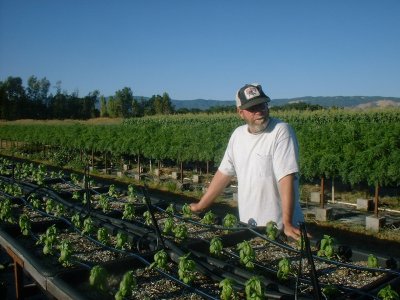
"Good people, good food, what more could you want?" local farmer Sky Hoyt said on a recent Saturday at the Lake County Farmer's' Finest market held at Steele Winery. The market is held every Saturday from May through October and Hoyt has been at each and every one since it began over 10 years ago.
While the ambiance is upbeat and farmers' markets are becoming more frequent and numerous around the country, many food policy experts, physicians and social justice organizations say that there are not enough of them.
As a result, they've been waging an assault on the 2007 Farm Bill – which they would like to rename the "Farm, Food & Health Bill" – particularly the issue of subsidizing commodity crops such as corn and soybeans which are used to manufacture sweeteners and fats used in "junk" food. These subsidized crops keep the costs down for high-fat, sweetened, calorie-dense foods that are nutritionally deficient many critics say.
"On one hand, public-health experts try to educate Americans about the importance of healthful food choices ... on the other, our federal government shells out billions of dollars to subsidize the production of pork, beef and other artery-clogging meat, as well as oil and sugar – while fruits and vegetables receive almost no support at all," Ana M. Negrón, a physician who works with low-income communities, told The Philadelphia Inquirer last week.
The Farm Bill was implemented in the 1930s to assist farmers recovering from the Dust Bowl and primarily subsidizes cotton, corn, wheat, rice, soybeans and a few other crops.
But California's agriculture focuses on mainly fruits and vegetables, which aren't considered commodity crops and have never been subsidized by the $70 billion annual budget in the Farm Bill, which comes up for reauthorization every five years.
Of the $70 billion dollar pie, California received $1.11 billion in commodity program payments from 2003-2005. Lake County received $456 during that period, placing it 40th out of 47 counties in subsidies, according to the Environmental Working Group, which set up an online database that lists publicly, for the first time, who received these subsidies.
Top-ranking Kern County received $490,972.
The $456 in subsidies paid in Lake County were to wool growers – of which there were three who received the federal payments.
On Friday, July 19, Democratic House Speaker Nancy Pelosi signed off on the bill as it came out of the Agricultural Committee, which kept intact the subsidies to the commodities crops, disappointing many groups advocating for change.
"We want to support our local Lake County farmers so they can help provide more nutritious fruits and vegetables to Lake County residents," said Lou Denney, Food Programs Manager with the Lake County Community Action Agency (LCCAA).
Denney and the LCCAA support any changes to the Farm Bill that could help their programs get more fresh fruits and vegetables onto the plates of residents who need it most.
One of the programs that Denney is getting off the ground here in Lake County is the Farm to Family program – a partnership with the Clear Lake Gleaners that will get produce to LCCAA who will then distribute it to their member agencies.
It's programs like these – and more support to farmers who participate in farmers' markets – that advocates for changing the status quo hope happens today when the Farm Bill goes before the House today.
"We're always looking for more farmers to participate," said Laura Sombs, market manager for the Lake County Farmer's Finest. There are currently less than a dozen farmers and several artisans who participate each week.
If Lake County fruit and vegetable growers could get some of the financial assistance that Midwestern corn, soy and cotton growers receive, imagine the difference that could make.
The Farm Bill goes before the House today, Thursday, July 26. For more information on the 2007 Farm Bill, visit the following sites.
U.S. Department of Agriculture: www.usda.gov/wps/portal/usdahome
California Department of Food and Agriculture: www.cdfa.ca.gov/farmbill07
Environmental Working Group Interactive Farm Bill Database: http://farm.ewg.org/sites/farmbill2007/index.php
California Food and Justice Coalition: www.foodsecurity.org/california/Farm_Bill.html
California Coalition for Food and Farming: www.calfoodandfarming.org
Food Fight: www.watershedmedia.org/foodfight_overview.html
Community Alliance With Family Farmers: www.caff.org
American Farmland Trust: www.farmland.org
Sustainable Agriculture Coalition: www.msawg.org
Western Growers: www.wga.com
Organic Farming Research Foundation: www.ofrf.org/index.html
Representative Mike Thompson: http://mikethompson.house.gov/
The Lake County Farmer’s Finest market runs from 8:30 a.m. to noon, May–October.
www.lakecountyfarmersfinest.org/
E-mail Terre Logsdon at
{mos_sb_discuss:2}

 How to resolve AdBlock issue?



