How to resolve AdBlock issue?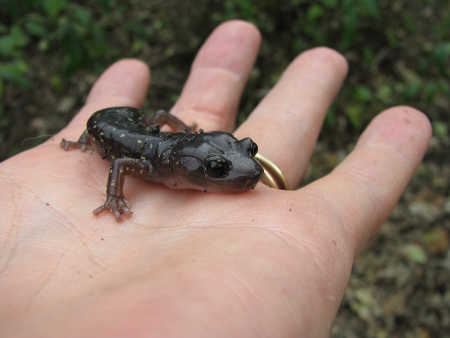
NORTHERN CALIFORNIA – During the summer, most salamanders in the Berryessa Snow Mountain region are deep underground; but in the wet winter months you can find them on the surface, tucked under rocks and branches.
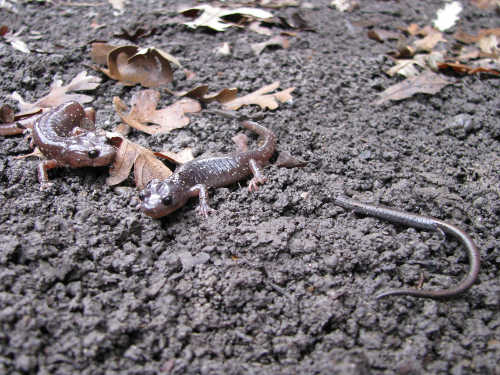
The photos show here feature two species of salamanders, and both of them are adults.
The larger pinkish one is the Arboreal (tree-climbing) salamander, and the skinny gray one (that looks like a tail) is the California Slender salamander.
The Arboreal salamander has a prehensile tail (like some monkeys) with which it can grasp branches or from which it can actually hang.
The California Slender salamander has a long body with very tiny legs and feet. If you don’t look at it carefully, you might think it’s a snake!
Both the Arboreal salamander and the California Slender salamander are found in the family Plethodontidae, called lung-less salamanders.
They do not have lungs, but rather breathe through their skin and the membranes in their mouth. They must remain moist at all times, or else they will die.
Their “permeable” skin (meaning that it has microscopic holes where the air goes in and out of it) makes them very sensitive to environmental pollutants – like the proverbial canary in the coal mine.
If there are poisons or toxins in the soil, or even in the air around Plethodontids, they will die. That’s why I always enjoying finding salamanders in my yard; because I know that the area where they live is healthy for me, too!
These gentle creatures spend their lives eating invertebrates (creatures without a backbone) like worms, mites, spiders and small insects. Larger salamanders like the Arboreal salamander will even eat other salamanders.
Salamanders are in a class of animals called amphibians. This class includes frogs and toads, as well as a very strange underground amphibian called a “caecilian” (pronounced ‘seh-SILL-yun’) – a kind of limbless amphibian which most people will never see in their lifetime because the caecilian lives deep underground.
Any creature that lives mainly in damp, loose soil and under leaf litter, logs, and plant debris, is called “fossorial” – which should not be confused with the word fossil. “Fossorial” comes from the Latin word fossor which means digger.
Scientists who are involved in the study of amphibians and reptiles, (like snakes, lizards or alligators) are termed herpetologists.
If you want to find and study salamanders in more detail, there are some basic rules to which you should adhere:
– First you should probably wear leather gloves when you turn over branches and rocks. There could always be harmful creatures, like poisonous spiders, scorpions, centipedes and snakes under those spots. In fact, the very same habitat which holds salamanders is also favored by spiders, snakes and scorpions.
– When you do grasp a rock or piece of wood to look underneath, do not curl your fingers around the underside where they might be bitten.
– You should also turn up the rock or wood so that it is exposed away from your face, rather than lifting it like a lid toward you.
– Take photos of the salamanders you find, but resist the urge to take them home and keep them as “pets.” It might seem fun to put them in a terrarium, but it will remove their diversity from the gene pool and prevent them from ever returning to the wild because this could introduce disease into the wild population.
– When you go to return a salamander to its home under the rock or wood, carefully lift the salamander away, replace the cover material (rock or wood), and then place the salamander beside the edge of the covering material so that the salamander can crawl back under cover on its own and not be squished.
– As a final point, you want to remember that the good scientific observer always leaves places looking untouched, just the way they found it. We call this the “leave no trace” ethic.
Oh, and keep in mind, too, that it’s very important to wash your hands after handling any salamander.
Their skin hosts a large number of harmful bacteria on it as a defensive mechanism to give them a nasty taste to large animals that might eat them.
If you find any salamanders in your yard, send the photos to Tuleyome to post on their Facebook page!
Tuleyome Tales is a monthly publication of Tuleyome, a nonprofit conservation organization based in Woodland, Calif. For more information about Tuleyome go to www.tuleyome.org . Christina Mann is a local wildlife biologist.