How to resolve AdBlock issue?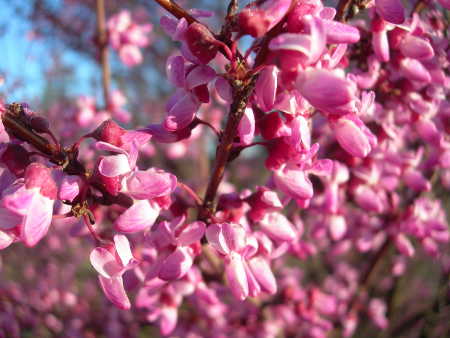
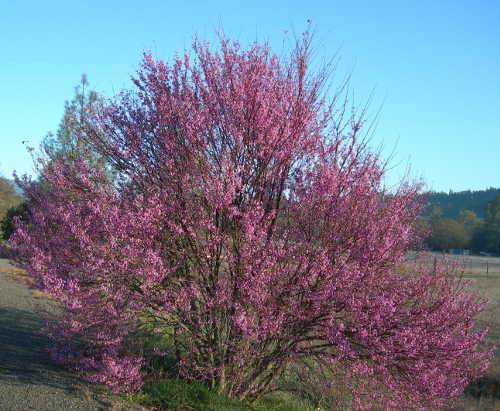
LAKE COUNTY, Calif. – The ubiquitous redbud stands out like a magenta umbrella amongst the spring greenery.
The western or California redbud, or Cercis orbiculata is the namesake of our local parks and hospitals.
More importantly, this highly visible shrub or tree has been a key plant, historically, in Lake County and California's native cultures for centuries.
It has been prized by about 20 different American Indian groups or tribes as a significant plant for basketry.
There are seven kinds of native redbud species in Europe, Asia and North America, but just one is indigenous to California.
Actually a member of the legume family, the redbud can reach a height of up to 20 feet.
The magenta pink flowers are wonders of nature, appearing as pea-shaped, and arriving before the leaves.
The pink mist of flowers arrives in Lake County from February to March, but an individual tree's display lasts only about two weeks.
Redbud is a drought-tolerant plant, and is found in several plant populations: riparian, cone forest, oak woodland and chaparral, preferring rocky soil.
In the Sierra Nevada mountains redbud plants have been studied by ethnobotanists, and there, too the plant played a large part in American Indian basketry.
After lightning fires there, the redbud regenerated and adapted vigorously in woodland plant ecosystems.
Copious amounts of redbud have been discovered by archaeologists studying the Sierra Miwok Indian sites, and they posit that human activity played a large part in the prolific presence of the redbud plants there.
It is believed that the trees were pruned and weeded to maintain the elegant wine-colored switches for basketry use throughout history.
Elders have given ethnohistories describing just that – the plants were coppiced, or cut back extensively to manage the plant's growth for future use. In this way, the new sprouts were longer and straighter, less scarred and better for basket making.
Redbud was harvested in fall or winter as basket making material to create unique patterns in their baskets.
In the spring or summer seasons redbud could be harvested and its bark removed to be used as a white sewing twine.
The plant was utilized for both structure and in the warp or foundation, and weft for coiling and twining the baskets.
Often, the redbud's branches were split, then stored in coils to “cure” for about a year, in a cool, dry location.
When the time came for basket making, the coils of redbud were soaked for hours, then cleaned again for use by talented tribe members.
Be sure to visit our local museums to see, firsthand, the beautiful, handmade baskets, some of which are so well made that they can hold water.
Kathleen Scavone, M.A., is an educator, potter, writer and author of “Anderson Marsh State Historic Park: A Walking History, Prehistory, Flora, and Fauna Tour of a California State Park” and “Native Americans of Lake County.” She also writes for NASA and JPL as one of their “Solar System Ambassadors.” She was selected “Lake County Teacher of the Year, 1998-99” by the Lake County Office of Education, and chosen as one of 10 state finalists the same year by the California Department of Education.