 How to resolve AdBlock issue?
LAKE COUNTY, Calif. — One in four Lake County residents rely on federal food aid that has remained suspended during the government shutdown, despite repeated court orders to release the funding.
Amid the longest government shutdown in U.S. history, 42 million, or 1 in 8 Americans nationwide who rely on the federal Supplemental Nutrition Assistance Program, or SNAP, have not received their November benefits.
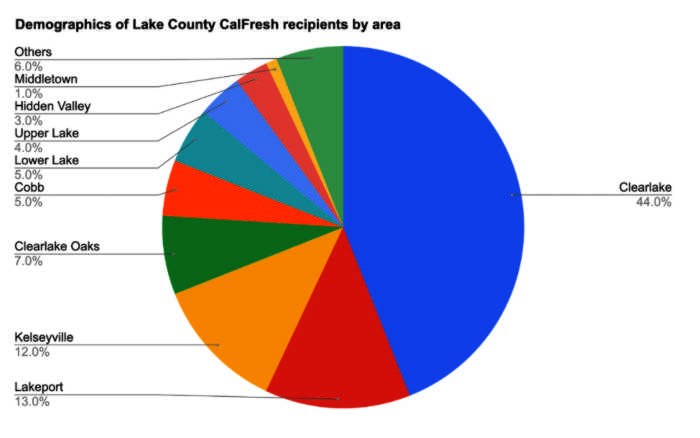
That includes 5.5 million Californians enrolled in CalFresh, the state’s version of SNAP, among them 16,320 Lake County residents — nearly a quarter of the local population — who, as the holidays approach and temperatures drop, still lack the support they need to stay fed.
Of all local benefit recipients, 46% are children, 18% are elderly, and 4% are disabled, according to Lake County Social Services Director Rachael Dillman Parsons.
While political maneuvering plays out at higher levels, shortage of food — a basic necessity for survival — can have serious local consequences, especially in Lake County, which is disproportionately affected by the fund freeze.
Typically, Lake County issues $2.9 million in CalFresh benefits each month to 10,333 families at an average of $287.49 per family — “a huge disparity” compared with wealthier Napa County, which distributes $1.9 million monthly despite having twice the population, Dillman Parsons noted.
On Tuesday, the Board of Supervisors approved $80,000 in county funds to help address the local food crisis as uncertainties linger.
The amount equates to about $2.50 per person every week, Supervisor Bruno Sabatier said, calling it “a drop in the bucket” compared with some county reserve accounts, asking to double it.
Staff noted that any amount drawn from reserves would require a resolution that couldn’t be accomplished at this meeting.
“The idea is not to replace the full benefit,” Dillman Parsons said. “It’s to potentially assist with making it not so hard.”
“I think we need to act right now on what we've got put in front of us,” said Supervisor Jessica Pyska.
Supervisors agreed that future emergency meetings can be called to allocate more funds if the crisis worsens, then unanimously voted to issue $80,000 immediately.
An ad hoc committee was also formed to include Supervisor Brad Rasmussen and Sabatier. A full membership list would later include various governmental agencies, local service providers and nonprofits.
Supervisors said they also will work with agencies and service providers in their respective districts to coordinate food assistance.
USDA stalls as federal courts order funds released
While food aid remains frozen, back-and-forth battles between the federal judiciary and the executive branch have continued to create both hope and uncertainty.
Last Friday, just before November hit, two separate lawsuits found the funding for SNAP should be released.
In addition to the $6 billion in SNAP contingency funds appropriated by the Congress to the U.S. Department of Agriculture, or USDA, one of the court decisions also found that USDA can use $23 billion in Section 32 funds for SNAP.
However, USDA had said it can only fund up to 50% of the full benefit for November, Tom Joseph of political consulting firm Paragon Government Relations explained at Tuesday’s board meeting.
Still, the agency did not release the partial funding.
Even if it did, it would take time to reach people’s accounts, according to Dillman Parsons. Different programming methods will determine how quickly enrollees receive benefits, and it was still uncertain which method USDA will use.
A slower method may require three weeks for system programming plus 10 days to issue benefits, she explained.
“It doesn't sound like benefits are rolling out anytime soon,” said Dillman Parsons.
“Most people are not getting their partial November benefits until after Thanksgiving,” she said. “And it's important to note, these are partial benefits.”
Joseph also added that USDA prohibits states and counties from making any new applicants eligible during this month.
Federal judge orders Trump Administration to pay SNAP, in full
Just a few hours before the board discussion convened on Tuesday, President Donald Trump said in a social media post that “billions and billions” of SNAP dollars will be given only after the government reopens, opposing what the court ruled last week.
Shortly after, however, White House Press Secretary Karoline Leavitt said the administration “is fully complying with the court order.”
While attributing the delay to Democrats, Leavitt offered no details on the timing or amount of funding at the time.
On Wednesday, USDA revised its plan and said it was able to fund 65% instead of 50% of full benefit for November.
Regardless, a federal judge in Rhode Island on Thursday ordered the Trump administration to fund full benefits, giving the administration until Friday to make the payments through SNAP.
“Without SNAP funding for the month of November, 16 million children are immediately at risk of going hungry,” said U.S. District Judge John J. McConnell Jr. “This should never happen in America. In fact, it’s likely that SNAP recipients are hungry as we sit here.”
The Trump Administration immediately appealed the decision.
Vice President JD Vance called the ruling “absurd” because “You have a federal judge effectively telling us what we have to do in the middle of a Democrat government shutdown,” Vance said during a roundtable with Central Asian leaders at the White House, according to The Hill.
On Thursday evening, Gov. Gavin Newsom’s office issued a statement reporting that California families are beginning to see their full CalFresh benefits restored on their EBT cards.
Supervisor Sabatier on Tuesday said he believes the distribution of food benefits has become a political tool.
“It's about leverage between Republicans and Democrats,” said Supervisor Sabatier. “If people have food, there's less leverage and pressure on Democrats to end the shutdown. If people don't, then there's potentially pressure on them to be able to end it earlier.”
As of late Thursday night, no other actions by the federal government to move forward with issuing any SNAP funds have been reported, other than the governor’s evening statement.
Community resources stepping up
Sabatier said he’s concerned that people may face eviction and homelessness when they now have to spend their rent money on food.
Dillman Parsons said that the county has some programs for preventing homelessness, such as the Family Stabilization program for families with minor children, and Home Safe program for elderly, disabled or dependent adults.
“If they have spent their housing money on food, it's a bit of a workaround,” she said, adding that CalWORKS enrollees may get cash assistance of an extra $13 a month and pregnant individuals may be offered a one time $100 cash aid.
Dillman Parsons said the department maintains an updated list of community resources pinned to their Facebook page.
Businesses are also affected: Joseph said that vendors that work with CalFresh are also “scrambling to get states back up and running.”
While the federal bargaining drags on, local agencies and nonprofits are stepping in, organizing resources to offer help — and calling for donations and volunteers.
Dillman Parsons said the Freedom Riders, the Good Old Boys, Wino’s crew, Priesthood, the 20 Boys and Ghosts of Freedom are providing 2000 turkeys to The Gleaners, which is Lake County’s official food bank. Redwood Empire Food Bank, based in Sonoma County, also serves numerous food pantries in Lake County.
The department is also compiling a list of local Thanksgiving dinners free for the community, Dillman Parsons said, naming Twin Pine Casino, Solano Women in Medicine and Middletown Methodist Church among those who have confirmed.
“I urge everyone to find out where their local food pantry is, reach out, and see what they need — whether it’s funds, food donations, or volunteers,” said Elizabeth Larson, Lake County News editor and publisher, who spoke at the meeting solely in her role as commissioned pastor at Kelseyville Presbyterian Church, which operates a food pantry.
“Mason Carter can lug a 50 pound bag of carrots like nobody's business,” Larson said of devoted volunteers at the church, lauding the son of Assistant County Administrative Officer Stephen Carter. “So we're grateful for people like that.”
“Trust me, a little will go a long way,” Larson said. “Local food pantries really stretch dollars and make the most of every donation.”
Both Larson and Shannon Kimbell-Auth of Red Cross brought up A Simple Gesture, a new countywide initiative that allows residents to donate food and volunteer as drivers to deliver it to local food pantries.
“So that’s this coming Saturday, starting at nine o'clock,” said Kimbell-Auth.
While the community is organizing self-help and federal judges appeal to the law to resume benefits, this nationwide delay of food aid has put forth a reminder of the critical role of safety net programs like CalFresh in Lake County — and there are broader concerns on local social services in the long run.
The presidential “Big Beautiful Bill” approved in July, which will take effect next year, changes the county administration contribution to a higher percentage, Dillman Parsons said.
“If that does not change, and if there is not a solution from the state to augment our funding, it's going to put some counties in a position where they can't afford to operate CalFresh any longer,” she said. “We are one of those counties who will be in deficit with our realignment.”
“But that's October 2026,” Dillman Parsons continued. “The problem today is feeding people.”
Correction: United Christian Parish will not be offering a Thanksgiving dinner.
Email staff correspondent Lingzi Chen at lchen@lakeconews.com.