 How to resolve AdBlock issue?
LAKE COUNTY, Calif. — The Board of Supervisors on Tuesday approved an additional $60,000 for three more weeks of hunger relief as food insecurity continues to strain Lake County, despite the end of the federal shutdown and the disbursement of delayed benefits.
The amount adds to the previously approved $80,000 on Nov. 4, which provided two weeks of food support for local residents in need while the federal shutdown froze the Supplemental Nutrition Assistance Program, or SNAP — the federal program that funds CalFresh, which a quarter of Lake County’s population relies on for food.
The funding allowed the county to bolster local pantries and food banks, which saw “never-before-seen lengths” of food distribution lines over the past two weeks, Lake County Social Services Director Racheal Dillman Parsons reported at Tuesday’s meeting.
Even with boosted supply, “Unfortunately, not all families could be served,” she said.
The federal shutdown ended on Nov. 12 with a continuing resolution opening the government through Jan. 31, 2026. Litigation against the federal government withholding November SNAP funds have been dropped.
Dillman Parsons said that the delayed November CalFresh benefits have been issued and December benefits “will be issued as usual.”
However, food insecurity continues to linger in Lake County and food banks are continuing to see increased demands.
Part of that strain predates the shutdown and is compounded with unemployment and consumer prices, Dillman Parsons said. “The cost of food in particular, went up 3.1% over the last year,” she added.
The longest federal shutdown in history has worsened the situation with its “residual effect,” as Dilman Parsons called it, continuing to impact the vulnerable residents who rely on food aid and live on fixed incomes.
She noted that finances have been disrupted for many families, and children who depend on free school meals will lose access during the November and December holidays, which total about three weeks.
In Lake County, individuals qualified for full CalFresh benefits receive just $292 a month.
“So could you imagine feeding yourself on $292 a month? It's not very much,” Dillman Parsons said. “So between the food banks and what everybody's experienced, I think that there is a lot of food insecurity happening, and I think that this just kind of pushed it over the edge for people.”
She shared the experience of an individual living on a fixed income who has spent “hours over years” waiting in food bank lines.
“When I have to rely on more coming out of my pocket that means not turning on the heater so that I don't have to pay for heating,” a passage from her presentation slide read. “It means not picking up as many prescriptions so that I don't have to pay a copay. It means trying to spend more on credit cards for food.”
With Supervisor Eddie Crandell absent, the remaining four supervisors voted unanimously to approve another $20,000 per week for the next three weeks through Dec. 9, continuing the support for local food distributions.
Dillman Parsons noted that the request for additional funds would be temporary, no longer than Dec. 31, “because the county doesn’t have unlimited funding.”
“But doing a little extra for the community during the holidays would be nice, if you have the ability to do it,” she added. “There’s certainly a need within our community.”
Local food distribution sites reported unprecedented demand for food
Soon after the Board of Supervisors approved the initial $80,000 and formed the ad hoc workgroup to administer the funds, the county entered into an agreement with Redwood Empire Food Bank.
Over the past two weeks, the partnership provided $70,000 worth of food to 10 local feeding partners, including Clear Lake Gleaners and other nonprofit and faith-based organizations.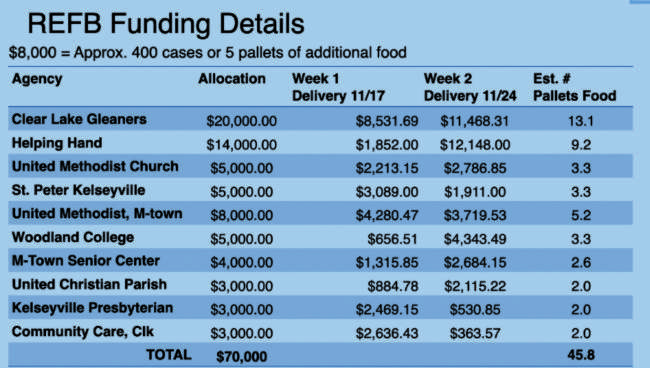
The workgroup spent another $9,500 ordering five pallets of “Meals Ready to Eat,” or MREs, to be distributed among eight sites around the county including all Peers Support Centers, Behavioral Health in Lucerne, and Social Services in Lower Lake, at approximately 250 MREs per site.
However, shipping has been delayed several times and the MREs had not yet arrived by Tuesday, Dillman Parsons said.
The remaining $500 was used to purchase 50 10-punch bus passes to help individuals without transportation reach food distribution sites.
So far, food distributors say they have seen “unprecedented demand” and “never-before-seen length” of food lines, according to Dillman Parson’s presentation.
Just last week, Clear Lake Gleaners and its sub-contracted sites reported serving a total of 1,753 meals around their nine sites.
“I’m surprised at the Finley numbers,” Supervisor Helen Owen said of the 793 individuals served at the site.
Dillman Parsons said it’s their main site so “people from everywhere will come there.”
Still, the overwhelming demand for food was not completely fulfilled.
“We talked to them to serve about 600 on that day, and had to scramble to get the other 193 bags together…and still have to turn people away,” said Social Services Program Manager Tera Gandolfo of the Finley situation.
It was estimated that 20 individuals were left unserved at the site, although Dillman Parsons said the Gleaners did not have a mechanism to track exactly how many families were turned away.
Gandolfo recalled the day directing traffic for the site on Thursday, Nov. 6, when the federal government was still in shutdown and CalFresh benefits had not rolled out.
“Thank everybody for their time, for being out there in the cold and potential rain," Gandolfo said. “Also they came two plus hours earlier than they normally do, because they knew it was going to be a heavier request from everybody.”
She continued: “And the line didn't stop, and it went all the way down their street and around the corner, and it just didn't stop.”
Find most updated food distribution information and Thanksgiving community meals on the Social Services Department’s Facebook page.
Food insecurity lingers into future uncertainties
While the federal government reopens and food benefit distribution has resumed, concerns over long-term food insecurity still persist, along with other complications.
During public comment, Margaux Kambara noted the additional challenges faced by immigrants in need of food.
“It would be helpful for the ad hoc committee to remind partners that some neighbors with immigration issues do not feel safe picking up food supplies; measures that partners can take to keep neighbors safe are appreciated,” she said. “Measures such as identifying private or employee only spaces at food distribution sites would go a long way.”
Supervisor Bruno Sabatier noted that even though SNAP benefits are currently budgeted through September of next year, that doesn’t guarantee there won’t be problems over food benefits again if another shutdown begins on Jan. 31, when “some more politics is being played.”
“So I just think we need to be prepared, because we know Jan. 31 it's probably going to happen again,” he said.
Lingzi Chen is a staff reporter at Lake County News and a 2024-2026 California Local News Fellow. Email her at lchen@lakeconews.com.