 How to resolve AdBlock issue?
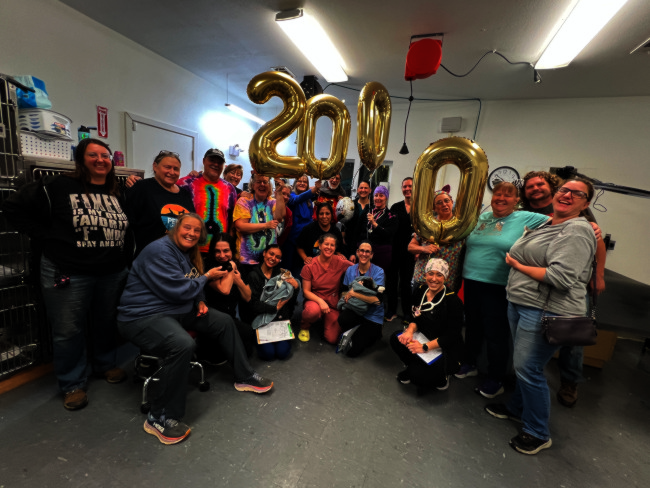
KELSEYVILLE, Calif. — Last Sunday afternoon, as the final day in its latest three-day spay/neuter clinic was drawing to a close, it was clear that the SPCA of Lake County had a lot to celebrate.
For one, while there were still 16 community cats queued up waiting for surgery, by the end of the day they would have completed care for 89 community cats, free of charge.
“It is the most we’ve ever done,” Fawn Williams, the SPCA board vice president, said, her face lit up with a smile.
Beyond the delight Williams and other volunteers took in that singular victory, it was dwarfed by another fact.
The bigger accomplishment was that, after using additional collaboration and funding support to conduct monthly clinics throughout the year, by the time the November clinic ended — the final one of the year — the little group of volunteers had more than doubled the number of animals served over the previous year.
“We were hoping for 2,000,” said Nancy Johnson, the SPCA board president.
And they did it — spaying or neutering 2,030 animals in 2025. That number includes dogs and cats, owned and feral.
The accomplishment becomes all the more impressive when compared to the 980 animals served in 2024.
“We’re hoping we can pull off 2,000 next year as well,” said Johnson.
An evolving mission
Johnson said the SPCA of Lake County began in 1983.
Over the years, it has operated as an animal shelter and has offered vet services, such as vaccinations.
For a time, it provided animal control services for the city of Clearlake, but terminated that agreement in 2015. In January of that year, the SPCA also closed its shelter. Since then, it also has ended its vaccination clinics.
In a history of the organization offered by Johnson, she said when they closed the shelter knowing that “you can’t adopt your way out of an animal overpopulation” situation.
In the years since, SPCA has focused on spay/neuter services. To do so, it created partnerships with other animal care organizations, including Animal Refugee Response. That group’s grant from Petsmart Charities was, said Johnson, “a perfect fit” for use of the SPCA facility and its volunteers to bring the Clearlake Pet Project to life.
That, she said, began the journey of the only high-quality, high-volume spay-neuter clinic in Lake County.
“Through COVID, through volunteer shortages, through staff challenges, through board changes, SPCA of Lake County proved over and over they are ‘the little clinic that could,’ providing 400 to 600 affordable spay neuter appointments two weekends a month,” Johnson’s history of the group explained.
At the end of 2024, after 980 successful spay/neuter surgeries, Johnson said the SPCA had a question: “We have the facility, we have the surgical staff, we have the volunteer base — what would we need to offer more appointments?”
In answering that question, Johnson said partners were key. So they joined forces with groups including Dogwood Animal Rescue and the Clearlake Animal Association to create Pet Fix Lake County.
She said Pet Fix Lake County contracted with Animal Balance, which brought to Lake County five MASH-style vet clinics that altered 200 cats and dogs in three days.
Animal Balance also educated the SPCA on how to streamline its operations, Johnson said.
Once that infrastructure was in place, Johnson said SPCA created collaborations with funding partners, including Lake County Animal Care and Control, Wine Country Animal Lovers, the Habematolel Pomo of Upper Lake and Dogwood Animal Rescue. That larger partnership provided the funding needed to offer 1,000 spay-neuter surgeries in 2025 at a copayment of only $25 for the client.
Other partners in the effort include Clearlake Animal Association, Humane Society of Inland Mendocino, Kelseyville Lumber, 100 Women Strong, city of Clearlake, United Spay Alliance and 100 Bucks Strong.
North Bay Animal services, which has held the animal control contract for the city of Clearlake, has spent $7,000 to $8,000 for spay and neuter services for animals in its care, Johnson said.
That funding is critical because Johnson said the full cost of a three-day clinic is up to $40,000. They spent close to $8,000 just on Nov. 16.
An efficient operation
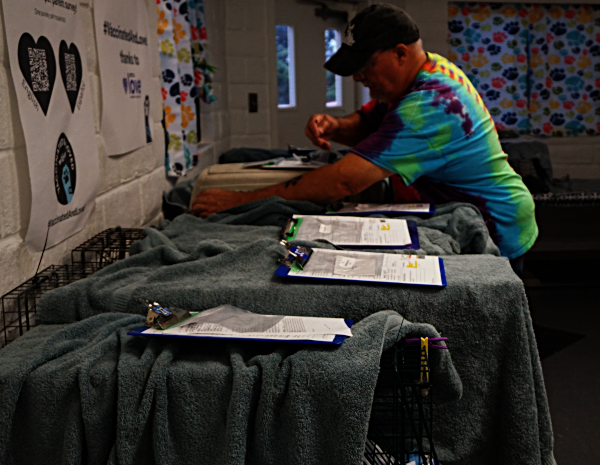
On Nov. 16, SPCA’s spay/neuter clinic was running at high capacity, with volunteers and the vet staff moving efficiently through a routine that they have perfected.
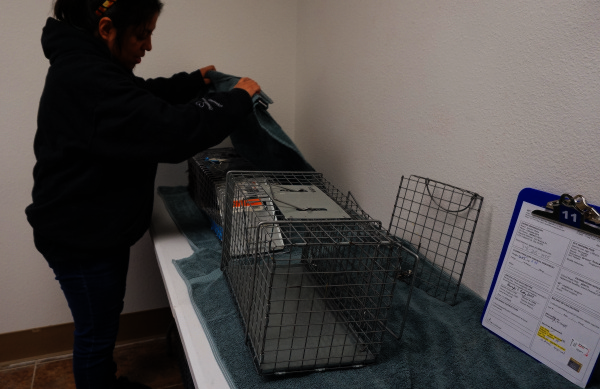
When the cats come in, held in the correct traps for feral cats, they’re taken into a room where they are weighed and then moved into squeeze traps that allow vet staff to safely handle them while prepping for surgery.
Adriana Hermosillo, an SPCA board member who is known as the “Transfer Lady,” showed the process of moving the cats to the cages.
From there, the cats wait to be taken in for surgery and prep, with volunteers and vet techs getting them ready to hand them off to vet staff.
That day, they had vet techs from Lake, Mendocino, Sonoma and Sacramento counties, Williams said. They brought not only their skills but, in some cases, additional equipment, like squeeze cages.
“It's a community group effort,” said Williams.
One of the vet techs, Rebecca Bloomquist — who is credited with having designed the SPCA’s surgical and operational layout — was working on anesthesia. Williams said they call Bloomquist “MacGyver,” a reference to the 1980s TV character known for being able to improvise solutions to tricky problems.
All three vets working at the clinic that day came from Sonoma County.
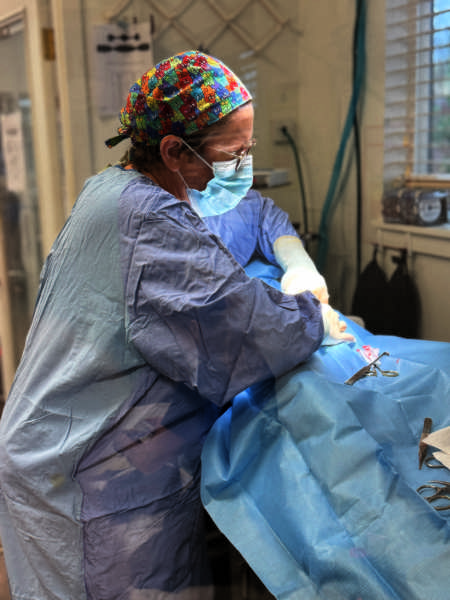
They were led by Dr. Jennifer Eisley, who has been SPCA’s regular vet for eight years. She was joined by Dr. Carley Boyd, who grew up in Lakeport and now works at Central Animal Hospital in Petaluma, and Dr. Lauren Pangburn of Alderbrook Animal Hospital in Santa Rosa.
The operations move rapidly. Once the animals are prepped, Dr. Eisley said that, on average, it takes about 30 seconds to neuter a male cat and six to 20 minutes to spay a female cat. However, she cautioned that those estimates depend on a variety of circumstances. Males, she added, take longer to prepare for surgery.
After surgery, the cats were handled by the recovery team, which gave them vaccines and fluids, and heat support.
Then it was back into their cages to fully recover and wake up from the anesthesia.
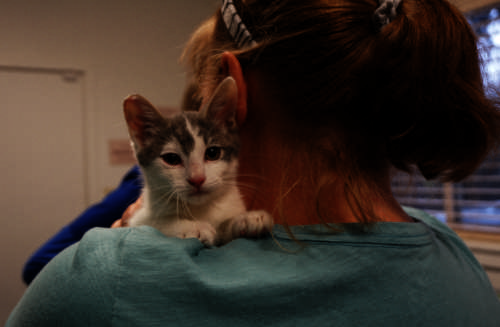
One friendly male kitten was happy to get out of his cage and be cuddled by Williams. And then it was back in the cage for rest and a snack.
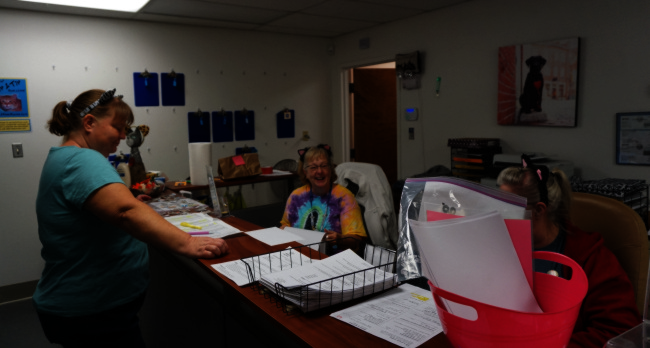
Williams said the entire operation is 100-percent volunteer, adding that without volunteers, none of it could be done. She added that she thinks people don’t know about how volunteers make the SPCA’s efforts possible.
Looking ahead
The SPCA points to the need for collaboration and volunteers. “Partnering is really the key to our continued success,” said Johnson.
This year their members attended the concerts in the park in Clear Lake and Lakeport to share information about their services and get more people involved in their work.
Johnsons said the experience, education and connections SPCA received throughout 2025 will carry over into 2026, with more veterinarian partnerships and volunteers, and with generous donors.
SPCA has two more Pet Fix clinics scheduled for 2026 and many multiple vet clinics scheduled for the benefit of owned cats and dogs and community cats.
Lake County Animal Care and Control has applied for a grant to help cover costs in the coming year, Johnson said.
Volunteers said it will take a few years of steady work on spaying and neutering to get caught up with a backlog in cases across Lake County.
They said that backlog is partially the result of the COVID-19 pandemic, as well as the sudden death in March of 2022 of Dr. Richard Bachman, a veterinarian who played a key role in establishing and running the clinic at Lake County Animal Care and Control and expanding its services. The county has still not been able to find another vet to continue the work that Bachman started, meaning many of its services have not resumed.
In order to fully address Lake County’s spay/neuter needs, SPCA staff and volunteers there needs to be another low-cost clinic available, in addition to theirs, and more vets.
“That is the bottleneck. There’s just not enough,” said Johnson.
Still, the SPCA of Lake County’s impact is being noted. Greg Stanley, a volunteer who also works with the group Street Dawgs, said other counties are watching what the group is doing.
Johnson said they're trying to figure out how to expand service in the current footprint that they are in.
She circled back to the importance of volunteers, who give thousands of hours to the work of addressing Lake County’s pet overpopulation challenges.
“This is just the hardest job you’ll ever love,” said Johnson.
Volunteers like her will go home exhausted after a clinic, but she says they know they are doing something important.
How you can get involved
If you would like to volunteer, the basic commitment is a four-hour shift once a month. However, volunteers can work longer if they desire.
To apply, visit the SPCA’s volunteer webpage.
To donate funds, visit the SPCA’s donations page and donate online or mail donations to SPCA of Lake County, P.O. Box 784, Clearlake, CA 95422.
Donations also can be made by purchasing items on SPCA’s Amazon wish list.
Staff said equipment like cages also are always needed.
Email Elizabeth Larson at elarson@lakeconews.com. Follow her on Twitter, @ERLarson, and on Bluesky, @erlarson.bsky.social. Find Lake County News on the following platforms: Facebook, @LakeCoNews; X, @LakeCoNews; Threads, @lakeconews, and on Bluesky, @lakeconews.bsky.social.