How to resolve AdBlock issue?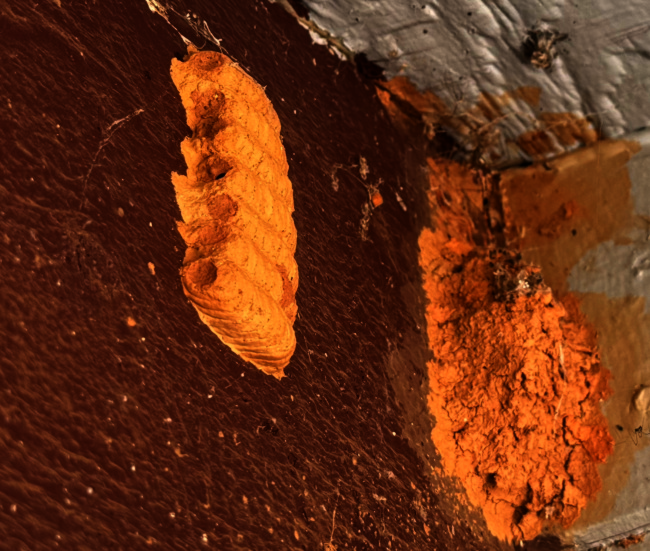
Of the over 4,000 known species of wasps in California, two are known as mud daubers: Sceliphron caementarium (black and yellow mud dauber) and Chalybion californicum (blue mud dauber).
Mud daubers get their name from their habit of using mud to build their nests, while most wasp species use wood pulp for nest construction. If you ever get a chance to see the nest making process, it is a sight that inspires awe and appreciation for these hardworking builders.
Blue mud daubers look intimidating, but if you set the fear aside, they are exquisite, with metallic blue-black bodies and iridescent wings that shimmer in the sunlight. Their threadlike waists are part of what makes them look menacing, but also add to their elegance.
Black and yellow mud daubers don’t have the iridescent flair of the blue, but are beautiful in their own right. They are mostly black with small yellow markings on their thorax and abdomen, the yellow being more pronounced on their legs. Their long threadlike waists give them an overall slender appearance, and they have beautiful tawny-colored wings.
Despite their intimidating appearance mud daubers are very docile, and extremely unlikely to sting a human unless provoked or accidentally smooshed.
Mud daubers are solitary wasps, and unlike social wasp species, do not tend to be as protective of their nests. This is likely because without strength in numbers they are better off fleeing rather than fighting a threat. When a nest is disturbed, they will often abandon the nest and rebuild elsewhere. So, unless you are a spider, be not afraid.
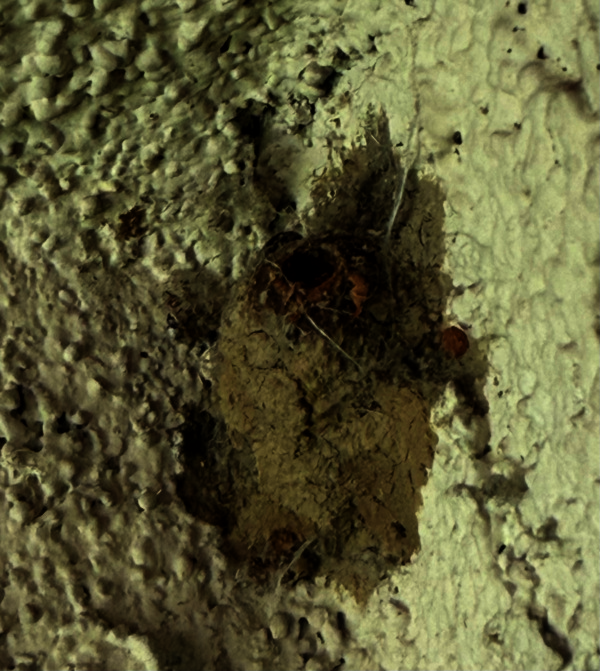
Both species can be found in a variety of habitats and build their nests in sheltered locations. Their nests are commonly found under eaves of buildings, under bridges and even in sheds. In natural settings they nest under rock overhangs or in hollow trees.
In both species, it is the females who are the builders. They seek out nesting sites with access to mud and ample spiders and begin construction by gathering mud from nearby creek beds or puddles. She uses her mandibles and front legs to form a compact ball of mud and saliva which she carries back to the nest in her mouth.
At the nesting site, she makes a high-pitched sound by activating her flight muscles, causing her head and mandibles to vibrate rapidly, which helps her to shape and spread the mud evenly into a tubelike chamber.
She will add mud until the chamber is large enough to contain an adult wasp, usually 30 to 40 mud foraging trips. A finished nest is made up of 6 to 25 of these individual chambers, painstakingly built over the course of several days with hundreds of trips to gather mud.
Once an individual cell is complete, she will begin to provision it with food for her egg. While adult mud daubers feed primarily on nectar from flowers (their threadlike waist or petiole is too small to process solid foods), their larvae exclusively eat spiders.
Because the larvae require fresh food, dead spiders won’t do. Instead, she will hunt and sting a spider, using venom to paralyze it, and bring the immobile but very much alive spider back to the nest, where she will stuff it into the chamber.
This continues until the chamber is full of spiders, sometimes up to two dozen. Once filled, she will lay a single egg on the spiders, and seal the chamber with more mud before moving on to the next cell.
The egg hatches about three days later, and the larva will begin eating the spiders over the next two weeks, until the larva spins a cocoon, where it will undergo metamorphosis before emerging as an adult the following spring or summer.
Blue mud daubers, in addition to building their own nests, seek out abandoned nests from other species to conserve energy. Sometimes blue mud daubers will even take over an active nest of another species, especially the nests of black and yellow mud daubers. They will use water to moisten and break into the nesting chambers, remove materials, add new spiders and lay their own egg inside.
Black and yellow mud daubers seek out smaller spiders such as orb weavers, crab spiders, and jumping spiders whereas blue mud daubers are known to hunt larger and venomous spiders, their preferred prey being black widow spiders. Blue mud daubers are the primary predator of black widows and help keep their numbers in balance.
Adult mud daubers only live between three to six weeks, but during that time they are amazingly productive, providing ecosystem services such as pollination, and spider population management and interesting bug watching for those so inclined. They also manage to make amazing architectural structures. They are good neighbors to us.
Alarmingly, insect populations worldwide are significantly on the decline due to habitat loss, pesticide use and climate change. One way that we can help our insect neighbors (and the species that depend on them such as birds) is by finding ways to coexist.
You can be a good neighbor to mud daubers by leaving nests over the winter, and allowing them to complete their life cycle. Removing spent nests in spring causes no harm, and is generally considered safe. If you are so inclined, you could even leave the spent nests and save them a bit of work next year.
More importantly, think twice before calling a pest control company or spraying pesticides as they cause harm all along the food chain and negatively impact our shared environment. Plus, those spiders might seem pesky, but they are a needed meal for a future pollinator.
Diana Drips is a Certified California Naturalist. Tuleyome is a 501 (c)(3) nonprofit conservation organization based in Woodland, California. For more information go to www.tuleyome.org.