How to resolve AdBlock issue?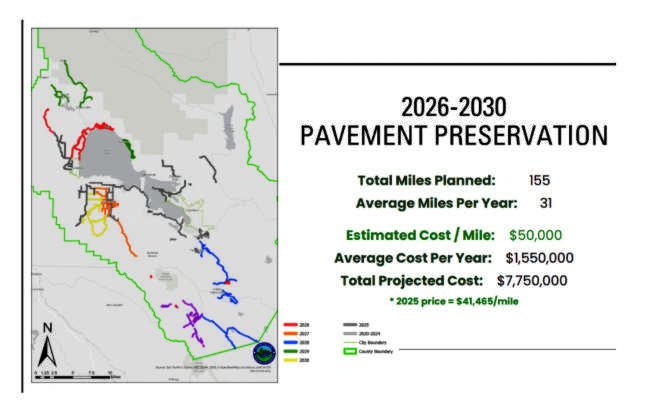
LAKE COUNTY, Calif — The county’s Public Works Department interim director on Tuesday presented a five-year plan to pave county roads, projecting a nearly $8 million investment from 2026 through 2030 — a fraction of the proposals in 2022 and 2023, which officials now say were unrealistic.
Over the next five years, the department plans to pave 155 miles out of the county’s 612 miles of roads, or about 31 miles per year, at an estimated cost of $50,000 per mile.
Total cost is estimated to be $7.75 million, or about $1.55 million annually, Public Works Interim Director Lars Ewing told the Board of Supervisors.
“I’m calling it a realistic and financially constrained plan,” Ewing said. “It is a financially viable plan.”
The work is projected to improve the county’s overall Pavement Condition Index, or PCI — a scale from zero to 100 that rates road conditions — from the current 34 to 48, moving county roads from “poor” to “marginal” by 2030, Ewing said.
While roads across the county need attention, Ewing emphasized prioritizing paving roads by county crews over rebuilding new roads through outside contractors as the most cost-effective approach under a constrained budget.
In 2025 alone, Public Works crews completed pavement preservation on 38.5 miles of county roads at a cost of $1,597,616, or $41,465 per mile. The department averaged 17 miles per year from 2020 through 2024.
County road finances
Each year, road work receives about $8.1 million in total funding, with roughly 70% going to the department’s routine operations and administration, according to Ewing.
That portion covers salaries, services and supplies for the county’s 28-member road crew, which handles tasks such as repairs, dura patching and sign striping.
“So this is the bulk of where the work really hits, where those 28 crew members, day in and day out, are handling it,” Ewing said.
Funding sources for these routine operations include property taxes, the state’s Highway Users Tax Account, federal gas tax allocations, and other grants and miscellaneous programs.
Of the remaining 30% of funds, 12% is allocated to capital improvement projects and 18% to pavement preservation, all funded through California Senate Bill 1, or SB 1, the Road Repair and Accountability Act enacted in 2017.
SB 1 allocates a portion of fuel taxes and vehicle registration fees to road maintenance, repairs, and transportation infrastructure improvements.
Ewing said the plan in his presentation focused solely on the county’s in-house road work carried out by the crew, which centers on pavement preservation, and did not include capital improvement projects, which are typically contracted to outside construction firms.
“We get more bang for our buck with our crew, and that's where I'd like to maximize it,” Ewing said. “That's where we want to spend our money, preserving our infrastructure, rather than — I’d say — building new.”
Cost of contracted work
Indeed, contractors cost more.
Immediately following the presentation of the five-year plan, the board considered a separate Public Works agenda item requesting an additional $311,850 for a contract change order on the 2024 Pavement Rehabilitation Project in Cobb, which covers 16 miles of county roads.
In 2024, the county awarded a $5.1 million construction contract to Argonaut Constructors for the project, scheduled to be carried out in summer 2025.
However, Cobb residents soon reported quality issues with newly paved roads, prompting Ewing and county officials to order the project paused.
During a board discussion in September, officials determined that the “double chip seal” used on the roads was not durable. Supervisors directed staff to redo the roads using a two-inch asphalt overlay, resulting in a change order that increased the contract cost to more than $6.1 million.
At the time, Supervisor Bruno Sabatier criticized the county’s oversight of the project.
“We failed,” Sabatier said. “We had plans made available to us. We approved these plans. Two directors have gone through these plans and continued to push forward with these plans, and now we’re saying something went wrong.”
Coming back with the request for additional money, “Just due to adjustments in the road, there were imperfections in the road, more asphalt was needed to complete the remaining four roads,” Ewing told supervisors on Tuesday.
The Board of Supervisors approved the request unanimously in four minutes, with no questions asked.
Sabatier wanted it to proceed even faster.
“We need to figure out a future process to allow you to finish a project and maybe give you a 10% wiggle room,” he said. “Because the weather is changing, and so I'm just thinking about the timeline here. Other than that, we have to finish the project, so there's no question to it.”
The contract now sits at $6,453,941.38 for 16 miles of Cobb roads, averaging just above $400,000 per mile.
Supervisors question district rotation in road plan
At the end of the September discussion on the Cobb project, District 3 Supervisor Eddie Crandell, whose district has the lowest PCI, reminded the board that road challenges extend beyond Cobb.
“I'm not trying to go against this project; I support it. I just want to emphasize that I just want these to get done, so my district can get a higher PCI code,” he said. “I only say that just to kind of stand on a soapbox, not trying to go against this.”
A similar discussion surfaced at the Tuesday meeting.
Looking at the color-coded map that lays out the next five years’ plan in pavement preservation work, District 1 Supervisor Helen Owen questioned why after “two years worth of money spent in Jessica’s district — District 5,” it is coming back to the district again in 2027, before going to District 1 in 2028.
Owen said that Crandell and she “both need some attention in our districts early on.”
Ewing said that the schedule for the road work is “not based on any preference or priority for one district or another; this is looked at from a network perspective.”
Road Superintendent Jim Hale responded that in 2025, “we did 22 miles in District 1.”
In 2024, Hale said, the crew did not chip seal. “We were in preparation for this chip seal and the preparation work for Cobb,” he added.
In 2026, some roads in District 3 and 4 are going to “get chip seal done as well,” Hale said. “So that was just the rotation.”
He later also mentioned that the Lucerne area — also under District 3 — will be covered later in 2029.
“I just had to remind that my district is like the lowest [in PCI] — not saying it takes precedence,” Crandell said, suggesting that there are specific roads that really need attention and the plan shouldn’t focus on just one area.
District 5 Supervisor Jessica Pyska asked about the criteria used to determine which roads to work on.
“This was more of a boots-on-the-ground,” rather than having a formula and a computer to spit out the answer, Ewing said.
“There is a cost to road work that we need to put away our differences as district supervisors and really just look at it from a county perspective,” said Bruno, whose district does not have any work plan on the map.
“Where can we make a difference and focus on those roads to do a chip seal that will give us seven to 10 years of lifespan without having a pothole every day or throughout the whole winter?” Hale said of the considerations in planning out the map.
Ewing calls prior road plans unrealistic
At the beginning of his presentation, Ewing referenced past pavement preservation plans that he said “may have been either misrepresented or misinterpreted.”
Later as he responded to questions related to previous plans, he criticized them more explicitly.
In 2022, then–Public Works Director Scott De Leon proposed spending $84 million over five years — more than 10 times the current plan.
At that time, the Board of Supervisors did not question the feasibility of the proposal. Instead, they reached a consensus to ask De Leon to formalize the plan with a resolution.
Under direction from the board to present a 10-year plan in 2023, De Leon returned with a proposal to spend $102 million over the next decade, accompanied by maps outlining the work, Ewing recalled.
“Those maps were a hope and a dream — I’m being perfectly blunt,” Ewing said. “So my plan today was realistic.”
Still, supervisors raised concerns about whether existing funding sources could hold up over time, even for Ewing’s scaled-back plan.
They also pointed to a consensus reached in May to pursue a preliminary feasibility study on a potential special sales tax to fund road improvements.
At the time, Glen March, then director of the department, was given six months to work on the task. However, he was soon terminated in June, after just a year on the job.
March was hired in June 2024, following De Leon’s retirement.
Ewing said he was not aware that the special sales tax study was “a point of emphasis” as he took the role as the interim director, noting the department has been in transition.
“It's not going to happen for next upcoming year,” Sabatier said. “It's way too late in the game to get something on the ballot, but we still need to have that conversation.”
“I knew that we missed the date on bringing that back,” Owen said. “But that's something we really should be looking at too to be able to handle the finances of what our roads are needing.”
“If that's the board's direction, then that's what staff will do,” Ewing said.
At the end of the discussion, all supervisors commended the road crew’s work, especially as winter approaches.
“Keep up the hard work,” Sabatier said. “The more we do in-house — and I say this, and I know it sounds kind of bad — the ‘cheaper’ it is than paying for a contract.”
“Economical,” Crandell interjected, suggesting a good replacement.
Email staff reporter Lingzi Chen at