How to resolve AdBlock issue?
 LAKE COUNTY, Calif. – What led to the Lake County Community Development Department’s deficit just months after approval of its final budget, necessitating a loan request to the Board of Supervisors to support the department’s operations?
It wasn’t just a drop in building permits that drove the Community Development Department into the red. It was a years-long practice of spending about $1 million in Building Division reserves to prop up other divisions, officials revealed in December.
When the Community Development Department, or CDD, requested a $390,000 emergency loan from the county on Nov. 18 to meet payrolls amid a budget deficit — just two months after supervisors approved a “balanced” budget — CDD Director Mireya Turner attributed the shortfall to “a significant drop in building permits.”
But on Dec. 9, staff exposed a deeper structural issue at the Board of Supervisors meeting: The department’s Building Division, which is funded primarily by building permit fees, had been effectively using the division reserve to subsidize the Planning and Code Enforcement divisions for multiple years until the reserve was drained.
The years-long transfer of Building Division reserves within CDD went through multiple budget cycles without being identified and corrected by the county’s budgeting process that involved the department, the administrative office as well as the Board of Supervisors.
While the board directed staff to provide further analysis in January, questions regarding the legality of transferring division reserves remain unanswered, as does the concern of paying back general fund loans using income from future permitting costs.
“The source of this problem is a slow and steady trend of reserve spending,” CDD Deputy Administrator Shannon Walker-Smith told the board on Dec. 9.
“Most of that is due to contributions to Code and Planning department operations that began in Fiscal Year 2022-23 when Building’s reserves have gotten significantly high,” Walker-Smith said, indicating that the Building Division’s reserve got up to over $900,000 at that time.
“So the Community Development [Department] was directed to start spending down those reserves as was appropriate at the time,” she said. “Unfortunately, that spending continued.”
Deputy County Administrative Officer Casey Moreno later cited a higher figure, saying more than $1 million had been internally transferred to cover salaries in the receiving divisions.
“Over the past three years, about $1.1 million has been transferred as contributions to those divisions, while just over a million was for salaries,” Moreno said. “Last year, the amount transferred to Code nearly doubled.”
“We did know reserves were spending down, you know, at a rate that was unsustainable,” Walker-Smith said during her presentation. “But it's very difficult when most of the budget revenue is locked up in salaries and other obligated expenses.”
Department records showed the internal transfer of reserves, labeled as “contributions,” started as early as fiscal year 2020-21 at about $400,000 and peaked at almost $800,000 in fiscal year 2023-24.
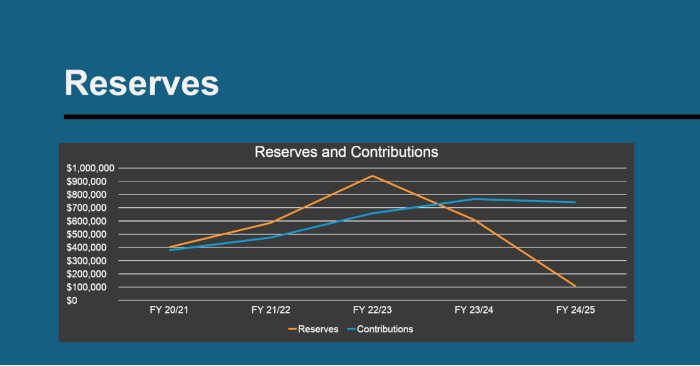
Fiscal year 2023-24 “would have been a good time for us to start looking at course correction,” Walker-Smith said. “But unfortunately, that did not happen.”
Turner admitted that it was her “error” as the department head to “take on the direction of spending down the reserves without a proper full-circle understanding of where that stops and like the long term use of those reserves,” she said. “So I do apologize for that.”
The admission marks a distinct shift in the department's narrative over just three weeks: what was first presented as an external shock — a drop in permitting revenue — is now acknowledged as a result of internal financial decisions.
Lake County News reached out to the county asking about the conflicting explanations of the CDD’s deficit.
Chief Deputy County Administrative Officer Matthew Rothstein, the administrative office’s spokesperson, said the CDD staff shared “initial impressions” in November with the intent to conduct further analysis.
“From a budgetary standpoint, revenue did not support appropriations,” Rothstein said in an email on Dec. 11, indicating the department was spending more than it was bringing in. “However, further analysis revealed reserve spending in recent budget years was the greater concern.”
“Director Turner acknowledged that the recent investigation had grown her understanding,” he added.
The financial “course correction” that officials admit was needed years ago appeared to be happening now.
“Immediately, we have a pause on all intradepartmental funding,” Walker-Smith said. “So no more contributions from Building to Code and Planning, beginning this entire fiscal year.”
However, the sudden stop of these internal transfers creates an immediate hole in the Code and Planning budgets, which rely on that money for salaries.
“That’s a direct 100% hit to the general fund that obviously we don't necessarily have,” said Assistant County Administrative Officer Stephen Carter. “We need to work out part of that plan at the same time.”
Carter suggested coming up with a CDD plan, not just a plan for the Building Division.
Staff from the CDD, Administrative Office, and County Counsel are scheduled to provide further analysis of the financial problem, repayment plan, and legality at the Board of Supervisors meeting this Tuesday, at 2 p.m.
Repayment proposal: Extended from one year to three years
The resolution of the CDD loan approved in November requires a full payback by June 30, 2026 — the end of the current fiscal year.
“We do anticipate a return to historic norms of permitting in the future, and are confident that we will be able to repay this loan within the fiscal year,” Turner said.
All supervisors at that time said they were skeptical about the viability of the plan. Nonetheless, they voted unanimously to approve the request, with Supervisor Eddie Crandell absent.
“Obviously we have to do something; We’ve got to make payroll,” Supervisor Brad Rasmussen said back then.
“But I don’t see how we’re going to get paid back,” Supervisor Jessica Pyska added.
In December, staff reiterated that confidence — but with a significantly extended timeline.
“We do think we can recover and rebuild this budget within a three-year period,” said Walker-Smith.
Carter said the reason for the three-year proposal is because the department needs to build back their reserve which is now depleted.
Without recovering the reserves, “every July, they’ll have a cash flow problem where they would need a loan of about two months worth of salary,” Carter said. “So that's why, at the same time as paying us back, you need to put a little bit in reserve.”
Supervisors were less skeptical about the longer repayment timeline.
“I’m comfortable with the three-year repayment, because I think it's important to be able to build reserves while at the same time paying that back,” said Supervisor Rasmussen.
Still, Supervisor Bruno Sabatier warned that there is an opportunity cost with loans the county gives out.
“Anything that we loan out is coming out of our general fund reserves,” he said, adding that these reserves are being invested and generating revenues in the pool. “We’re losing that.”
He continued: “We’re handing — wrong term — we are ‘providing support’ in loans which take away from our taxpayers’ dollars to be invested and create more dollars to put back into services, into our community.”
“So the longer the loan is, the more we lose out on those opportunities,” Sabatier added.
Right now, the county has given out two loans to avoid disruptions in departmental operations.
In addition to the $390,000 lent to CDD, the Board of Supervisors in June approved a $2 million loan to Behavioral Health which initially required payback within 90 days. That deadline was not met.
In September, the board approved a 180-day extension for the repayment with Sabatier the sole dissenting vote.
The December meeting did not result in any formal changes to the CDD’s loan agreement.
Concerns on legality of loan repayment and reserve spending
At the November meeting, Supervisor Sabatier said he had “grave concerns” about a repayment plan that depends on future permit revenues.
At that time, he noted that the county is not supposed to “make money off” the rates on county services, raising doubts on the legality of using future permit revenues to pay for services rendered in the past.
In December, Sabatier brought it up again.
Sabatier said he received a “white paper” from staff saying it is allowable to use permit fees for the loan repayment — and that he disagrees.
“I just don't understand how a developer in March can pay a fee that helps repay for salaries spent in October,” he said. “That, to me, makes no sense at all.”
Sabatier’s concerns were also compounded by the new discovery of reserve transfers and overspending.
“I do still have concerns in the way that we have used our funds, the sense that we've used reserves from Building to help pay for Planning — completely different projects.”
Lake County News requested a copy of the “white paper” from the county after the December meeting. Rothstein said in an email that the document was “not disclosable on grounds including attorney-client privilege and attorney work-product privilege.”
What is the legal justification for using these restricted funds of the Building Division to subsidize other divisions? Has the Board of Supervisors authorized such transfers, or is there a section of county code that permits them?
Lake County News posed these questions in the same request to the county.
Rothstein’s response did not provide an immediate reference to county code. He reiterated the unavailability of a legal explanation. “As previously noted, legal analysis supporting those statements is not disclosable at this time.”
He added that County Counsel Lloyd Guintivano will be prepared to publicly discuss some of the issues in January.
Unanswered questions
However, as of the last public discussion in December, many questions regarding the department’s financial decisions and the county’s budgeting oversight remained untouched:
How had the Building Division accumulated a reserve pool of over $900,000 in the first place? Who or what processes directed and authorized the inter-division transfer of those reserves for years? Why wasn’t a “course correction” made sooner — and why did the Board of Supervisors and county staff only appear to recognize the problem after the division reserve was drained and a loan was needed to cover salaries?
Why didn’t this discussion surface at the June budget hearings — or at least, prior to the final budget approval in September?
“The Administrative Office relies on departments who accurately project their financial needs to sustain operations,” Moreno said at one point, before she went into details of the CDD’s reserve spending. “During the annual budgeting process, we meet with each department to review their budget and as needed throughout the year.”
Later, Turner of CDD briefly brought up the lack of sufficient, productive time with the administrative office during budgeting.
“Additionally, in preparation for this meeting, we have had a number of meetings with admin that have been productive and helpful,” Turner said. “And there, we were able to have the types of discussions that we don't usually get to have when we're preparing a budget, because they're busy with everybody's budgets, and so we get a little bit of time.”
Email staff reporter Lingzi Chen at