How to resolve AdBlock issue?
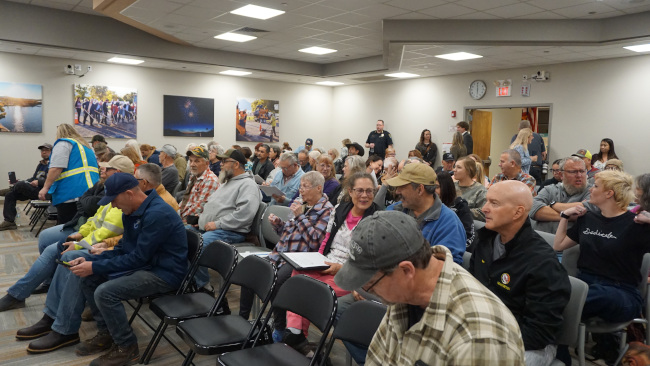
CLEARLAKE, Calif. — Close to 100 community members impacted by a massive sewage spill in the northern part of the city of Clearlake attended a town hall on Wednesday evening to hear the latest about efforts to test wells and help residents try to get back to normal.
Wednesday marked 10 days since a 16-inch force main operated by the Lake County Sanitation District ruptured in the area of Robin Lane in Clearlake, spilling an estimated 2.9 million gallons during the 38-hour period of time in which repairs were underway.
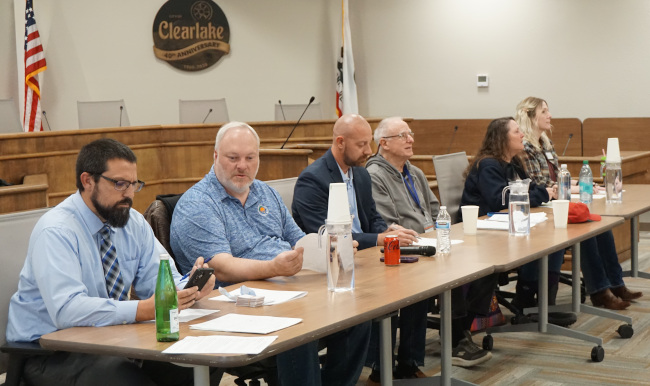
The town hall, held at Clearlake City Hall, featured updates from county officials and comments from the city manager on the ongoing efforts to clean up the nearly 300-acre spill area and test and clean nearly 100 private wells. A similar town hall was held the week before at City Hall.
Among the updates on Wednesday was that the recovery is now transitioning to being led by the Health Services Department, with Lake County Special Districts — which oversees the Lake County Sanitation District — to continue its mitigation efforts.
District 2 Supervisor Bruno Sabatier said the spill, which began on the morning of Sunday, Jan. 11, was stopped on the night of Monday, Jan. 12, and the cleanup started on the morning of Tuesday, Jan. 13.
Environmental Health is taking the lead on well testing. Department Director Craig Wetherbee said the first week of testing was a blitz to try to get as many sample points as possible.
During the question and answer portion of the meeting, Wetherbee said that of the 94 wells tested, 39 were found to be contaminated with E. coli and coliform. Of those, four came back with testing levels so “astronomically high” they were outside of the scope of the test.
Starting this weekend, drillers and pump teams were in the spill area, shocking — or treating — 51 wells.
He said the effort is focusing on what level of contamination is now present in the wells. Fresh water comes into the aquifer and will push out contaminated water, but Wetherbee said they’re not sure of how rapidly that's happening.
Some of the test results are encouraging, not showing contamination which Wetherbee said is a good sign for the aquifer. If the sanitized wells have clean testing results, he said that will show the aquifer is clean.
Once the wells start getting two clean samples in a row, county officials can start to lift the prohibitions against using the well water, he said.
“I’m actually really encouraged,” Wetherbee said, noting that the process will take time but it’s heading in the right direction.
Then, there is still the ground surface to deal with, and Wetherbee said the warm weather and sunshine is the best thing that could have happened. That’s because more ultraviolet light and heat leads to bacteria dying faster.
Wetherbee said the viable lifespan of E. coli already has passed, and other pathogens from the wastewater are closing in on the end of their lifecycles as well.
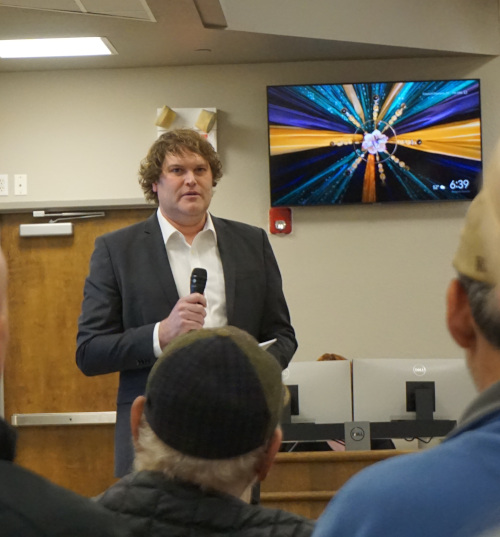
Special Districts Administrator Robin Borre, who made her first town hall appearance on Wednesday, said only 3,900 gallons of wastewater made it into the nearby creek. Preventing more of it from going into the creek was what she called a “heroic feat” by her staff.
She said that by Tuesday, Jan. 13, most of the wastewater had been removed from the spill site.
However, in the audience, spill area resident Cassie Hulbert — on hearing Borre’s statement — shook her head and mouthed “no.”
Borre said her team has been working on surface decontamination — pastures, driveways and roadways. Contaminated soil will be removed and replaced with clean backfill. Wetherbee later explained that contaminated soil will be taken to Special Districts and placed in a lined pond.
Crews on Wednesday dug up a 10-inch valve that had been patched after a spill several years ago and replaced it with a new pipe, Borre said.
Special Districts staff also have been assisting with moving livestock out of harm’s way and providing water for them.
Public Health Officer Dr. Bob Bernstein said wells are being tested for E. coli and coliform, which can get into wells with damaged lids and casings. So far, public health monitoring of emergency room visits has not found any cases of illness associated with exposure to wastewater.
City Manager Alan Flora said his heart goes out to the people who are impacted, and he recognized the enormous frustration and need due to the situation.
“I’m going to be really blunt. I’m pissed about a lot of things, too,” Flora said.
He told residents that while they can’t see everything that is happening, there are a lot of people fighting for them.
Flora said he’s been participating in daily briefings with the county, and the city is prepared to respond and assist.
He noted that the Clearlake City Council has been concerned about the system for some time and is engaged going forward.
State Sen. Mike McGuire was in the city on Sunday and Congressman Mike Thompson has been reaching out to the city and county every day to ask what he can do, Flora said.
The city and Konocti Unified School District will host a dinner for impacted residents at Burns Valley School on Thursday evening.
“We love Clearlake,” Flora said, adding that city staff are working every day to make the city better.
Officials explain next steps
Sabatier, in explaining the next steps in the response and recovery process, said the Board of Supervisors earlier that day approved up to $750,000 to be utilized for buying water tanks for residents, with pumps to connect the tanks to homes. By that time, he said some tanks had already been installed.
He said there are conversations about long-term planning and how to prevent — or be better prepared for — such incidents in the future.
Wetherbee responded to questions about ongoing well monitoring. He said monitoring will be long-term — for years — but the response itself won’t last that long.
If there is more rain, he said it could cause more contamination, with the bacteria mobilized in the soil.
Wetherbee said many of the wells in the spill area are very old — some having been sunk in the 1940s — and therefore they lack the sanitary seals that didn’t come into effect until 1981. Additionally, some of them have livestock and septic systems nearby — within 100 feet. Environmental Health is working with property owners to remediate those issues.
Asked about regular well testing, Wetherbee said the United States Environmental Protection Agency suggests it take place once a year. Kits can be picked up at the Environmental Health Office in Lakeport, and usually costs between $60 to $80.
Wetherbee warned of individuals who have been in the spill impact area and representing themselves as contractors, giving property owners bids that he called “extortionist” at best.
The county is paying local companies $435 for each well sanitized, but he said he’s heard of a property owner getting a well sanitization bid for $12,000. Wetherbee urged people to check references and get multiple bids.
Borre received questions about equipment maintenance. She said force main valves — like the one that ruptured — are usually checked yearly, with high priority valves checked every six months.
She said there are 90 miles of gravity line in Clearlake, running from Lower Lake to Lake County Sanitation District’s Southeast Regional plant and passing through a series of lift stations on the way.
Gravity lines are easier to investigate, inspect and clean because they have manholes, Borre said. With a force main, there are limited access points because they are underground and under pressure. The series of valves in them is exercised every six months or a year.
Borre said the majority of Lake county’s pipes are “AC” — or asbestos cement — with a lifetime of 70 to 100 years. The system isn’t quite that old yet, she added.
Sabatier said the county is having high level conversations about future spills not impacting the water table. That work could be years in the making.
“Nothing will be happening any time soon,” Sabatier said, noting that no public works project happens overnight.
Email Elizabeth Larson at elarson@lakeconews.com. Follow her on Twitter, @ERLarson, and on Bluesky, @erlarson.bsky.social. Find Lake County News on the following platforms: Facebook, @LakeCoNews; X, @LakeCoNews; Threads, @lakeconews, and on Bluesky, @lakeconews.bsky.social.