
 How to resolve AdBlock issue?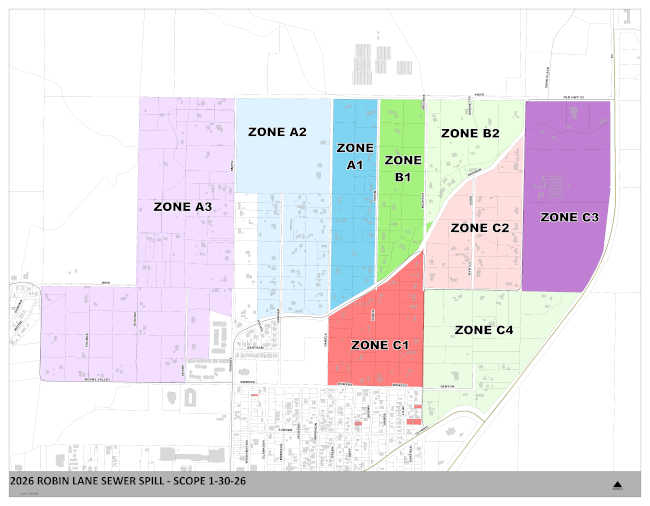
CLEARLAKE, Calif. — Water tank installation resumed Monday for residents impacted by the Robin Lane sewer spill, as well testing continues and officials prepare for another town hall later this week.
After a pause over the weekend, the total number of water tanks installed rose from 25 to 29, with 22 installed by the incident management team and seven by the Lake County Social Services Department.
An additional 22 water samples were collected Monday, bringing the total to 441, up from 419 the previous day.
These samples have been drawn from 151 sites, a number that has remained unchanged since Jan 29, which covers at most three quarters of the properties impacted, according to public data released by officials.
The spill began more than three weeks ago, on Sunday, Jan. 11, when a 16-inch force main operated by the Lake County Sanitation District ruptured on Robin Lane, releasing nearly three million gallons of sewage over a 38-hour period.
The incident led to temporary relocations for some residents who rely on private well water, as dozens of wells were found to be contaminated amid ongoing testing.
The city of Clearlake declared a local emergency on Jan. 12, while the spill was still active, and announced that 58 properties were impacted in the area enclosed by Robin Lane, Pamela Lane, Pond Road and Rumsey Road.
Since Jan. 26, the city of Clearlake and the Lake County Sheriff’s Office of Emergency Services have started leading the recovery operation, establishing a “joint command,” following more than two weeks of immediate response led by the Special Districts.
That day, the city announced that more than 200 properties relying on a private well were impacted by the spill — a significant increase from the initially cited 58.
On Jan. 31, an updated map was released showing nine impact zones totaling an estimated 550 acres — an increase of about 250 acres — on the northern end of Clearlake. The update did not indicate the number of properties affected within the expanded area.
The city’s most recent Frequently Asked Questions document states, “As a precautionary measure, 151 properties that rely on private wells are now included in the monitoring and testing area." This number has remained unchanged since Thursday.
For the first time, the incident management team also reported on Monday the number of wells sanitized, which totaled 65.
After sanitization, a well is deemed safe for use once it receives two negative test results — taken 24 hours apart — for E. coli and coliform, according to City Manager Alan Flora and Undersheriff Corey Paulich, who also is the deputy director for the Office of Emergency Services at last week’s town hall.
At that point, the property owner will be notified with test results and information on how to treat the well going forward.
So far, the city has not publicly released any notices or aggregated data on contaminated wells that have been cleared for safe use in the impacted area.
At the same meeting, Flora said the city has hired a hydrologist to assist with studying the aquifer and understanding the spill’s impact on it.
The fourth in a series of town halls on the spill is scheduled for 6 p.m. Wednesday, Feb. 4, at Clearlake City Hall, 14050 Olympic Drive.
“The hydrologist will be there to speak,” Clearlake Councilmember Tara Downey wrote in a Facebook group called “Robin Ln sewage spill & contamination,” where impacted residents share information.
Water tanks offered to assist affected households
For the past 23 days, households in the impacted areas have not had safe access to their private water wells. Some of them — 29 so far — have had a water tank installed for them that is large enough to provide clean water of a minimum of 60 gallons per person per day as recommended by Public Health Officer Dr. Robert Bernstein.
On Jan. 21, the Board of Supervisors approved an allocation of $750,000 to the Lake County Special Districts to cover costs of purchasing and installing water tanks for impacted residents, as well as refilling the tanks.
“We are out of money; we've depleted our reserves in that district,” Special Districts Administrator Robin Borre said of its disaster response funding at that meeting.
The 34-minute special meeting revolved mostly around water tanks including their quantity, size and costs.
“This money would purchase an extra, I believe, 60 tanks,” District 2 Supervisor Bruno Sabatier said of the initial $500,000 requested at the meeting. “We have a number of the amount of wells that are out there. We're hoping 60, and the program that Social Services is providing will provide what is needed.”
To cover water refilling, “It would need to be raised a little bit, at least to $600,000,” said Assistant County Administrative Officer Stephen Carter.
Sabatier suggested a bigger amount.
“So why not make it $750,000 and if we don't spend it, we don't spend it,” he said. “If we have to spend it, at least it's available so we don't have to have an urgent situation of money.”
At the last town hall, a resident asked how many water tanks out of the 60 had been ordered.
“I'm not sure where that number came from,” said Undersheriff Paulich. “There was never a number put to — we're going to buy 60 tanks.”
Paulich said he did not watch the entire board meeting but he was briefed by the County Administrative Office.
“Five hundred thousand dollars was the original. There was a request for $250,000 more, and that was for the testing and for water supply,” said Paulich. “That's why I've been advised by our County Admin.”
Use of these funds in water testing was neither specifically mentioned during the meeting nor in the resolution document.
Email staff reporter Lingzi Chen at




