 How to resolve AdBlock issue?

CLEARLAKE, Calif. – Residents impacted by the Robin Lane sewage spill will receive home filtration and sanitization systems, officials said Wednesday, as groundwater restoration is expected to take a long time.
After consulting with experts, including a hydrologist, the incident command team determined that groundwater contamination may persist despite temporary negative well test results for fecal bacteria, officials said at Wednesday’s town hall at Clearlake City Hall.
“The path to the aquifer being clear – to the extent that our team and Public Health are comfortable saying your water is safe to drink again, for most properties at least – is going to be an extended period of time,” said Clearlake City Manager Alan Flora at the Wednesday town hall meeting. “Probably months.”
Given the length of time to clear the aquifer, Flora said each impacted residence will be offered a “whole-house filtration and sanitation system that includes sediment and carbon filters and a UV filter.”
These systems are designed to disinfect water that may be "microbiologically unsafe, which is obviously the main issue here,” he said.
“The county will be covering the cost of the systems and the install,” Flora added.
The plan marks a shift from guidance given a week earlier, when officials said a well would be deemed safe for use after two negative test results taken 24 hours apart following sanitation.
“Even if you got a zero-zero test, there could be the possibility of a reoccurrence,” said Undersheriff Corey Paulich, who also is the deputy director for the Office of Emergency Services. “So we don't want to take that chance – so that's why we kind of abandoned that plan.”
Incident team to offer additional equipment
The recovery efforts led by the city of Clearlake and the Lake County Office of Emergency Services, or Lake County OES, follow a massive sewage spill that began nearly a month ago, on Sunday, Jan. 11.
A 16-inch force main operated by the Lake County Sanitation District – overseen by the Lake County Special Districts – ruptured on Robin Lane, releasing 2.9 million gallons of sewage over a roughly 38-hour period.
The impacted area has expanded from the immediate vicinity of the rupture to about 550 acres – illustrated in a large color map hung on both sides of the Clearlake City Hall meeting room – impacting estimated 164 houses relying on private wells.
Residents within the impacted zone remain under a public health advisory to avoid using water from their wells, amid ongoing well tests, sanitization and retests.
According to the city’s latest update on Wednesday, a total of 33 water tanks had been installed to provide impacted residents with sufficient clean water, including eight through Lake County Social Services. The remaining 25 water tanks were installed by the incident management team using funds from the $750,000 approved by the Board of Supervisors on Jan. 21.
A total of 489 water samples had been collected from a total of 151 sites. And a total of 67 wells had been sanitized, up from 65 on Tuesday.
Flora said Wednesday that the plan is to provide filtration and sanitization systems to all residences within the area that need them.
“We are working to identify contractors that will install those units,” Flora said at the town hall. “We intend to work with a large number of general contractors to complete those installs as soon as possible.”
On Thursday, Flora confirmed that 100 units of these systems had been ordered.
“That is what they have available,” Flora said in a text message to Lake County News. “Needed additional units will be ordered once they are available.”
Impacted residents must submit requests for the filtration and sanitization system through the online portal, Flora said. Residents experiencing difficulty accessing the portal may reach out to the city for assistance.
Through the same portal, residents may also request water tanks, well testing and bottled water delivery.
“I know there's a lot of frustration out there from folks. It's taken too long to get where we are now,” Flora said during the Clearlake City Council’s meeting Thursday evening, adding that he’s incredibly proud of city staff who have been supporting the recovery effort.
The sewage spill event “is not something that is really the city's responsibility to deal with but we felt that it was imperative to step in and help the folks that do live within our community,” Flora said.
Flora also explained at the Thursday night council meeting that the hydrologist hired to assist in the recovery, who spoke at the Wednesday night town hall, concluded that “it’s unknown at this time how long it will take the sewer plume to dissipate from the aquifer."
The hydrologist: Impact on aquifer, caution to rainstorm
The incident occurred within the Burns Valley groundwater basin, specifically affecting a shallow alluvial aquifer composed of stream gravel and clay, according to Hydrologist Dr. Annjanette Dodd of Northpoint Consulting, hired by the incident command team to study the spill’s impact on the aquifer.
By analyzing aerial imagery and water quality samples over a 21-day period, Dodd identified two primary plume directions: one moving southeast and another moving southwest through the water-bearing gravel layers.
Dodd said the major challenge in her investigation is the lack of pre-spill data, which makes it difficult for her to “really ascertain baseline conditions.” So the assumption of her analysis: “If I see elevated levels of bacteria – there's something going on in that direction.”
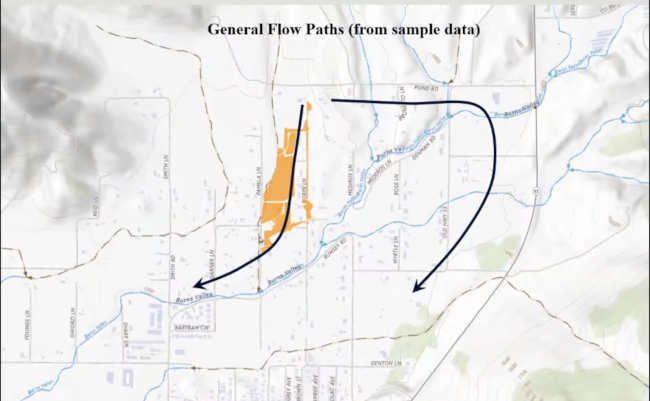
"Shallow groundwater wells are particularly vulnerable to contamination because they intersect the part of the aquifer system that is closest to the land surface, meaning it's less protected by natural barriers," she said.
Later, Lake County Environmental Health Director Craig Wetherbee said that the average well depth is about 74 feet and they ranged "anywhere between 34 feet to 140 feet.”
“Basically anything less than 100 feet is considered a very shallow well and lightly susceptible to surface water intrusions,” Wetherbee added.
Dodd advised residents to adopt a proactive defense strategy with their wells: test well water at least once a year – ideally following significant rainfall – and implement point-of-entry treatment systems. Maintaining the physical integrity of wellheads and seals is critical, she said, as any changes in water taste, odor or clarity serve as immediate warning signs that the well’s natural or mechanical barriers have failed.
In response to a resident’s question on her observation of the movement of the plume, “I'm generally seeing things decrease and the plume slowing down,” she said. “I'm waiting for some more samples.”
As the spill plume moves further away from the ruptured force main, “I'm seeing numbers go down, and I'm seeing the spread lesson,” Dodd said.
“What if we get significant rain?” a resident asked.
“My intuition: if we get rain, we'll see dilution,” Dodd responded, adding that rainstorms will also cause “mobilization of what’s already there in the aquifer.”
“So after a rainstorm, we're going to want to continue sampling to see what things look like,” she added.
The costs of recovery
Cassandra Hulbert, a ground zero impacted resident living on Robin Lane, asked about expenditures related to recovery efforts at the town hall.
“I don’t have that number sitting right here today,” said Undersheriff Paulich, adding that the funds had been used for various expenses, including purchasing tanks and water deliveries. “A lot of that is very expensive.”
Each of the 25 tanks installed by the incident management team costs approximately $8,000, according to Lauren Berlinn, public information officer for Lake County OES, in an email response to Lake County News.
Regarding how frequently the tanks are being refilled for residents and the estimated weekly cost of refilling, Berlinn said delivery is as needed and invoices are still coming in so the cost can’t be calculated yet.
Filtration and sanitization systems cost about $1,800 per home to purchase, while installation costs will not be available until invoices are submitted, Berlinn said.
Flora said the systems carry an “NSF/ANSI-55 Class A” rating and are equipped with monitoring and alarm features that alert homeowners if the disinfection system experiences a problem.
An existing order of 100 units totals $180,000. Combined with the 25 tanks, total invoiced costs for the two items to date are at least about $380,000, according to a Lake County News calculation.
“I’ve requested a financial update,” District 2 Supervisor Bruno Sabatier whose district includes the spill impact area said in a phone call with Lake County News on Thursday.
Sabatier said he expected to hear the update early next week and bring up further requests for funds, if needed, to the Board of Supervisors.
Sabatier also explained that the local emergency declarations have brought assistance from the state departments including Public Health, Water Board and OES.
So far, the governor hasn’t declared a state emergency, which is a prerequisite for federal emergency declaration, according to Lauren Ott, communications director for Congressman Mike Thompson, in a Jan. 21 email response to Lake County News’ inquiries.
“The sewage spill in Lake County is terrible and has disrupted families’ lives and risked making people ill,” Thompson said in a comment. “I contacted Lake County officials immediately upon news of the spill to offer my help if any federal needs arose.”
He added that he had remained in contact with local officials during this cleanup effort, and “prepared to help deliver all available federal resources as needed.”
Lingzi Chen is a staff reporter at Lake County News and a 2024-2026 California Local News Fellow. Email her at lchen@lakeconews.com.