 How to resolve AdBlock issue?
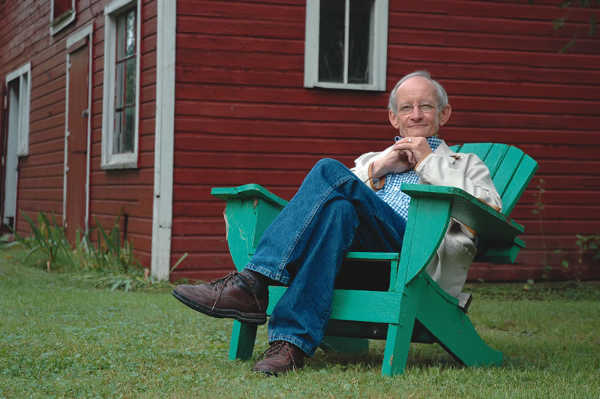
Robert Bly is one of the last living major American poets of his generation, and W.W. Norton recently published his Collected Poems.
I and many other poets of the central states owe Bly, who grew up on a Minnesota farm, a great deal, for showing us how to write about what's around us, the turkey sheds, the great skies, the rain-filled roadside ditches, all of it.
Here's one poem about our life force that I'm especially fond of.
Why We Don't Die
In late September many voices
Tell you you will die.
That leaf says it, that coolness.
All of them are right.
Our many souls—what
Can they do about it?
Nothing. They’re already
Part of the invisible.
Our souls have been
Longing to go home
Anyway. “It's late,” they say,
“Lock the door, let’s go.”
The body doesn't agree. It says
“We buried a little iron
Ball under that tree.
Let’s go get it.”
American Life in Poetry does not accept unsolicited manuscripts. It is made possible by The Poetry Foundation, publisher of Poetry magazine. It is also supported by the Department of English at the University of Nebraska, Lincoln. Copyright © 2018, 2011, 2005, 2001, 1997, 1994, 1985, 1981, 1979, 1977, 1975, 1973, 1972, 1967, 1966, 1965, 1964, 1963, 1962, 1961, 1960, 1959, 1953 by Robert Bly. Used with permission of the publisher, W.W. Norton & Company, Inc. All rights reserved. Introduction copyright @2020 by The Poetry Foundation. The introduction’s author, Ted Kooser, served as United States Poet Laureate Consultant in Poetry to the Library of Congress from 2004-2006.