 How to resolve AdBlock issue?
Arts & Life
- Details
- Written by: Ted Kooser
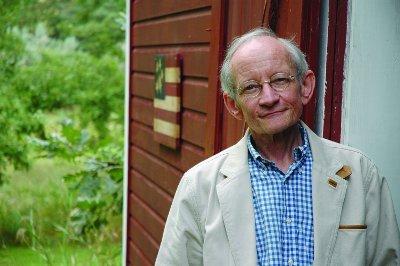
I open every spring with a garden more precisely laid out and cared for than the year before, and by the end of summer it’s collapsed into a tangle of weeds, bugs and disorder.
Here’s Gabriel Welsch, a poet from Pennsylvania, carrying a similar experience right into winter.
A Garden’s End
Forsythia, scaled and bud-bangled,
I pruned to a thatch of leaves
for the curb, by the squirrel-gnawed
corn, silk strewn, kernels tooth carved
and husks shorn over the ground
pocked with paw prints.
The borers mashed the squash vine,
the drought tugged the roots of sage,
catmint languished by the sidewalk,
tools grew flowers of rust.
That winter we left our hope
beneath the snow, loved through the last
of the onions, watched the late leeks freeze
to crystal, bent like sedges, their shadows
on the snow. That winter we left
our hope beneath the snow.
American Life in Poetry is made possible by The Poetry Foundation ( www.poetryfoundation.org ), publisher of Poetry magazine. It is also supported by the Department of English at the University of Nebraska-Lincoln. Poem copyright 2012 by Gabriel Welsch from his most recent book of poems, The Death of Flying Things, WordTech Editions, 2012. Poem reprinted by permission of Gabriel Welsch and the publisher. Introduction copyright 2013 by The Poetry Foundation. The introduction's author, Ted Kooser, served as United States Poet Laureate Consultant in Poetry to the Library of Congress from 2004-2006. They do not accept unsolicited manuscripts.
- Details
- Written by: Lake County News Reports
If you are not getting enough of “Masterpiece” or the running of old episodes of “Downton Abbey” on PBS, then the Starz cable channel has a special treat in the five-episode series “Dancing on the Edge.”
Understandably, Starz is hopefully filling the gap while fans of British period costume dramas await the fourth season of “Downton Abbey,” scheduled to start in January 2014.
Adjusting to a competitive cable marketplace, Starz is just now concluding its series run of “The White Queen,” a British television drama about royal palace intrigue set against the backdrop of the War of the Roses.
Unfortunately, Starz discovered that interesting dramas like “Boss” and “Magic City,” both series set uniquely on the American stage, one involving raw politics and the other the glitter of Miami Beach, didn’t have staying power.
“Dancing on the Edge” may not be a tip of the scales to an Anglophile programming trend at Starz, but there is undeniable appeal to many of the British imports that are now thriving on American television.
Loosely inspired by the true accounts of the iconic Duke Ellington Band mingling with royalty in Europe during the Great Depression, “Dancing on the Edge” is entirely fictional but no less compelling than the obvious societal challenges faced by black jazz musicians during that era.
British actor Chiwetel Ejiofor plays Louis Lester, who starts his own band and dreams of introducing American jazz music to the United Kingdom during the early 1930’s. He’s almost immediately befriended by ambitious journalist Stanley Mitchell (Matthew Goode).
Writing for Music Express magazine, Stanley has an eye for talent. He discovers and becomes enamored with the Louis Lester Band while they are performing in a basement jazz club that apparently caters to more bohemian tastes.
Stanley immediately signs them to headline at the illustrious Imperial Hotel. At first, the hotel’s older, elite audience is hostile or indifferent to the band, owing to racial prejudice and the lack of familiarity with jazz music.
But the younger crowd of aristocrats is enchanted by this new music and invites the members to play at a garden party, where Prince George, the Duke of Kent, is in awe of the private performance, taking notice of the lead singer Jessie (Angel Coulby).
Writer and director Stephen Poliakoff is no stranger to period drama. He penned a note to critics in which he revealed that during research for his drama “The Lost Prince” he discovered that Prince George’s passion of jazz music was absolutely genuine.
Poliakoff learned that Prince George patrolled the clubs of London with his eldest brother David, the Prince of Wales, to explore the music of different bands, and the two princes mixed with the musicians and invited some of them into their homes.
Again, the Louis Lester Band’s interaction with royalty is entirely fictional, but there is little doubt that visiting American musicians like Duke Ellington and Louis Armstrong were given an enthusiastic welcome in London.
Still, against the backdrop of the worldwide financial meltdown of 1929, Britain endured an enormous gulf between rich and poor, and society was torn by racism and prejudice, especially among the aristocracy and the ruling class.
Yet, at the same time, certain black musicians were blending with high society, playing at their parties and even having love affairs with them. The latter is the case when Louis meets attractive society photographer Sarah (Janet Montgomery).
Not only royalty pays attention to the band, the mysterious American mogul Masterson (John Goodman), who loves jazz and resides at the Imperial, senses popular culture and journalism about to explode and he becomes obsessed with potential lucrative opportunities.
Meanwhile, the eccentric aristocrat Lady Cremone (Jacqueline Bisset) known for discovering unknown talent is persuaded by Stanley to become a key player in propelling the career of the Louis Lester Band.
“Dancing on the Edge” is ambitious for the number of stories that are told. It’s about more than the rise of a popular musical genre. Race and class issues run deep throughout.
England in the 1930s was a time when certain musicians could find themselves one week on the verge of being deported and the very next week fraternizing with the ruling elite at a great country home.
Sudden success and the acclaim of London society are heady experiences for the Louis Lester Band. Just at the height of their fame, one terrible event overtakes them and they get to discover which members of their elite fan club are truly genuine in their support.
“Dancing on the Edge,” beautifully evoking the 1930s, is entertaining on many levels, including the mystery element that should remain a surprise. Of course, the music is excellent, making for a terrific soundtrack.
Tim Riley writes film and television reviews for Lake County News.
- Details
- Written by: Editor
HIDDEN VALLEY LAKE, Calif. – A Big Read partnership with Mt. High Coffee and Books will host a young people’s talent show on Saturday, Oct. 26.
The event begins at 7 p.m. at the coffee shop’s Hidden Valley shopping center location, 18983 Hartmann Road.
Dress in costume if you wish and support the student performances to benefit the Middletown Unified School District music program.
The Big Read is designed to restore reading to the center of American culture.
Lake County is one of 77 communities across the country to receive a 2013-14 Big Read grant award.
For more information, visit the www.NEABigRead.org Web site or contact program director for the Lake County Big Read, Robin Fogel-Shrive, at
- Details
- Written by: Ted Kooser

Perhaps you’ve experienced the sudden, unsettling intimacy of putting on somebody else’s jacket and finding a wad of tissue in the pocket. Here’s a fine poem by Debra Nystrom, raised in South Dakota and now teaching in Virginia.
Little Parka
Dream of Mom’s red parka gone—
someone stole it right out of the closet
of the burned-down house—what
good could it do anybody else, broken
zipper that always got caught,
she’d jimmy it loose, just part
of putting it on—and she was so tiny,
the arms too short even for me,
too-tiny gloves in the pockets, thumbs
stubby, practically useless to anyone
but her—they deserve it if they shove in
a hand, find the tissue she used and then
left there who knows which cold day,
what she needed it for, or why.
American Life in Poetry is made possible by The Poetry Foundation ( www.poetryfoundation.org ), publisher of Poetry magazine. It is also supported by the Department of English at the University of Nebraska-Lincoln. Poem copyright 2009 by Debra Nystrom, from her most recent book of poems, Bad River Road, Sarabande Books, 2009. Reprinted by permission of Debra Nystrom and the publisher. Introduction copyright 2013 by The Poetry Foundation. The introduction's author, Ted Kooser, served as United States Poet Laureate Consultant in Poetry to the Library of Congress from 2004-2006. They do not accept unsolicited manuscripts.