
 How to resolve AdBlock issue?
 Arts & Life
The play stars Holman as Daisy Werthan and Robinson as Hoke Colburn, Daisy’s driver. Derrick Harvey plays Bodie Werthan, Daisy’s son. In 2003, during its run on stage in Lower Lake, the play was sold out and ended with standing ovations every night.
During an interview that will air after the play, Joan Holman said that she had “eight decades of experience on the stage” before she played the part of Miss Daisy.
She got her start as an actress at the age of 7, and stayed involved in the theater throughout her life, even while she was working as a reporter for the San Francisco Chronicle for 30 years.
When she retired to Lake County, she was involved in the Ukiah Players Theatre for 10 years before she became involved in the Lake County Repertory Theatre.
About acting, she said, “The character has to come from the actor. I knew Daisy, and I became her.”
Ginger Ingersoll, the producer, said that one of the qualities she liked about the play was that it would give an opportunity for both Holman and Robinson to portray interesting characters.
“Miss Daisy is not a feel good play,” she said. “It’s about a relationship between two unlikely friends – a Jewish woman and an African-American man.”
In the after-play interview, Mary Howe, the play’s director, said that she has been involved in show business since she was 5 years old, growing up in Los Angeles and then studying radio and TV in college. She owned and operated dinner theaters for many years before she moved to Lake County.
Howe said she’s a bookkeeper by trade, and “I’m into detail.” Directing “Miss Daisy” gave her an opportunity to project this story through “one of the best casts I’ve ever had.”
“Driving Miss Daisy” will air as a one-hour play, followed by an hour of interviews and commentary, on Sunday, Nov. 22, at 2 p.m.; Monday, Nov. 23, at 9 p.m.; Tuesday, Nov. 24, at 11 a.m.; and two times on Thanksgiving Day, Nov. 26, at 3 p.m. and again at 9 p.m.
- Details
- Written by: Mary McMillan
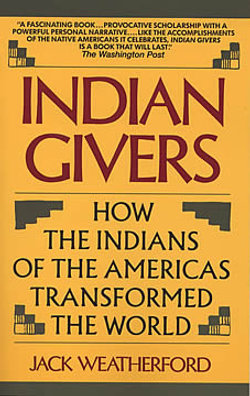
Indian Givers: How the Indians of the Americas Transformed the World
By Jack Weatherford
(NY: Ballantine Books, 1989. 288 pp. $15.00, ISBN-10 0449904962)
Native American Studies/ American History
“Columbus arrived in the New World in 1492, but America has yet to be discovered.” Jack Weatherford’s provocative book “Indian Givers: How the Indians of the Americas Transformed the World” seeks to change that.
He makes the reader aware that the average American today knows more about ancient Egypt “than we know about the pyramid builders of the Mississippi.”
It comes as a bit of a surprise to realize the truth of his statement, but even here in Lake County where the Pomo have lived for 10,000 years, most folks in Lake County probably could tell you more about the pyramids of ancient Egypt than they could tell you about the Pomo people.
Granted, the Pomo did not build pyramids, but they did build a society that thrived for thousands of years – here in the same place we are living today – not thousands of miles away. As a young nation, not even 400 years old, we have much to learn from our elders.
“Indian Givers” explores what modern society has learned from the native peoples throughout the Americas, even if we have not given them full (or any) credit for the original knowledge.
Some of this will not come as any surprise to the reader – particularly in the area of agriculture. It is well known that many new foods were introduced to the earliest European settlers by the natives, corn and potatoes perhaps being the most well known. The immense diversity of foods may come as a shock, however, as well as their impact, not just on the pilgrims, but around the globe.
In recent years there has been a resurgence of using herbal remedies but the surgical skills of the Aztecs far surpassed simply knowing which bark made good aspirin or could be used to prevent malaria. Weatherford claims that the Aztecs’ obsidian knives would equal the surgical steel of today and is only bettered by the precision of lasers.
The Aztecs knew how to perform a variety of surgeries, from the mundane to brain surgery, although Weatherford acknowledges they most likely had such advanced knowledge because they practiced human sacrifice.
Perhaps the most surprising knowledge Weatherford maintains we gained from the native peoples is in the arena of politics. He argues that the fledgling American government bore more resemblance to the League of the Iroquois than the Greek Senate or English House of Lords and that the Founding Fathers learned the practical potential of liberty from a variety of tribal communities.
Going a step further Weatherford proposes that the first person to suggest that the colonies form a united body of some sort was the Iroquois chief Canassatego in July of 1744, 32 years before the Declaration of Independence.
The scholarship in “Indian Givers” is well documented but not ponderous as to detract form the story telling style of Weatherford. Overall it's an excellent read, and as we prepare to celebrate Thanksgiving, it may just inspire you to give thanks for the wealth of knowledge we have gained from the Aztecs, Iroquois and countless other tribal communities whose histories and knowledge ought be remembered.
Geri Williams is a local book fancier.
- Details
- Written by: Geri Williams




