 How to resolve AdBlock issue?
Arts & Life
- Details
- Written by: Elizabeth Larson
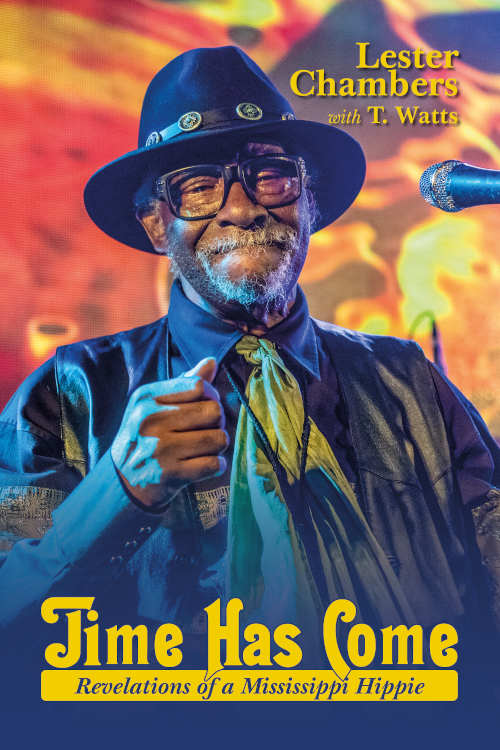
Lester Chambers, lead singer of the Chambers Brothers of 1960s yore and lately of the group, Moonalice, has released his memoirs.
The Chambers Brothers' anthem of Psychedelia, “Time Has Come Today,” ushered the flower children into The Summer of Love in 1967.
The book is titled, “Time Has Come: Revelations of a Mississippi Hippie,” and is co-authored by local writer Thurman Watts.
The release was announced at the recent KPFZ Moonalice benefit concert, where the 82-year-old Chambers exhibited the masterful vocal and harmonica chops that are solely his.
The foreword of “Time Has Come” is written by Robert Darden, professor of journalism and new media at Baylor University.
He is also the former gospel music editor of Billboard Magazine and makes several spot-on observations about the Chambers Brothers, including, they were too rock for folk, too secular for gospel, and too raw, real and passionate for rock.
The book traces the origins of the Chambers family back to 1830 but focuses on the mid-20th century when their family escaped from the farm that they sharecropped on that was owned by a leader of the Ku Klux Klan.
Landing in California, the Chambers Brothers eventually signed a recording contract with a major label, only to discover that they were still sharecropping — for the label.
Through Lester Chambers’ lens, this story details the mercurial rise of the Chambers Brothers and the decision by Lester Chambers to go it alone.
Glimpses of larger-than-culture figures like Lightnin’ Hopkins, Jimmy Reed, Miles Davis, Betty Davis, John Lennon, Yoko Ono, Augustus Owsley Stanley II, Bob Dylan, Mahalia Jackson, Sonny Terry and Brownie McGhee, and a host of others spring from the pages that span Lester Chambers’ career.
Revisit the hardships of recurring illnesses, the 2013 festival where he was attacked on stage, recovering, returning to the stage and working into his 80s, and the accolades commensurate with the release of the 2022 Grammy-winning documentary, “Summer of Soul,” in which the Chambers Brothers opened and closed the film.
“Time has Come: Revelations of a Mississippi Hippie” is available in paperback and Kindle eBook format. An audiobook will follow in 2003. It is also available at www.lesterchambers.com.
- Details
- Written by: Kwame Dawes

There is, of course, no hidden chapter in the “Good Book” that explores sandaled Jesus’ fashion rules, but Cornelius Eady in “Easter Shoes” is being funny and deadly serious.
The poem takes him back to childhood, to the pains of conformity and the forced obedience of being “dressed,” “encased” and “pinched” into decency.
“Easter Shoes” celebrates the petulant act of creative rebellion that he achieves by scuffing the impractical shoes while maintaining the “mirage” of obedience.
Easter Shoes
By Cornelius Eady
In a hidden chapter of the Good Book,
Is there a verse that explains
Why Jesus cares for fashion,
Why my feet must be encased
And pinched? When you're a kid,
It's how someone else dresses you;
You won't grow into these black, shiny
patents, as much as your mother
Wants it. On the way to Sunday School,
You are a mirage, like the new store shine
You scuff, as you obey.
American Life in Poetry does not accept unsolicited manuscripts. It is made possible by The Poetry Foundation, publisher of Poetry magazine. It is also supported by the Department of English at the University of Nebraska-Lincoln. Poem copyright ©2022 by Cornelius Eady, “Easter Shoes” from Prairie Schooner Winter, 2019. Poem reprinted by permission of the author and the publisher. Introduction copyright ©2022 by The Poetry Foundation. The introduction’s author, Kwame Dawes, is George W. Holmes Professor of English and Glenna Luschei Editor of Prairie Schooner at the University of Nebraska.
- Details
- Written by: CITY OF LAKEPORT
Awards to successful applicants will range from $5,000 to $20,000, depending on the scale and budget of the proposed work, which includes materials, artist’s labor, installation needs, and any necessary travel expenses.
Proposals with interactive components are encouraged.
Lake County artists and Black, Indigenous and people of color, or BIPOC, are strongly urged to submit proposals; there are no geographic restrictions for applications.
Proposed art works must be made of materials that can endure the outdoors and extreme weather in a public setting.
All object-based sculptures must be securely mounted to the ground or a plinth base at the designated site; all work must be safe for pedestrian traffic.
The call for artists may be viewed on the city’s website.
The request for proposal includes specific application requirements and a map of the lakefront park with designated spaces for art.
In January 2020, the city of Lakeport was awarded a competitive grant from the California Department of Parks and Recreation funded by Proposition 68, the California Drought, Water, Parks, Climate, Coastal Protection and Outdoor Access for All Act of 2018. After two years of design, the project is ready for construction.
The new park consists of approximately 6.9 acres and will include, in addition to the public art, a basketball court, splash pad, skate park, concession building with restrooms, shade structures, picnic areas, fitness equipment, a pavilion, lighting, irrigation, and landscaping.
Estimated completion date is Spring 2023.
For more information, contact Jenni Byers, Community Development director, 707-263-5615, Extension 201,
- Details
- Written by: Kwame Dawes
Rachel Eliza Griffiths has written poems and composed photographs in response to the loss of her mother.
She has always been fascinated by the exchange between birth and death that characterizes their relationship.
“Illusion” is doing the same work of connecting the haunting memory and spirit of her mother to her own awareness, her own mortality, and her turn to live and fill the space vacated by her mother.
I typically do not quote poets speaking of their work in this column, but I found this gem by Griffiths from an interview that seems a fit introduction to this poem: “With the death of my mother, the woman (myself) can’t go back out of the world until she mothers herself. I must go forward to my own beginning and to consider my own death.”
Illusion
By Rachel Eliza Griffiths
Waiting inside of the night,
I could make out the mound
& my mother's eyes, the blank embrace
of innocence when she returned
from the other side of the light
where everything wept
as it was loved & forgotten.
It's your turn, it's always
your turn,
the night says.
American Life in Poetry does not accept unsolicited manuscripts. It is made possible by The Poetry Foundation, publisher of Poetry magazine. It is also supported by the Department of English at the University of Nebraska-Lincoln. Poem copyright ©2020 by Rachel Eliza Griffiths, “Illusion” from Seeing The Body (W.W. Norton & Company, 2020.) Quote from “Anatomy of Grief: A Conversation with Rachel Eliza Griffiths” By Sarah Herrington, LA Review of Books, October 13, 2020. https://lareviewofbooks.org/article/anatomy-of-grief-a-conversation-with-rachel-eliza-griffiths/. Poem reprinted by permission of the author and the publisher. Introduction copyright ©2022 by The Poetry Foundation. The introduction’s author, Kwame Dawes, is George W. Holmes Professor of English and Glenna Luschei Editor of Prairie Schooner at the University of Nebraska.