
 How to resolve AdBlock issue?
 Arts & Life

NICE – Lake County News came pretty close to an exclusive with "The Original Dreamgirl" Mary Wilson this past Friday in conjunction with her performance in Lake County. Unfortunately, Ms Wilson's flight was late and the interview was scuttled.
Nonetheless, for your entertainment correspondent and the two-thirds capacity crowd at Robinson Rancheria Resort & Casino Wilson performed in the exemplary manner one would expect from a professional of her legendary stature.
Looking fit and beautiful, the founding member of the Supremes took the stage wearing an irridescent, sheer wrap, over a hot pink, sexy evening dress and launched into a medley of 60s Supreme hits; "Love Child," "My World Is Empty Without You" and "Reflections." These songs were, of course, all sung originally with Diana Ross singing lead, but Mary Wilson definitely showed the crowd that she can handle the tunes out front as well.
In her opening monologue, she introduced herself as one of the original Supremes and promised to sing all of the old songs for us "old, old, old, old teenagers." She then launched into an hilarious skit with her male backup singer to the strains of "Back In My Arms Again" which was reminiscent of the cabaret style the Supremes employed in their live shows.
Though some of us knew her age, many jaws dropped when Ms. Wilson announced she'd recently celebrated her 63rd birthday and was the proud grandmother of eight! She then segued into a duet with her guitarist, reprising the Sting-penned, "Field Of Gold." She followed that with her rendition of the Bonnie Raitt hit, "Can't Make You Love Me" to rousing applause. At this point in the performance Wilson left the stage with the promise to return to rock & roll.
She was back in a flash in black dancing attire and swung into Martha & The Vandella's "Dancing In The Street" and the crowd danced into action. So many people started dancing that soon Ms. Wilson had a second line cadre of dancers on stage with her.
Wilson then acknowledged the success of the film Dreamgirls and reminisced about seeing the Broadway stage production of it some years ago. She spoke of how even then it was seen as loosely based on the story of the Supremes. So loose, she mused, that she didn't get paid, either time.
As a tribute to the late Florence Ballard, the founder of the Supremes, Wilson stated that the Effie character in the play and film was really a fictionalized version of Ballard and that the song "I'm Changing" was the song that Flo Ballard would have sang in real life. Wilson then brought the house down with her heartfelt version of the song.
The Supremes had 12 singles that sold a more than a million copies and Mary Wilson as a solo artist had one, "I Ain't Gonna Walk That Line" a seemingly autobiographical song that powerfully revealed victory over the challenges of life.
As she attempted to end the show with "Someday We'll Be Together," the crowd would not let her. "The Original Dreamgirl" came back for two encores, pulling out all the stops on "Satisfaction," "I Want To Take You Higher" and "Brown Sugar."
Wow! How sweet it was.
E-mail Thurman Watts at
{mos_sb_discuss:5}
- Details
- Written by: Lake County News Reports
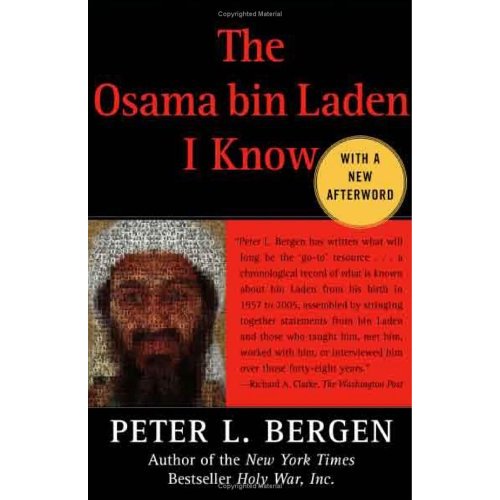
In the book The Osama bin Laden I Know: An Oral History of al Qaeda's Leader, author Peter L. Bergen extends his personal interviews of bin Laden with interviews of over 50 other people from a spectrum of society, all of whom have known bin Laden at various times in his life. The result is a verbal documentary of the Islamic terrorist's life.
Given the ongoing failures of American military intelligence, this is probably the best biographical data extant on bin Laden. This becomes more evident when the reader studies Bergen's qualifications as an Islamist, a journalist and an academic; he is probably as, or more, qualified than any CIA staff member.
Bin Laden's changes throughout the book are interesting, though not unexpected if considered from a Muslim standpoint.
He is a quiet reticent bland religious youth, a rich kid who refuses to be spoiled by family wealth. At first, he runs the family business when he has to, including construction of a road in the Tora Bora Mountains of Afghanistan. Later, he goes to Afghanistan to work in refugee relief, then to combat the Russian invasion, as a religious duty, somewhat in an Islamic version of "Onward, Christian Soldiers."
His wealth empowers him to raise his own fighting unit, much as well-to-do Americans used to enroll their own militia units. His combat experience emboldens him. He insists on keeping his unit together as a fighting force small in number though large in publicity. He commits them to audacious but militarily inconsequential battles. As a result, he is regarded as a showoff with little military talent. He draws no backing from Pakistani or American covert operators.
Nevertheless, emerging from the battle against the Russians with a reputation among Muslims as a warrior for his faith gives him the standing to consolidate his brand new organization with other Islamic terrorist organizations. He loses his native Saudi citizenship, is disowned by his family and moves to the Sudan. While there he sponsors the attack against American Army Rangers depicted in Black Hawk Down. His subsequent move back to Afghanistan, and his jihad against the United States, are well known.
This is an anvil of a book, heavy with fact and jargon. It also references a whole library of supporting information that appears to elucidate almost every facet of the interviews.
This reader emerged with some insights that are dismaying, and don't bode well for America. I present them in no particular order.
The Middle Eastern concept of citizenship is a much more fluid one than ours. A man is a Muslim first, a Lebanese or Iraqi or Saudi second. As a result, Muslim citizens seem to travel throughout the Arab world relatively easily.
Muslim ideology also spreads easily. Al Qaeda's ideological roots are as much Egyptian as Saudi or Yemeni.
Our intervention to free Kuwait is a major cause of bin Laden's anger against our country. He believed that Muslims should have freed Kuwait, and that the American presence in Saudi Arabia is an abomination.
Bin Laden hated Saddam Hussein. He claimed that because Saddam was a socialist, he was a traitor to Islam.
Our present invasion of Iraq is considered to be an advantage for al Qaeda. It eliminated a dictator opposed to them, supplies combat training for its fighters and stirs up such discontent it serves as a recruiting tool for their cause.
Israel is regarded by Muslim militants as virtually an American colony. Only its extinction will satisfy al Qaeda and its ilk.
There is probably much much more than this to be gleaned from this book. Certainly, anyone who wants to grapple with the realities of our war in Iraq can benefit from reading it.
E-mail George Dorner at
{mos_sb_discuss:5}
- Details
- Written by: Lake County News Reports




